


Electric vehicles (EVs) use powerful lithium-ion batteries. However, these batteries get very hot when they are used. If they get too hot, they can catch fire or stop working. To solve this, engineers design special cooling plates. A very modern method is to use a “Nanofluid” (water mixed with tiny particles) flowing through “Wavy Channels.” To test this design without building it, we use Battery Cooling System CFD simulation.
This project is a Battery Cooling System fluent tutorial. We will teach you how to model this advanced cooling technique. We use ANSYS Fluent to visualize how the fluid moves and cools the batteries. By performing this Battery Cooling System Simulation, we can see how the wavy shape improves safety. For more lessons on thermal management, please visit our Heat Transfer tutorials. The geometry used here is based on the research by Sarchami et al. [1].
- Reference [1]: Sarchami, Amirhosein, et al. “A novel nanofluid cooling system for modular lithium-ion battery thermal management based on wavy/stair channels.” International Journal of Thermal Sciences182 (2022): 107823.
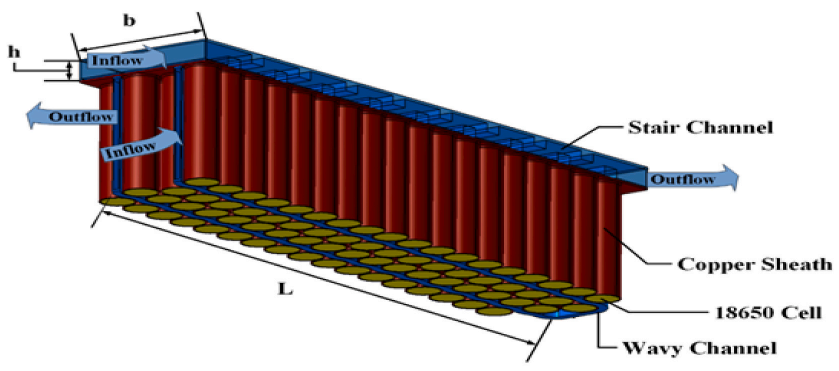
Figure 1- Schematic of the Battery Thermal Management System (BTMS) showing 18650 batteries and the wavy channel. [1].
Simulation Process: Nanofluid and Conjugate Heat Transfer Setup
To start this Battery Cooling System ANSYS fluent analysis, we modeled a cooling plate for “18650-type” batteries. The plate is made of Copper because copper is good at moving heat. Inside the plate, the channel is not straight; it is “Wavy” or shaped like stairs. This shape is very important. For the liquid, we used an Al2O3-water nanofluid. This means we added tiny Aluminum Oxide particles to the water. These particles help the water carry more heat. We modeled this using the “Single-phase approach” in Fluent, which is fast and accurate.
In the ANSYS Fluent setup, we faced a “Conjugate Heat Transfer” (CHT) problem. This means we have to solve the physics for both the solid parts (batteries and copper plate) and the liquid part (nanofluid) at the same time. We applied a Constant Heat Flux to the walls of the cooling plate to simulate the heat coming from the batteries working at full power. The software calculates how this heat moves from the solid into the flowing nanofluid.
Post-processing: CFD Analysis of Wavy Channels and Temperature
To truly understand the success of this Battery Cooling System CFD simulation, we must look at the “Cause and Effect” of the design. The “Cause” is the wavy shape of the channel. When water flows through a straight pipe, it flows smoothly. But when the Nanofluid for Battery Cooling System flows through these wavy curves, it cannot go straight. The liquid is forced to turn left and right. This turning motion creates strong swirling patterns called Dean Vortices. These vortices are the engine of the cooling system. In a normal pipe, there is a layer of hot, slow water sticking to the wall (called the boundary layer). The Dean Vortices act like a mixer. They constantly break this hot layer and push fresh, cool nanofluid from the center of the pipe against the hot copper walls. This mixing action, combined with the Al2O3 particles, pulls the heat away much faster than normal water in a straight pipe.
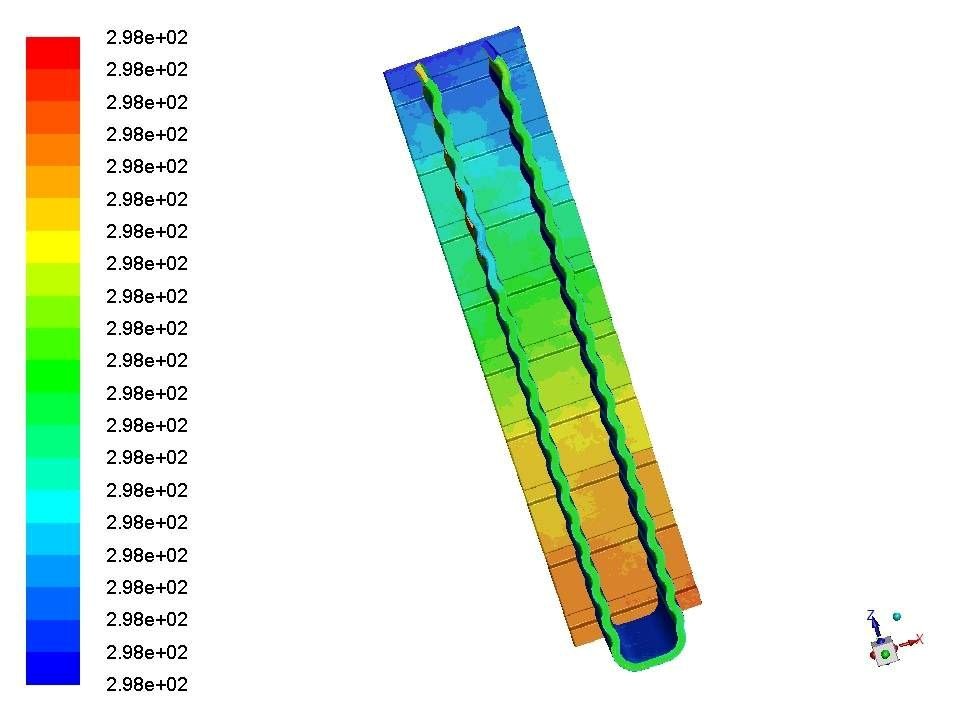
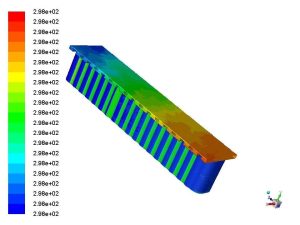
Figure 2: Temperature contours showing the uniform temperature distribution around 298 K.
The “Effect” is clearly seen in the Temperature Contour (Figure 2). The goal of any Battery Cooling System fluent simulation is to keep the batteries cool and uniform. The contour shows the battery surface is blue and green, not red. The data confirms that the temperature stays around 298 K (25°C). This is the perfect operating temperature for a battery. More importantly, the color is very even. There are no “hot spots.” The smooth change from the inlet to the outlet proves that the wavy channel is distributing the cooling power equally. This analysis confirms that the Wavy Channels for battery cooling successfully keep the entire module safe and efficient.
Key Takeaways & FAQ
- Q: Why use Wavy Channels instead of straight ones?
- A: Wavy channels create Dean Vortices. These swirling motions mix the fluid and break the thermal boundary layer, which improves heat transfer in this Battery Cooling System CFD simulation.
- Q: What is a Nanofluid?
- A: It is a base fluid (like water) mixed with nanoparticles (like Al2O3). In this Nanofluid for Battery Cooling System study, it helps conduct heat better than pure water.
- Q: What is the final battery temperature?
- A: The simulation results show the batteries stay at a safe and uniform temperature of approximately 298 K (25°C).







Reviews
There are no reviews yet.