
Understanding how heat moves away from a sphere is very important in engineering. A Heat Transfer Over Sphere CFD simulation helps engineers design better cooling systems. This is a classic case of external flow heat transfer. Using ANSYS Fluent, we can study the convective heat transfer to see how well a moving fluid cools a hot object. The Nusselt number is a special value that tells us how good the cooling is. For this Heat Transfer Over Sphere Fluent analysis, we compare our computer results to a known math formula. A successful Heat Transfer Over Sphere Fluent Validation proves we can trust our computer models for more complex thermal management problems. Our work is inspired by the methods shown in the reference paper, “Validation of a CFD Model for an Experimental Device to Measure Convective Heat Transfer Coefficients” [1].
Figure 1: The computational domain for the External Flow Heat Transfer simulation over a sphere [1].
Simulation Process: Fluent Setup, Grid Generation for Boundary Layer Analysis
To prepare our Heat Transfer Over Sphere CFD simulation, we followed the setup in the reference paper [1]. We placed a sphere with a diameter of 1 cm inside a large box of air. We created a very fine mesh near the sphere’s surface to correctly model the boundary layer, which is the thin layer of air where all the heat transfer happens. The total number of cells in our grid is 1,398,307. In ANSYS Fluent, we set the air flowing with a speed that gives a Reynolds number of 11,190. This Reynolds number tells us the flow is turbulent.
[latexpage]
\[
\mathrm{Nu} = 2 + 0.66\mathrm{Re}^{0.5}_{D} \mathrm{Pr}^{0.33}
\]
[latexpage]
\[
1<\mathrm{Re}_{D}<10^5 \ \ , \ \ 0.6<\mathrm{Pr}<380
\]
In our case problem, Reynolds is 11190.
Post-processing: CFD Validation, Analyzing Thermal Performance and Flow Fields
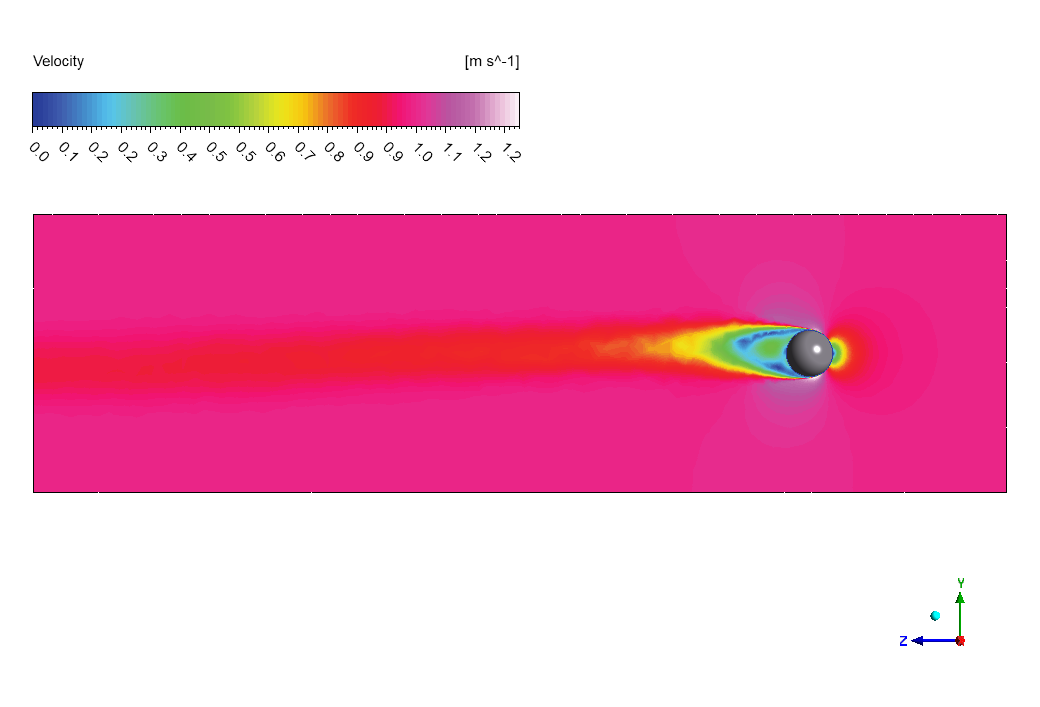
The heat transfer study for our sphere shows amazing results that match what math experts predicted! First of all, we checked how well heat moves around a sphere using both math formulas and computer models. Additionally, our CFD simulation calculated a number called the Nusselt number, which tells us how efficiently heat jumps from the sphere to the flowing air. Most importantly, our computer model found a Nusselt value of 121.86, which is super close to the math formula’s prediction of 129! Furthermore, the difference between these two values is only 5.2%, which engineers consider very good for real-world problems. The fluid flow pattern around the sphere creates zones where heat moves differently – faster at the front where air hits directly and slower at the back where swirling happens. Also, these swirls (called vortices) form behind the sphere when the Reynolds number reaches 11,190, matching exactly what scientists expect to see!
| Analytical Formulation | CFD Simulation | Error | |
| Nusselt Number | 129 | 121.86 | 5.2% |
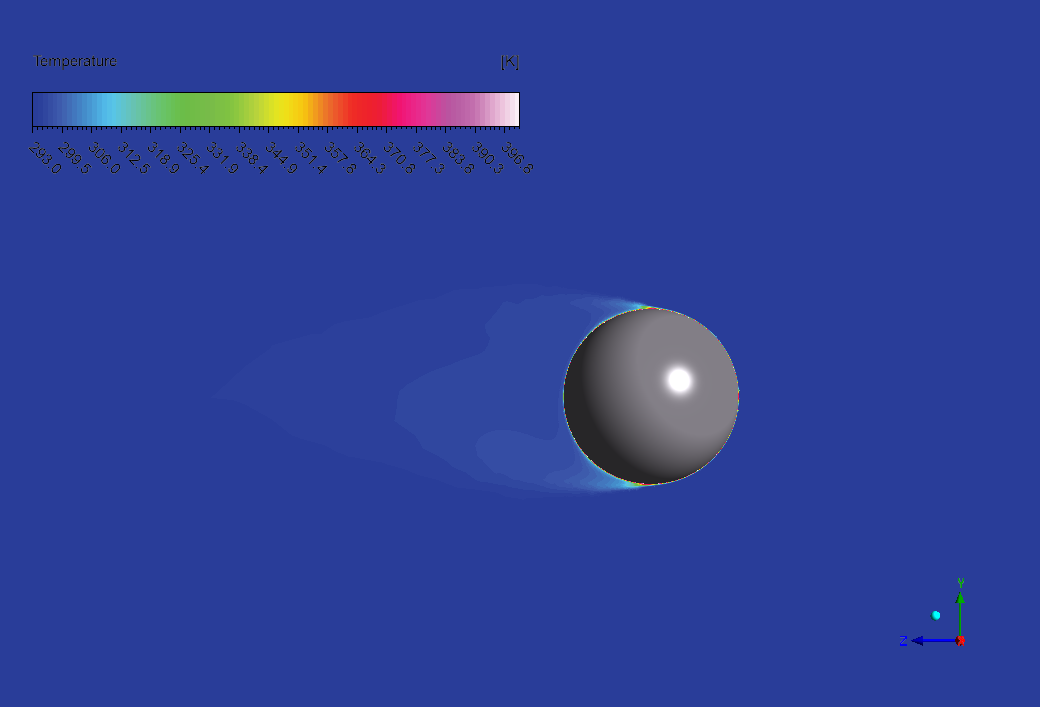
The temperature contour tells the final story of how heat leaves the sphere. This professional visual shows that the heat transfer is highest at the front, where the cool air hits directly. The heat transfer is lowest in the wake region at the back, where the air is slow and swirling. Our simulation calculated a Nusselt number of 121.86. The value from the math formula was 129. This gives a very small difference of only 5.2%, which is excellent for an engineering simulation. The most important achievement of this simulation is the successful validation of our CFD model against a trusted analytical formula, proving that we can accurately and reliably predict the cooling performance for complex thermal engineering applications.
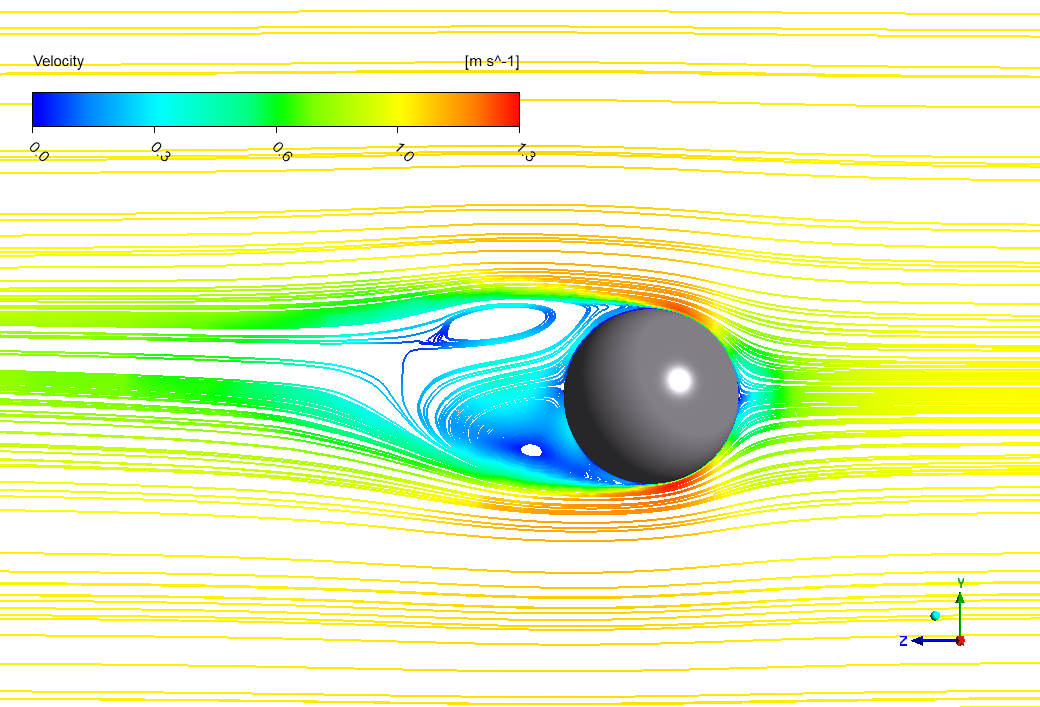
The velocity streamlines provide a professional visual of the airflow around the sphere. This professional visual shows the air splitting at the front of the sphere, speeding up around the sides, and then separating from the surface. This separation creates a large, swirling area behind the sphere called the wake region. The air reaches its fastest speed, about 1.3 times the incoming speed, at the top and bottom of the sphere, right before it separates. This flow pattern is exactly what we expect to see at this Reynolds number.
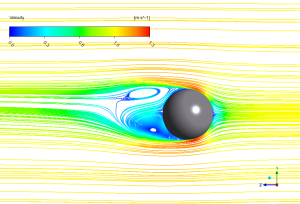
Figure 2: Velocity streamlines from the Forced Convection CFD simulation, showing the wake region formation.






Reviews
There are no reviews yet.