


The Shell and Tube Heat Exchanger (STHE) is one of the most important devices in the process industry, used to transfer heat between two fluids. Its design features a bundle of tubes inside a larger cylindrical shell. To maximize performance, designers place special plates called baffles inside the shell. These baffles have a section removed, known as a baffle-cut, which is critical for directing the fluid flow.
A Shell and Tube Heat Exchanger CFD simulation is the perfect tool to understand how these baffles work. This project is a CFD simulation, not a validation study. We will use ANSYS Fluent to analyze the flow on the shell side of an STHE to see how the baffle arrangement enhances heat transfer. For more in-depth projects on this topic, we highly recommend exploring our dedicated heat exchanger tutorials. The methodology for this analysis is based on the research by Ozden and Tari [1].
- Reference [1]: Ozden, Ender, and Ilker Tari. “Shell side CFD analysis of a small shell-and-tube heat exchanger.” Energy conversion and management5 (2010): 1004-1014.
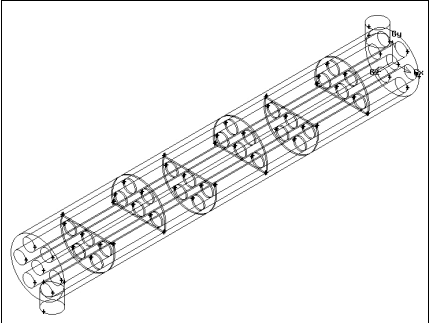
Figure 1: The 3D model of the shell and tube heat exchanger showing six internal baffles [1].
Simulation Process: Modeling Shell-Side Flow and Heat Transfer
The first step in this Shell and Tube Heat Exchanger fluent simulation was to prepare the geometry. We focused exclusively on the fluid volume on the shell side, effectively subtracting the space occupied by the tubes and baffles. This shell-side domain was then meshed with 1,471,826 high-quality tetrahedral cells. A dense mesh is required to accurately capture the complex flow patterns and turbulence that form around the baffles and tubes.
Next, we defined the physics in ANSYS Fluent. We set the cold water inlet velocity to a constant 1 m/s and the inlet temperature to 300 K. To simulate the hot fluid inside the tubes, we applied a constant high temperature of 450 K to all the tube wall surfaces. The primary goal of this Baffle-cut in heat exchanger simulation is to quantify how much heat the cold water absorbs as it is forced through this complex path.
Post-processing: How Baffles Boost STHE Thermal Performance
A detailed analysis of the simulation results provides a clear and powerful explanation of how the baffle-cut design drastically improves the heat exchanger’s efficiency. The velocity contours reveal the core mechanism. Without baffles, the water would flow straight from the inlet to the outlet, barely interacting with the tubes in the center. The baffles completely prevent this. They force the fluid into a winding, zigzag path, directing the flow perpendicular to the tube bundle. This is known as cross-flow, and it is the key to effective heat transfer. As the fluid is squeezed through the spaces between the baffles and the shell, its speed increases significantly, reaching local velocities as high as 2.882 m/s—nearly triple the inlet speed. This high velocity and the constant change in direction create intense turbulence and mixing.
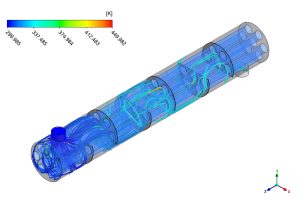
Figure 2: Streamlines colored by temperature, showing the zigzag flow path created by the baffle-cuts.
This turbulent, high-velocity cross-flow is directly responsible for the excellent thermal performance observed in the temperature results. The constant mixing ensures that colder fluid from the core is continuously brought into contact with the hot tube surfaces. This process vigorously disrupts the insulating thermal boundary layer that would otherwise form on the tubes, allowing for a much higher rate of heat transfer. The temperature streamlines in Figure 3 beautifully illustrate this process. We can visually track the fluid as it warms up progressively with each pass across the tube bundle. The simulation quantifies this success precisely: the water temperature rises from 300 K at the inlet to a final average outlet temperature of 332.77 K. This substantial temperature increase of nearly 33 K is a direct and measurable consequence of the enhanced mixing and turbulence generated by the baffle arrangement. This Shell and Tube Heat Exchanger ANSYS fluent simulation confirms that the baffle-cut design successfully transforms a simple shell-side flow into a highly effective heat extraction process.
Key Takeaways & FAQ
- Q: What is the main purpose of baffles in a Shell and Tube Heat Exchanger?
- A: The primary purpose of baffles is twofold: they physically support the long tubes to prevent sagging, and more importantly, they direct the shell-side fluid to flow across the tube bundle (cross-flow). As shown in this Shell and Tube Heat Exchanger CFD study, this creates turbulence and drastically improves the heat transfer coefficient.
- Q: What does “baffle-cut” mean?
- A: A baffle-cut is the segment or window that is cut out from each baffle plate. It’s the opening that allows the shell-side fluid to pass from one cross-flow section to the next, creating the characteristic zigzag flow path through the heat exchanger.
- Q: Why does cross-flow increase heat transfer?
- A: Flowing perpendicular to the tubes (cross-flow) is much more effective at disrupting the thin, stagnant layer of fluid (the thermal boundary layer) that clings to the tube surface. Breaking this insulating layer allows for more energetic mixing and a much higher rate of heat convection from the tube wall to the bulk fluid.









Reviews
There are no reviews yet.