Fuel Cell & Battery

Original price was: €150.Current price is: €139.

Original price was: €140.Current price is: €125.

Original price was: €145.Current price is: €129.

Original price was: €140.Current price is: €120.

Original price was: €140.Current price is: €125.

Batteries and fuel cells are important power sources for many modern applications. They provide energy for devices, vehicles, and large systems. Both batteries and fuel cells help store and produce clean and sustainable energy. This is very important today because the world needs to reduce pollution and use renewable energy.

A battery stores electrical energy inside it. It uses chemical reactions to save energy and release it when needed. Batteries are everywhere, from small devices like phones and laptops to large systems such as electric cars and energy storage stations. A fuel cell makes electricity in a different way. It changes chemical energy from a fuel, such as hydrogen, directly into electrical energy using an electrochemical reaction. Fuel cells need a constant supply of fuel and oxygen to work. They are used for clean energy because they do not make harmful gases, only water.

Both batteries and fuel cells play a key role in energy storage and power generation. They are essential for creating cleaner and more efficient energy systems. Using these technologies helps lower carbon emissions and supports the future of green energy.

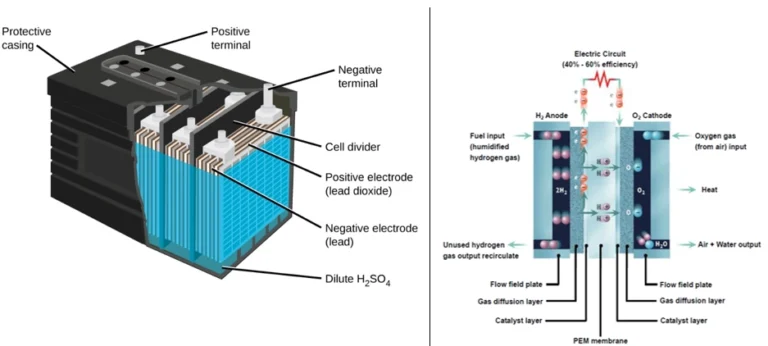
Batteries and Fuel Cells

Figure 1: Batteries store electrical energy chemically, while fuel cells generate electricity from fuel through electrochemical reactions.

Types of Batteries

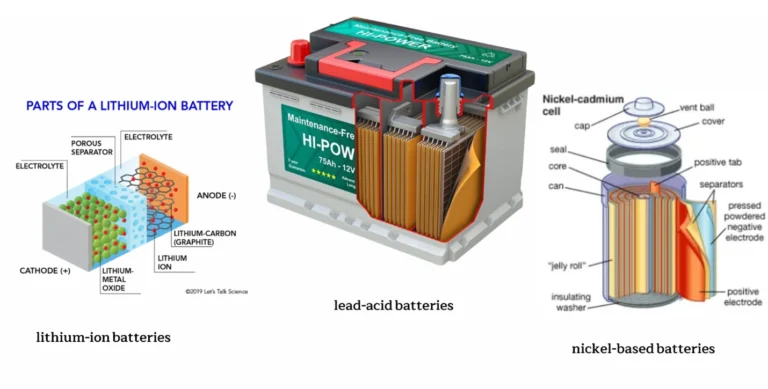
There are many types of batteries. Each type works differently and is used for different purposes. The most common types are lithium-ion batteries, lead-acid batteries, and nickel-based batteries.

Lithium-ion batteries are popular because they store a lot of energy and can be recharged many times. They are used in portable devices like phones and laptops, and also in electric vehicles and renewable energy storage systems. These batteries are light and powerful.

Lead-acid batteries are older but still very useful. They are often used in cars and backup power systems. They are heavier but cheaper than lithium-ion batteries.

Nickel-based batteries are reliable and used in some industrial machines and emergency power sources. They have good performance but can be more expensive.

Batteries work by storing electrical energy inside electrochemical cells. Each cell has two electrodes and an electrolyte that allows ions to move. When the battery is used, chemical reactions happen inside the cell to produce electricity. To design better batteries, engineers use battery simulation. This helps them understand how batteries behave, manage heat, and improve performance. Simulation is important for making batteries safer and more efficient.

Batteries and Fuel Cells

Figure 2: Common battery types: lithium-ion, lead-acid, and nickel-based batteries used in various applications.


Types of Fuel Cells

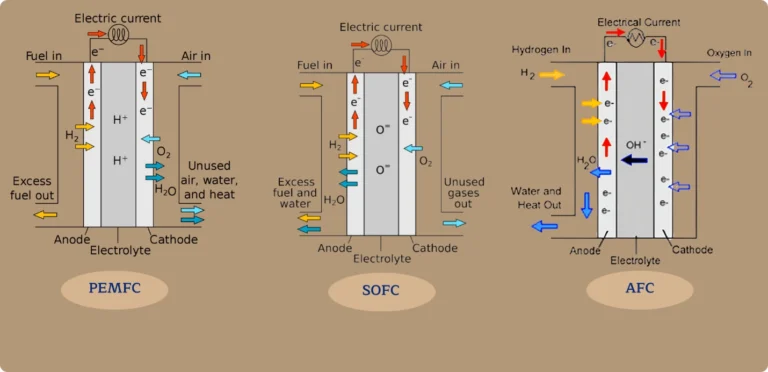
There are different types of fuel cells. Each type works in a special way and is used for different energy needs. The most common types are proton exchange membrane (PEM) fuel cells, solid oxide fuel cells (SOFC), and alkaline fuel cells (AFC).

PEM fuel cells are popular because they work at low temperatures and can start quickly. They are used in cars and portable devices. These fuel cells use hydrogen and oxygen to make electricity and water.

SOFCs work at high temperatures and are very efficient. They are often used in power plants to produce electricity. SOFCs can use different fuels, including hydrogen and natural gas.

AFCs are mainly used in space and military applications. They work well with pure hydrogen and oxygen and produce clean energy.

Fuel cells create electricity by converting chemical energy from fuels directly into electrical energy. This process helps reduce pollution because the main byproduct is water, not harmful gases. To improve fuel cell designs, engineers use fuel cell simulation. Simulation helps understand how fuel cells work and how to make them more efficient and reliable.

Batteries and Fuel Cells

Figure 3: Show layers like the membrane, electrodes, and flow channels In three different types of fuel cells.

ANSYS Fluent Environment Settings and Battery & Fuel Cell Models

ANSYS Fluent is a powerful tool used to model and simulate batteries and fuel cells. It helps engineers understand how these energy devices work and improve their design. In the ANSYS Fluent software, the environment settings window allows you to choose different models for batteries and fuel cells.

For batteries, there are several models you can use:

  • The MSMD Model simulates the battery’s physical and chemical behavior over time.
  • The Equivalent Circuit Model (ECM) uses electrical circuits to represent battery performance simply.
  • The NTGK Model predicts how batteries heat up and work using experimental data.
  • Reduced Order Models (ROMs) provide fast and efficient simulations based on complex models.
  • Electrode and Electrolyte Models show detailed electric and chemical changes inside the battery.

For fuel cells, ANSYS Fluent offers these models:

  • The PEM Fuel Cell Model simulates low and high-temperature proton exchange membrane fuel cells.
  • The SOFC Model helps model solid oxide fuel cells, including how the electrolyte works.
  • The Fuel Cell and Electrolysis Model covers fuel cells and electrolyzers with detailed electrolyte behavior.

1. Potential/Electrochemistry Window (Battery Model Setup)

This window lets you select the battery model and set up its parts. You can enable the Lithium-ion Battery Model here. The window shows sections for the Negative Electrode, Electrolyte, and Positive Electrode. You select the zones for each part, which helps Fluent calculate the battery’s behavior and energy changes.

Batteries and Fuel Cells

Figure 4: This window is used to activate the lithium-ion battery model. It allows defining zones for negative electrode, electrolyte, and positive electrode. You can also include heating effects in the energy equation.

2. PEM Fuel Cell Model Window

This window is for setting up the Proton Exchange Membrane Fuel Cell (PEMFC) model. You can turn on options like Joule Heating, Reaction Heating, and Electrochemistry Sources. It also lets you choose models for diffusion and electrical system setups. Tabs let you define details for the anode, electrolyte, cathode, and electrical connections.

Batteries and Fuel Cells

Figure 5: This window configures the PEM fuel cell model. It includes settings for heat sources, diffusion models, and electrical system setup. Users can adjust advanced parameters for accurate simulation.

3. SOFC Model Window

This window is for the Solid Oxide Fuel Cell (SOFC) model. You can enable important features like electrolyte conductivity, energy sources, and species transport. It also allows setting the current and voltage parameters of the fuel cell. The window provides options for advanced solver settings to improve accuracy.

Batteries and Fuel Cells

Figure 6: The SOFC model window allows activation of electrolyte and energy sources. Parameters like current, voltage, and electrolyte thickness are set here for detailed fuel cell simulation.

4. Fuel Cell and Electrolysis Models Window

This window provides a combined model for fuel cells and electrolysis. You can select the type of fuel cell, like PEMFC or SOFC, or choose electrolysis mode. Important options like heating, reaction rates, and membrane water transport are available. The window also includes settings for relaxation factors and automatic solver options.

Batteries and Fuel Cells

Figure 7: This window manages different fuel cell models and electrolysis. It allows users to enable heating effects, reaction sources, and transport phenomena for comprehensive simulation.

How to Model Each Battery and Fuel Cell in Fluent

  • Lithium-ion Battery Model: Use the Potential/Electrochemistry window to define electrodes and electrolyte zones. Set material properties and energy equations for heat management.
  • PEM Fuel Cell Model: Enable PEMFC in the model window. Adjust heating, electrochemical reactions, and diffusion parameters. Define anode, cathode, and electrolyte details in separate tabs.
  • SOFC Model: Enable SOFC and configure electrolyte conductivity and energy sources. Set system current and voltage for simulation accuracy.
  • Fuel Cell and Electrolysis Model: Choose the model type, enable heating and reaction sources. Use advanced options to simulate membrane water transport and multiphase flows.

These environment settings windows in ANSYS Fluent make it easier to simulate complex battery and fuel cell systems. Simulation helps improve design, performance, and safety for clean energy applications.

Applications and Benefits of Batteries and Fuel Cells

Batteries and fuel cells have many important uses in today’s world. They help provide clean and reliable energy for different applications. This makes them very valuable for a sustainable future. Batteries are widely used in portable devices like phones and laptops. They also power electric vehicles and store energy from renewable sources such as solar and wind. Batteries help reduce pollution by replacing gasoline engines with clean electric power.

Fuel cells are used to produce electricity in a clean way. They are found in cars, buses, and even in power plants. Fuel cells are very efficient and produce only water as a byproduct. This helps lower harmful emissions and protects the environment.

Both batteries and fuel cells are important for the transition to green energy. They reduce dependence on fossil fuels and help fight climate change. Engineers use simulation tools like ANSYS Fluent to design better batteries and fuel cells. Simulation improves their performance, safety, and lifetime. The use of batteries and fuel cells is growing fast. They play a key role in electric vehicles, renewable energy systems, and portable electronics. These clean energy technologies support a healthier planet and a better future for all.

Batteries and Fuel Cells

Figure 8: Applications of Batteries and Fuel Cells.

CFDLand’s Products and Tutorials

CFDLand offers many useful simulation tutorials and products for batteries and fuel cells. These tools help engineers and students learn how to model and improve these important energy devices. CFDLand’s resources are designed to make simulation easier and more effective.

Simulation is very helpful for battery thermal management. It shows how heat moves inside the battery and helps prevent overheating. This keeps batteries safer and longer-lasting. Simulation also helps with performance optimization. It allows engineers to test different designs and materials to make batteries work better. For fuel cells, simulation improves efficiency. It helps understand how fuel cells produce electricity and how to reduce energy losses. With simulation, engineers can design fuel cells that use fuel better and create less pollution.

We invite you to explore CFDLand’s tutorials and products. They are a great way to start learning about battery and fuel cell simulation. Whether for education or advanced design projects, CFDLand’s resources support your work in clean energy technologies.

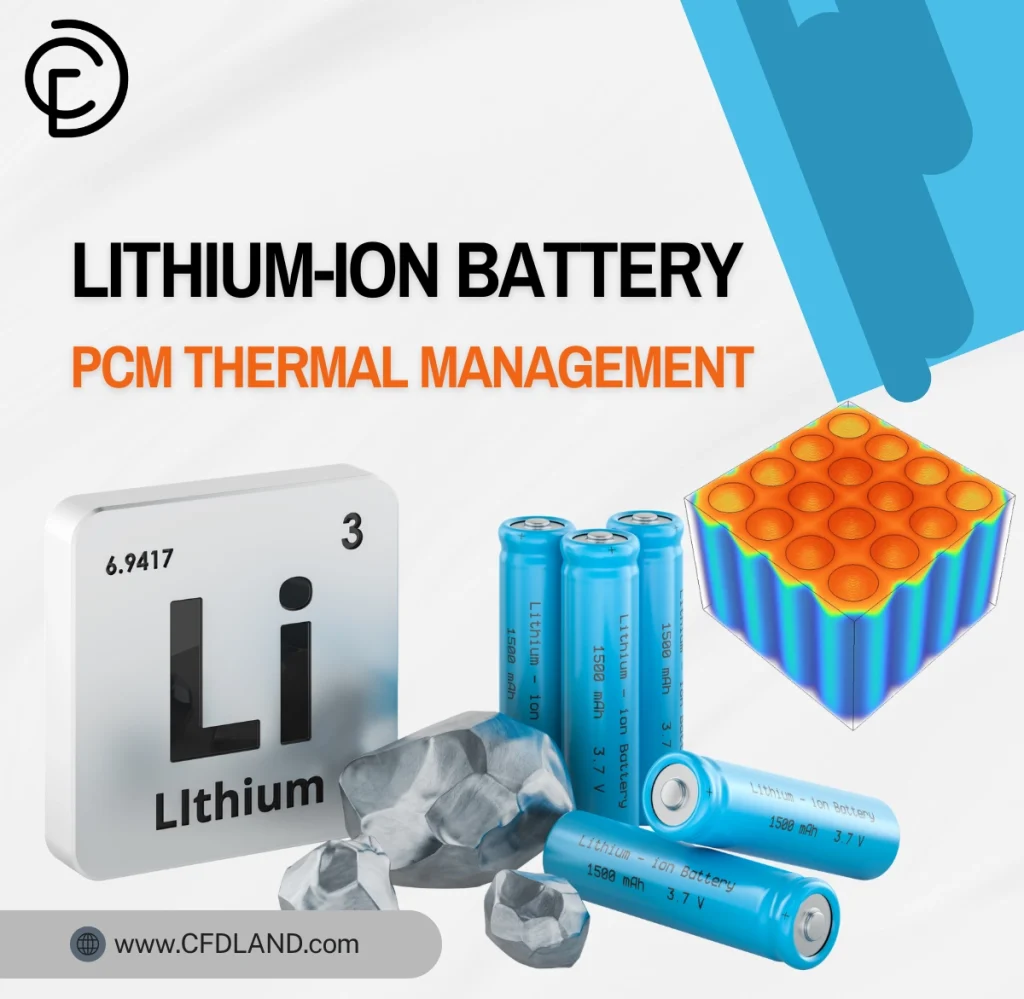
Batteries and Fuel Cells Batteries and Fuel Cells Batteries and Fuel Cells

Figure 9: CFDLand offers detailed simulation tutorials and products for batteries and fuel cells.

Conclusion

Batteries and fuel cells are very important technologies for the future of clean energy. They help store and use energy in a safe and efficient way. Batteries power many devices and electric vehicles, while fuel cells produce clean electricity with little pollution. Together, they support the move toward a greener and healthier planet. Using simulation and modeling tools like ANSYS Fluent helps engineers understand how batteries and fuel cells work. These tools allow testing and improving designs before building real devices. Simulation helps make batteries safer, longer-lasting, and more powerful. It also helps improve fuel cell efficiency and reduce emissions.

We encourage everyone to use these simulation tools to innovate and develop better energy systems. By modeling batteries and fuel cells, we can create new solutions for clean energy. This will lead to a more sustainable future for our world.

Shopping Cart
Scroll to Top