

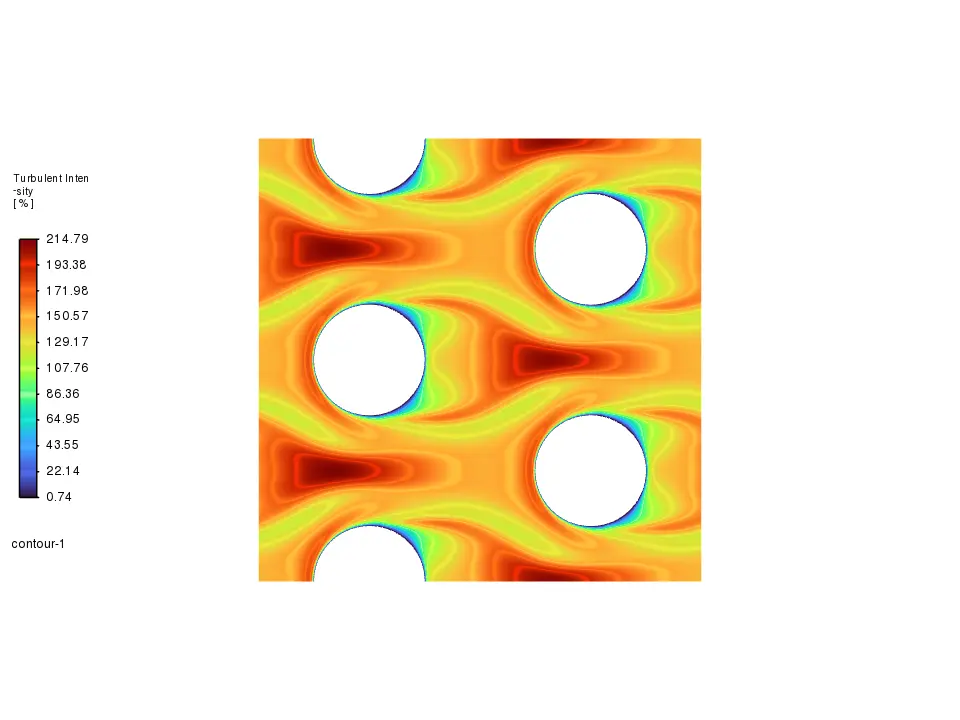
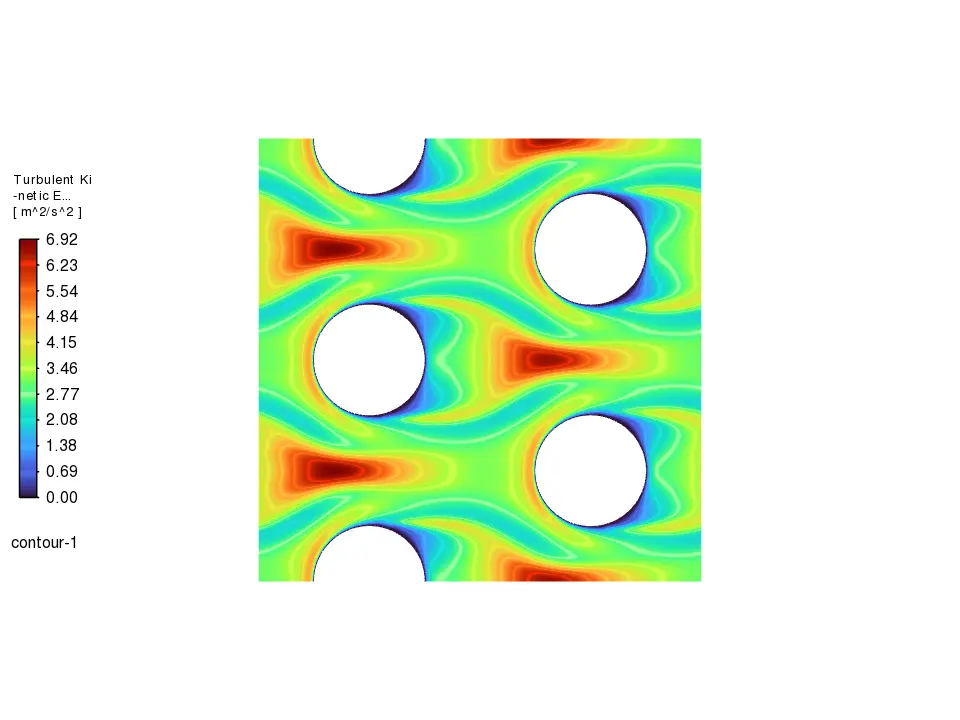
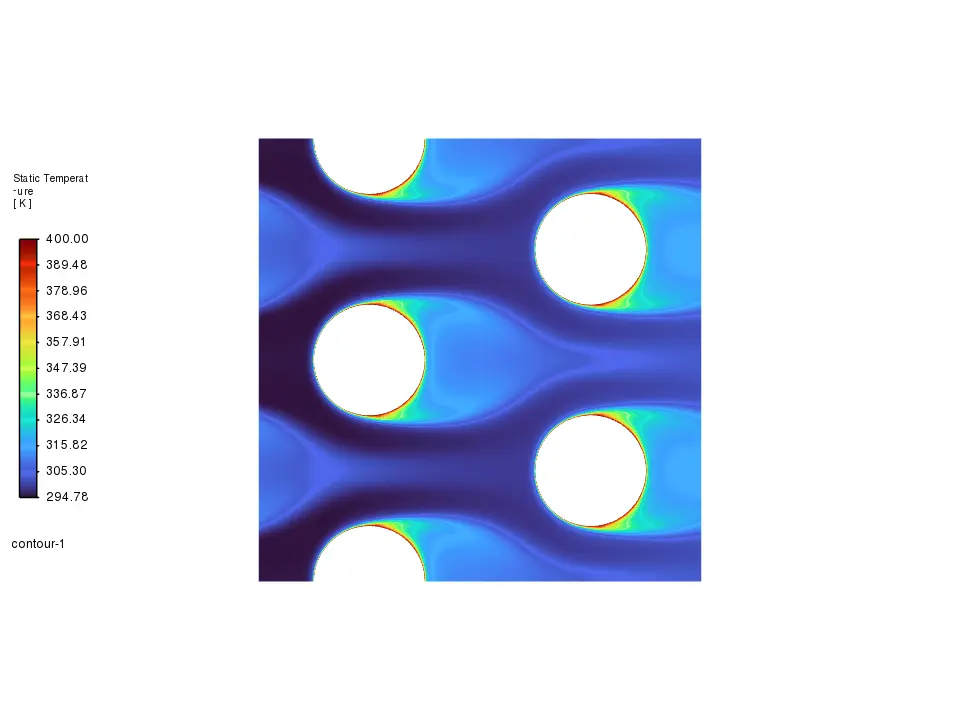
A Bank of Tubes CFD simulation is essential for designing and analyzing industrial heat exchangers, boilers, and reactors. These devices can contain hundreds or even thousands of tubes, and simulating the entire assembly would be computationally impossible. The solution is to use a powerful technique called a Periodic Boundary CFD analysis. Instead of modeling the whole system, we simulate one small, repeating section from deep inside the tube bank. This allows us to accurately predict the performance of the entire system in a fast and efficient way.
This powerful simulation technique is a great example of the advanced skills taught in our comprehensive ANSYS Fluent course for beginners, a Course that provides an excellent foundation for performing your own complex industrial simulations.
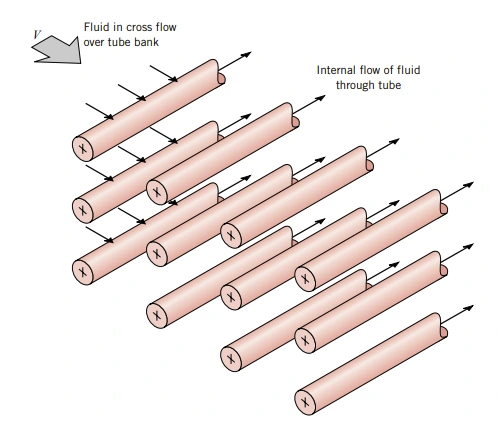
Figure 1: Bank of tube CFD analysis
Simulation Process: Modeling a Bank of Tubes with Periodic Boundaries in Fluent
The simulation was performed in ANSYS Fluent using a 2D model representing a single, repeating “unit cell” of the larger tube bank. The key to this simulation is the Periodic Boundary Condition. This special boundary is applied to the top and bottom surfaces of our small model. It works like a magic connection: any fluid that flows out of the top boundary is instantly re-inserted into the bottom boundary with the exact same velocity, pressure, and temperature. This tricks the small model into behaving as if it is surrounded by an infinite array of identical neighbors, perfectly mimicking the conditions for a tube deep within a large bank. This Periodic Boundary Fluent setup allows us to accurately calculate the “fully developed” flow behavior without needing to model the entire device.
Post-processing: CFD Analysis, How Tube Obstruction Creates Pressure Drop and Wakes
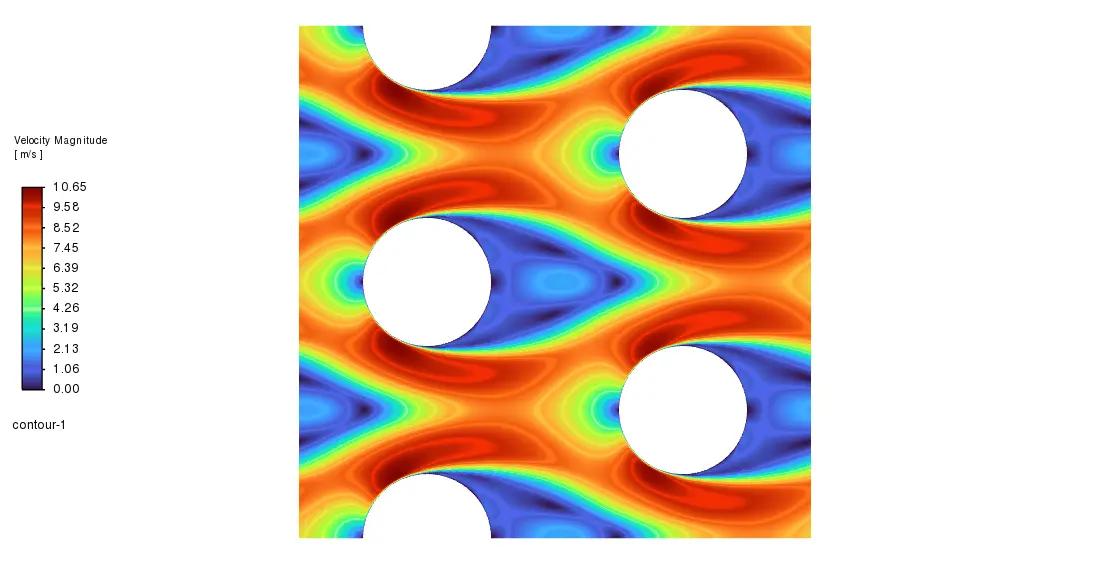
The simulation results provide a clear and fully substantiated story that begins with the tube itself, which is the primary “cause” of the complex flow field. As the uniform fluid flow approaches the solid tube, it is forced to drastically change direction and speed up to get around the obstacle. The immediate “effect” of this is a significant acceleration of the fluid as it squeezes through the narrow gaps between the tubes. The velocity contour in Figure 2 is the perfect visual proof of this effect. It clearly shows the fluid splitting and accelerating into high-velocity jets (the red areas) in the passages around the cylinder. This acceleration requires energy and is the primary source of pressure drop in the heat exchanger.
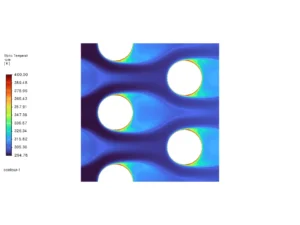
Figure 2: Velocity contour from the Bank of Tubes Fluent simulation, showing the high-velocity jets (red) as fluid is forced through the narrow gaps.
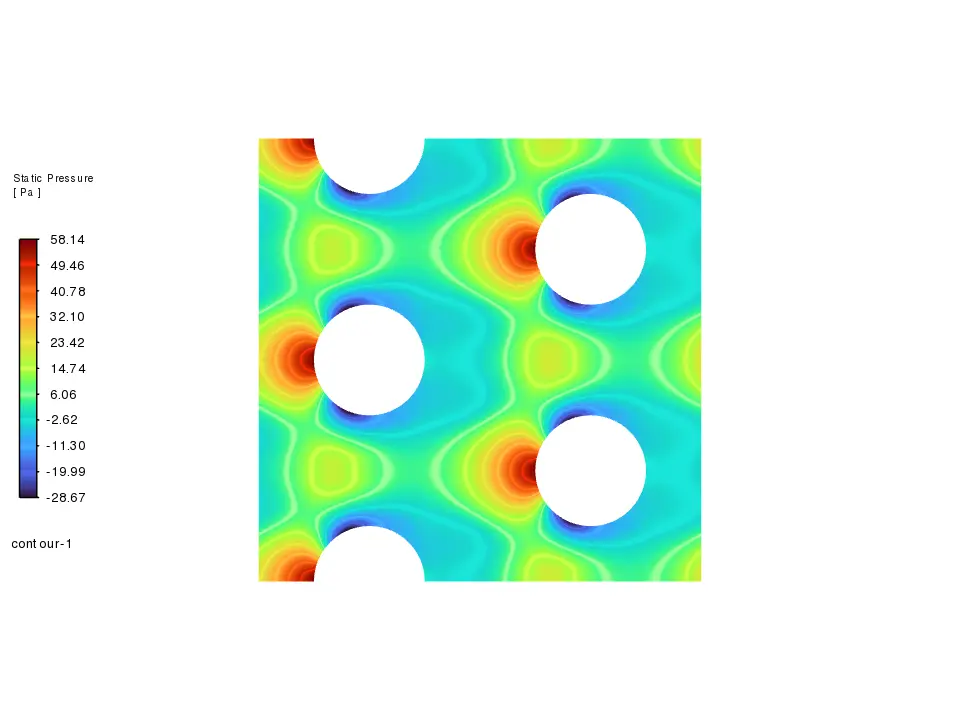
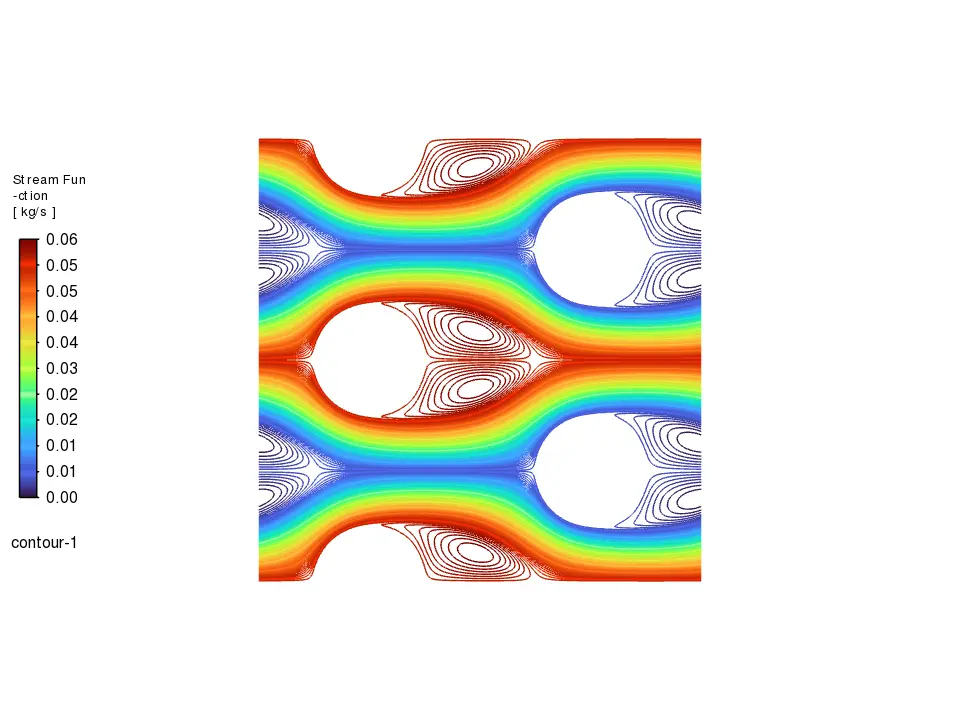
This high-speed jet is the “cause” of the next critical effect: the formation of a large, protected, low-pressure zone directly behind the tube, known as the “wake.” Because the fluid is moving so quickly, it cannot make the sharp turn required to immediately fill the space behind the tube. The direct “effect” is a region of slow, recirculating flow. The pressure contour in Figure 3 provides clear evidence of this, showing a distinct area of low pressure (in blue) on the downstream side of the cylinder. The velocity vectors in Figure 4 confirm this recirculation, showing the flow swirling back on itself. This wake region is very important because the slow-moving fluid inside it is not effective at transferring heat, creating an insulating pocket. The most significant achievement of this Bank of Tubes CFD analysis is the clear demonstration of how a simple repeating unit cell, when combined with powerful periodic boundary conditions (the cause), can accurately predict the complex flow field—including the acceleration zones and the low-pressure wake regions (the effect)—that dictates the overall pressure drop and heat transfer performance of an entire industrial-scale heat exchanger, providing engineers with a fast and reliable design tool.








Reviews
There are no reviews yet.