


A Centrifugal Left Ventricular Assist Device (LVAD) is a special heart pump that helps people with weak hearts. When a heart cannot pump enough blood on its own, this medical device takes over. A Centrifugal Left Ventricular Assist Device (LVAD) CFD simulation is a very important tool for engineers who design these life-saving machines. Because blood can be damaged easily, a good hemodynamics study is needed to make sure the pump is safe. Using powerful software like ANSYS Fluent, we can see how the blood flows and check for problems without any risk to a patient. A Centrifugal Left Ventricular Assist Device (LVAD) Fluent simulation helps engineers design the spinning part of the pump, called an impeller, to move blood gently and effectively. This study is guided by the methods in the reference papers [1, 2].
- Reference [1]: Kannojiya, Vikas, Arup Kumar Das, and Prasanta Kumar Das. “Numerical simulation of centrifugal and hemodynamically levitated LVAD for performance improvement.” Artificial Organs2 (2020): E1-E19.
- Reference [2]: Li, Donghai, et al. “Hemolysis in a continuous-flow ventricular assist device with/without chamfer.” Advances in Mechanical Engineering4 (2017): 1687814017697894.

Figure 1: Schematic of the Centrifugal LVAD, the focus of this Cardiovascular Device Simulation [1].
Simulation Process: Fluent Setup, MRF Modeling of a Non-Newtonian Blood Pump
To prepare for our LVAD CFD simulation, we first created the 3D geometry of the pump. Because the blood paths are very thin and complex, we needed a very detailed mesh. We created a high-quality grid with 12,021,305 elements. Blood is a special fluid, so we defined it as a non-Newtonian fluid using a special code called a User-Defined Function (UDF) to model its viscosity correctly. The most important step was to model the spinning impeller. We used the Multiple Reference Frame (MRF) method in ANSYS Fluent. This smart technique lets us simulate the rotation of the pump’s blades inside the stationary casing.

Figure 2: A section view of the geometry used in the Rotating Machinery CFD analysis [1]
Post-processing: CFD Analysis, Visualizing Pump Performance and Blood Flow
The velocity contour provides a professional visual of how the LVAD moves blood. As the impeller spins, it creates a powerful swirling flow that pushes blood from the inlet at the center toward the outlet at the edge. Our simulation shows that the blood speed increases smoothly from 0 m/s to a maximum of 3.4 m/s at the tips of the curved blades. This professional visual shows how the special shape of the blades creates a gentle path for the blood. This smooth acceleration is very important because it helps prevent damage to the delicate red blood cells, a problem known as hemolysis.
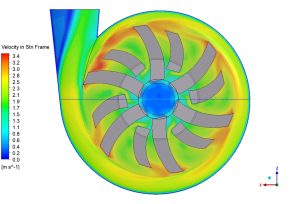
Figure 3: Velocity distribution from the LVAD Fluent simulation, showing how the MRF model captures the impeller’s effect on blood flow.
The pressure contour explains how the pump creates the force needed to push blood through the body. The professional visual shows that the pressure is very low at the center of the spinning impeller, reaching -6985.2 Pascals. This creates a suction effect that gently pulls blood in from the patient’s weak heart. The pressure then increases as the blood moves outward, creating a total pressure difference of 7863.4 Pascals. This pressure increase is what pushes the blood out of the pump and into the aorta to circulate through the body. The most important achievement of this simulation is the successful use of the MRF method to show how the LVAD efficiently converts rotational motion into a stable, life-saving blood pressure and flow, all while maintaining gentle flow patterns that are critical for patient safety.
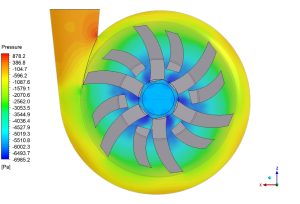
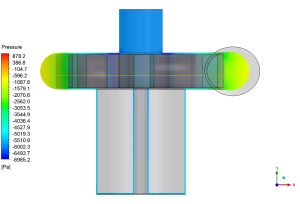
Figure 4: Pressure distribution from the Centrifugal LVAD CFD analysis, highlighting the pump’s ability to generate a safe and effective pressure head.









Reviews
There are no reviews yet.