



Keeping people comfortable and healthy in large, busy places like theaters is a big challenge. This means designing smart air conditioning and ventilation systems, often called HVAC systems. Old buildings, like the historic Vasile Alecsandri National Theatre in Iasi (Figure 1), need very special care to keep their indoor air good and the temperature just right, especially when many people are inside. Using computer tools called Computational Fluid Dynamics (CFD) helps us predict exactly how air moves and feels in these complex spaces. This is much better than installing expensive equipment or making changes without knowing if they will work. The ventilation system in a theater needs to be quiet, keep the same temperature everywhere, and remove moisture from hundreds of people breathing inside. Our study uses ANSYS Fluent to look at these exact challenges, based on important research about HVAC System In Sociocultural Building CFD.
- Reference [1]: Popovici, Cătălin-George, and Valeriu Sebastian Hudişteanu. “Numerical simulation of HVAC system functionality in a sociocultural building.” Procedia technology22 (2016): 535-542.
Figure 1: External view of the Vasile Alecsandri Sociocultural Building in Iasi, the subject of the HVAC System CFD study.
Simulation Process: Building the Digital Theater Model in Fluent
To study the HVAC System In Sociocultural Building Fluent problem, we first made a computer drawing of the theater, like the one in Figure 2. We used a program called ANSYS Design Modeler to create this 2D shape. After that, we used ANSYS Meshing to divide the drawing into many small, neat boxes, especially making them smaller near walls and important areas. This careful step creates a very good “structured grid” for our simulation, which helps make the results accurate. Since people breathe out water vapor, we needed to treat the air not just as a single gas, but as a mix of air and water vapor. So, we used a special feature in Fluent called the Species Transport model. We also knew that a person sitting down makes about 70 grams of water vapor per hour and gives off heat. So, we added heat into the model, like a constant source of 100 Watts for every cubic meter of space, to show what happens when the theater is full of people. This setup helped us see how the Sociocultural Building Ventilation CFD system works.
Figure 2: 2D schematic of the Sociocultural Building Ventilation CFD model, showing the interior layout for simulation.
Post-processing: Analyzing Airflow Patterns and Temperature Uniformity
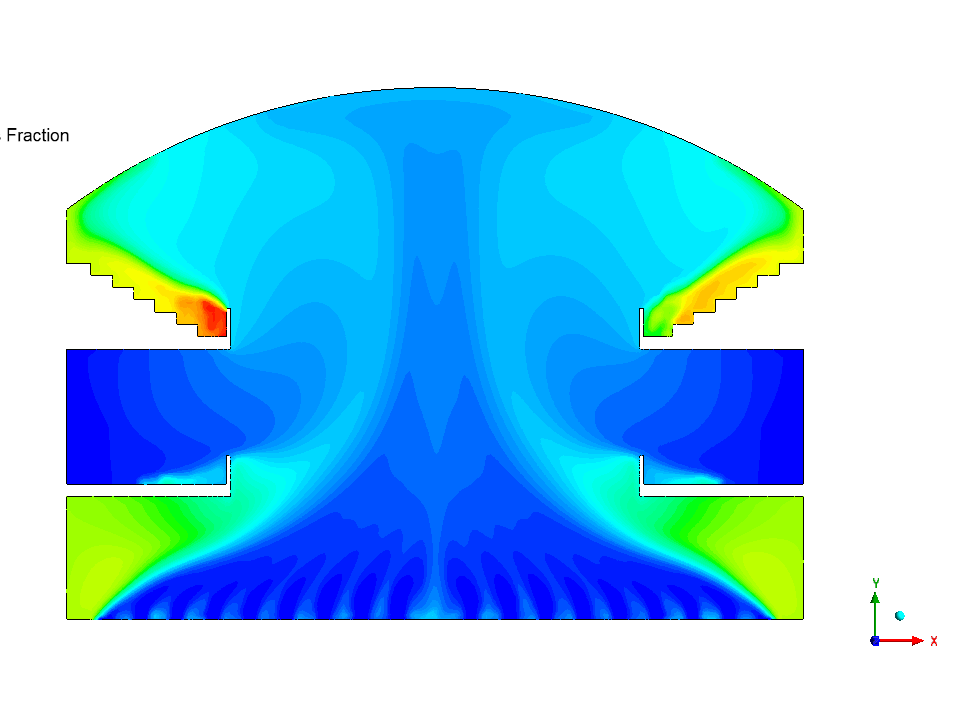
The simulation results tell an important story about how well the HVAC System CFD controls humidity in the theater. Figure 3, the H₂O Mass Fraction contour, shows where moisture from people’s breath goes. We can see that the main audience areas, where most people sit, have low humidity (dark blue colors, around 0.006 mass fraction). This is a great success! It means our design successfully prevents sticky, uncomfortable air right where it matters most. As a direct effect of the ventilation, some moisture naturally gathers in the upper corners and near the stepped sections (green and yellow areas). This pattern shows that the system is pulling humid air away from the main breathing zones and moving it upwards towards the exit points. A major achievement of this Sociocultural Building Fluent simulation is its clear demonstration of effective humidity stratification, where the HVAC system successfully keeps the primary seating areas comfortably dry while efficiently drawing moisture-laden air to less critical upper zones for removal, thus ensuring occupant comfort and protecting the building’s historic interior.

Figure 3: H₂O Mass Fraction contour from the HVAC System In Sociocultural Building Fluent analysis, illustrating the distribution of humidity.
Looking at Figure 4, which shows velocity and temperature, we get even more insights into the HVAC System Fluent performance. The velocity contour and streamlines (top images) show how the air moves. The main cause is the air being supplied by the HVAC system from below. The direct effect is a strong, central updraft of air (bright green, over 1 meter per second) that pulls stale air straight up and out of the audience area. This is ideal for quickly removing used air. Importantly, the air moves very slowly (dark blue, under 0.2 meters per second) right where people are sitting. This careful design ensures no annoying drafts will bother the audience. The most important achievement of this HVAC System In Sociocultural Building CFD analysis is the precise control over air velocity, specifically creating low-speed airflow in occupied zones (below 0.2 m/s) while establishing a robust central updraft for efficient contaminant removal, ensuring optimal thermal comfort without creating uncomfortable drafts for the audience. Furthermore, the temperature distribution (bottom image) shows a gentle change from warmer air at the top (orange-red, almost 300K) to cooler air at the bottom (yellow-green, around 280K). This smooth change means the Building Ventilation CFD system maintains an even temperature throughout each level without any sudden hot or cold spots, which is crucial for overall comfort during long performances.
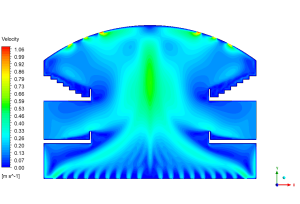
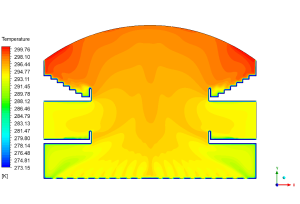
Figure 4: Combined Velocity Magnitude (top) and Temperature Magnitude (bottom) contours, revealing airflow patterns and thermal distribution within the HVAC System In Sociocultural Building CFD simulation.






Reviews
There are no reviews yet.