
In modern engineering, standard fluids like water are not good enough to cool down high-power machines. To fix this, scientists mix tiny particles into the fluid to make “Nanofluids.” A newer and better version is the Hybrid Nanofluid, which mixes two different types of particles. In this study, we mix AlN (Aluminum Nitride) and Al2O3 (Aluminum Oxide). To prove that we can simulate this correctly, we perform a Hybrid Nanofluid CFD Validation.
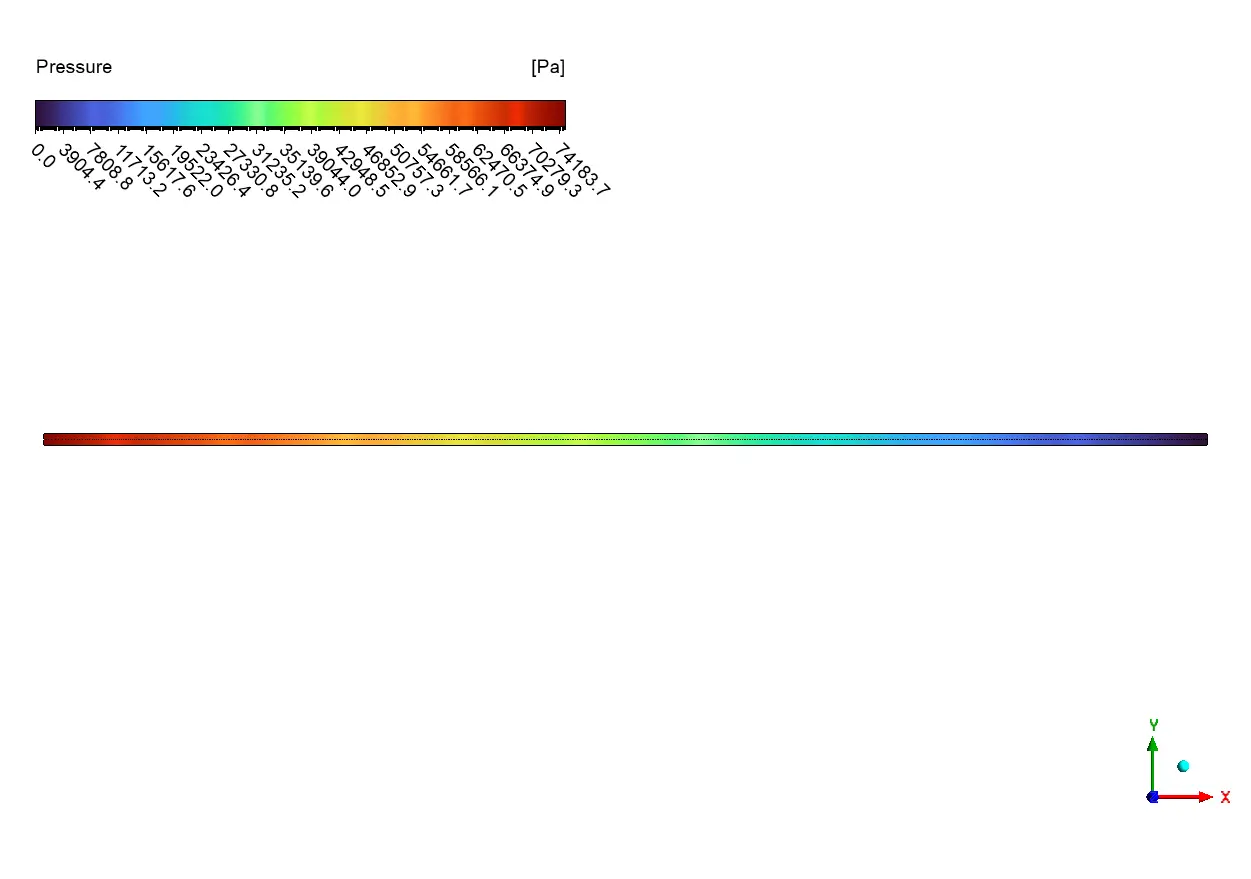
This project is a Hybrid Nanofluid In Pipe validation study. We compare our Hybrid Nanofluid fluent simulation results against a famous math formula called the “Dittus-Boelter relation.” We use ANSYS Fluent to calculate the heat transfer and pressure drop. By performing this Hybrid Nanofluid CFD simulation, we confirm that our computer model is accurate and reliable. For more lessons on advanced fluids, please visit our Microfluids and nanofluids tutorials. The reference paper for this validation is Kaska et al. [1].
- Reference [1]: Kaska, Sheren A., Rafeq A. Khalefa, and Adnan M. Hussein. “Hybrid nanofluid to enhance heat transfer under turbulent flow in a flat tube.” Case Studies in Thermal Engineering13 (2019): 100398.
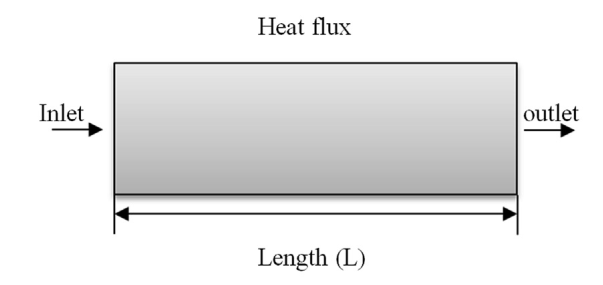
Figure 1: Schematic of physical model showing the 2D axisymmetric pipe domain.
Simulation Process: Single-Phase Model and Turbulent Flow Setup
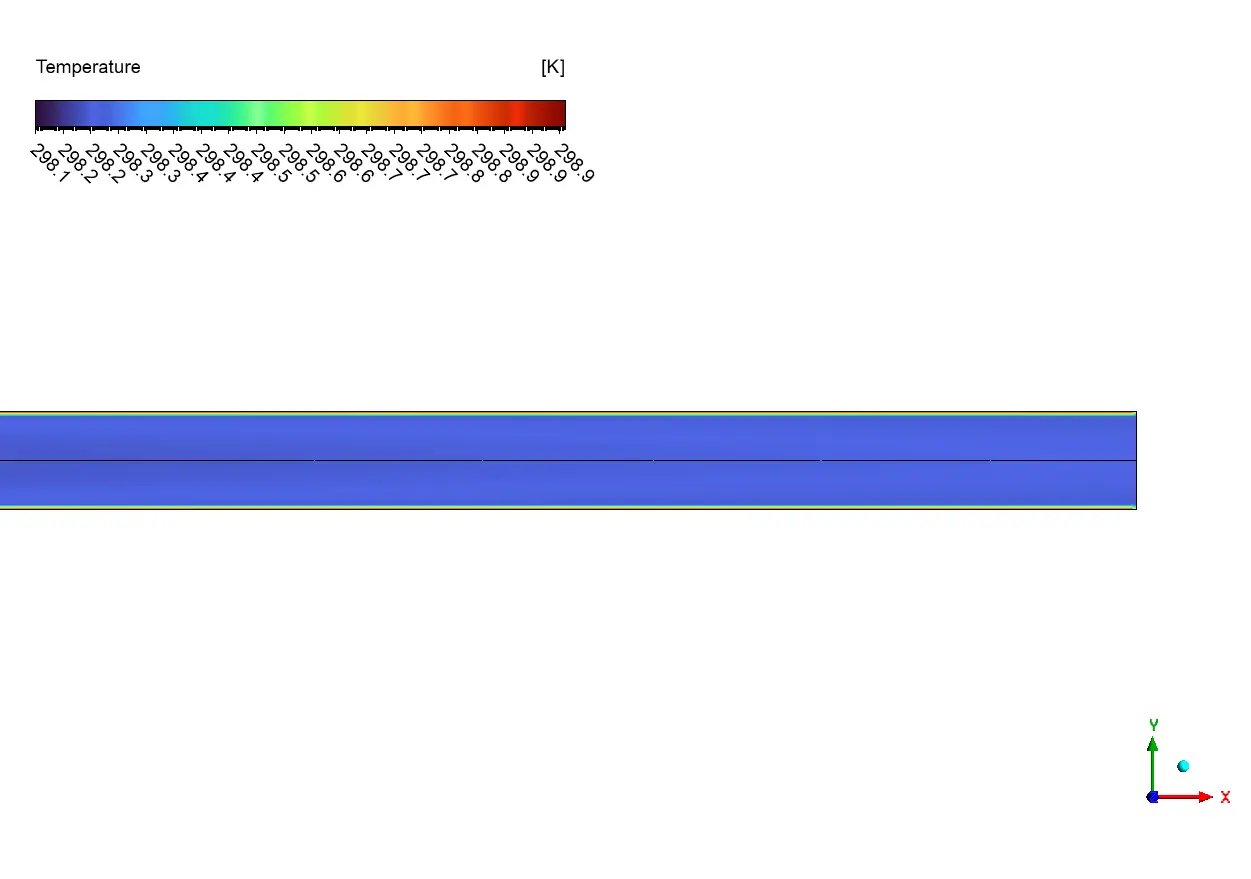
To start this Hybrid Nanofluid ANSYS fluent validation, we designed a simple pipe geometry. Because the pipe is round, we used a “2D Axisymmetric” domain. This saves calculation time. The mesh (grid) is a “Structured Grid.” We made the cells very tight and small near the walls. This is necessary to capture the “Boundary Layer,” which is the thin layer of fluid touching the pipe wall where heat transfer happens.
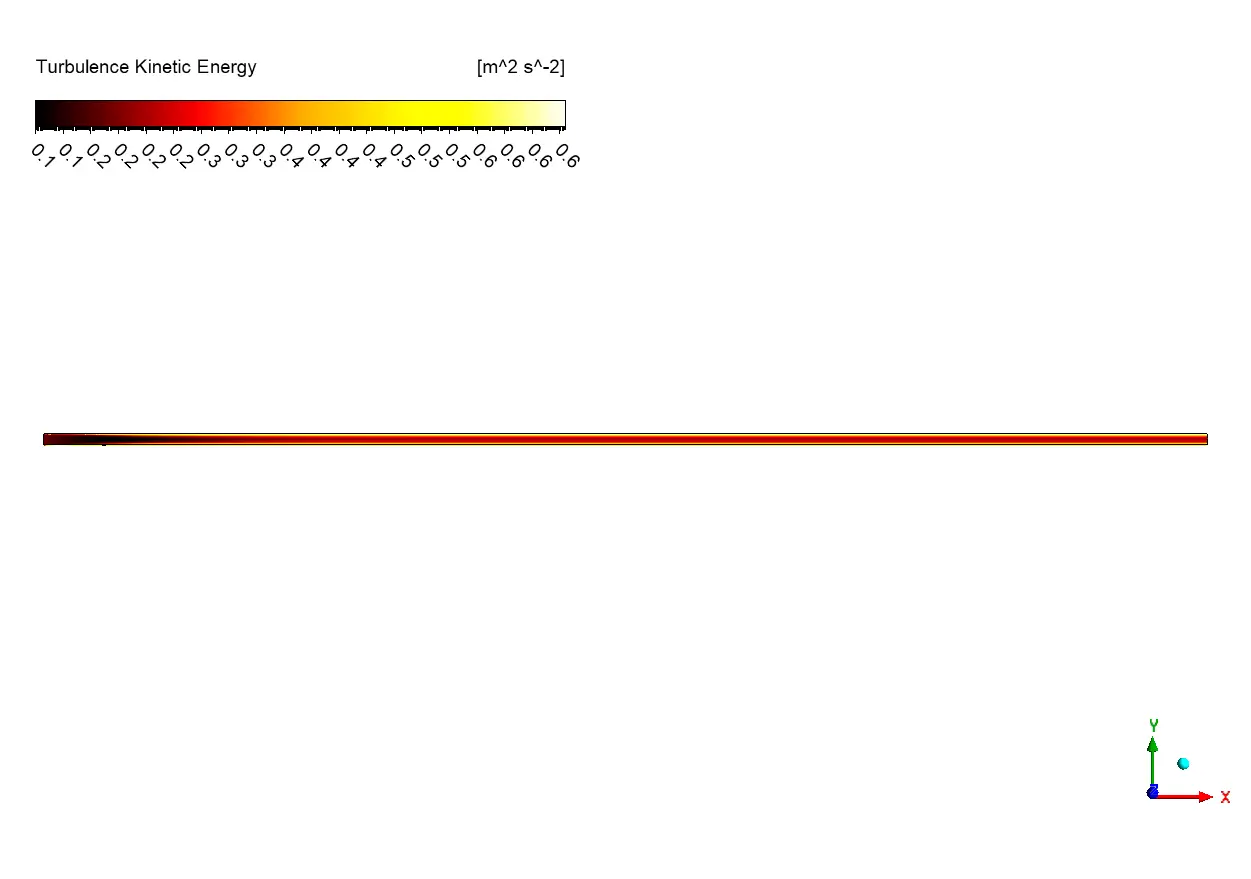
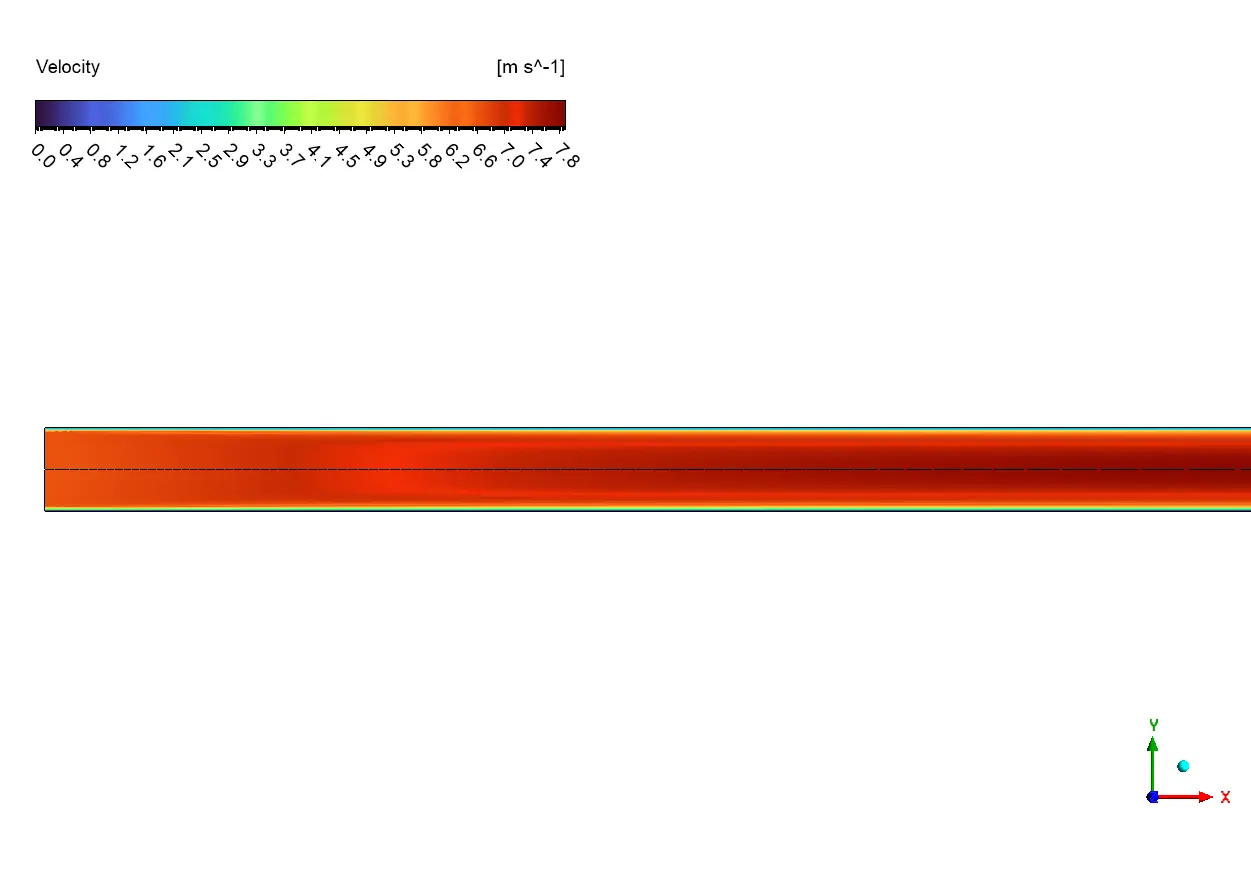
In the ANSYS Fluent setup, we set the flow to be “Turbulent” with a Reynolds Number (Re) of 17,000. The fluid is a mixture of water, AlN, and Al2O3 with a 1% Volume Fraction. We used the “Single-phase technique.” This means we treat the water and particles as one mixed fluid with new properties, rather than tracking every single particle. This method is faster and usually accurate enough for this type of Hybrid Nanofluid fluent analysis.
Post-processing: Detailed Accuracy Analysis and Error Calculation
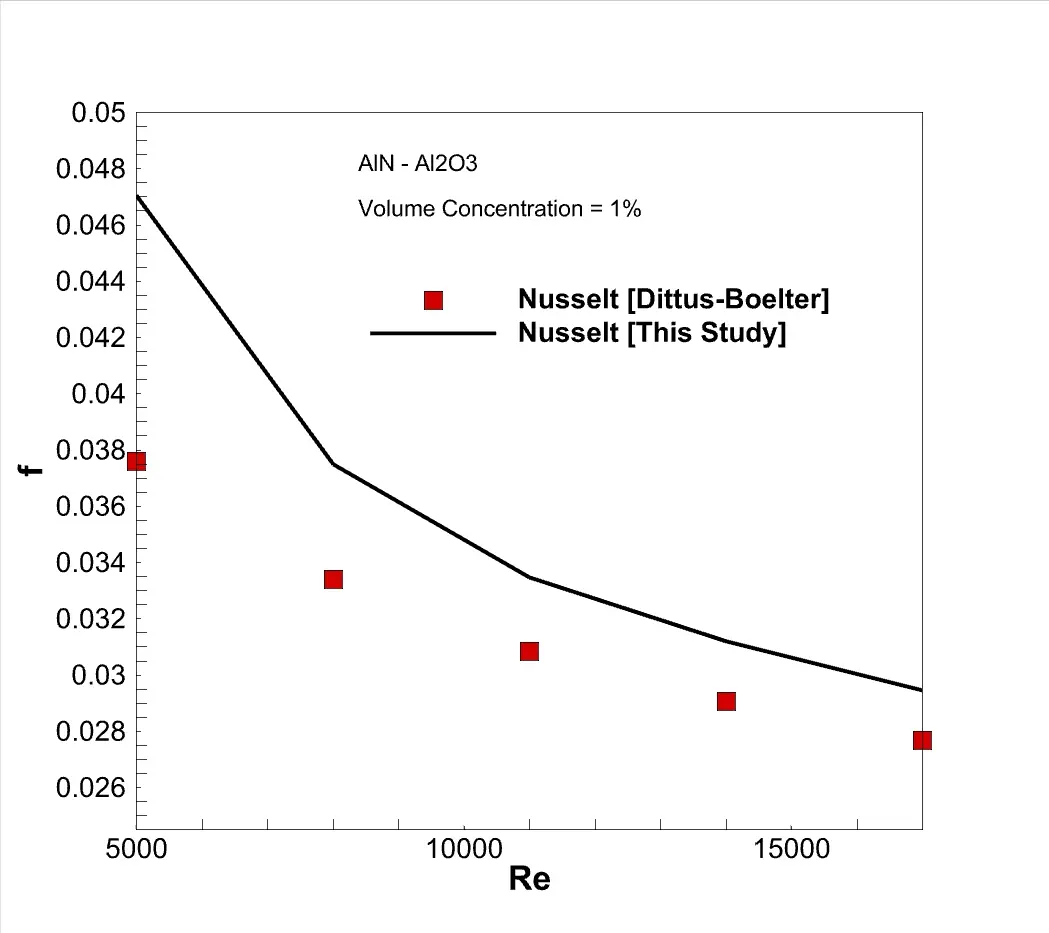
To truly prove this is a successful Hybrid Nanofluid CFD Validation, we must look at the numbers closely. We are comparing our simulation “Outputs” to the theoretical “Inputs” from the Dittus-Boelter equation. The first and most accurate result is the Friction Factor. This measures how hard it is to push the fluid through the pipe. Looking at Figure 2, the simulation data points follow the theory line almost perfectly. At a Reynolds number of 17,000, the error is extremely small. The calculated deviation is only 1.01%. This tells us that our Structured Grid and near-wall mesh are excellent. The computer is correctly predicting how the fluid rubs against the pipe wall.
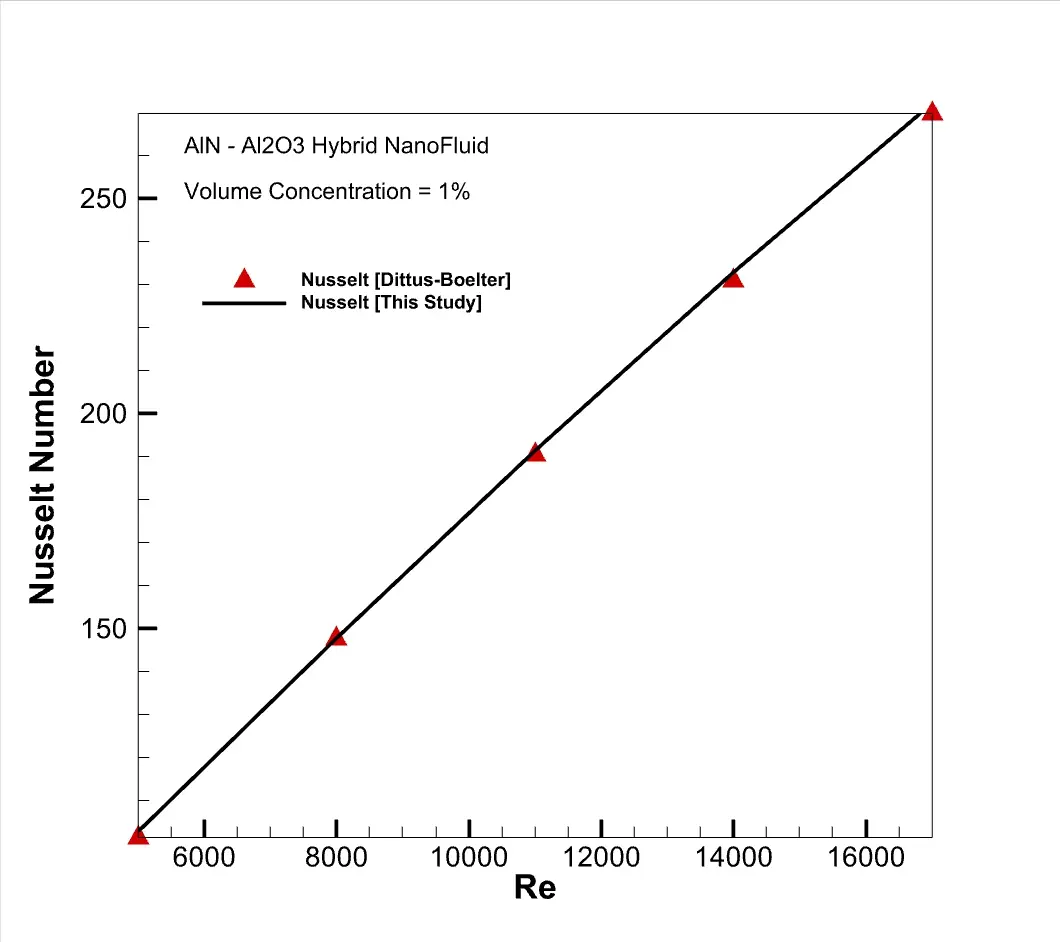
The second part of the validation focuses on the Nusselt Number (Nu). This number tells us how good the heat transfer is. We want a high Nusselt number for better cooling. In Figure 3, we compare the Hybrid Nanofluid In Pipe simulation results (Red Dots) with the Dittus-Boelter calculation (Blue Line). The agreement is very good. The calculated relative error is 6.41%. While this is higher than the friction error, it is still very acceptable for CFD.
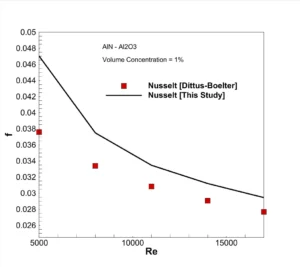
Figure 2: Friction factor versus Reynolds number showing excellent agreement (1.01% error).
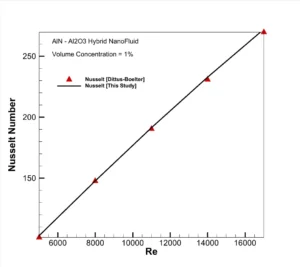
Figure 3: Nusselt number validation against Dittus-Boelter relation showing 6.41% error.
Why is there a 6.41% difference? This small error likely comes from our “Single-phase assumption.” The Dittus-Boelter equation is a general formula for pure fluids. Our Hybrid Nanofluid has solid particles that might move differently than water. However, an error under 10% is considered a success in engineering. This result validates that using the Single-phase technique in ANSYS Fluent is a reliable way to predict the thermal performance of AlN/Al2O3 nanofluids without needing complex multi-phase models.
Key Takeaways & FAQ
- Q: Is this a validation study?
- A: Yes. We compared Hybrid Nanofluid CFD simulation results with the theoretical Dittus-Boelter correlation to prove accuracy.
- Q: How accurate is the simulation?
- A: The hydrodynamic accuracy is very high with only 1.01% error for friction. The thermal accuracy is also good with 6.41% error for the Nusselt number.
- Q: What is the fluid composition?
- A: It is a hybrid mix of AlN and Al2O3 nanoparticles in water with a 1% volume fraction.







Reviews
There are no reviews yet.