

In many factories, the air gets dirty with dust. To clean this air, engineers use a machine called a Cyclone Separator. It spins the air to throw the dust out. However, normal round cyclones have a problem. The air inside them is very chaotic and messy (turbulent). This mess wastes energy. To fix this, we use a new design: the Square Cyclone Separator with Laminarizer. This design has a square body and uses special tubes called a “Laminarizer” to calm the air down.
This project is a Square Cyclone Separator CFD simulation designed to teach you how to analyze this new device. We use ANSYS Fluent to see inside the machine. By simulating this Laminarizer in Square Cyclone, we can see how the tubes organize the wind. For more examples of cleaning machines, please visit our Separator tutorials. This guide uses methods from the research paper by Fatahian et al. [1].
- Reference [1]: Fatahian, Hossein, Esmaeel Fatahian, and Majid Eshagh Nimvari. “Improving efficiency of conventional and square cyclones using different configurations of the laminarizer.” Powder technology339 (2018): 232-243.
Figure 1: The geometry of the laminarizers used in the Square Cyclone CFD model [1].
Simulation Process: DPM and Laminarizer Setup in Fluent
To start this Square Cyclone Separator fluent tutorial, we built a 3D model. The model is unique because it has a square body. It also has two sets of tubes. The first set is the “Inlet Laminarizer,” which has 3×5 hollow tubes. The second set is inside the top exit, which has 7 vertical tubes. We created a mesh with 2,540,574 tetrahedral cells. We needed this many small cells to capture the air moving through the tiny tubes accurately.
In the ANSYS Fluent setup, we used the Discrete Phase Model (DPM). This model is perfect for Square Cyclone Separator ANSYS fluent projects because it tracks individual dust particles. We assumed one-way coupling. This means the wind pushes the dust, but the dust does not slow down the wind. We also turned on the discrete-random-walk model. This helps us simulate how the particles bounce around in the turbulent air.
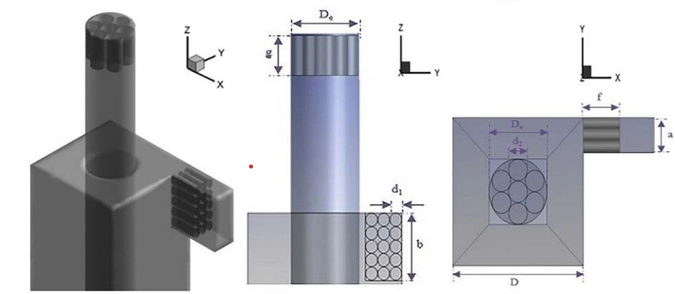
Figure 2: The geometry of the conventional cyclone with a laminarizer. [1]
Post-processing: Detailed Analysis of Velocity and Separation Time
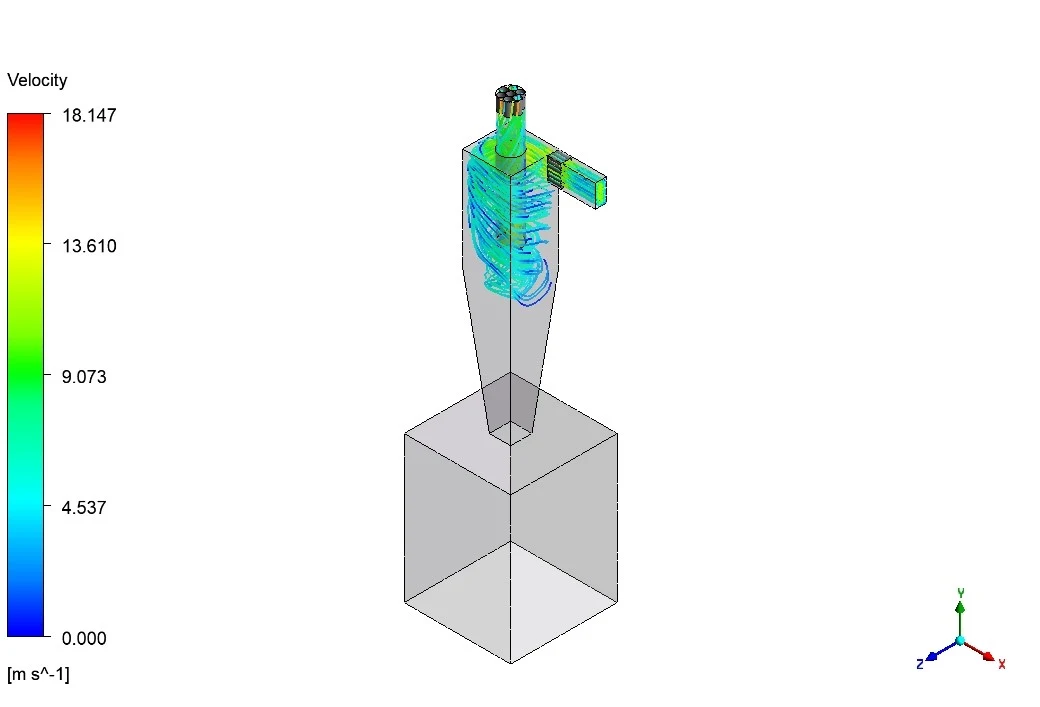
To truly understand the Square Cyclone Separator CFD simulation, we must follow the journey of the air. The story begins at the inlet. In a normal cyclone, the air enters as a messy, turbulent cloud. But here, the Laminarizer changes everything. The air is forced to pass through the 3×5 tubes. These tubes act like a straightener. They take the chaotic wind and comb it into smooth, straight lines. This process is called “laminarization.” The simulation results prove this works. The air entering the main chamber is calm and organized, which prepares it for the next step: the spin. Once this smooth air enters the square body, it hits the walls and begins to rotate. Because the air was organized by the tubes, it spins very efficiently. It forms a powerful “Vortex.” The velocity contours in Figure 2 show this clearly. The red color in the center represents very high speed. The data shows that the air in this vortex reaches a maximum velocity of 18.15 m/s. This high speed is the engine of the separator. It creates a massive Centrifugal Force. This force is what pushes the heavy dust particles away from the center.
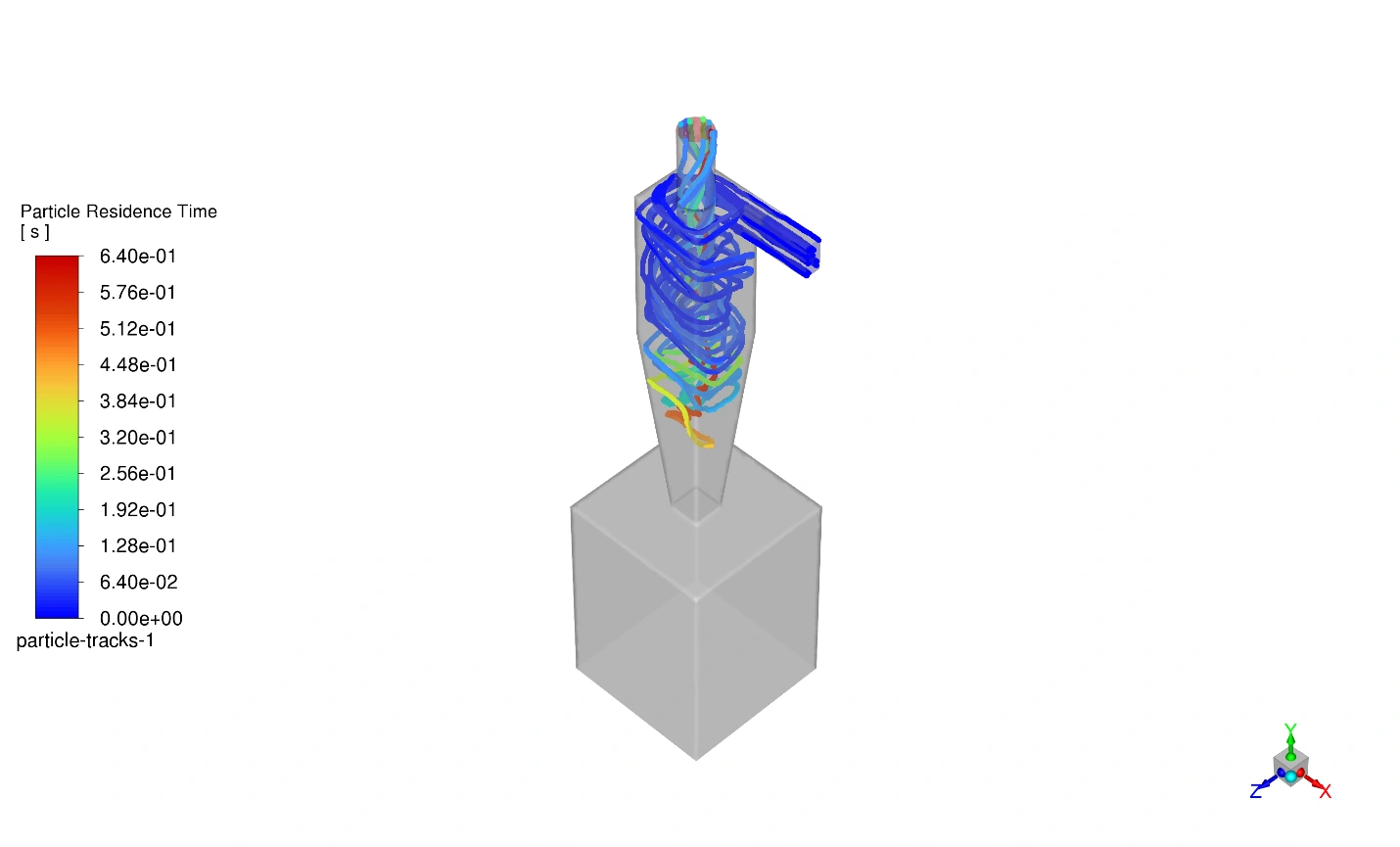
The final part of the analysis looks at the dust itself. The Discrete Phase Model (DPM) tracks show the result of this strong force. As soon as the particles enter the spinning zone, the 18.15 m/s wind throws them hard against the square walls. The particles hit the wall, lose their energy, and fall to the bottom. The most impressive number from this study is the “Residence Time.” The data shows that the particles spend less than 0.5 seconds inside the machine before they are separated. This is incredibly fast. It proves that the Laminarizer in Square Cyclone makes the separation process almost instant. By smoothing the inlet flow, the laminarizer allows the vortex to spin faster and cleaner, resulting in a highly efficient dust collector.
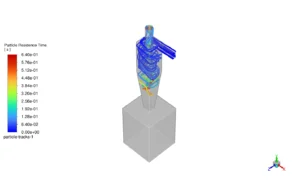
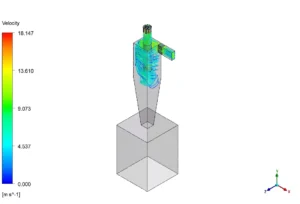
Figure 3: Particle residence time and velocity paths showing rapid separation.
Key Takeaways & FAQ
- Q: what does the Laminarizer do?
- A: The Laminarizer (the 3×5 tubes) organizes the air at the inlet. In this Square Cyclone Separator fluent simulation, it turns messy turbulence into smooth flow, which helps the cyclone spin better.
- Q: Why is the 18.15 m/s velocity important?
- A: This high speed creates the centrifugal force. The faster the vortex spins, the harder it throws the dust against the wall. This leads to the fast 0.5s separation time.
- Q: Why use a Square Cyclone?
- A: Square cyclones are easier to manufacture than round ones. With the addition of a Laminarizer, they can be just as efficient as traditional round cyclones.



Reviews
There are no reviews yet.