


Heat exchangers are used everywhere to move heat from hot fluids to cold fluids. A simple “Double-pipe Heat Exchanger” is good, but sometimes it is not efficient enough. To make it better, engineers put a special metal strip inside the tube. This strip is twisted like a screw and is called a Twisted Tape. This simple addition changes how the water moves and helps it transfer heat much faster. To understand exactly how this works, we use Twisted Tape in Heat Exchanger CFD simulation.
This project is a Twisted Tape in Double-pipe Heat Exchanger fluent simulation designed to teach you how to analyze this device. We use ANSYS Fluent to visualize the flow and calculate the efficiency. By simulating this Twisted Tape Simulation case, we can see the hidden “swirl flow” that improves performance. For more lessons on thermal systems, please visit our Heat exchangers tutorials. The methods in this guide are based on the research by Barzegar and Vahid [1].
- Reference [1]: Barzegar, Ali, and Dovood Jalali Vahid. “Numerical study on heat transfer enhancement and flow characteristics of double pipe heat exchanger fitted with rectangular cut twisted tape.” Heat and Mass Transfer12 (2019): 3455-3472.
Figure 1: The 3D model of the twisted tape insert inside the double-pipe heat exchanger.
Simulation Process: Hybrid Mesh and UDF Setup
To start this Double-pipe Heat Exchanger fluent tutorial, we built the 3D model of the pipe with the twisted tape inside. The tape has a complex curved shape with rectangular cuts. Because of this complexity, the mesh (grid) is very important. We used a Hybrid Grid made of hexagonal cells. Hexagonal cells are very high quality. They fit the curved surface of the twisted tape perfectly and help us get accurate results near the walls.
In the ANSYS Fluent setup, we needed to be very precise with the water properties. In real life, water changes its density and viscosity when it gets hot or cold. To simulate this, we wrote a User-Defined Function (UDF). This small computer code tells ANSYS Fluent to update the water properties automatically based on the temperature in every cell. This ensures that our Twisted Tape in Heat Exchanger ANSYS fluent simulation is realistic and accounts for thermal effects.
Figure 2: The hybrid mesh showing high-quality hexagonal cells on the twisted tape.
Post-processing: Analysis of Swirl and Heat Transfer
To truly understand the results of this Twisted Tape in Heat Exchanger CFD simulation, we must look at the “cause and effect” relationship. The cause is the geometry of the tape. When the fluid flows through the pipe, the twisted tape forces it to spin. This creates a “Swirl Flow” or a vortex. The velocity streamlines in Figure 3 show this helical path clearly. The fluid does not go straight; it wraps around the tape. The rectangular cuts in the tape add even more mixing. The velocity contours show that the speed of the water ranges from 0.07 m/s to 0.438 m/s. This high-speed swirling motion is the engine that drives the performance.
The effect of this swirl is a dramatic increase in heat transfer. In a normal pipe, there is a layer of slow, stagnant water near the wall called the thermal boundary layer. This layer acts like a blanket and stops heat from moving. The swirling vortex created by the Twisted Tape breaks this layer. It pushes the cold water from the center to mix with the hot water at the wall. We measure this improvement using the Nusselt Number. The simulation data shows that the Nusselt number increased from 34.52 in the empty pipe to 43.16 with the twisted tape. This is a massive 25% improvement in thermal performance.
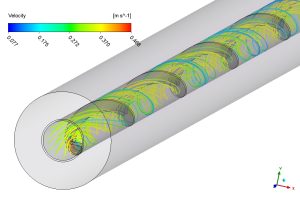
Figure 3: Velocity streamlines showing the helical swirl flow created by the twisted tape.
However, this improvement comes with a small cost. Because the water has to spin and move around the tape, it is harder to push it through the pipe. This resistance is called “Pressure Drop.” The Twisted Tape Simulation results show that the pressure drop increased by 18% compared to the plain pipe. Engineers must balance these two numbers. But in this case, a 25% gain in heat transfer is usually worth the 18% cost in pressure. This analysis proves that the Twisted Tape in Double-pipe Heat Exchanger fluent simulation correctly predicts the physical mechanism: Swirl Flow breaks the boundary layer and enhances heat transfer.
Key Takeaways & FAQ
- Q: How does a Twisted Tape improve heat transfer?
- A: It creates Swirl Flow. This spinning motion mixes the fluid and breaks the thermal boundary layer, which allows heat to move faster.
- Q: What is the trade-off?
- A: The trade-off is Pressure Drop. In this Twisted Tape in Heat Exchanger ANSYS fluent study, we gained 25% in heat transfer (Nusselt Number) but lost 18% in pressure.
- Q: Why use a UDF?
- A: Real fluids change properties with temperature. The User-Defined Function (UDF) updates density and viscosity to make the Double-pipe Heat Exchanger fluent simulation more accurate.






Reviews
There are no reviews yet.