

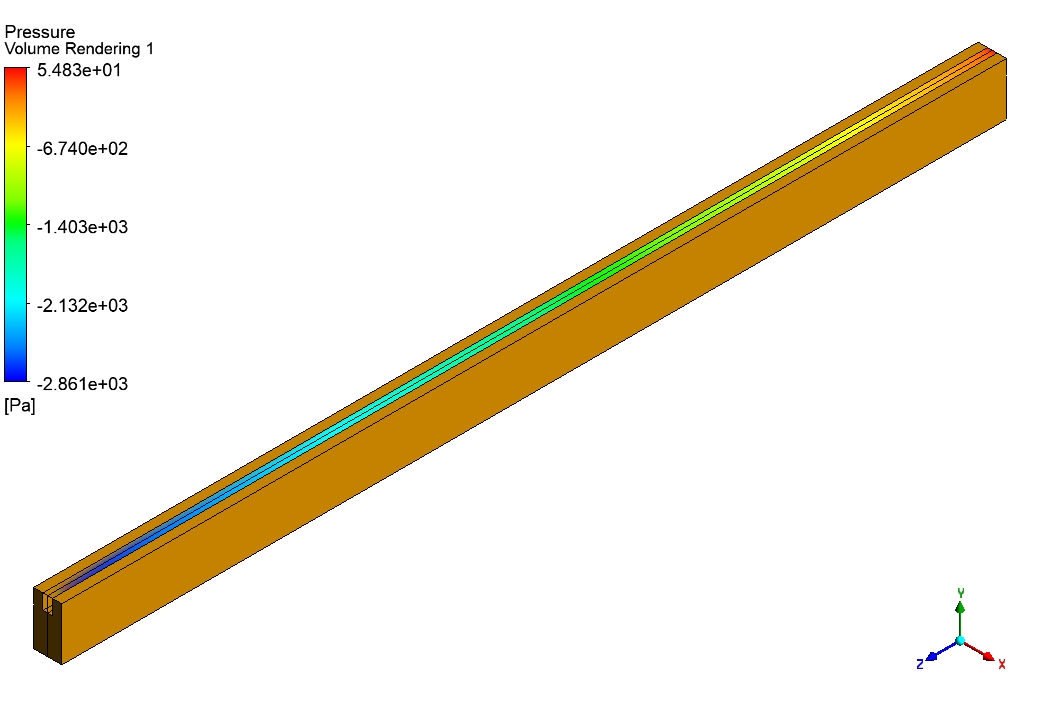
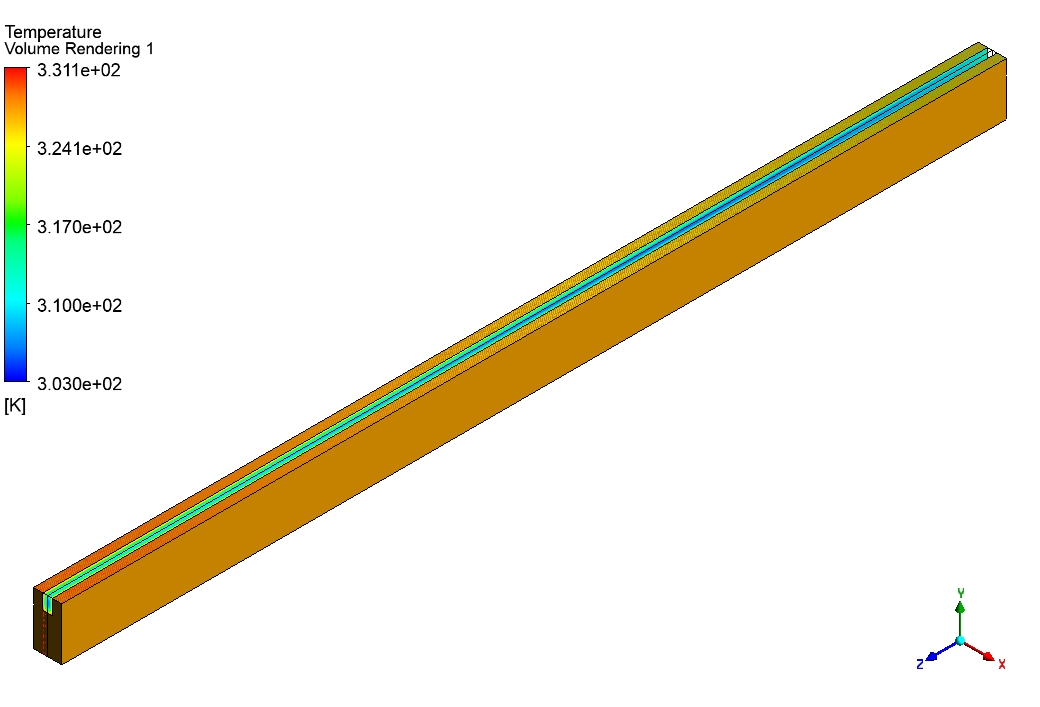

Cooling high-performance electronics is a major challenge in modern engineering. As devices get smaller and more powerful, they generate more heat. Traditional cooling methods are often not enough. This is where Nanofluid in microchannel technology becomes essential. A microchannel heat sink uses tiny channels to increase the surface area for cooling. However, we can push the performance even further by replacing standard water with a Nanofluid. A Nanofluid is a mixture of a base fluid (like water) and tiny solid particles (nanoparticles).
Simulating this process helps us understand how to lower the Thermal Resistance of the system. In this tutorial, we perform a Nanofluid in microchannel in heat sink simulation using ANSYS Fluent. We focus on validating our results against experimental data to ensure accuracy. For more resources on small-scale flows, please explore our Microfluid and Nanofluid tutorials. This study validates the Nanofluid Thermal Resistance using the experimental work of Sohel et al. [1].
- Reference [1]: Sohel, M. R., et al. “An experimental investigation of heat transfer enhancement of a minichannel heat sink using Al2O3–H2O nanofluid.” International Journal of Heat and Mass Transfer74 (2014): 164-172.
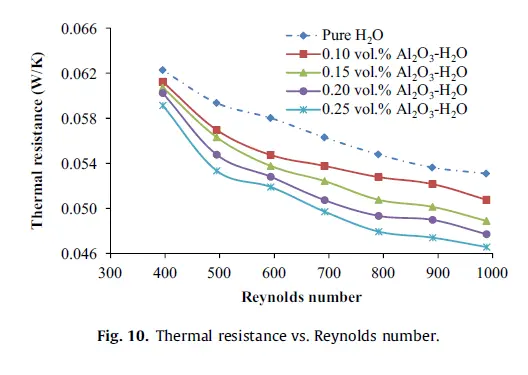
Figure 1: Schematic of the minichannel heat sink used for the Nanofluid Microchannel Multiphase CFD analysis. [1].
Simulation Process: Mixture Multiphase Model and UDF
To create an accurate Nanofluid in microchannel CFD simulation, we started with the geometry. We modeled a single section of the heat sink in 3D and applied symmetry boundary conditions. This saves calculation time. We generated a high-quality structured mesh. This type of mesh is very important near the walls where the heat transfer happens.
For the physics, we selected the Mixture multiphase model in ANSYS Fluent. This model is perfect for Nanofluid in microchannel studies. It treats the Al2O3 nanoparticles and the water as two phases that move together but have different properties. However, standard software settings are not enough. The properties of a nanofluid, such as density and thermal conductivity, change depending on the temperature and how many particles are present. To capture this, we wrote and compiled a User-Defined Function (UDF). This code tells the solver exactly how the Nanofluid properties behave, ensuring the Thermal Resistance calculations are precise.
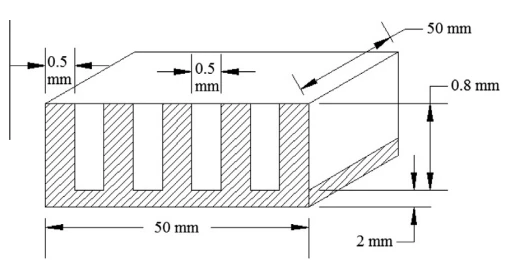
Figure 2: Schematic of the minichannel heatsink showing dimensions. [1]
Post-Processing: Thermal Resistance Validation and Analysis
The most important part of any CFD project is validation. We must prove that our Nanofluid in microchannel in heat sink model matches reality. Figure 3 shows the validation graph. This graph compares the Thermal Resistance calculated by our ANSYS Fluent simulation (solid lines) with the experimental data (dots). The results show an excellent match. We simulated different Reynolds numbers. As the Reynolds number increases (meaning the fluid moves faster), the Thermal Resistance drops significantly. This is expected because faster fluid carries heat away more efficiently. More importantly, we analyzed different nanoparticle concentrations, ranging from 0.1% to 0.3%. The data confirms that adding more nanoparticles lowers the thermal resistance. The 0.3% concentration performs better than the 0.1% concentration. This proves that our Mixture multiphase CFD model correctly predicts the heat transfer enhancement caused by the Al2O3 particles.
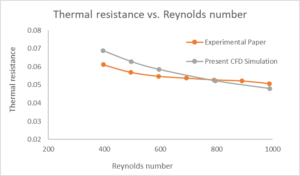
Figure 3: The Nanofluid validation CFD graph, showing the excellent agreement between the simulation results and experimental data for thermal resistance.
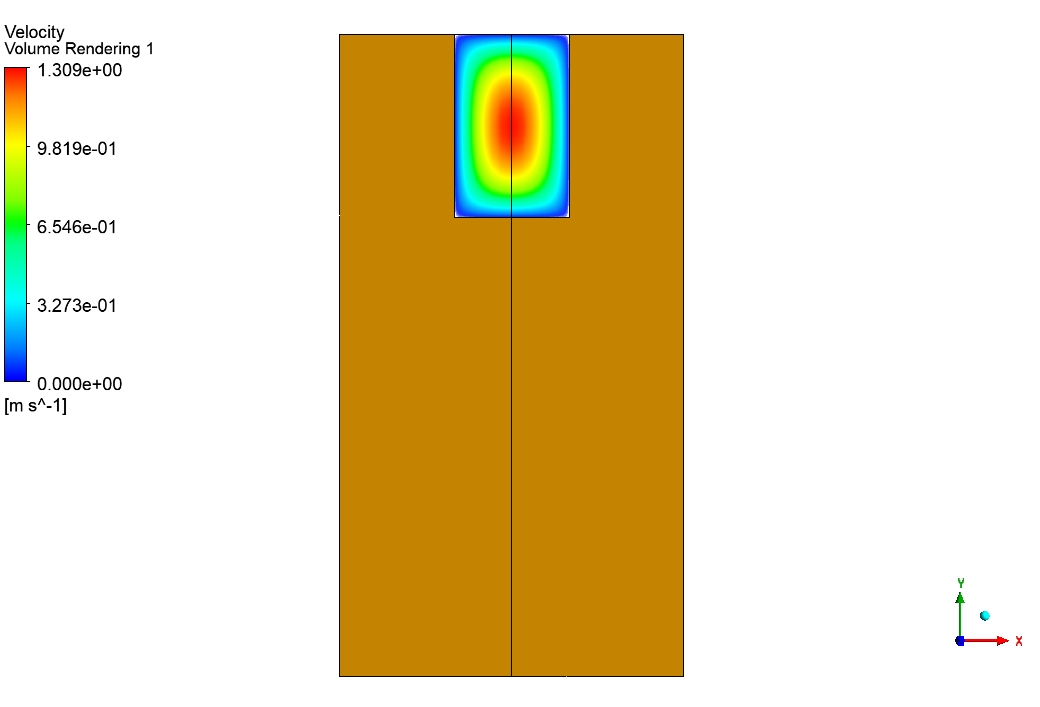
Finally, we look at the flow behavior inside the channel in Figure 4. The velocity contour shows a smooth, laminar profile. The velocity is zero at the walls and reaches a maximum of 1.309 m/s in the center. Even though the flow is laminar, the Nanofluid improves cooling because the particles increase the mixture’s thermal conductivity. This allows the fluid to absorb heat from the walls much faster than pure water. This detailed Nanofluid Thermal Resistance analysis confirms that using nanofluids in microchannels is a viable strategy for cooling high-power electronics.
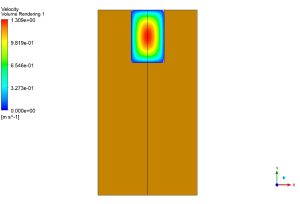
Figure 4: Velocity profile from the Multiphase nanofluid CFD simulation, showing the laminar flow inside the minichannel.
Key Takeaways & FAQ
- Q: What is Thermal Resistance in a heat sink?
- A: Thermal Resistance is a measure of how difficult it is for heat to move from the hot source to the coolant. A lower thermal resistance means the heat sink is more efficient at cooling. In our Nanofluid in microchannel simulation, we aim to minimize this value.
- Q: Why use the Mixture Model for Nanofluids?
- A: The Mixture model is computationally efficient. It solves momentum equations for the mixture and calculates the relative velocity of the dispersed phase (nanoparticles). This is ideal for Nanofluid in microchannel in heat sink cases where particles are very small and follow the flow closely.
- Q: How do Nanofluids improve heat transfer?
- A: Nanoparticles (like Al2O3) have a much higher thermal conductivity than base fluids (like water). When added to the fluid, they improve the overall ability of the mixture to conduct heat. They also increase mixing due to Brownian motion, further reducing Nanofluid Thermal Resistance.








Reviews
There are no reviews yet.