
Water tanks are used everywhere, from large cargo ships to chemical plants and airplane fuel systems. Inside these tanks, there are often floating objects, like round sensor floats or moving safety valves. When water violently rushes into an empty tank, these floating objects are thrown around. If the water pushes the ball too hard, it might smash into the metal walls and break the sensor. Testing this inside a real, closed steel tank is incredibly difficult because engineers cannot see through the metal to watch the water.
To solve this, engineers use a Ball Motion During Water Tank Filling fluent simulation on a computer. We use the ANSYS Fluent software to visualize the water, the air, and the solid ball all at the exact same time. This process is called Fluid-Structure Interaction (FSI). By running a complete CFD Analysis of Ball Motion During Water Tank Filling, manufacturers can perfectly predict gravity, buoyancy, and heavy wave impacts. For more detailed lessons on how to simulate moving solid parts inside fluids, please explore our Dynamic Mesh tutorials.
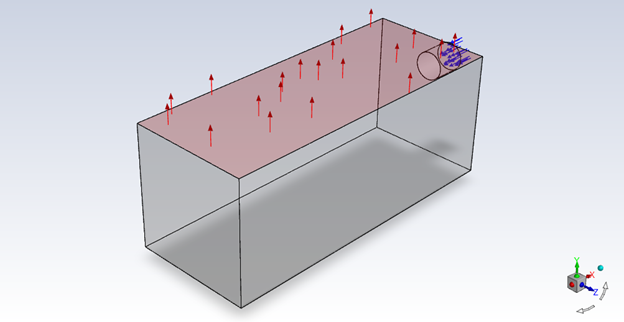
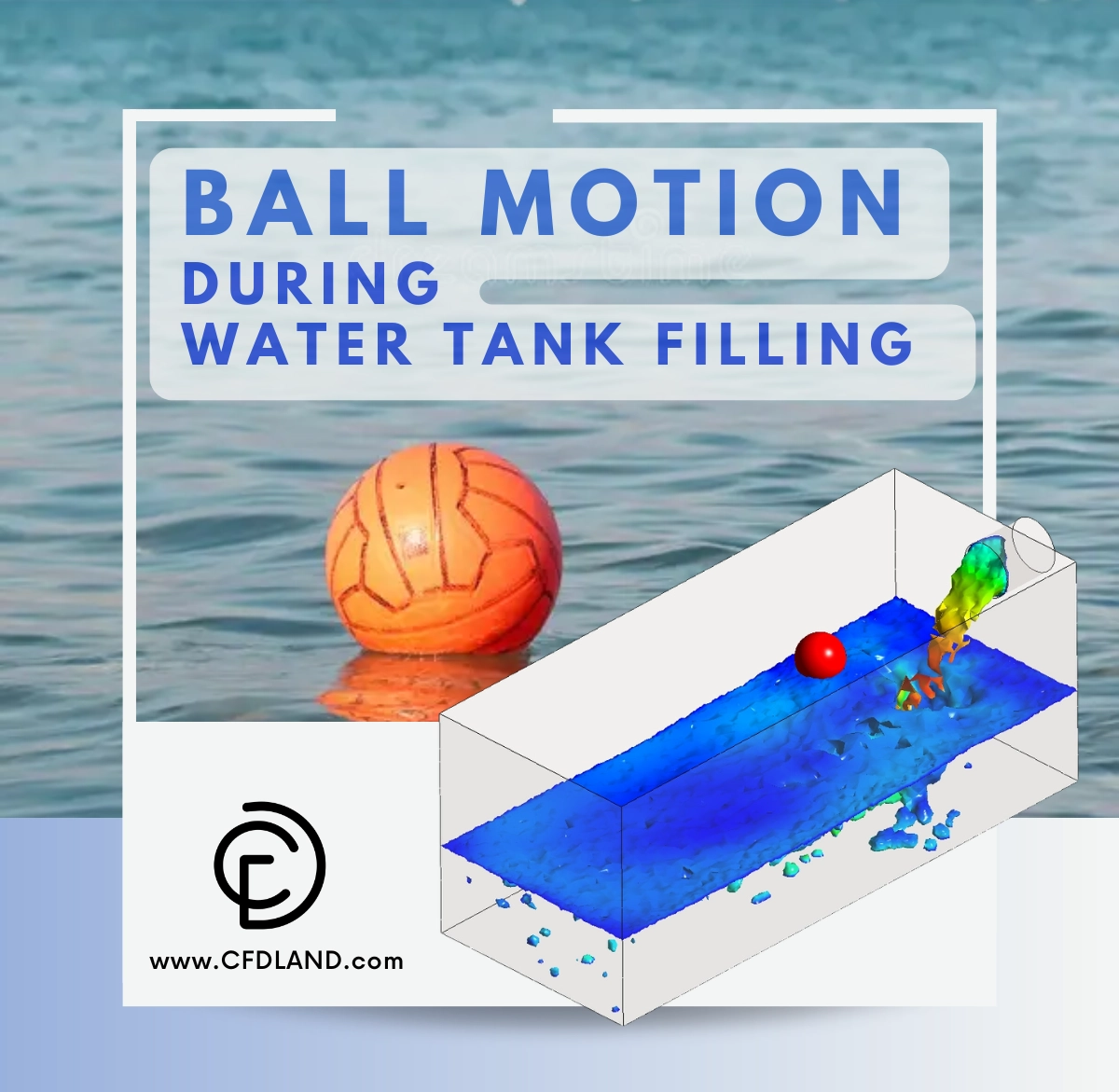
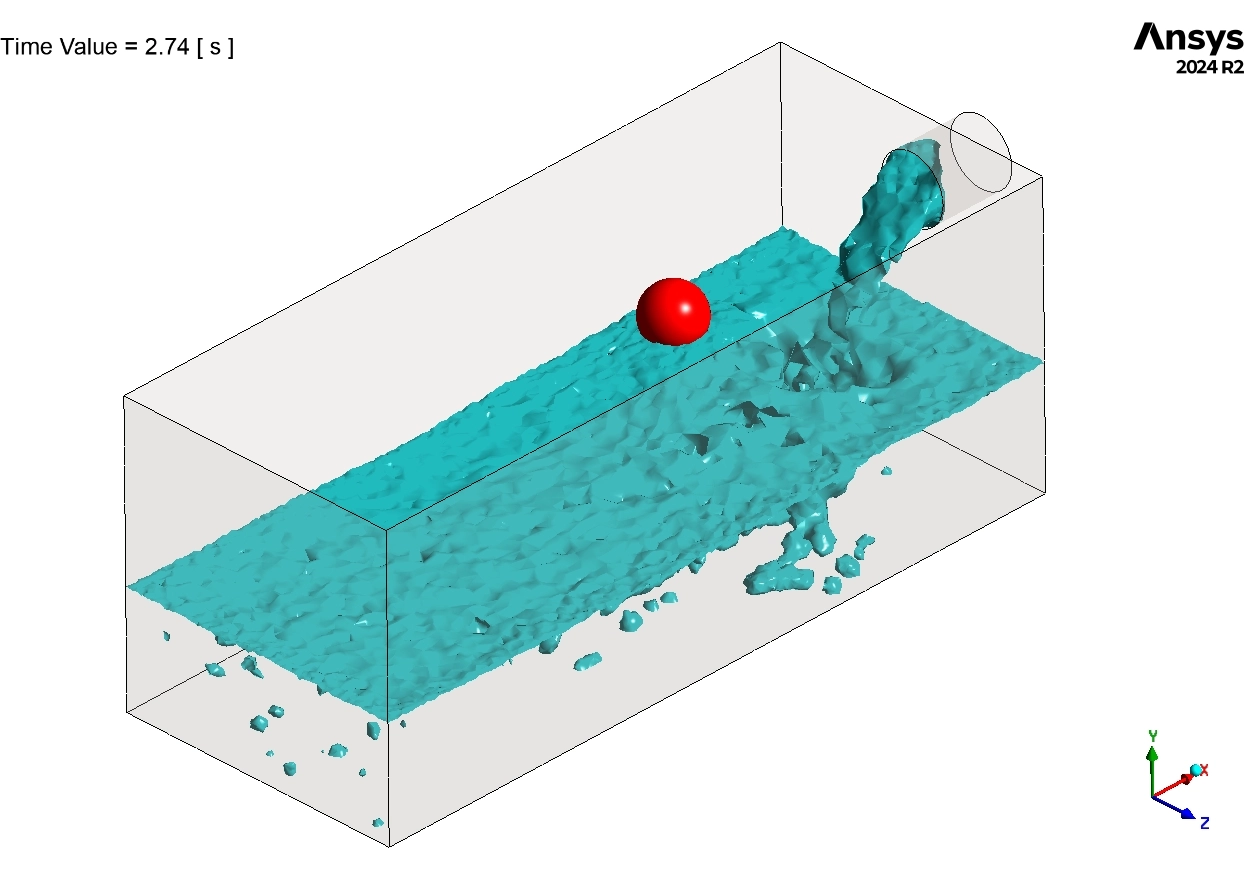
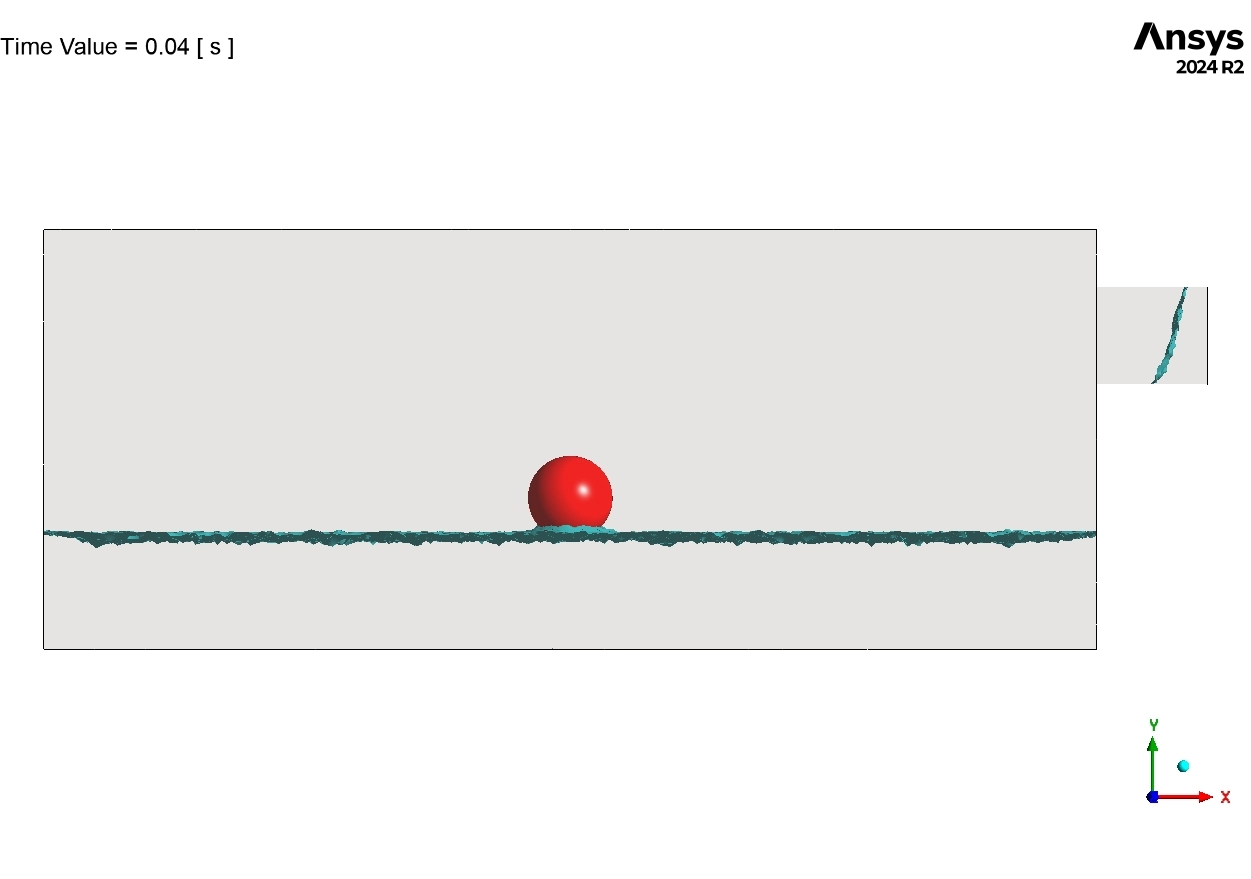
Figure 1: Geometry of the Rectangular Tank, showing the initial position of the ball resting calmly on the free surface before the filling process begins.
Simulation Process: VOF Multiphase and 6DOF Dynamic Mesh Setup
For this Ball Motion During Water Tank Filling ANSYS Fluent project, we built a 3D industrial container. Inside, we placed a lightweight solid ball weighing exactly 0.01 kg. It starts by resting quietly on top of the initial waterline.
To create an accurate Water Tank Filling Fluent setup, we must solve two major physics problems:
- The Water and Air Boundary (VOF): A tank contains heavy liquid water and light invisible air. We used the VOF (Volume of Fluid) multiphase model. VOF is a brilliant mathematical tool that tracks the exact free surface (the sharp boundary line) where the water meets the air, even when it splashes into a million droplets.
- The Moving Ball (6DOF Dynamic Mesh): We set the water to pump in from a bottom-right inlet pipe at a continuous speed of 0.5 m/s. As this water hits the ball, the ball must move. To do this, we activated the 6DOF Dynamic Mesh Fluent settings.
- 6-DOF (Six Degrees of Freedom): This rigid body solver uses Newton’s laws of physics to measure the exact water pressure hitting the ball, calculating how it should slide and spin.
- Dynamic Mesh: As the ball moves, the computer grid (the mesh) automatically stretches, compresses, and redraws itself around the ball every single millisecond so the simulation does not break.
Post-processing: Analytical Physics of Fluid-Structure Interaction
To truly master this Ball Motion During Water Tank Filling fluent study, we must strictly analyze the Cause and Effect shown in the contours. We will look at how the water jet causes waves, how those waves push the ball sideways, and how swirling water forces the ball to spin.
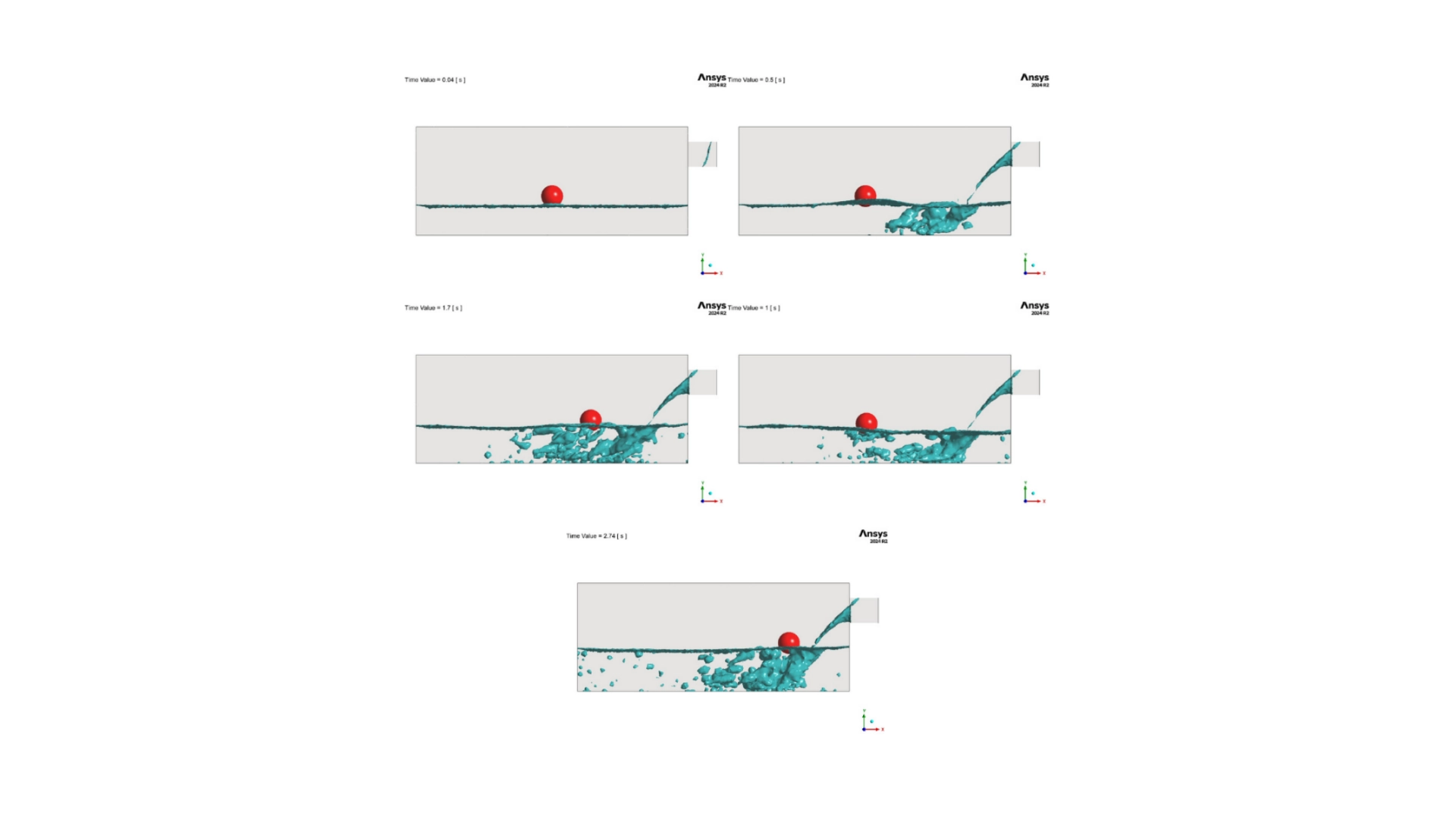
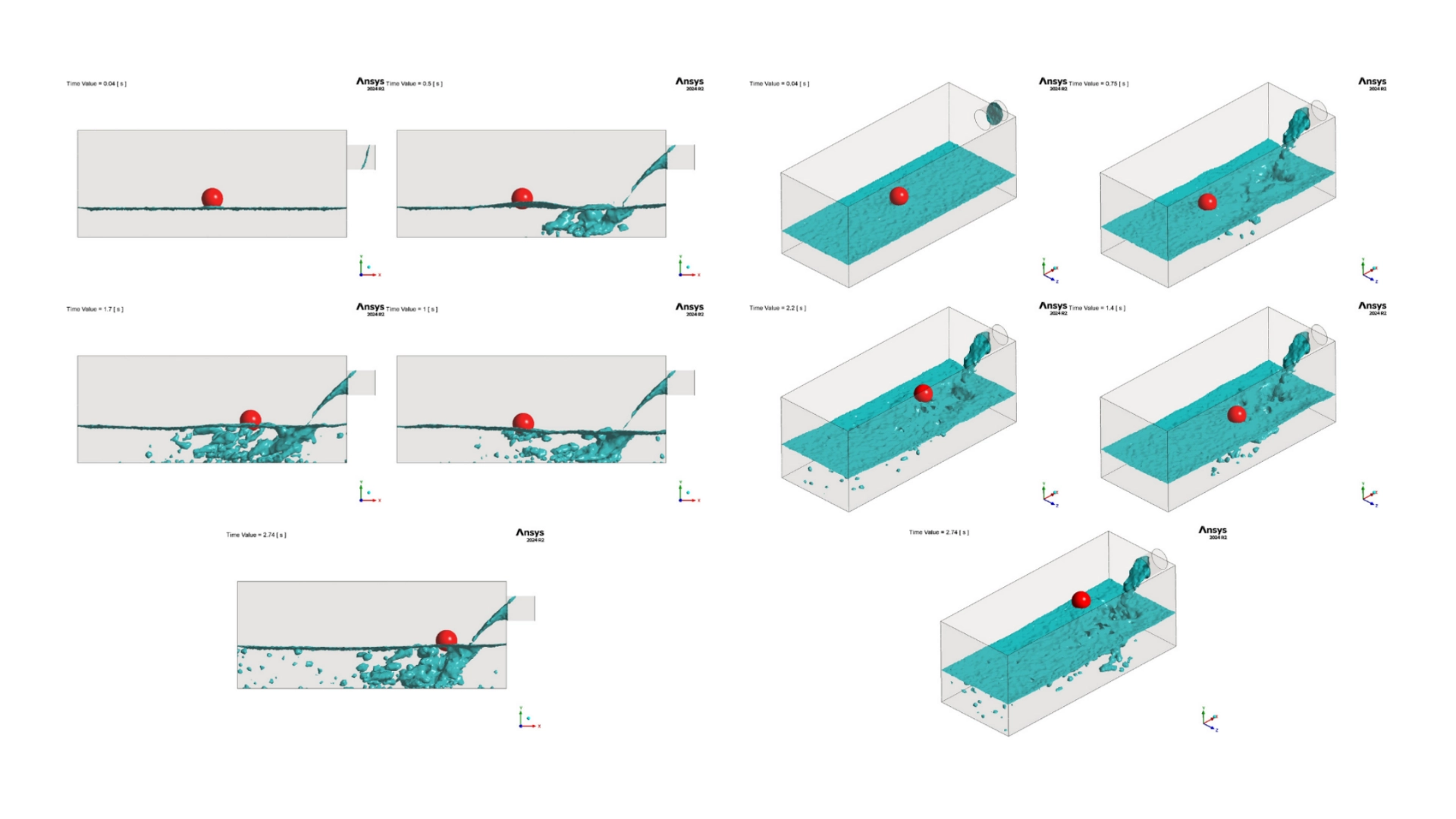
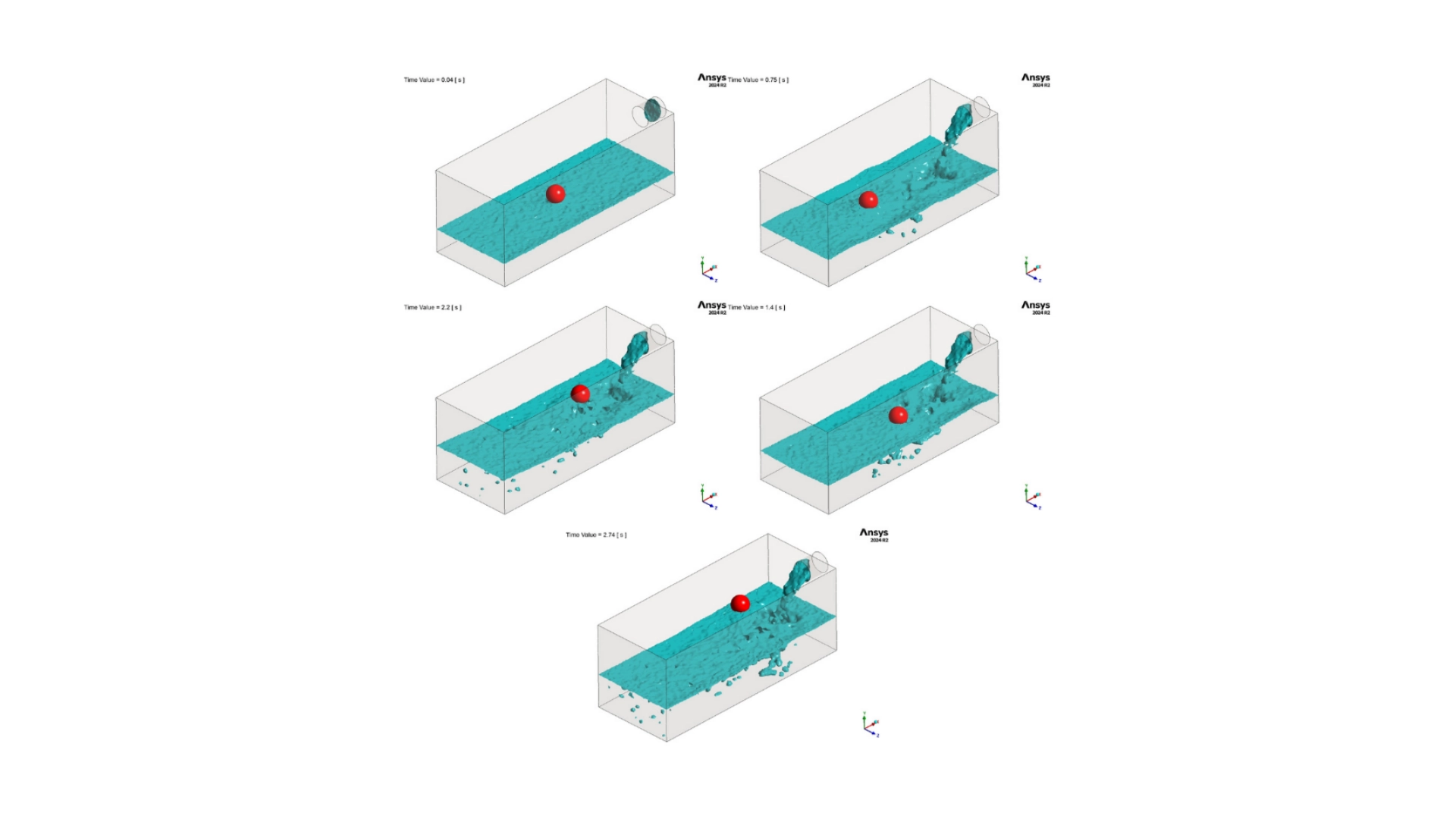
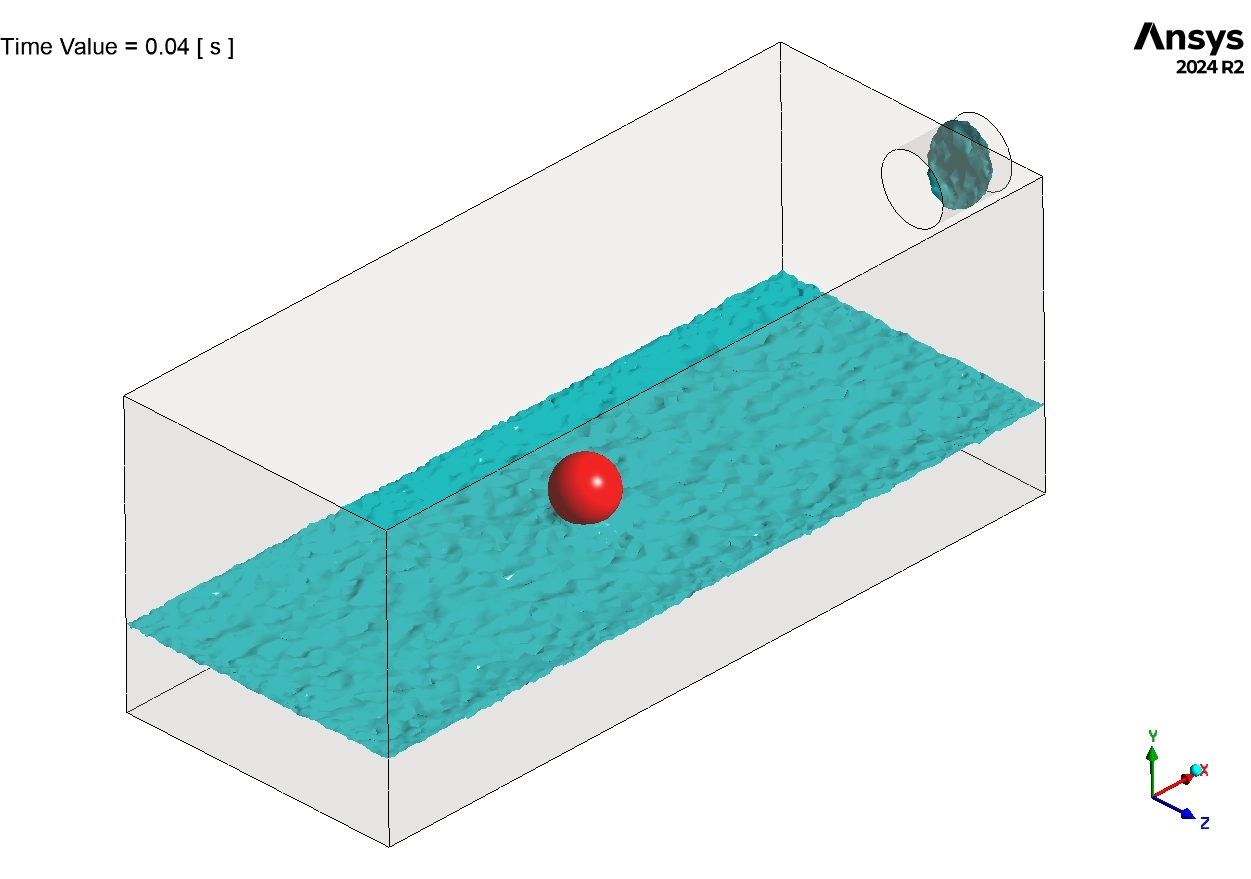
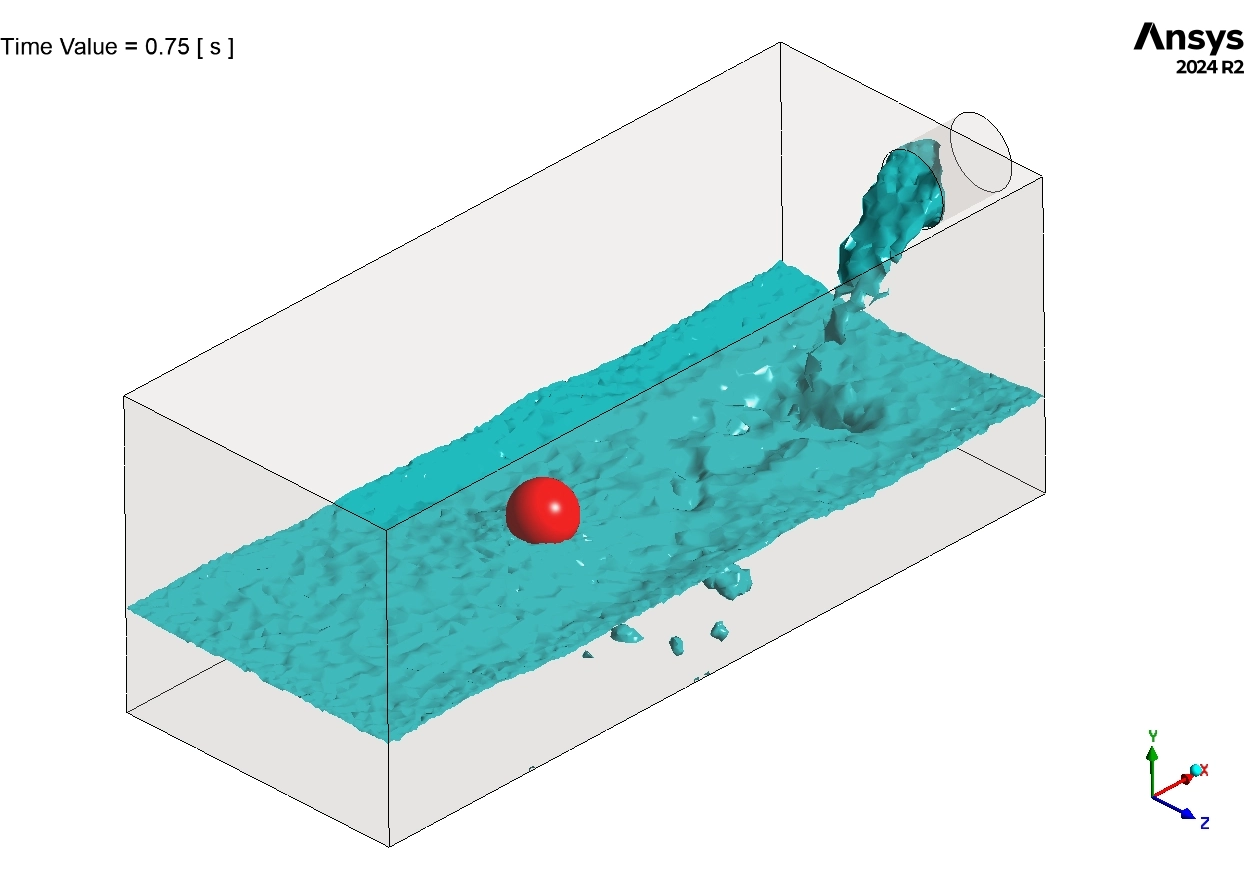
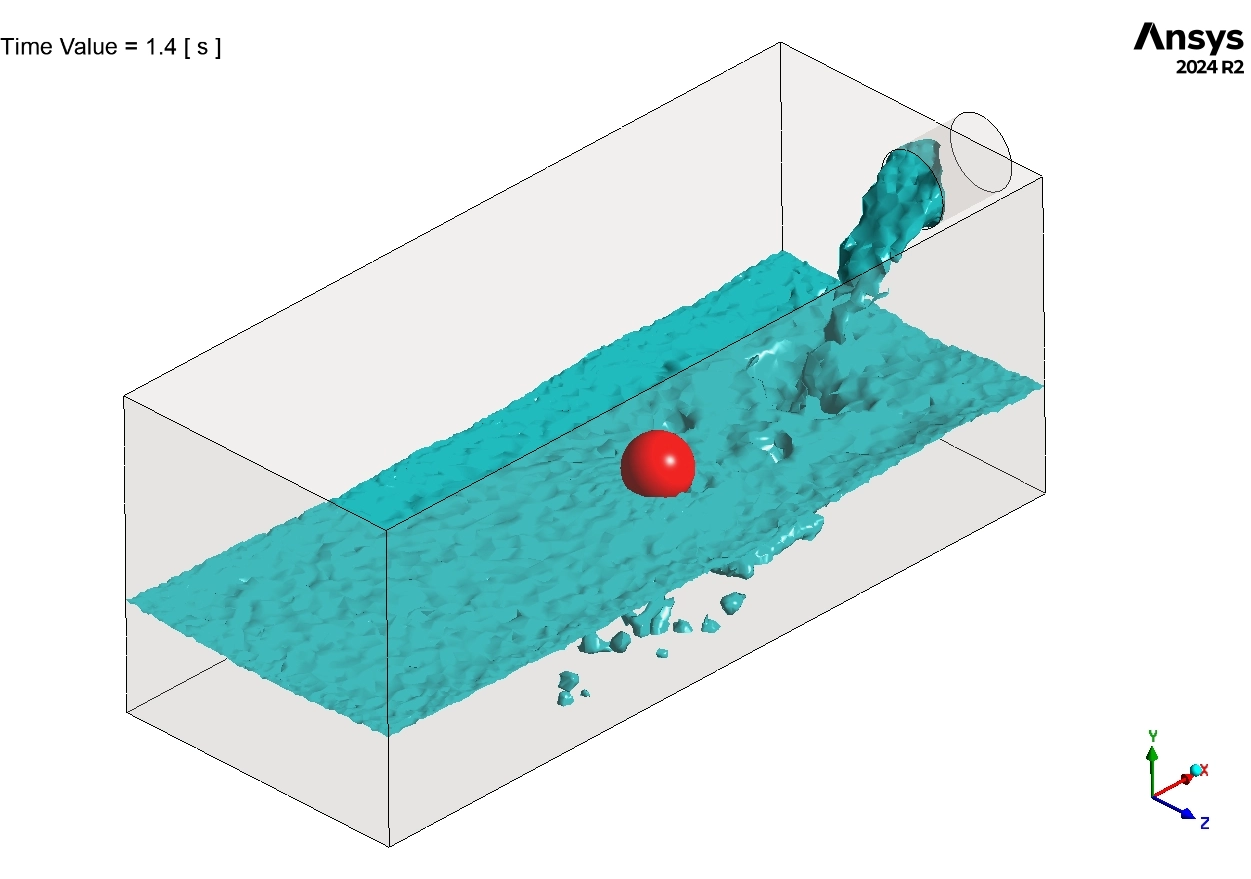
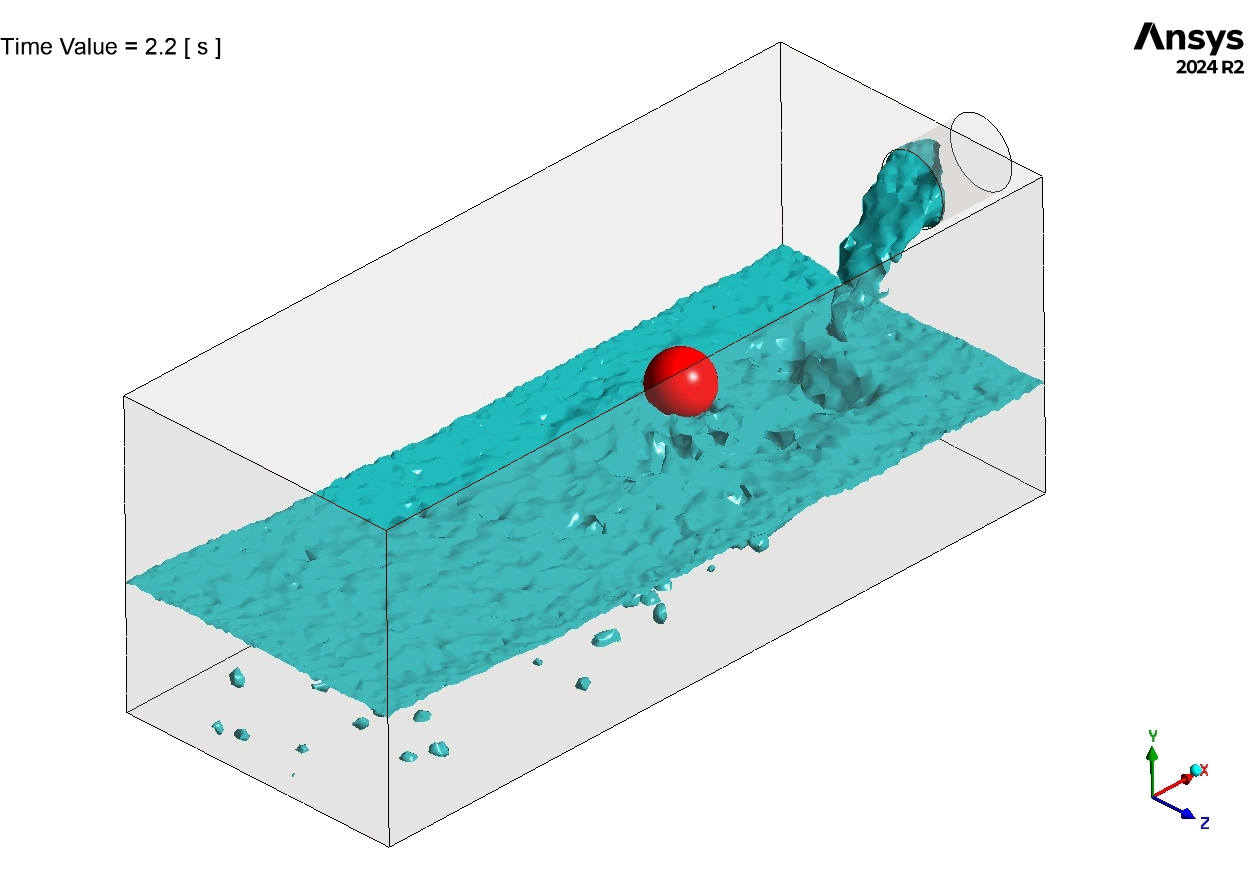
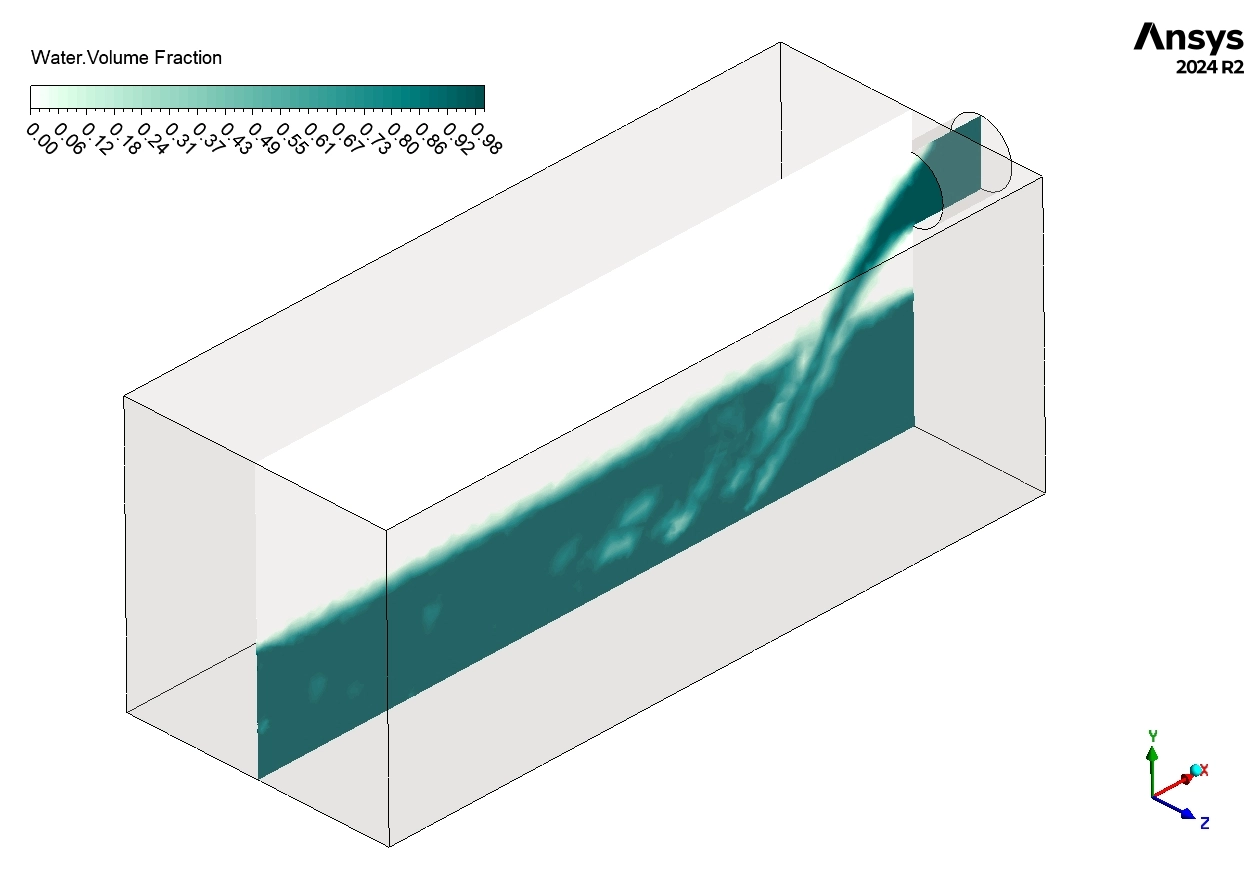
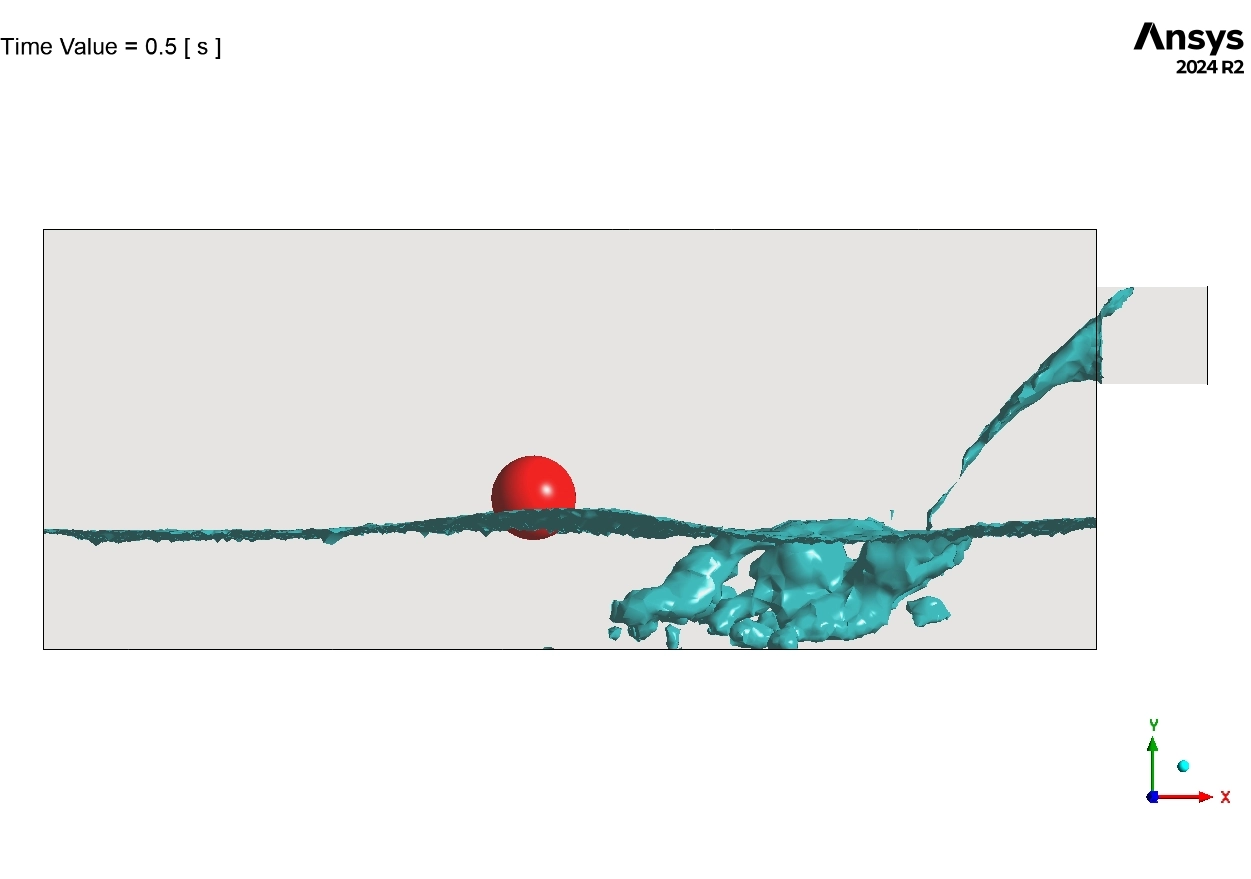
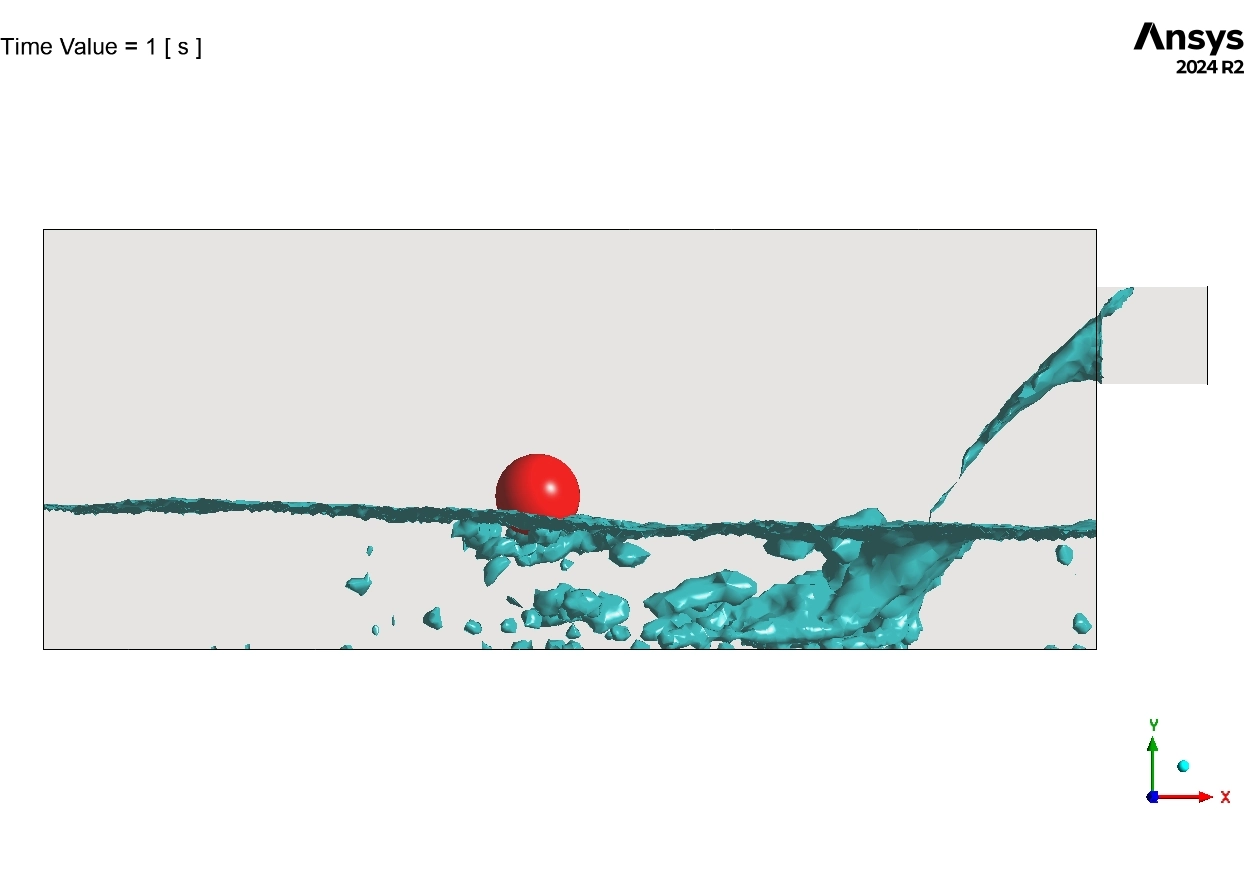
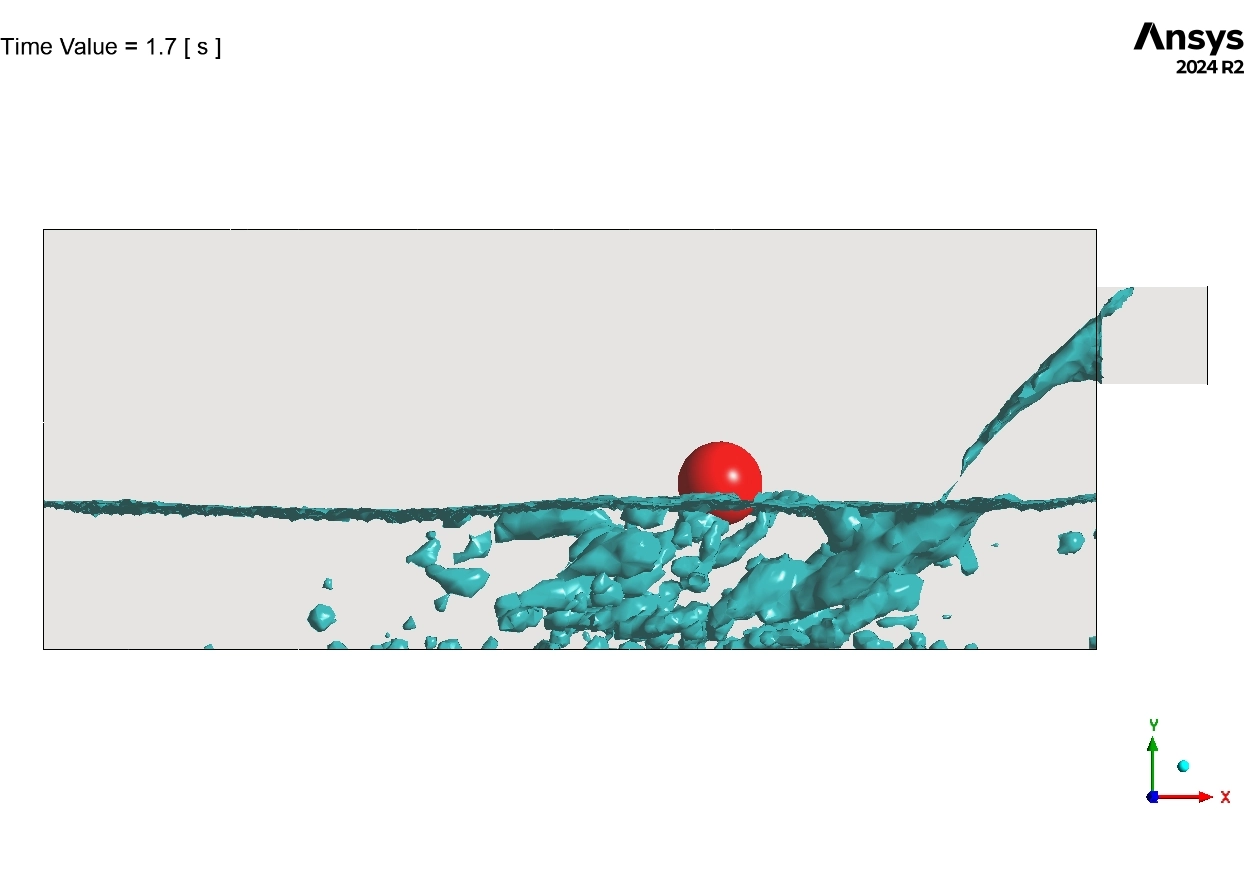
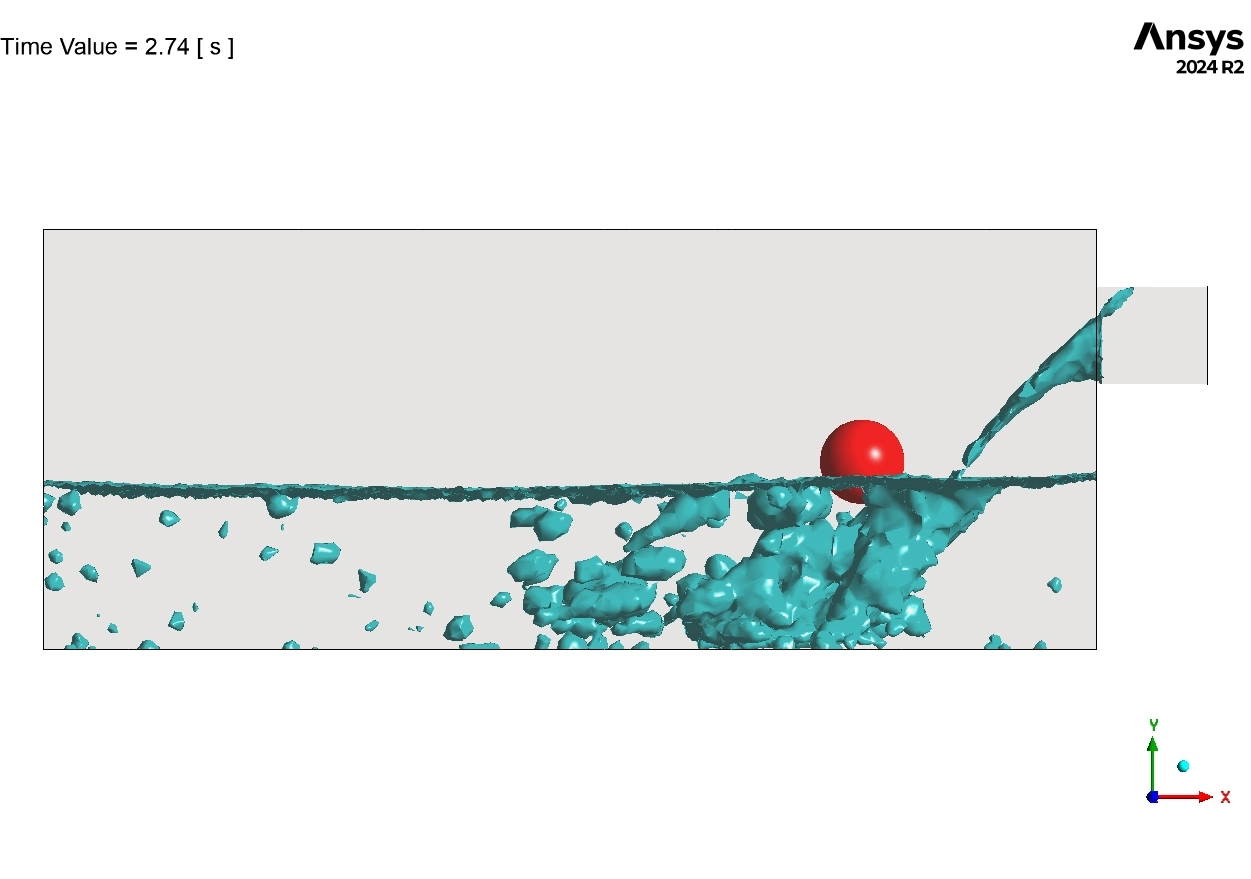
Look at the Transient VOF Animations (Figure 2). At 0.04 seconds, the red ball floats perfectly still on the flat, calm water surface. By 0.94s to 1.1s, the peaceful surface is completely destroyed. The incoming water crashes upward, creating violent, chaotic waves and scattered droplets. By 2.04 seconds, the tank is 60% to 70% full. The most important engineering discovery here is that the ball did not rise straight up. It bobbed vertically and drifted far laterally (sideways) to the left. This visually proves to tank designers that simple buoyancy math is useless here; the ball’s path is entirely controlled by the violent waves.
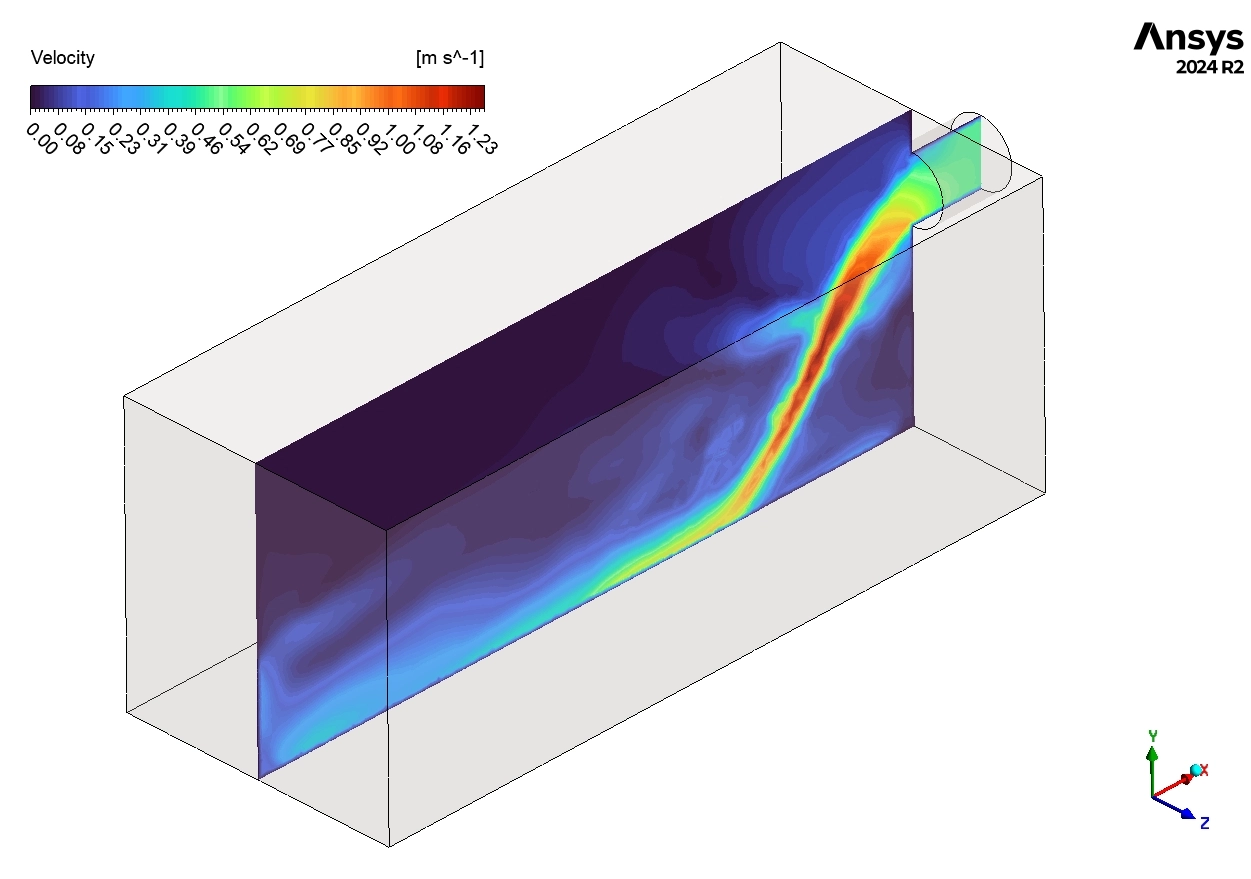
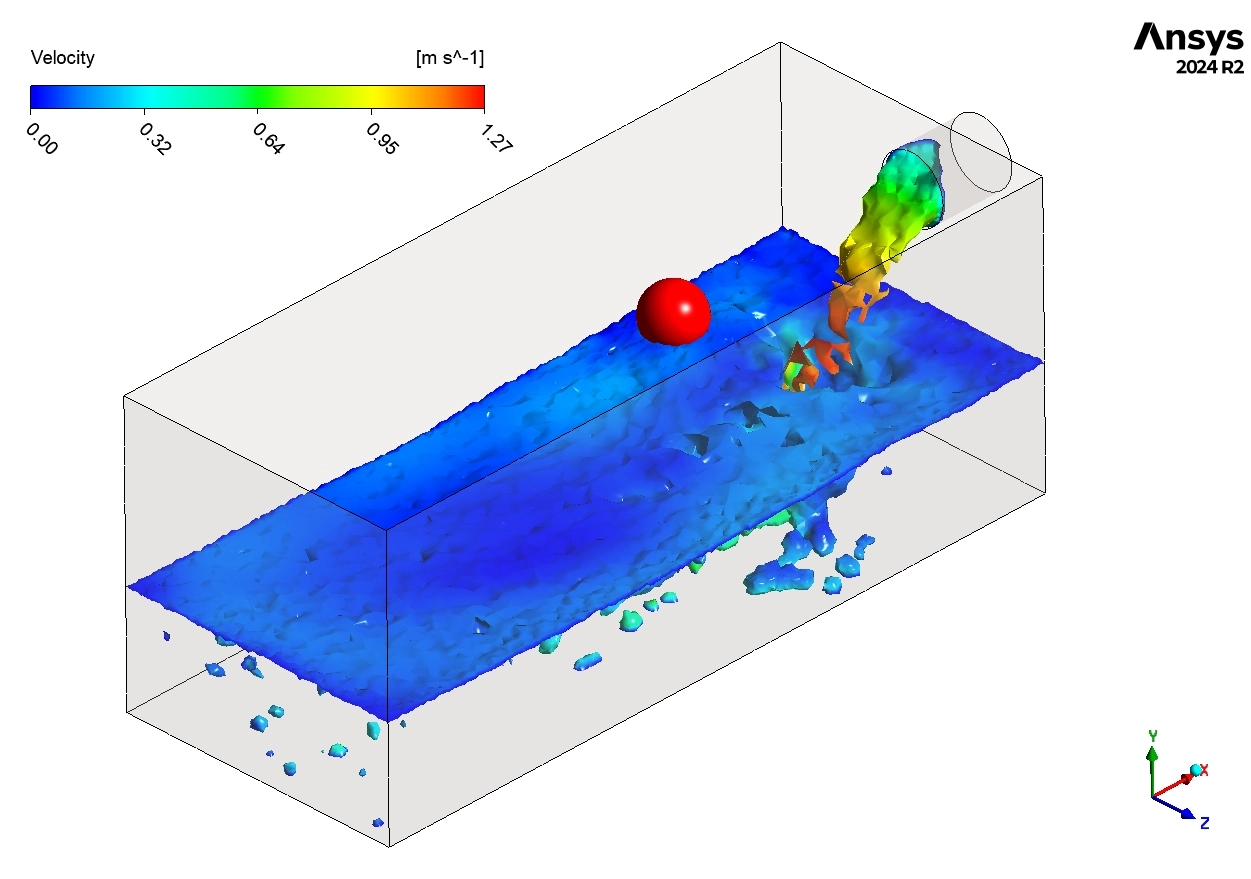
Why did the ball drift sideways? Look at the Velocity Contours (Figure 3). Water enters the bottom-right inlet at a moderate 0.5 m/s. However, because of the tank’s pressure, this water accelerates into a powerful underwater jet reaching a maximum speed of 1.27 m/s (glowing Red). This high-speed jet shoots completely across the bottom of the tank and smashes into the left wall, pushing all the water upward and to the left. As a result, the floating ball is caught in a moderate velocity zone of 0.32 to 0.64 m/s (Cyan/Green colors). This 0.64 m/s current is the exact physical force dragging the 0.01 kg ball away from the center of the tank.
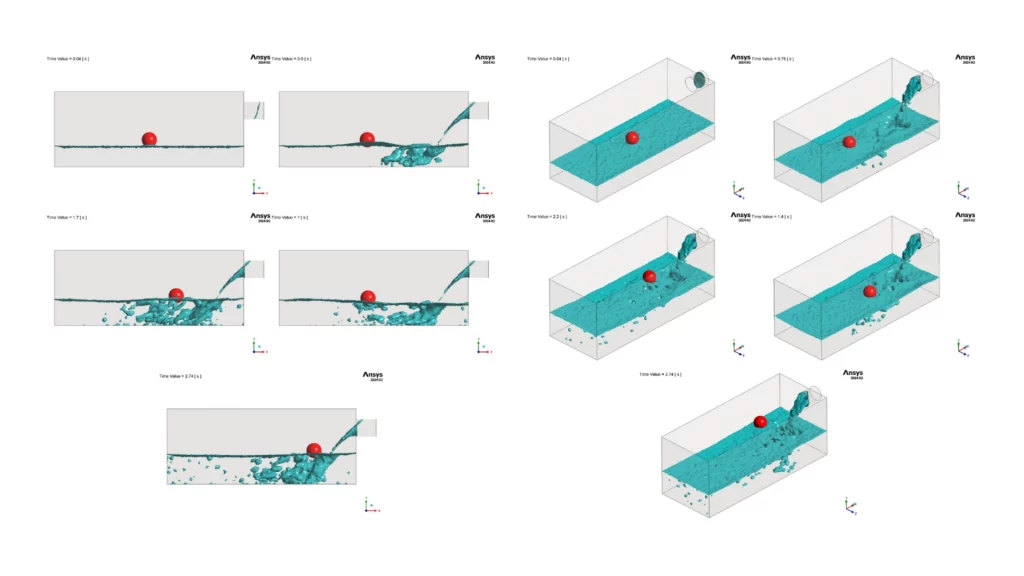
Figure 2: Ball motion animation (Time 0.04s – 2.04s). The ball initially floats on a calm surface, but the 0.5 m/s inlet creates turbulent mixing, causing violent bobbing and lateral drift.
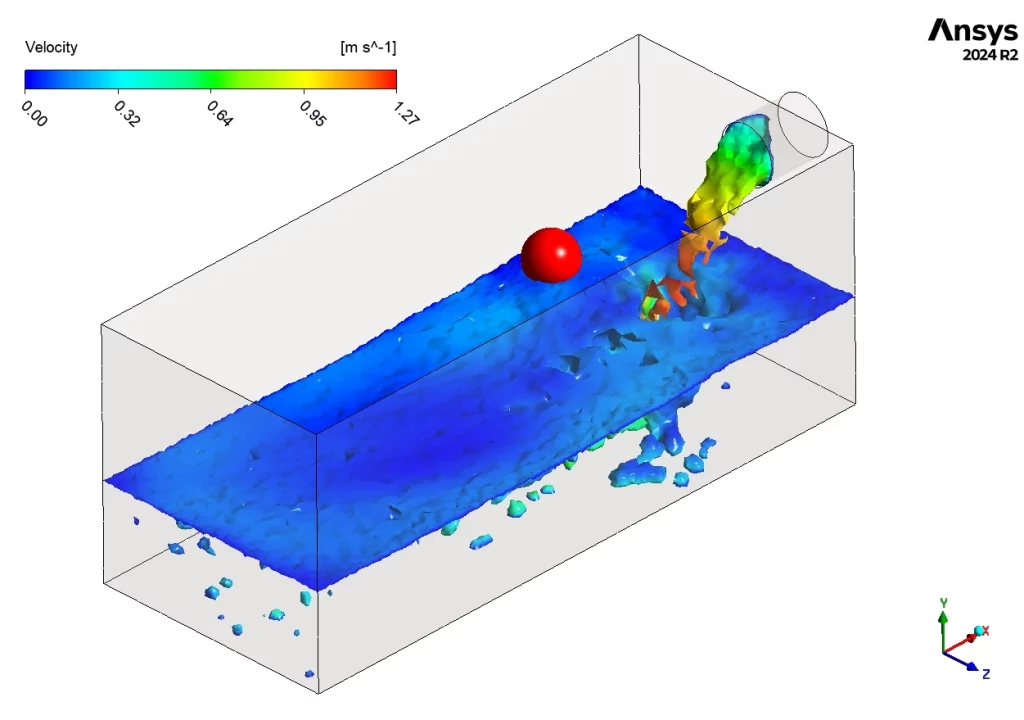
Figure 3: Velocity contour (Blue 0.00 to Red 1.27 m/s) proving how the powerful underwater jet creates a 0.32 – 0.64 m/s lateral surface current that pushes the ball sideways.
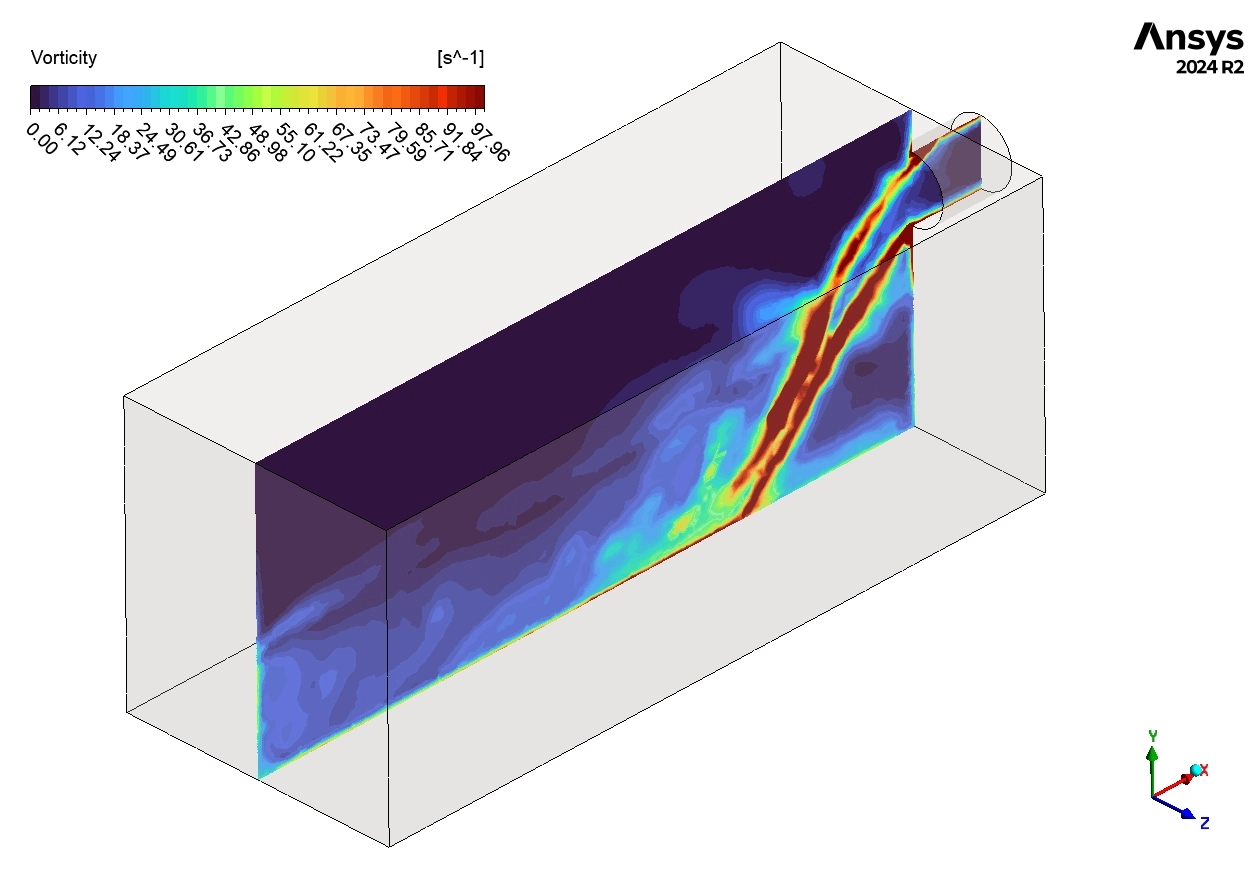
Finally, why does the ball spin? Look at the Vorticity Contours (Figure 4). Vorticity measures how fast the fluid is swirling like a mini-tornado.
- The Shear Layer: Where the fast 1.27 m/s jet violently rubs against the slow, still water, it creates intense spinning vorticity measuring between 70 and 94.98 s⁻¹ (Red/Orange).
- The Ball’s Wake: As the 0.64 m/s surface current flows around the solid 0.01 kg ball, the water flow separates. Directly behind the ball, it creates a turbulent wake with moderate vorticity of 30 to 50 s⁻¹ (Yellow/Green).
This wake creates a strong Drag Force (Figure 5) pulling the ball backward. Furthermore, the swirling 50 s⁻¹ water rubbing against the bottom curved surface of the ball creates viscous shear stress. This stress acts like a twisting hand (torque), forcing the ball to continuously spin and shake. By looking at this exact CFD Analysis of Ball Motion During Water Tank Filling, engineers know they must design stronger, thicker mounts for their sensors, or install a baffle plate to block the 1.27 m/s jet, so the sensor does not vibrate to death.
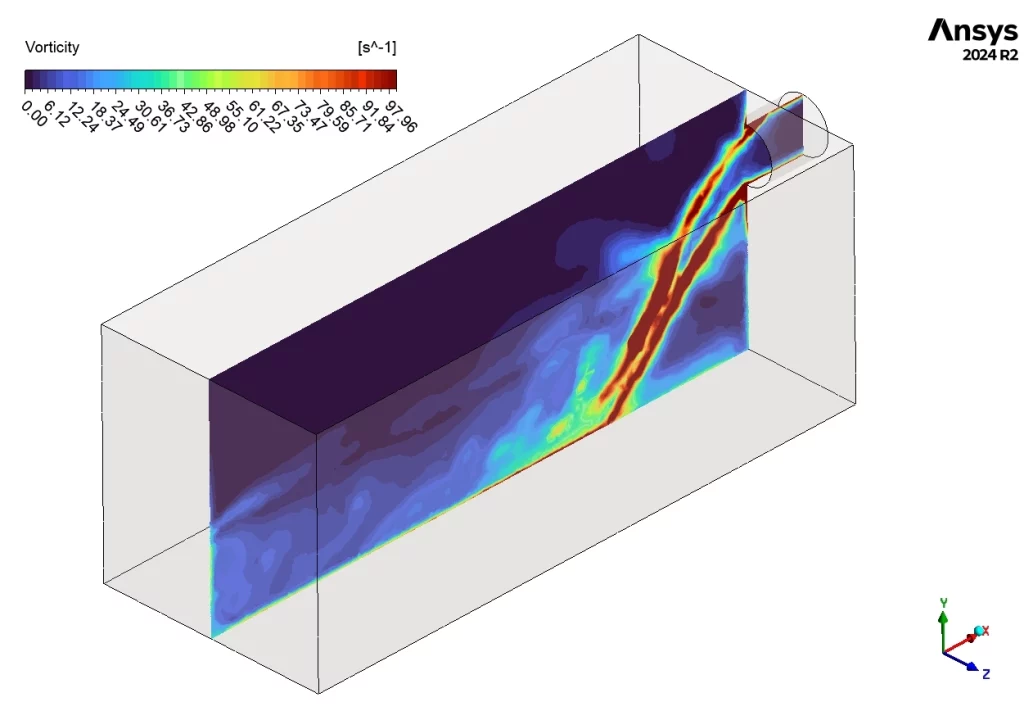
Figure 4: Vorticity contour (Blue 0.00 to Red 94.98 s⁻¹). The intense 94.98 s⁻¹ inlet shear layer and the 50 s⁻¹ wake behind the ball create the drag and torque that force the ball to spin.
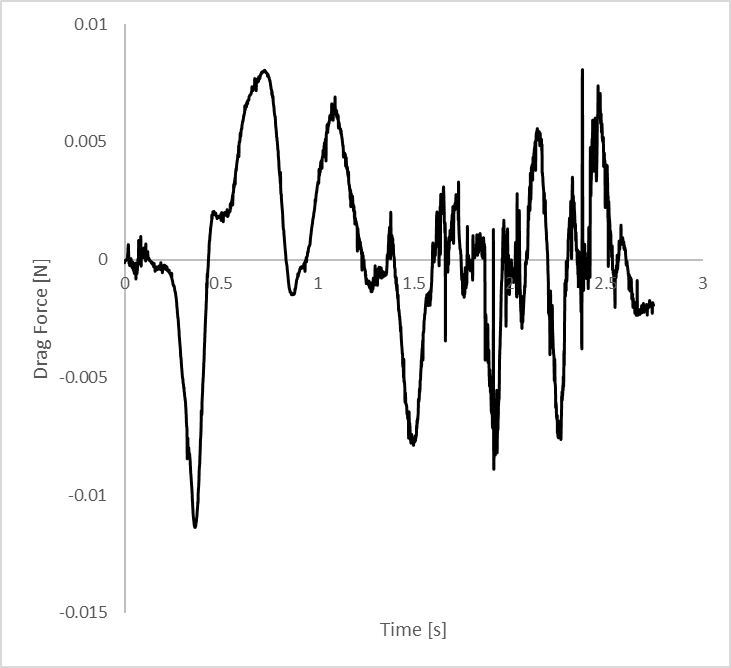
Figure 5: Drag Force graph detailing the exact hydrodynamic pushing forces applied to the rigid body over time.
Key Takeaways & FAQ
- Q: What does the 6DOF Dynamic Mesh Fluent setting do?
- A: 6-DOF (Six Degrees of Freedom) calculates the exact physical forces hitting a solid object. The Dynamic Mesh then automatically stretches and redraws the computer grid around the object as it moves, preventing the simulation from crashing.
- Q: Why does the ball drift sideways instead of just floating up?
- A: While buoyancy pushes the 0.01 kg ball up, the 1.27 m/s underwater jet creates a strong 0.32 to 0.64 m/s lateral surface current. This hydrodynamic drag force overpowers the ball, pushing it to the side.
- Q: What does the Vorticity contour tell us about the ball?
- A: The vorticity of 30 to 50 s⁻¹ behind the ball shows swirling water. This swirling water rubs against the ball, creating viscous shear stress (torque) that forces the ball to continuously rotate and vibrate.







Reviews
There are no reviews yet.