



Biomass Pyrolysis is a process that uses high heat to break down organic materials like wood chips or farm waste without oxygen, turning them into useful products like bio-oil and syngas. To do this efficiently, we need a special kind of container called a Conical Spouted Bed Reactor. Its unique cone shape and a powerful jet of gas from the bottom create a continuous fountain of particles, ensuring everything is mixed perfectly and heated evenly. This process is a type of fluidization, and for more projects on this topic, we recommend our Fluidized bed tutorials.
A Biomass Pyrolysis CFD simulation is the best method for seeing how this complex process works inside the reactor. This project is a CFD simulation, not a validation study. We will use ANSYS Fluent to analyze the reactor’s performance, based on the principles outlined in the research by Hooshdaran, et al. [1].
- Reference [1]: Hooshdaran, Bahar, et al. “CFD modeling and experimental validation of biomass fast pyrolysis in a conical spouted bed reactor.” Journal of Analytical and Applied Pyrolysis154 (2021): 105011.

Figure 1: The 2D geometry and boundary conditions for the Conical Spouted Bed Reactor CFD model [1].
Simulation Process: Modeling Multiphase Pyrolysis in Fluent
To start our Conical Spouted Bed Reactor fluent simulation, we used an efficient 2D axisymmetric model. This approach represents the 3D cone shape in 2D, which saves significant computer processing time while maintaining accuracy. We then created a high-quality structured grid to ensure the results for the gas and particle interactions would be precise.
Setting up the physics in ANSYS Fluent was the most critical step. Since Biomass Pyrolysis is a process that develops over time, we ran a Transient (unsteady) simulation. We used the Eulerian-Eulerian multiphase model, which is designed to track two separate phases at once: the hot gas and the solid biomass particles, which were defined as a granular material. Finally, we activated the Species Transport model to handle the chemical reactions that break down the biomass into valuable products.
Post-processing: How Spouting Action Drives Efficient Pyrolysis
A real analysis of the simulation results, based on the true given contours, reveals a direct and powerful connection between the reactor’s shape and its chemical efficiency. The velocity contour in Figure 3 shows the engine of the entire process: a narrow, high-speed gas jet entering from the bottom and reaching a peak speed of 10.6 m/s in the center. This powerful spout acts like a fountain, pushing the solid biomass particles directly upwards. The volume fraction contour in Figure 2 visualizes the consequence of this action perfectly. We can see a high concentration of solid particles forming a slow-moving bed along the angled walls of the cone (the annulus), while the center (the spout) is very dilute. The particles are lifted by the jet, reach the top, and then gently slide back down the sides, creating a continuous, stable circulation loop. This is the single most important feature of a Spouted Bed Reactor.
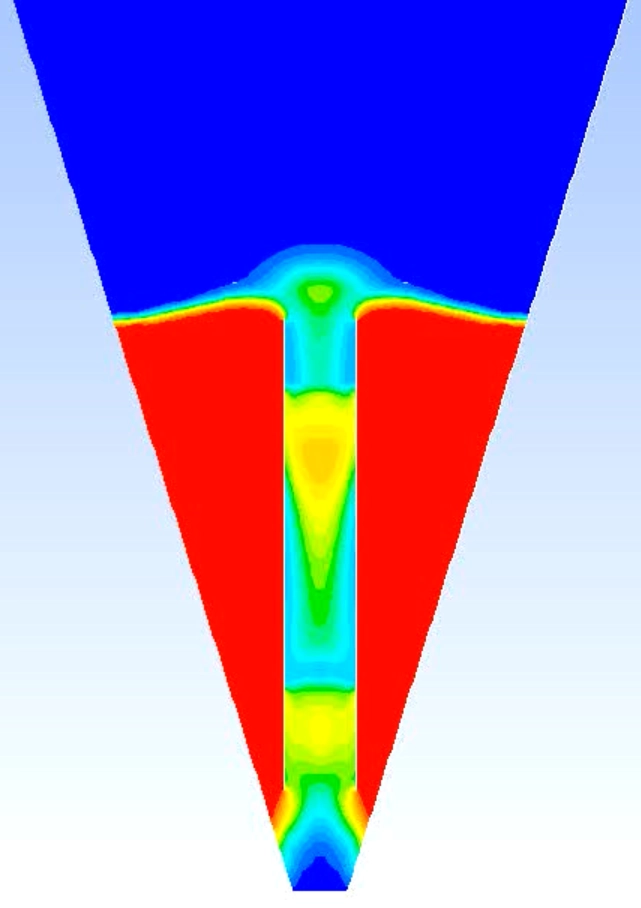
Figure 2: Solid particle volume fraction showing the classic “spouting” pattern in the Biomass Pyrolysis Fluent simulation.
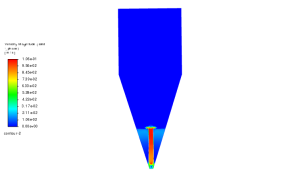
Figure 3: Velocity field, highlighting the high-speed central jet that drives the particle circulation.
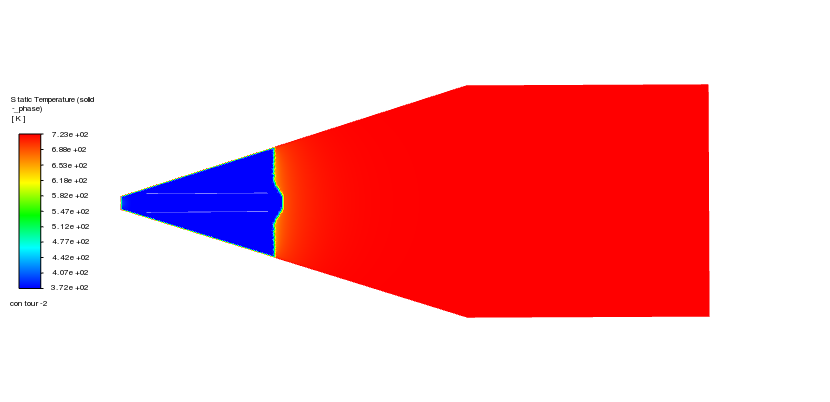
This constant circulation is not just for mixing; it is the key to creating the perfect thermal environment for the pyrolysis reaction. Without this spouting motion, particles at the bottom would overheat and burn, while particles at the top would remain too cold to react. The constant loop guarantees that every single particle is repeatedly exposed to the hot gas, preventing any cold spots and ensuring a uniform temperature distribution. The temperature contour confirms this success, showing a stable and hot reaction zone ranging from 372 K to over 729 K, especially in the upper region where the particles have the longest residence time. This detailed Biomass Pyrolysis ANSYS fluent analysis proves that the spouting hydrodynamics are directly responsible for creating the stable, high-temperature environment needed for complete and efficient thermochemical conversion, making the Conical Spouted Bed Reactor an outstanding technology for renewable energy production.
Key Takeaways & FAQ
- Q: What is the difference between a Spouted Bed and a Fluidized Bed?
- A: A traditional fluidized bed uses a porous distributor to bubble gas through particles. A Spouted Bed Reactor, as shown in this CFD simulation, uses a single, high-speed jet to create a fountain-like circulation, which is better for handling larger or irregular-sized particles often found in biomass.
- Q: Why is the conical shape important?
- A: The cone-shaped bottom helps stabilize the spouting pattern and promotes smooth sliding of the particles back down into the jet. This improves the reliability and efficiency of the particle circulation loop, which is critical for the Biomass Pyrolysis process.
- Q: What is the Eulerian-Eulerian model in Fluent?
- A: The Eulerian-Eulerian model is a multiphase approach used when you have two or more intermingled phases (like gas and solids). It treats both phases as continuous fluids that interact with each other. It is the standard model for dense particle flows like those in a Conical Spouted Bed Reactor CFD simulation.




2 reviews for Biomass Pyrolysis CFD Simulation: Conical Spouted Bed Reactor in Fluent
faezenobakht –
great
sam –
This is great, thank you.