

A Fluidized Bed is a type of reactor where solid particles behave like a fluid. This happens when gas flows upward through the particles at high speed. These systems are essential in many industries because they offer excellent mixing and very efficient heat transfer. However, predicting exactly how the gas and particles interact is difficult. The flow is complex and chaotic. To design better reactors, engineers need to simulate these Particle Dynamics accurately.
A standard CFD simulation is not enough because it often treats particles as a cloud rather than solids. To get accurate results, we must use a Fluidized bed DEM CFD approach. This involves coupling two powerful solvers: ANSYS Fluent for the gas flow and ANSYS Rocky for the particles. Rocky DEM (Discrete Element Method) calculates the motion of every single particle, including how they hit each other and the walls. This tutorial presents a coupled Fluidized bed CFD simulation benchmarked against research by Azmir et al. [1] and He et al. [2]. For those learning these methods, valuable resources can be found in our DEM tutorials.
- Reference [1]: Azmir, Jannatul, Qinfu Hou, and Aibing Yu. “CFD-DEM simulation of drying of food grains with particle shrinkage.” Powder Technology343 (2019): 792-802.
- Reference [2]: He, Yi, Andrew E. Bayly, and Ali Hassanpour. “Coupling CFD-DEM with dynamic meshing: A new approach for fluid-structure interaction in particle-fluid flows.” Powder Technology325 (2018): 620-631.
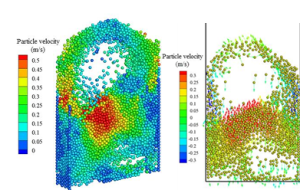
Figure 1: Example of bubbling phenomena in a fluidized bed, showing particle velocity distribution from the reference paper [2].
Simulation Process: Coupling ANSYS Rocky and Fluent
The simulation process started with creating a cylindrical geometry and generating a fine, structured mesh using ICEM. The most important part of this Fluidized bed DEM project is the physics setup. We used an Eulerian-Lagrangian framework. This means ANSYS Fluent solves the equations for the gas (Eulerian), while ANSYS Rocky tracks the individual particles (Lagrangian).
We established a “4-way coupling” for this simulation. This is the most advanced level of CFD-DEM interaction. It means the simulation calculates four things:
- How the gas pushes the particles (Drag).
- How the particles push back on the gas (Displacement).
- Particle-particle interactions (Collisions between grains).
- Particle-wall interactions (Friction with the reactor).
Standard Fluent DPM cannot handle dense flows like this because it ignores collisions. By linking ANSYS Rocky CFD with Fluent, we capture the realistic physics of millions of collisions, which is essential for predicting bed expansion and mixing.
Post-processing: Analyzing Particle Dynamics and Mixing
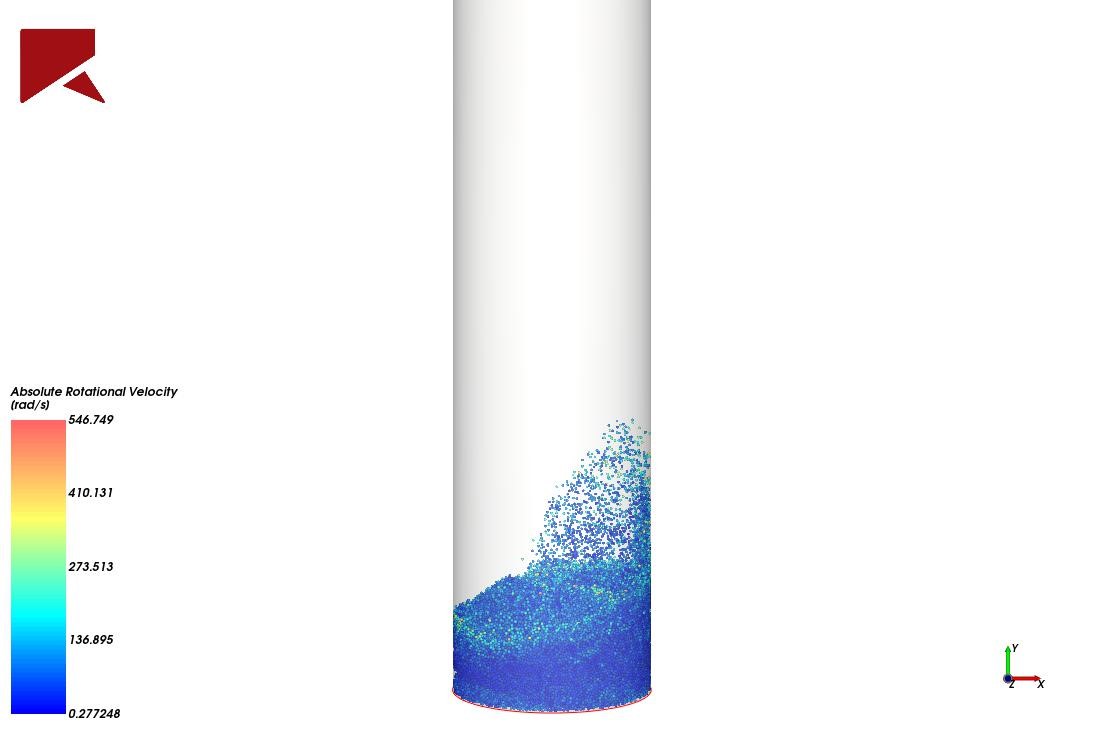
The results from the Fluidized bed Rocky simulation give us deep insight into the reactor’s performance. First, we look at the Particle Rotational Velocity in Figure 2. The contour shows particles spinning at very high speeds, reaching a maximum of 546.7 rad/s. This high rotation is not random. It is caused by the intense friction when particles collide with each other and the walls. The green and yellow areas in the contour show where this agitation is strongest. These areas usually correspond to rising gas bubbles. This tumbling motion is critical because it constantly exposes different sides of the particle to the hot gas, which improves drying and reaction rates.
Figure 2: Particle rotational velocity from the ANSYS Rocky CFD simulation, highlighting the intense particle interactions.
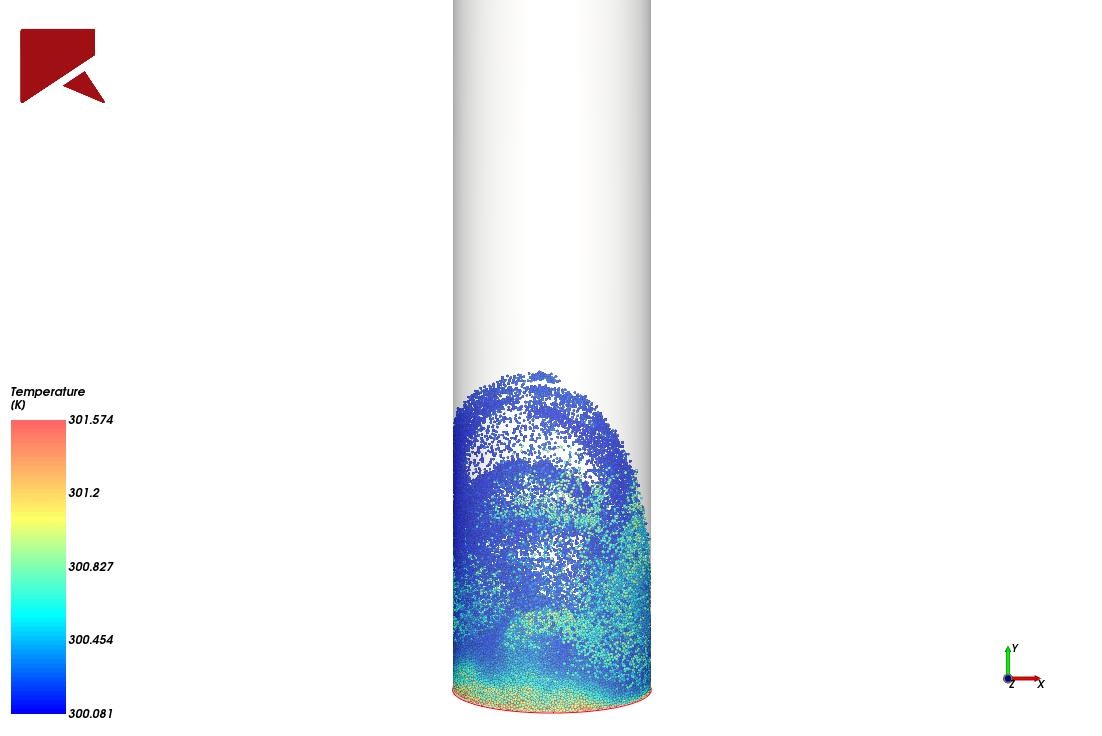
Next, we analyze the thermal performance in Figure 3. The Temperature Distribution shows that the particles are almost the same temperature everywhere. The range is very narrow, from 300.08 K to 301.57 K. This is a difference of only about 1.5 degrees. This uniformity is the main advantage of a fluidized bed. The chaotic bubbling motion mixes the particles so fast that no hot spots or cold spots can form. The Fluidized bed CFD results prove that the reactor is operating in a near-isothermal state. This confirms that the coupled ANSYS Rocky and Fluent model is correctly capturing the rapid mixing dynamics that physical experiments describe.
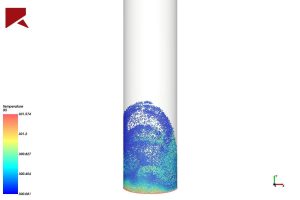
Figure 3: Particle temperature distribution from the Fluidized Bed CFD analysis, demonstrating excellent thermal mixing.
Key Takeaways & FAQ
- Q: Why use ANSYS Rocky instead of Fluent DPM?
- A: Fluent DPM (Discrete Phase Model) treats particles as points and usually ignores collisions between them. This is fine for sprays but fails for dense beds. ANSYS Rocky is a dedicated DEM solver that accurately calculates the physical volume, shape, and collision forces of every particle, which is required for a Fluidized bed DEM CFD simulation.
- Q: What is 4-way coupling in CFD-DEM?
- A: 4-way coupling includes all physical interactions: Fluid-to-Particle, Particle-to-Fluid, Particle-to-Particle, and Particle-to-Wall. Standard simulations often miss the particle-particle part, but it is dominant in fluidized beds.
- Q: How does particle rotation affect the process?
- A: As seen in the results (546.7 rad/s), particles spin rapidly. This rotation creates lift forces (Magnus effect) that change the particle path and enhances heat transfer by mixing the boundary layer around the particle.
The animation extracted from the transient (unsteady) CFD simulation is shown below:


Reviews
There are no reviews yet.