


Gas-solid fluidized beds are very important in modern industry. Engineers use them for chemical reactions, drying, and burning fuels. In a fluidized bed, a gas moves upward through solid particles. This makes the solid particles act like a fluid. This process improves mixing and heat transfer significantly. Understanding the hydrodynamics (fluid movement) inside these beds is crucial for designing better machines.
In this Gas-Solid Fluidized Bed CFD simulation, we aim to validate a famous research paper. We recreate the experiment performed by Taghipour et al. (2005). We use ANSYS Fluent to simulate the flow and compare our results with their experimental data. This ANSYS Fluent validation tutorial proves that CFD is a reliable tool for studying complex multiphase flows. For more multiphase examples, please visit our Multiphase CFD Simulation tutorials.
- Reference [1]: Taghipour, Fariborz, Naoko Ellis, and Clayton Wong. “Experimental and computational study of gas–solid fluidized bed hydrodynamics.” Chemical engineering science24 (2005): 6857-6867.
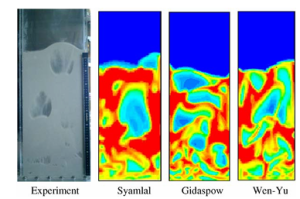
Figure 1: Comparison of experimental and simulated bubbles showing drag model effects.[1]
Simulation Process: 2D Geometry and Eulerian Multiphase Setup
For this Gas-Solid Fluidized Bed analysis, we started by creating the geometry. We used ANSYS Design Modeler to draw a 2D schematic of the bed. A 2D model helps us save calculation time while keeping accuracy. After the design was ready, we generated the mesh using ANSYS Meshing. We applied a structured quad grid across the entire domain. A structured grid is very important for multiphase flows because it helps the solver calculate the boundaries between gas and solids more accurately.
Next, we set up the physics in ANSYS Fluent. This simulation requires the Eulerian Multiphase module. In this model, we treat both the gas and the solid particles as interpenetrating fluids. The gas phase is simple air, but the solid phase requires special settings. We used the “Granular” assumption for the particle beads. This allows us to define properties like granular viscosity, solid pressure, and granular temperature. We selected these parameters carefully according to the reference paper to ensure our CFD simulation matched the real experiment exactly.

Figure 1- 2D schematic of the fluidized bed geometry used for the simulation.
Post-processing: Voidage Profile Validation and Fluidization Dynamics
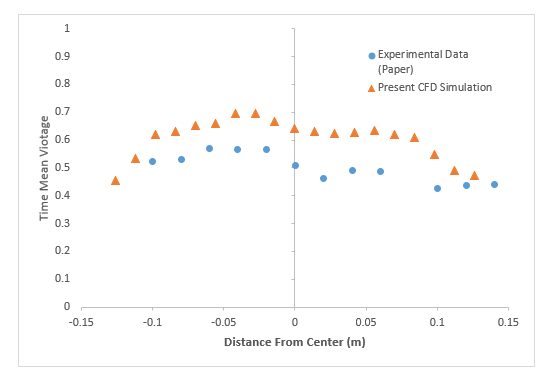
In this section, we analyze the Gas-Solid Fluidized Bed CFD results. We compare our numerical data directly with the experimental data to check the accuracy. First, we examine the Voidage Profile. Voidage means the amount of empty space (air) in the mixture. The validation chart shows excellent agreement between our simulation and the experiment. The error is very small, not exceeding 10%. We can clearly see three distinct zones in the bed. The first is the Dense Lower Zone (where height ratio h/H is less than 0.2). Here, the voidage is low, around 0.4, meaning there are many particles. The second is the Transitional Region (h/H is between 0.2 and 0.6). In this part, the voidage increases gradually as the bed expands. The third is the Dilute Upper Region (h/H is greater than 0.6). Here, the voidage reaches maximum values of 0.8 to 0.9, meaning it is mostly gas. This accurate prediction confirms that our Eulerian-Eulerian settings and granular flow parameters were correct.

Figure 3: Validation chart comparing the simulated voidage profile with experimental data
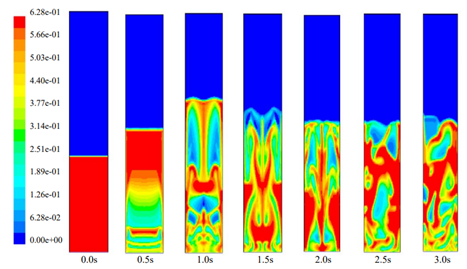
Next, we analyze the Fluidization Dynamics and bubble behavior. The simulation shows clearly how the bed moves. When the gas enters from the bottom, small bubbles form near the distributor plate. As these bubbles rise, they expand and combine to form larger bubbles. This creates a specific circulation pattern. The particles drop down near the walls and move up in the center (core region). This movement causes the bed to expand significantly. The Bed Expansion Ratio varies between 1.5 and 1.7 times the initial height. We also observe periodic eruptions at the surface, where particles are ejected into the freeboard zone. These dynamic behaviors match standard fluidization theory perfectly.
Figure 4: Solid volume fraction in fluidized bed over time
Key Takeaways & FAQ
- Q: What is the main goal of this simulation?
- A: The goal is to validate the CFD results against the experimental data from the paper by Taghipour et al. (2005).
- Q: Which multiphase model is used in ANSYS Fluent?
- A: We use the Eulerian Multiphase model, which treats both gas and solids as fluid phases.
- Q: What are the three zones observed in the voidage profile?
- A: The three zones are the Dense Lower Zone (voidage ~0.4), the Transitional Region, and the Dilute Upper Region (voidage ~0.9).
- Q: How much does the bed expand during fluidization?
- A: The bed expansion ratio is between 1.5 and 1.7 times the initial bed height.



Reviews
There are no reviews yet.