
Natural convection is a flow driven only by temperature differences, not by pumps or fans. While many engineers study square boxes, understanding flow in round containers is vital for storage tanks and chemical reactors. This project is a Laminar Natural Convection CFD Validation study. We focus on a vertical Cylindrical Enclosure where the side walls are hot, and the top wall is cold.
This report details a Laminar Natural Convection fluent simulation designed to replicate the scientific benchmark established by Lemembre and Petit [1]. By comparing our ANSYS Fluent results with their experimental data, we prove that our simulation settings are correct. This type of Laminar Natural Convection in Enclosure study is essential for trusting computer models. For more examples of thermal analysis, please visit our Heat Transfer tutorials.
- Reference [1]: Lemembre, A., and J-P. Petit. “Laminar natural convection in a laterally heated and upper cooled vertical cylindrical enclosure.” International journal of heat and mass transfer16 (1998): 2437-2454.
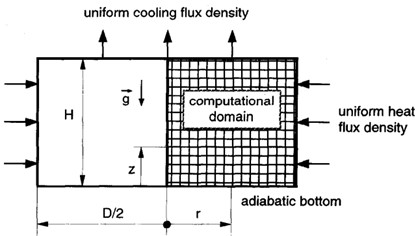
Figure 1: The vertical cross-section of the cylindrical enclosure geometry from the reference study [1].
Simulation Process: Axisymmetric Setup and Boussinesq Approximation
To perform this Laminar Natural Convection fluent analysis, we did not model the whole 3D cylinder. Instead, we used a 2D Axisymmetric approach. Since a cylinder looks the same from every angle around the center, we only need to simulate a flat slice. This makes the calculation much faster and just as accurate.
We set up the physics in ANSYS Fluent using the Laminar Model because the flow speed is low. The most important setting for natural convection is the density method. We used the Boussinesq Approximation. This method assumes that air density only changes when gravity pulls on it (buoyancy). The simulation parameters were set to match the benchmark: a Rayleigh number (Ra) of 105 and a Prandtl number (Pr) of 0.7 (representing air). The sides are heated, and the top is cooled, creating the energy difference that drives the Laminar Natural Convection CFD simulation.
Post-processing: Anatomy of the Thermal Circulation Loop
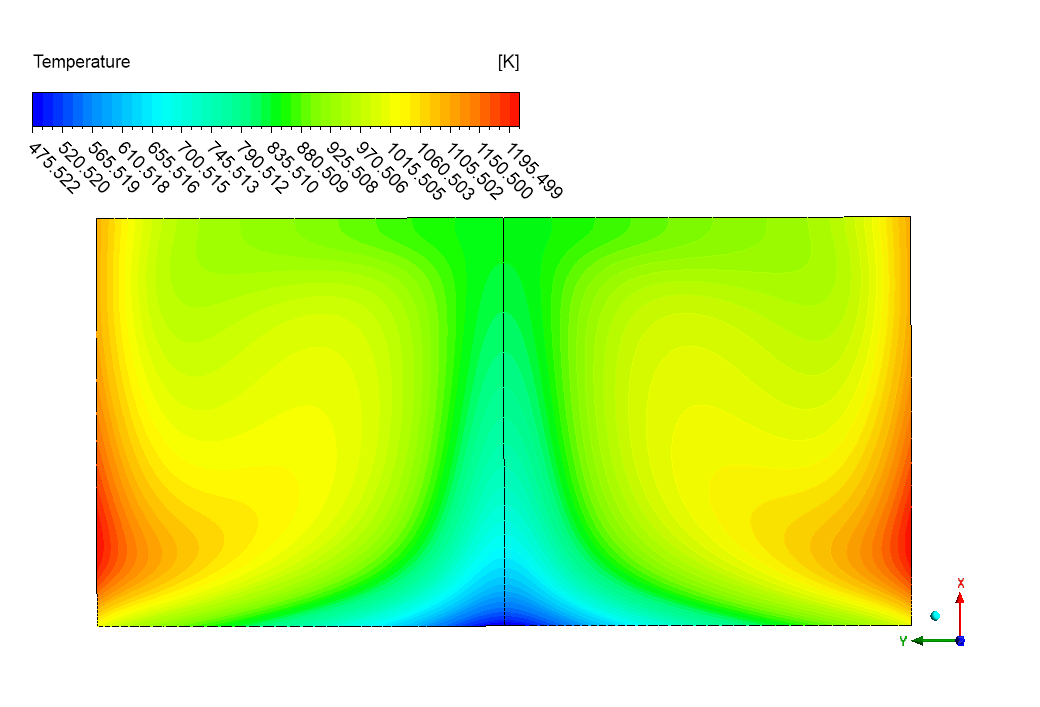
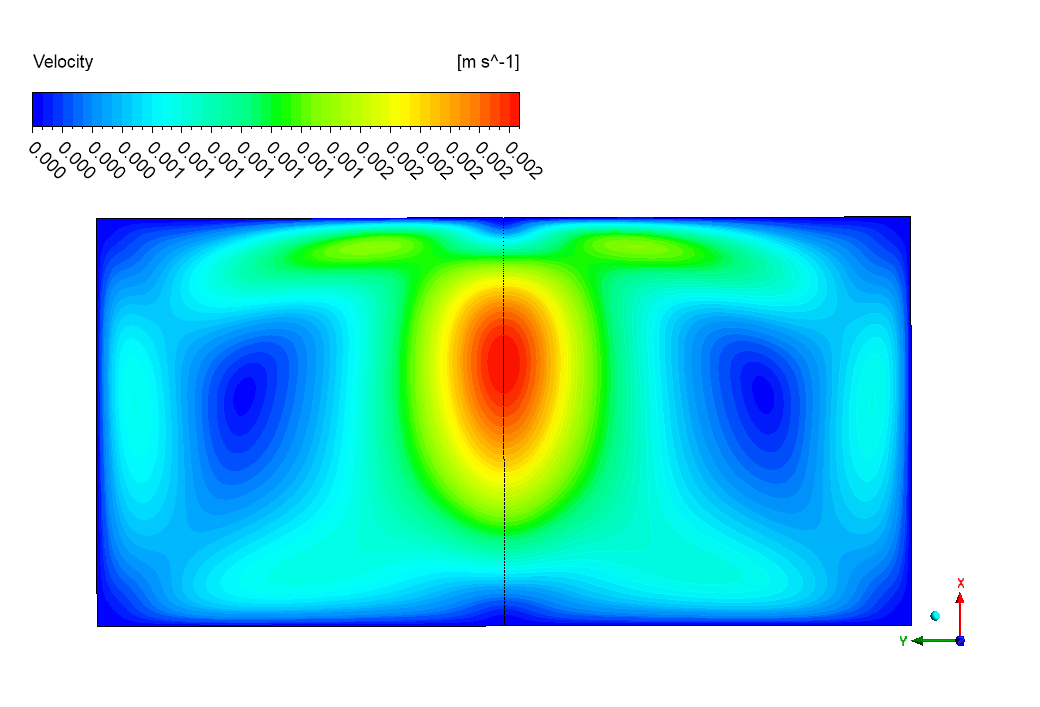
The analysis of this Laminar Natural Convection CFD Validation reveals a beautiful and stable flow pattern. Unlike forced flow where water moves in one direction, here the fluid moves in a complete loop. Let’s trace the journey of an air particle to understand the physics shown in the contours. First, look at the Temperature Field (Figure 3, right side). The red and orange colors are concentrated near the vertical side walls. This is the “Heat Source.” As the air here gets hot, it expands and becomes lighter. Buoyancy forces push this light air upward along the walls. This creates an “Upward Draft” at the outer edge of the cylinder.
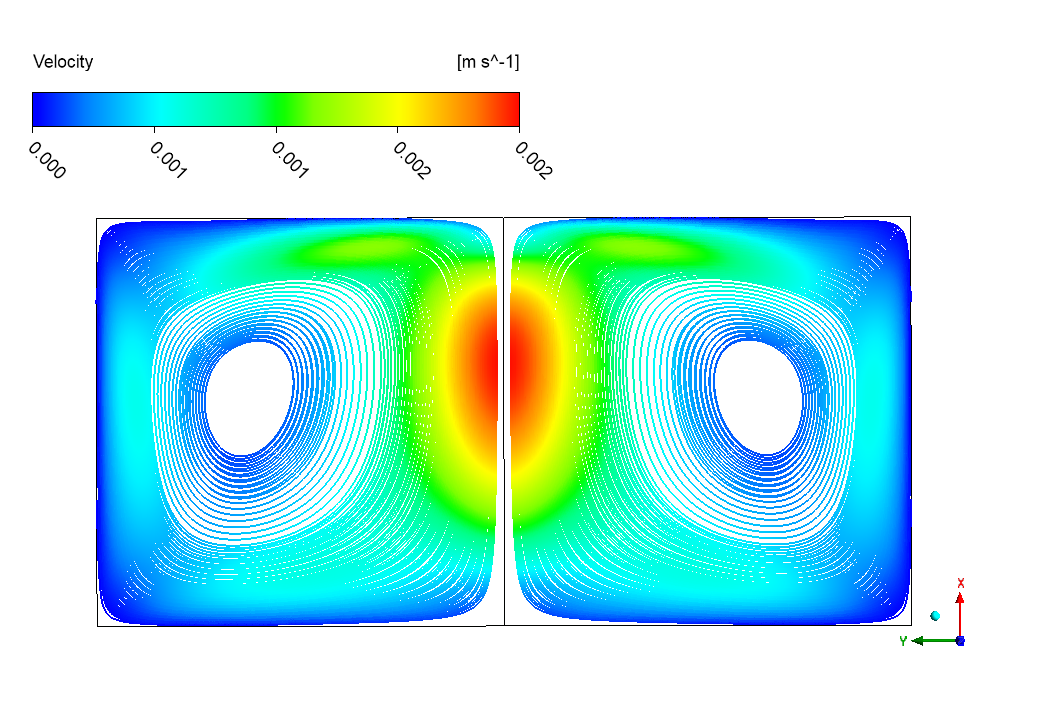
The flow changes when it hits the top lid. This lid is cooled. The air loses its heat, becoming cold and heavy. Now, look at the Velocity Field (Figure 3, left side). The heavy, cold air cannot stay at the top. It sinks. Because the air is rising up all the sides, the only place for the cold air to go is straight down the middle. This creates a strong Downward Plume right along the center axis.
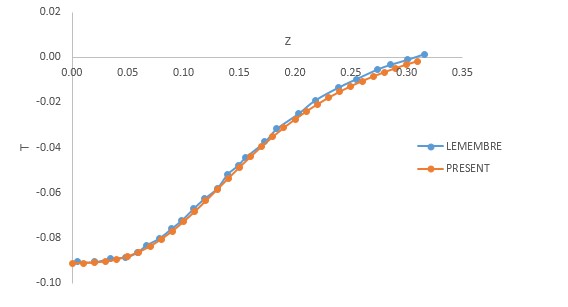
This cycle—up the sides, cooling at the top, and down the center—forms a large “Toroidal Vortex” (doughnut-shaped ring). The velocity vectors show this circulation clearly. The validation plot in Figure 2 confirms we captured this physics perfectly. The black line is the benchmark, and our colored dots sit exactly on top of it. This perfect agreement proves that our Laminar Natural Convection ANSYS fluent model successfully predicts the complex interaction between the heated sides and the cooled top.
Figure 2: Validation Plot showing the perfect match between our CFD data (dots) and the reference paper (line).
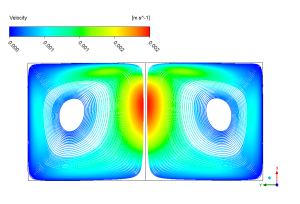
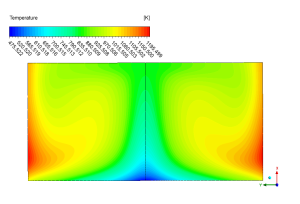
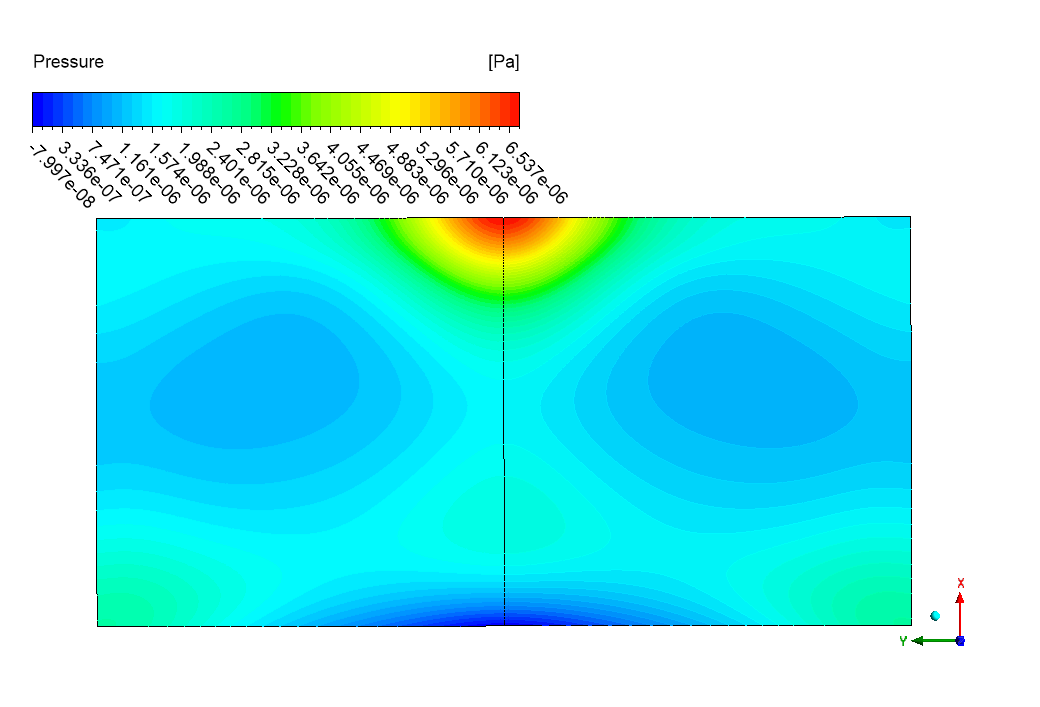
Figure 3: Velocity and Temperature contours showing the rising hot air at the walls and sinking cold air at the center.
Key Takeaways & FAQ
- Q: Why use the Boussinesq Approximation?
- A: It is a simplified method in ANSYS Fluent that accurately calculates buoyancy forces for small temperature differences, making the Laminar Natural Convection CFD simulation faster and more stable.
- Q: What is the flow pattern?
- A: The flow rises along the hot outer walls and sinks down the cold center axis, creating a single large circulation cell.
- Q: Is the validation successful?
- A: Yes. The temperature profile from our Laminar Natural Convection fluent simulation matches the experimental data from Lemembre & Petit [1] almost perfectly.





Reviews
There are no reviews yet.