


Many fluids used in engineering and daily life are Non-Newtonian fluids. Unlike water or air, their viscosity (thickness) changes when force is applied. Examples include ketchup, blood, and polymer melts. In industrial applications like food processing or chemical engineering, efficient mixing and heat transfer are crucial. To achieve this, engineers often use a Corrugated channel. The wavy walls of these channels disturb the flow, promoting better mixing compared to straight pipes.
Simulating these complex behaviors requires advanced tools. This project presents a Non-Newtonian Fluid in Corrugated Channel CFD study. We use ANSYS Fluent to investigate the flow characteristics and Heat transfer performance. The goal is to visualize how the wavy geometry affects the fluid motion and thermal efficiency. For those looking to master the basics of fluid dynamics, we recommend checking our fluid mechanics tutorials. The geometric parameters and flow conditions for this Numerical simulation are adopted from the experimental work of Bereiziat and Devienne [1].
- Reference [1]: Bereiziat, D., and R. Devienne. “Experimental characterization of Newtonian and non-Newtonian fluid flows in corrugated channels.” International journal of engineering science11 (1999): 1461-1479.

Figure 1: The geometric details of the corrugated channel used for the Non-Newtonian fluid CFD study. [1].
Simulation Process: Non-newtonian Fluid in Fluent
The first step in this CFD analysis was creating the geometry in ANSYS Design Modeler. The channel features sinusoidal (wavy) walls designed to induce flow separation. Because the interaction between the fluid and the wall is critical for Non-Newtonian fluid flow, we generated a high-quality Structured mesh. As seen in Figure 2, the grid is very fine near the wavy walls. This is essential to resolve the steep gradients in velocity and temperature that occur in these regions.
In ANSYS Fluent, we set up the physics for a Laminar flow regime. The key aspect of this simulation is the material definition. We used the Herschel-Bulkley model to define the Rheological properties. This model is excellent for fluids that exhibit a yield stress (they act like a solid until pushed hard enough) and shear-thinning behavior. We also enabled the Energy equation to solve for Heat transfer. The boundary conditions were set with the channel walls at a constant hot temperature and the inlet at a cooler temperature. This setup allows us to simulate the heating of the fluid as it passes through the Corrugated channel flow path.

Figure 2: The structured mesh used for the ANSYS Fluent simulation of the corrugated channel.
Post-processing: Flow Recirculation and Heat Transfer Enhancement
The results of the Fluent simulation provide deep insights into the physics of the flow. Figure 3 displays the velocity streamlines and temperature contours. First, let’s analyze the velocity. The fluid accelerates through the narrow parts of the channel, reaching a peak velocity of approximately 0.22 m/s in the center. The most interesting feature, however, is the formation of Recirculation zones. In the “valleys” of the corrugations, the flow separates from the wall, creating small, spinning vortices. This happens because the fluid cannot follow the sharp curve of the wall, leading to a “dead zone” where the fluid recirculates. This is a classic characteristic of Flow in corrugated channels.
Second, the temperature contour reveals the mechanism of Heat transfer enhancement. The walls are maintained at a hot temperature of around 296 K, while the fluid enters at a cooler 288 K. The recirculation zones act like mixers. They trap fluid in the valleys, allowing it to heat up near the wall, and then exchange this heat with the main flow stream. This continuous mixing disrupts the thermal boundary layer, which normally acts as an insulator. By constantly bringing fresh, cool fluid to the hot walls and pushing hot fluid into the center, the Corrugated channel significantly improves the thermal efficiency compared to a flat channel. This CFD study confirms that using wavy walls is an effective strategy for heating viscous, Shear-thinning fluids.
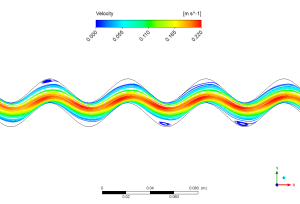
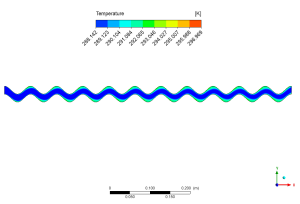
Figure 3: Velocity streamlines and temperature contours showing the recirculation zones and thermal mixing.
Key Takeaways & FAQ
- Q: What is a Herschel-Bulkley fluid?
- A: It is a type of Non-Newtonian fluid model used in CFD simulation. It describes fluids that require a certain amount of stress to start moving (yield stress) and then become thinner (less viscous) as they flow faster (shear-thinning). Examples include toothpaste and mud.
- Q: How do corrugated channels improve heat transfer?
- A: The wavy walls create Recirculation zones (vortices) in the valleys. These vortices mix the fluid, pulling cool fluid to the hot walls and pushing hot fluid into the center. This mixing process breaks the thermal boundary layer, leading to Heat transfer enhancement.
- Q: Why is a structured mesh important here?
- A: In Non-Newtonian fluid flow, the viscosity changes rapidly near the walls where the shear rate is high. A Structured mesh with fine cells near the boundary ensures that ANSYS Fluent accurately calculates these changes and the resulting friction and heat flow.



Reviews
There are no reviews yet.