


A Nucleate Boiling CFD simulation is a computer model of how bubbles form on a hot surface submerged in a liquid. This type of Phase Change CFD is very important for many engineering systems, like power plants and cooling systems. A Nucleate Boiling Fluent analysis helps engineers understand this Two-Phase Heat Transfer process, where liquid turns into vapor (steam). This process is excellent for cooling because forming bubbles takes away a lot of heat. This study looks at a Flow Boiling Simulation inside a vertical column with a heated wall to see exactly how this happens.
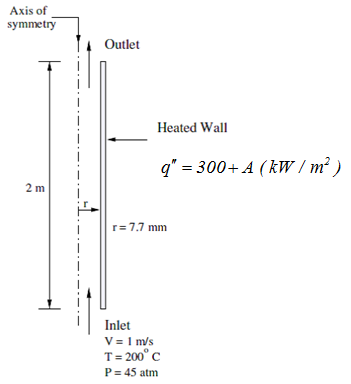
Figure 1: A schematic showing the setup for the Nucleate Boiling CFD problem in a vertical column.
Simulation Process: Fluent Setup, Eulerian-RPI Model for Flow Boiling Simulation
To perform this Nucleate Boiling Fluent study, we first created the geometry of the vertical column. To save computer time while keeping the results accurate, we modeled it as a 2D Axisymmetric problem. Then, in ANSYS Meshing, we made a high-quality structured grid to get precise results, especially near the wall where boiling happens. We then imported this model into the ANSYS Fluent solver to set up the physics. Because this problem has both liquid water and steam existing together, we activated the Eulerian multiphase model. This model is designed to handle mixtures of different phases. The most critical step was to enable the specialized RPI (Rensselaer Polytechnic Institute) Boiling Model. This model contains all the complex equations that control how the liquid turns into steam bubbles. It governs the mass transfer between the two phases. To provide the energy for boiling, we applied a strong and constant heat flux of 318 KW/m² to the side walls of the column.
Post-processing: CFD Analysis, Thermal Gradient and Boiling Efficiency
The temperature contour is not just a picture; it is a diagnostic map of the thermal energy that drives the entire system. From an engineering standpoint, the contour clearly reveals a very steep thermal gradient near the heated wall. The wall itself is very hot, reaching 664 K, which provides the necessary energy to start boiling. The temperature drops sharply away from the wall, down to a core fluid temperature of 473 K. This large temperature difference is the engine for the nucleate boiling process. It is this intense heat at the wall that causes tiny vapor bubbles to form, grow, and then detach, carrying heat away from the surface. This bubble activity is what makes this mode of heat transfer so effective.
The vapor volume fraction results tell the engineering story of the process’s efficiency. The simulation calculates an exit vapor volume fraction of just 0.0062. This number is a direct measure of performance, telling us that only 0.62% of the fluid has turned into steam by the time it leaves the column. The contour in Figure 3 confirms this visually, showing that vapor is only forming in a very thin layer right next to the hot wall. For an engineer, this low value suggests that the system’s boiling performance is limited. The column may be too short, or the fluid may be moving too fast for more of the liquid to turn into vapor. The most important achievement of this simulation is its ability to precisely quantify the limited efficiency of the phase change process, demonstrating that while nucleate boiling is successfully initiated at the walls, the overall conversion to vapor is minimal, providing a critical data point for optimizing the column’s design for better performance.
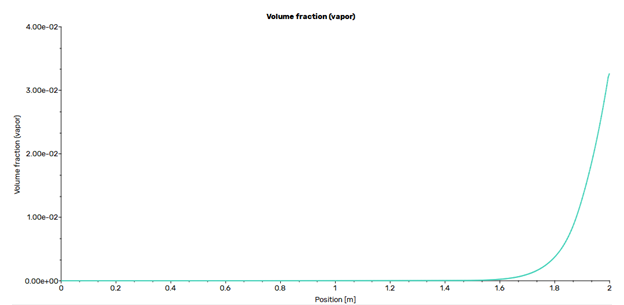
Figure 2: A graph showing the calculated outlet vapor volume fraction from the RPI Boiling Model Fluent simulation.
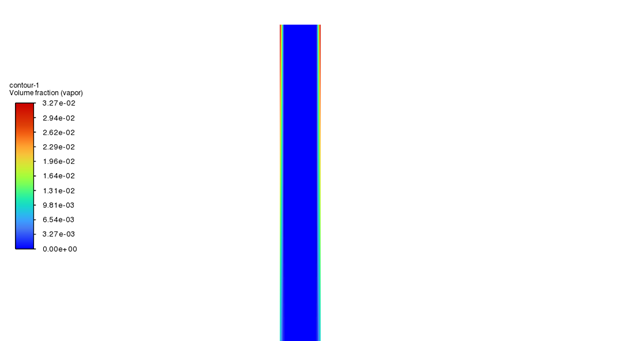
Figure 3: A contour of vapor volume fraction from the Eulerian Multiphase Boiling analysis, showing the location of steam formation along the heated wall.






Reviews
There are no reviews yet.