
In this advanced training guide, we focus on the CFD Analysis of Oblique Water Entry Supercavitation. This subject is vital for aerospace and naval defense industries. When a projectile strikes the water surface at a high velocity (over 100 m/s) and at an angle (oblique), the physics become chaotic. The drastic drop in pressure instantly turns liquid water into vapor, creating a gas bubble known as a supercavity. This bubble is desirable because it envelops the object and removes viscous drag. However, the Oblique angle creates a major problem: the forces on the top and bottom of the missile are not equal. This asymmetry can cause the projectile to tumble, break, or deviate from its path.
Testing this in real life is expensive and dangerous. Therefore, engineers rely on Oblique Water Entry fluent simulation to predict these complex crash dynamics. In this tutorial, we teach you how to set up this problem in ANSYS Fluent. We combine the Volume of Fluid (VOF) model to handle the air-water mixture with the 6DOF fluent solver. The 6DOF (Six Degrees of Freedom) solver acts as a virtual pilot, calculating how the object moves and rotates based on the water’s force. Crucially, we use a 6DOF dynamic mesh to let the grid deform and adapt as the projectile flies through it. This simulation provides the data needed to design stable, high-speed underwater vehicles. For further learning on mesh adaptation, please check our Dynamic Mesh tutorials.
- Reference [1]: Mu, Qing, et al. “Numerical simulation on the cavitation flow of high speed oblique water entry of revolution body.” Mathematical Problems in Engineering1 (2019): 8034619.
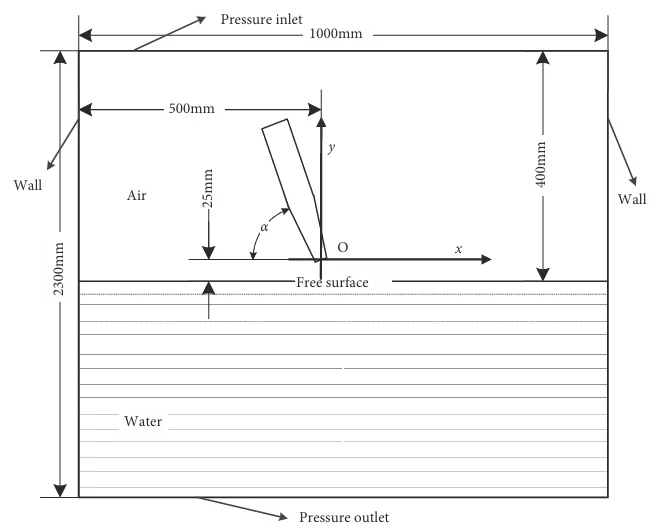
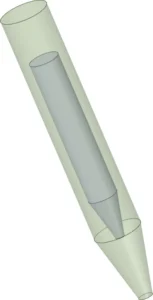
Figure 1: Computational Domain setup, displaying the cylindrical fluid zone and the initial position of the projectile for the Oblique Water Entry Supercavitation analysis.
Simulation Process: 6DOF Dynamic Mesh and Cavitation Setup
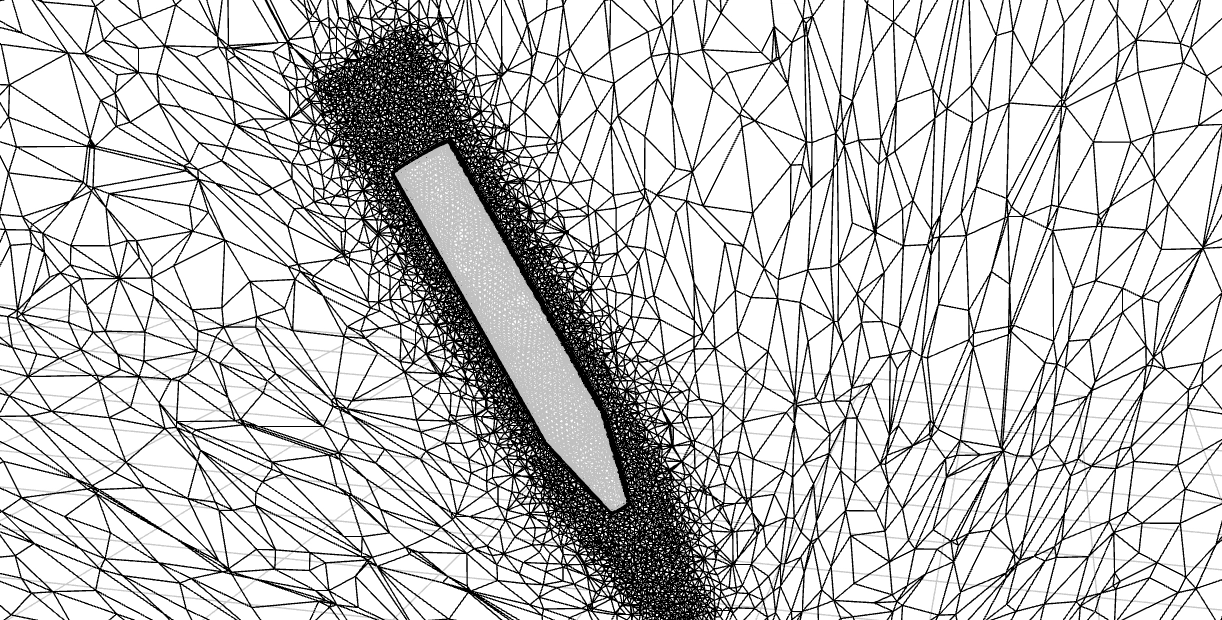
For this specific CFD – Oblique Water Entry Supercavitation case, the domain setup is critical. We built a large cylindrical control volume to prevent shockwaves from reflecting off the outer walls and disturbing the results. The mesh generation was handled with extreme care, resulting in 2.7 million cells (Figure 2). A very high density of cells was placed at the air-water interface. This is mandatory because the ANSYS Fluent solver needs to resolve the thin skin of the supercavity.
In the physics setup, we employed the VOF Multiphase Model to track the distinct phases of air, water, and vapor. To capture the phase change physics, we activated the Schnerr-Sauer Cavitation model. This model mathematically calculates where the water boils into vapor based on local pressure drops. The most challenging part of this simulation is the motion. We enabled the 6DOF fluent solver and defined the projectile as a rigid body with the density of Steel. We also had to input the Moment of Inertia so the solver could calculate rotation (pitch and yaw). Because the impact speed is high, the grid cells can become distorted and break the simulation within microseconds. To prevent this, we configured the 6DOF dynamic mesh with a robust Remeshing and Smoothing strategy. Remeshing automatically deletes cells that get too squeezed and replaces them with healthy new ones, ensuring the simulation remains stable during the violent impact.
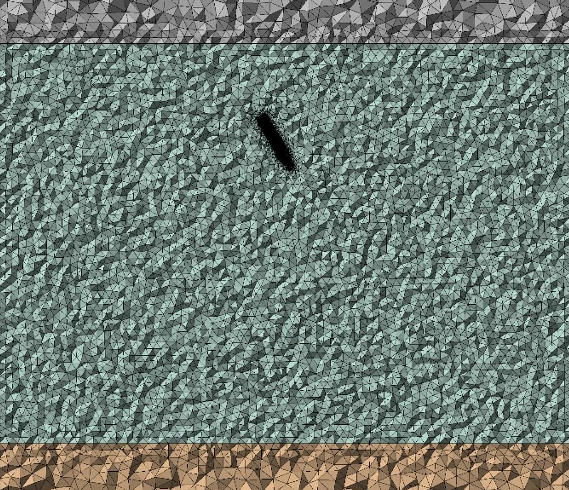
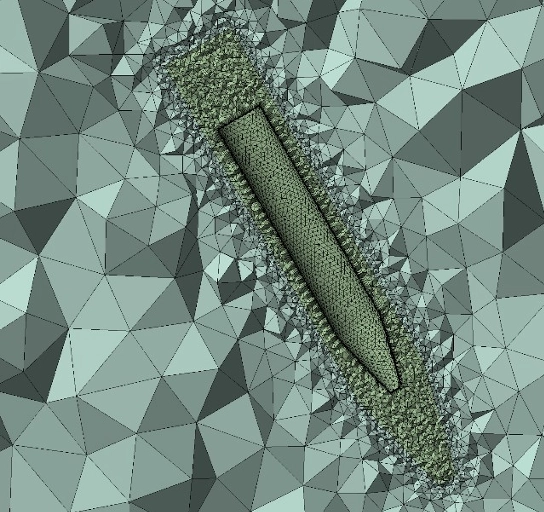
Figure 2: Detailed view of the generated grid, highlighting the fine mesh refinement required to support the 6DOF dynamic mesh deformation.
Post-processing: CFD Analysis of Oblique Water Entry Supercavitation
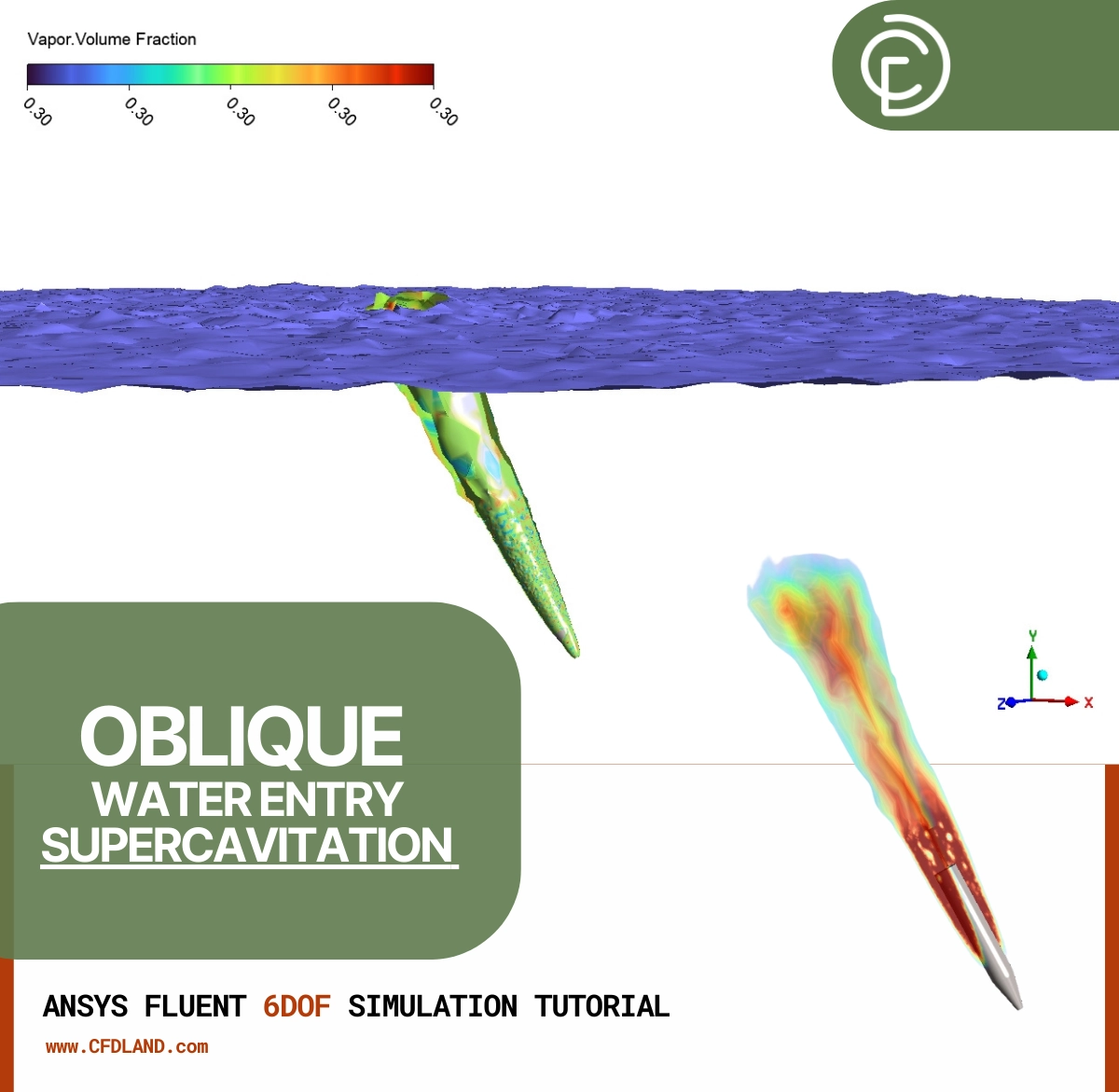
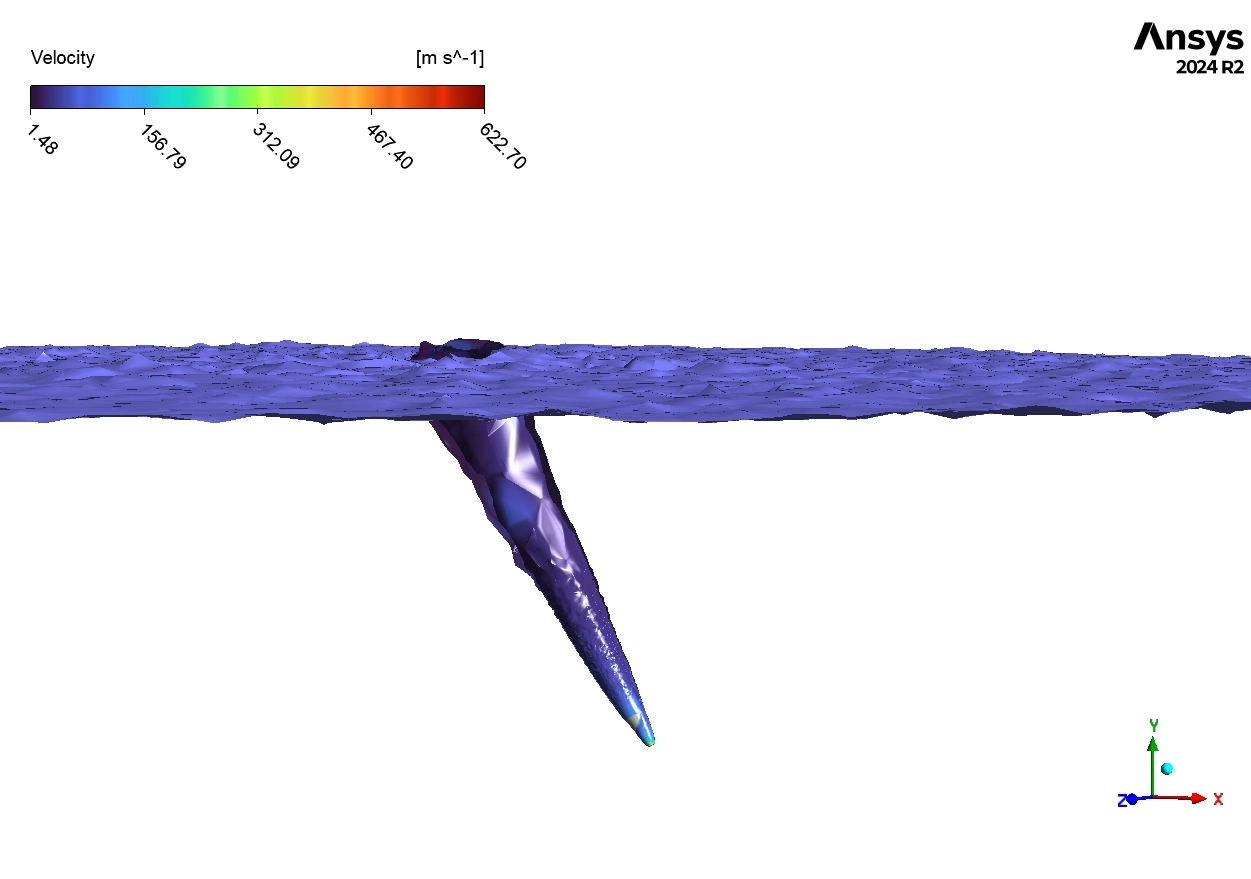
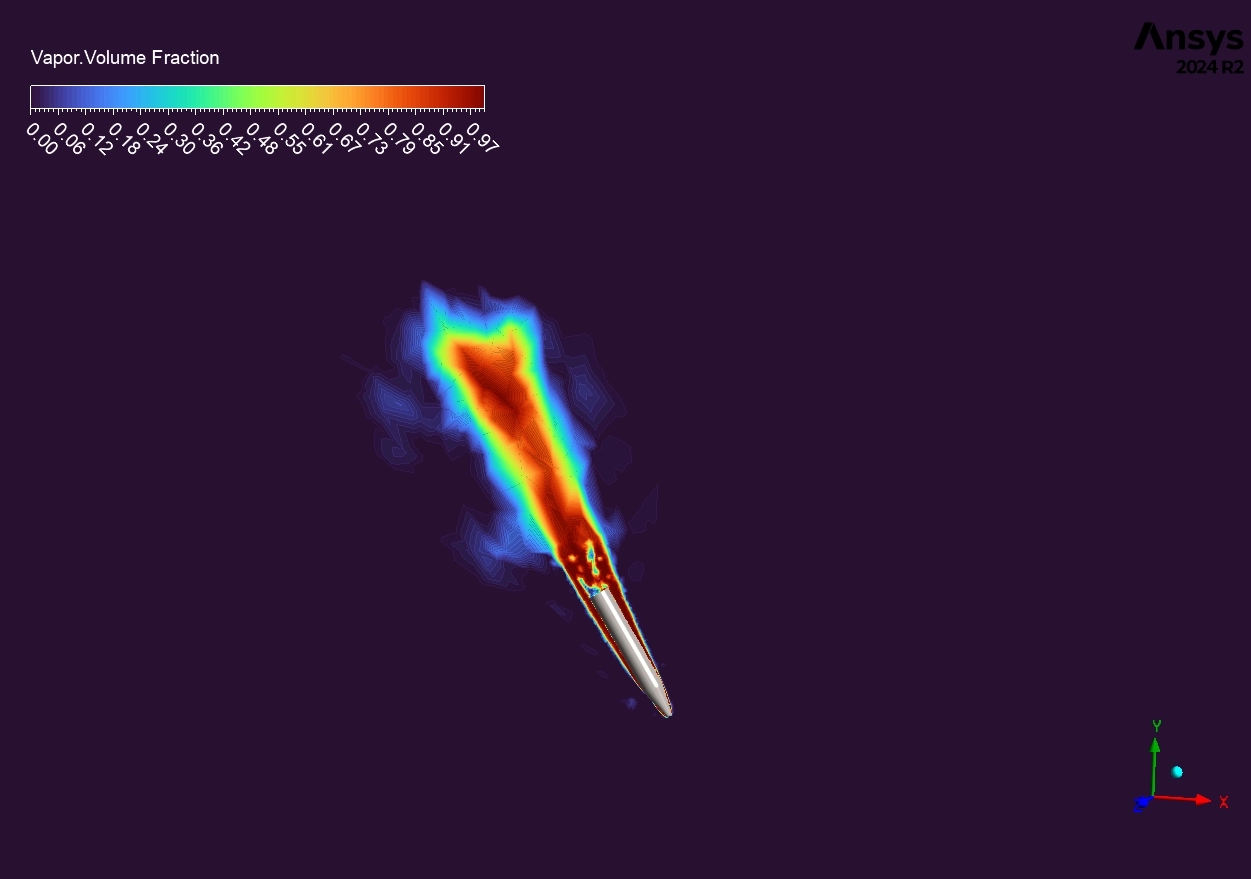
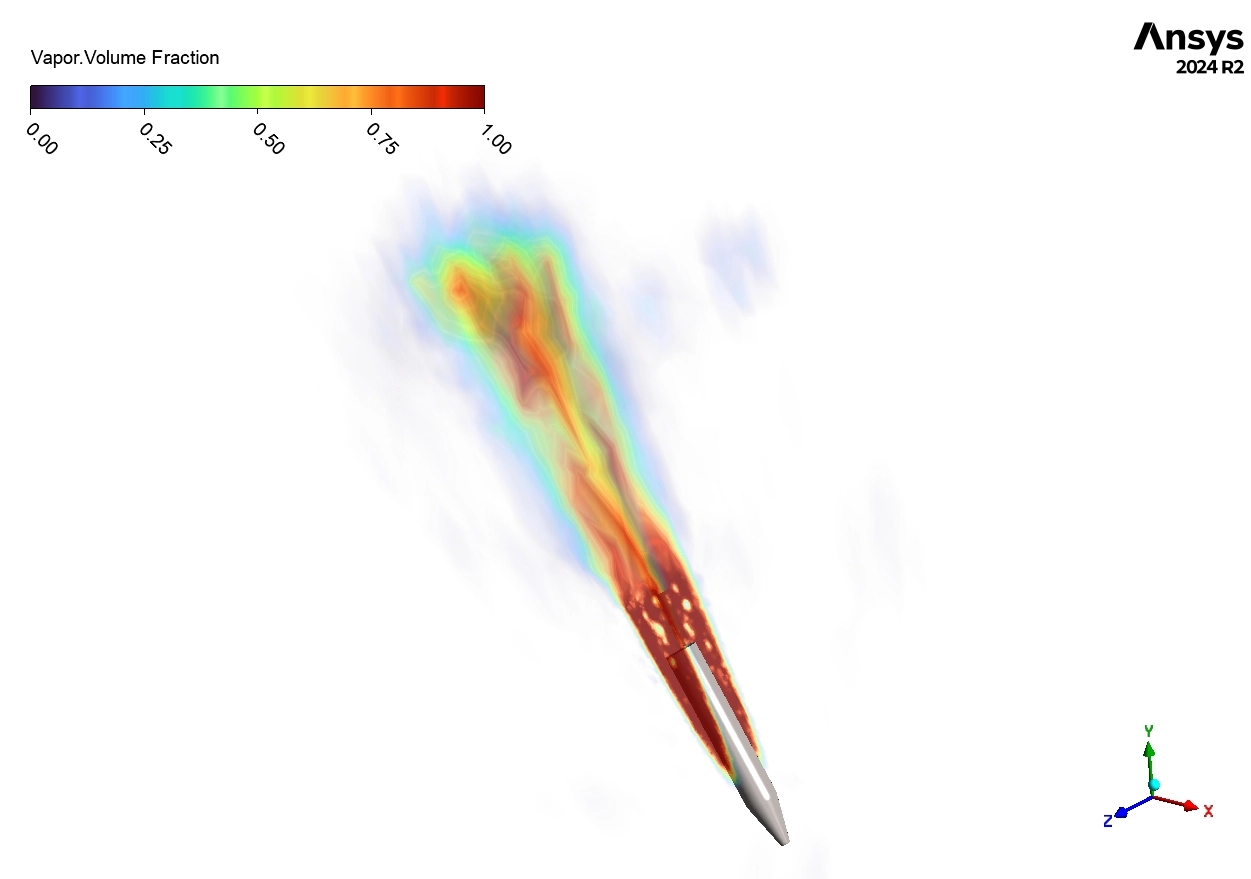
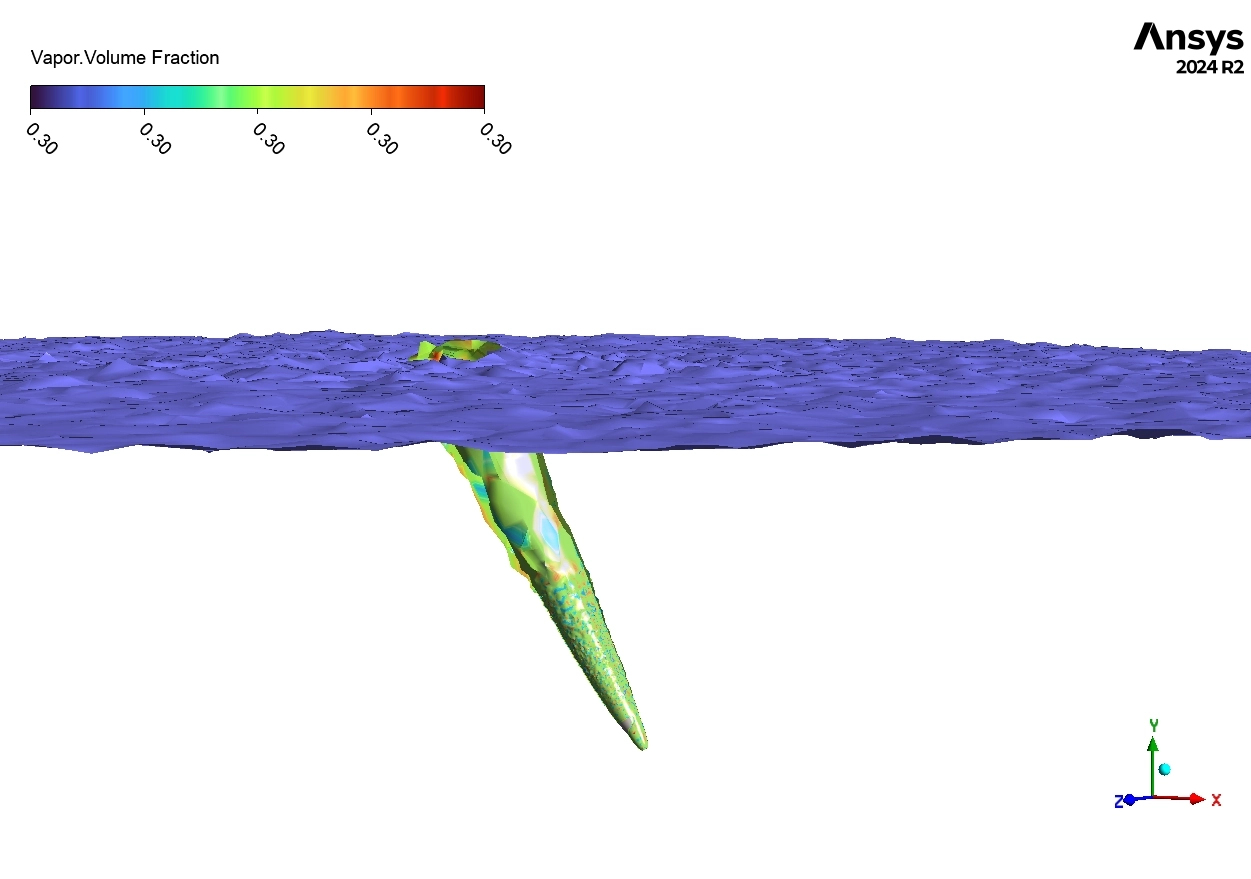
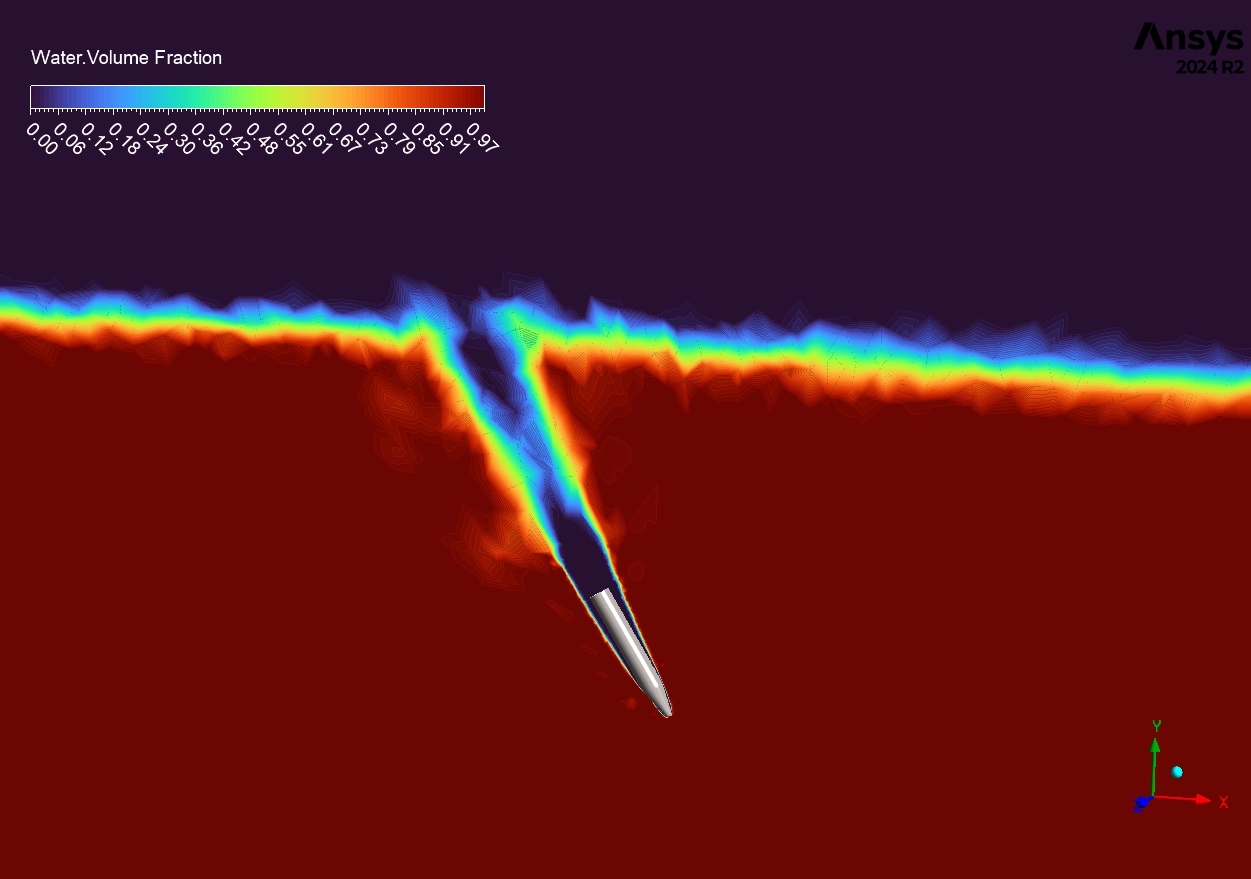
In this section, we perform a deep engineering analysis of the results to evaluate the projectile’s performance. We interpret the contours to understand the fluid dynamics of the impact. First, we analyze the Vapor Volume Fraction in Figure 3. This contour visualizes the shape of the supercavity. The Red area represents pure vapor (the cavity), while the Blue area is liquid water. From an engineering perspective, the Asymmetry of the Cavity is the most important finding in this CFD Analysis of Oblique Water Entry Supercavitation. Because the entry was oblique (angled), the cavity is thicker on the upper side than the lower side. This is critical because if the projectile tail touches the wet wall (a phenomenon called planing), it will experience a massive spike in friction. This sudden force can cause the missile to tumble or snap. The simulation confirms that at this speed, the cavity is fully developed, but the risk of tail-slap is high due to the entry angle.
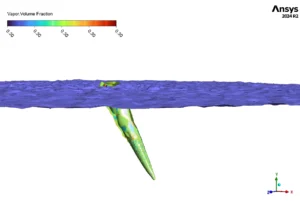
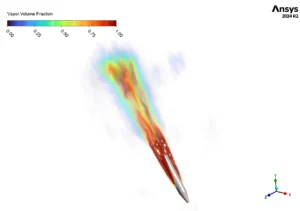
Figure 3: Vapor Volume Fraction Contourss, visualizing the asymmetric formation of the supercavity and potential instability regions.
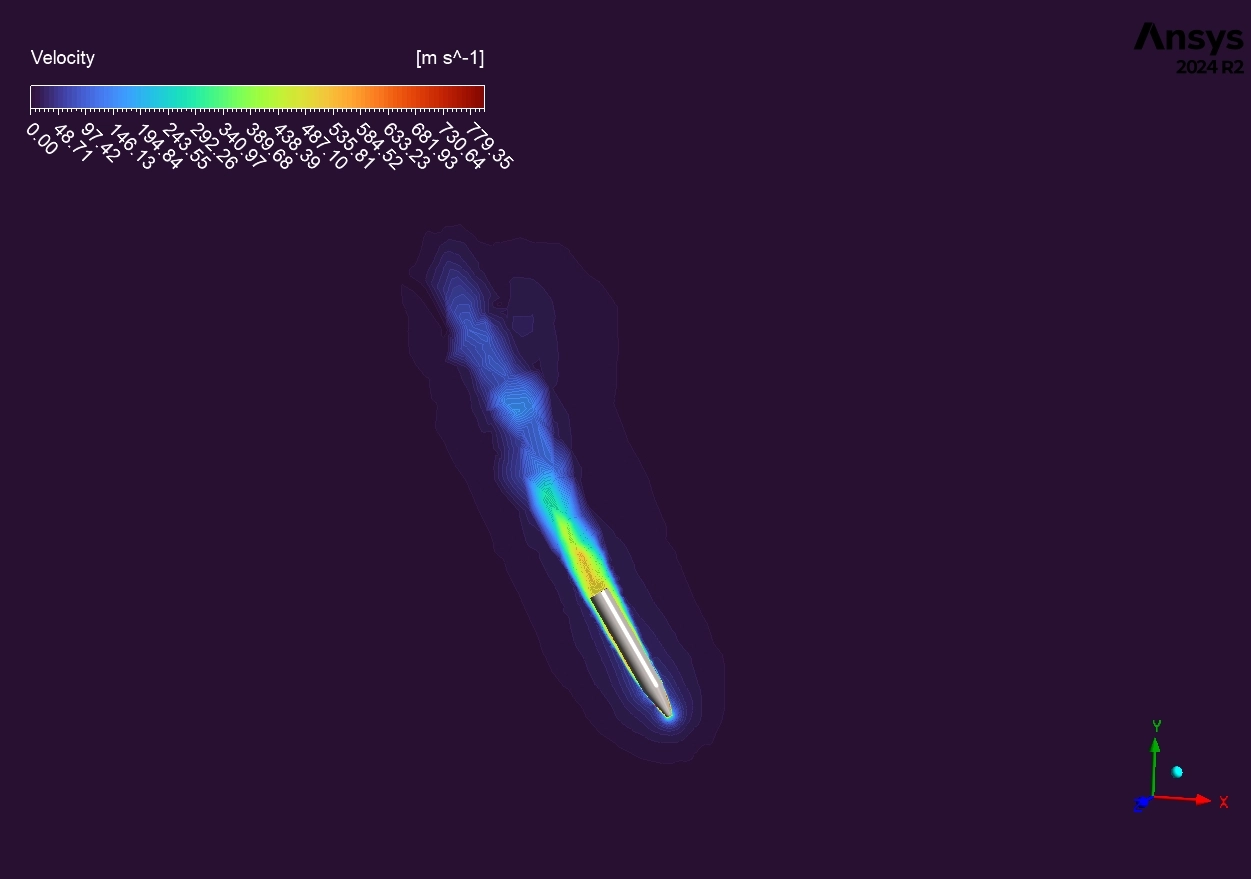
Next, we examine the Velocity Distribution in Figure 4. This contour shows the projectile entering the water, colored by velocity magnitude. The Maximum Velocity is 500 m/s. The simulation captures the massive energy transfer at the nose of the projectile. The sharp gradient between the high-speed body and the stationary water indicates a powerful Shock Wave. This shock wave propagates through the liquid, potentially damaging nearby structures. For a designer, this data is vital. It proves that the nose cone material must be extremely hard to survive the initial impact pressure. The CFD Analysis of Oblique Water Entry Supercavitation successfully predicts both the flow stability and the structural loads, providing the data needed to optimize the projectile’s shape for safer entry.
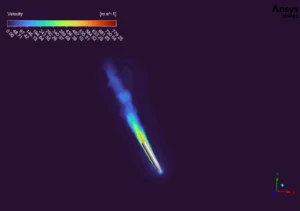
Figure 4: Velocity Magnitude Contours during impact, showing the high-speed shockwave generation and flow separation around the projectile nose.




Reviews
There are no reviews yet.