


Heat transfer inside tubes is a fundamental process in thermal engineering, used in applications like heat exchangers, boilers, and cooling systems. The efficiency of these systems depends on how well heat moves from the tube wall to the fluid inside. This is called convection, and we measure its effectiveness with the Nusselt number. The Nusselt number is a dimensionless value that compares convective heat transfer to conductive heat transfer. A higher Nusselt number means the system is better at heating or cooling.
To design these systems, engineers use powerful simulation tools. A Tube heat transfer CFD simulation allows us to study fluid flow and temperature in detail without expensive physical tests. This tutorial demonstrates a CFD validation study on this topic. Our main goal is to simulate the thermal performance inside a heated tube and correctly calculate the Nusselt number in Fluent. To ensure our simulation is accurate, we will compare the results to data from the reference paper by Ghasemi et al. [1]. For more tutorials on this subject, you can explore our Heat Transfer CFD Simulation projects.
- Reference [1]: Ghasemi, Seyed Ebrahim, and Ali Akbar Ranjbar. “Thermal performance analysis of solar parabolic trough collector using nanofluid as working fluid: A CFD modelling study.” Journal of Molecular Liquids222 (2016): 159-166.
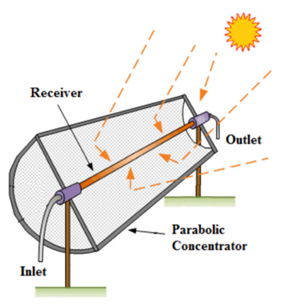
Figure 1- The solar collector from the reference paper [1], which provides the geometry for the heat pipe.
Simulation Process: Modeling Tube Heat Transfer in ANSYS Fluent
The simulation process began with creating the geometry in ANSYS Design Modeler. To save computing time, we used the pipe’s symmetry and built a 2D axisymmetric model. This is a common and effective technique for cylindrical shapes. Next, we generated a high-quality, fine-structured mesh. As seen in Figure 2, we added more elements near the tube wall. This is critical for accurately capturing the thermal boundary layer, which directly impacts the heat transfer coefficient calculation.
The setup for this Tube heat transfer Fluent simulation was done in ANSYS Fluent. We enabled the energy equation to solve for heat transfer. A constant heat flux was applied to the outer wall to simulate heating. The most important post-processing step was calculating the Nusselt Number in ANSYS Fluent. This is not a default output; it must be defined. We set up custom field functions to monitor the surface heat transfer coefficient, the fluid’s bulk temperature, and the wall temperature. These values were then used to calculate the Nusselt number, ensuring a reliable result for our validation.
Figure 2- The structured mesh for the Tube Heat Transfer Fluent analysis, with refinement at the wall for boundary layer accuracy.
Post-processing: Validating the Nusselt Number and Thermal Performance
The main goal of this project was to validate our numerical model against published data. The simulation results achieved this with excellent accuracy. The validation table below shows that our CFD model calculated an average Nusselt number of 271.5. The reference paper [1] reported a value of 245. This results in a difference of only 10%, which is a very strong agreement in the world of CFD validation. This confirms that our Convective heat transfer CFD methodology is correctly capturing the physics.
| Reference Paper | CFD Simulation | Error | |
| Nusselt Number | 245 | 271.5 | 10% |
The temperature contour in Figure 3 visually explains why our Tube heat transfer ANSYS Fluent model is successful. The fluid enters at a uniform 320K. As it flows along the tube, it gets hotter. You can see the temperature increasing along the wall and the centerline. This shows the development of the thermal boundary layer—the area near the wall where the temperature changes most sharply. The simulation shows a maximum temperature of 329.365K on the tube surface near the outlet, a total rise of nearly 10K. This detailed temperature field is what drives convection. The accurate capture of these temperature gradients is the reason our model successfully calculated the heat transfer coefficient and the validated Nusselt number.

Figure 3: Temperature distribution from the CFD analysis, showing the progressive heating of the fluid along the tube.
Key Takeaways & FAQ
- Q: How do you calculate the Nusselt number in ANSYS Fluent?
- A: You cannot directly output the Nusselt number. You must first calculate the surface heat transfer coefficient (h), fluid conductivity (k), and a characteristic length (L, often the tube diameter). Then, you use a custom field function to compute Nu using the formula Nu = hL/k.
- Q: Why is mesh refinement at the wall important for heat transfer simulations?
- A: The most significant temperature changes and fluid velocity slowdowns occur in the thin “boundary layer” near the wall. A fine mesh in this region is essential to accurately capture these gradients, which are critical for calculating the heat transfer coefficient and the Nusselt number.
- Q: What is considered a good validation error in CFD?
- A: For complex thermal-fluid simulations, an error of around 10% (like the one achieved in this study) is generally considered a very good result. It indicates that the simulation setup, mesh, and physical models are well-aligned with the real-world experiment or reference data.






Reviews
There are no reviews yet.