
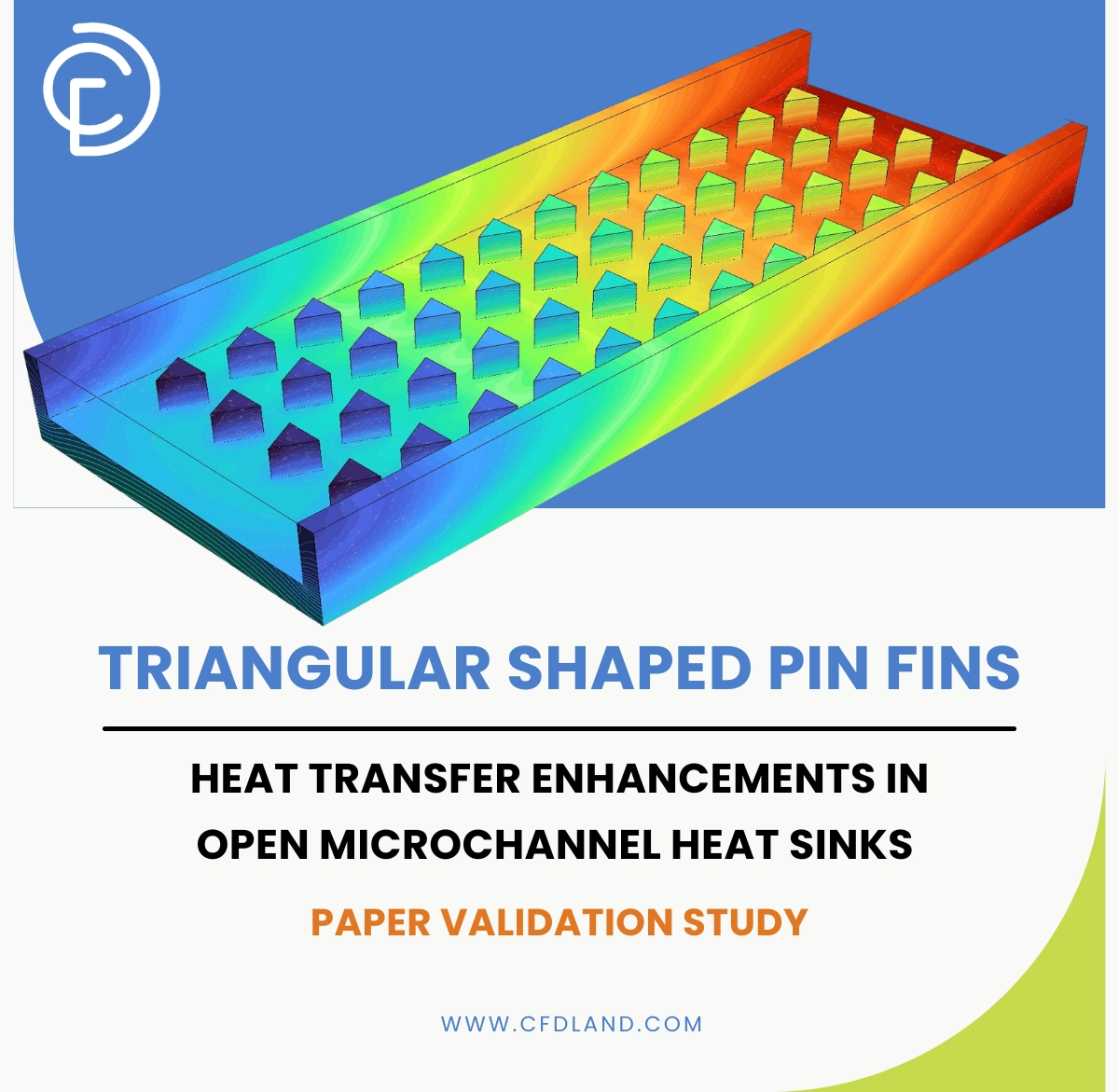
Modern electronics generate a lot of heat, and removing it is a major challenge. Open Microchannel Heat Sinks are a popular solution because they use liquid flow in tiny channels to cool chips down. To make them even better, engineers add small pillars called Pin Fins. In this study, we focus on Triangular Shaped Pin Fins. The sharp edges of a triangle are better at mixing the fluid than round shapes, which improves cooling.
This project is a Triangular Shaped Pin Fins CFD simulation designed to prove the accuracy of digital modeling. It is important to note that this is a Validation Study, meaning we compare our software results against real physical experiments to ensure they are correct. We use ANSYS Fluent to simulate the heat transfer and fluid flow. For more projects on tiny scale flows, please explore our microfluid and nanofluids tutorials. Our methodology follows the experimental work of Sheik et al. [1].
- Reference [1]: Sheik, Mohammed Anees, et al. “Study the effect of silicon nanofluid on the heat transfer enhancement of triangular-shaped open microchannel heat sinks.” Silicon1 (2024): 277-293.
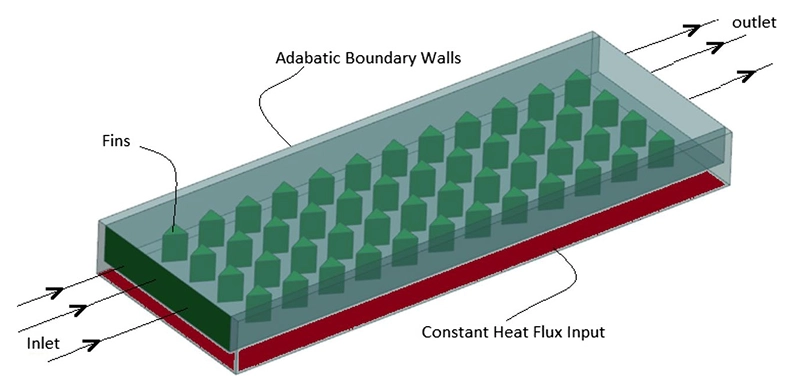
Figure 1: Schematic view of the open microchannel heat sink system with triangular fins [1].
Simulation Process: Conjugate Heat Transfer in Fluent
To perform this Triangular Shaped Pin Fins Simulation, we built a precise 3D model of a 27 mm long heat sink containing 48 staggered fins. We generated a mesh with 1,653,132 hexahedral cells. Using hexahedral (brick) cells is critical for Open Microchannel Heat Sinks because they align with the flow, reducing errors.
In ANSYS Fluent, we set up a Conjugate Heat Transfer (CHT) problem. This means the software calculates temperature in both the solid copper fins and the liquid nanofluid simultaneously. We defined the fluid as a Silicon Nanofluid and the solid as Copper. We ran the simulation at different speeds (Reynolds numbers 200 to 800) to validate the Triangular Shaped Pin Fins Fluent model against experimental data.
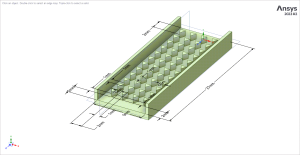
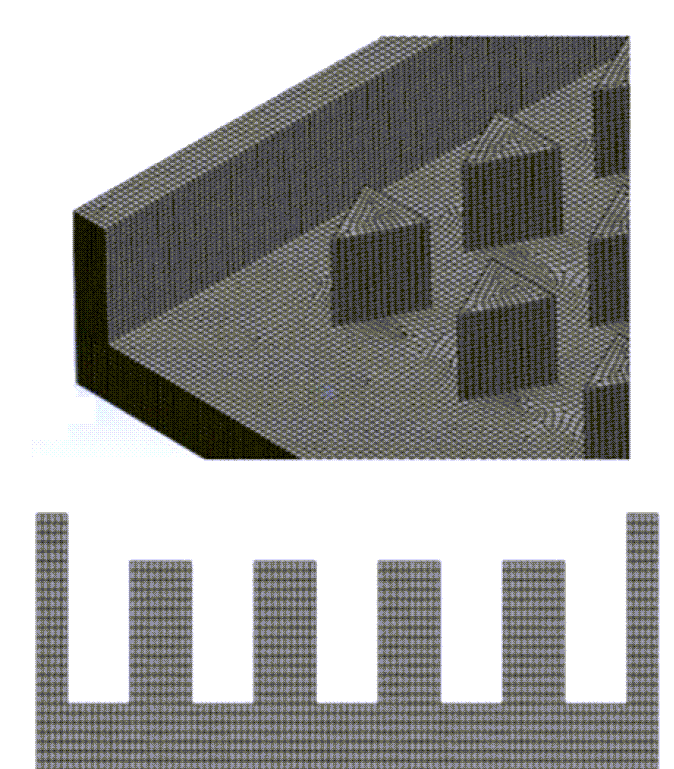
Figure 2: 3D Geometry and Mesh generated for the Triangular Shaped Pin Fins ANSYS Fluent simulation, showing the hexahedral grid refinement near the fin walls.
Post-processing: Validating Thermal and Hydrodynamic Performance
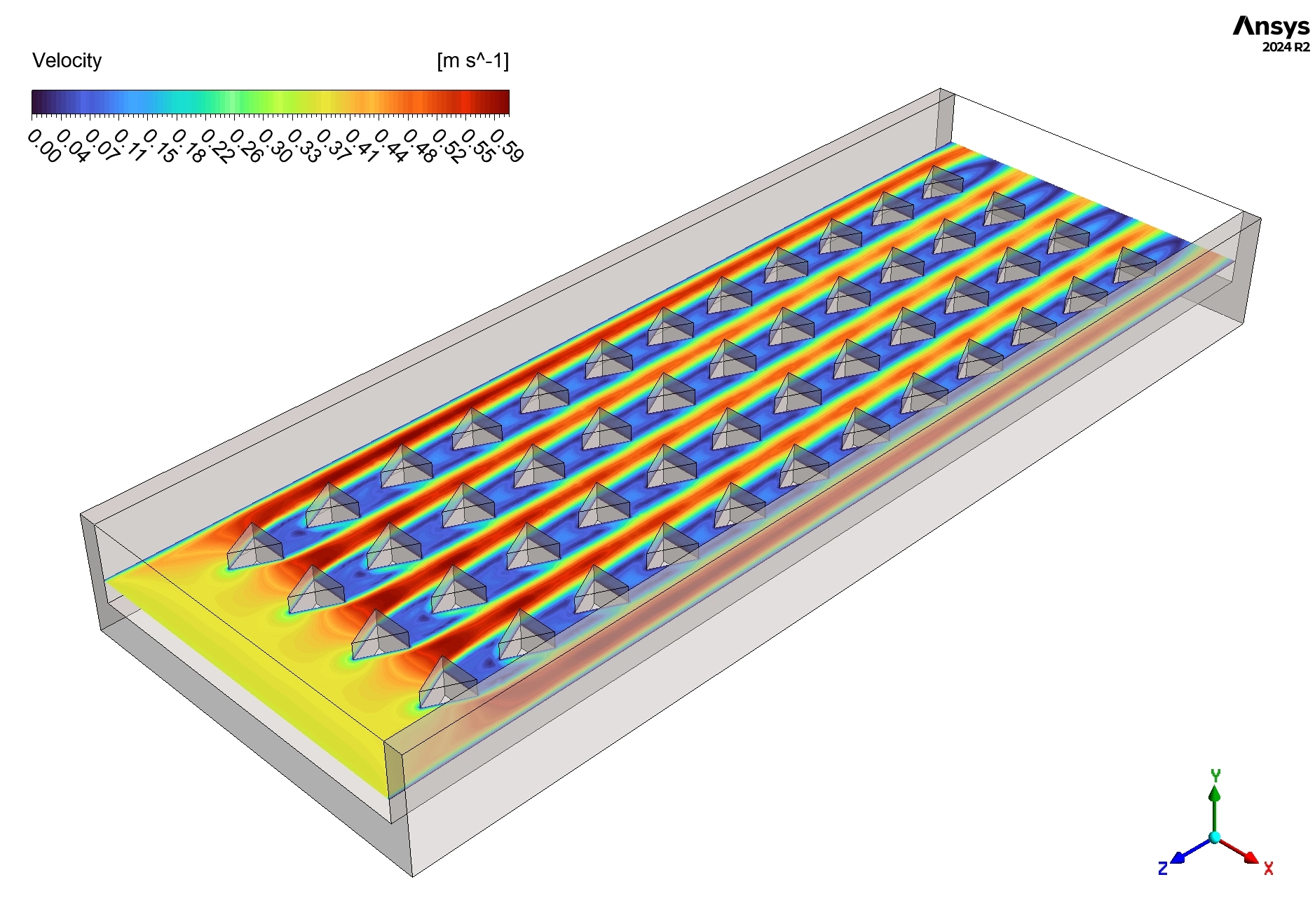
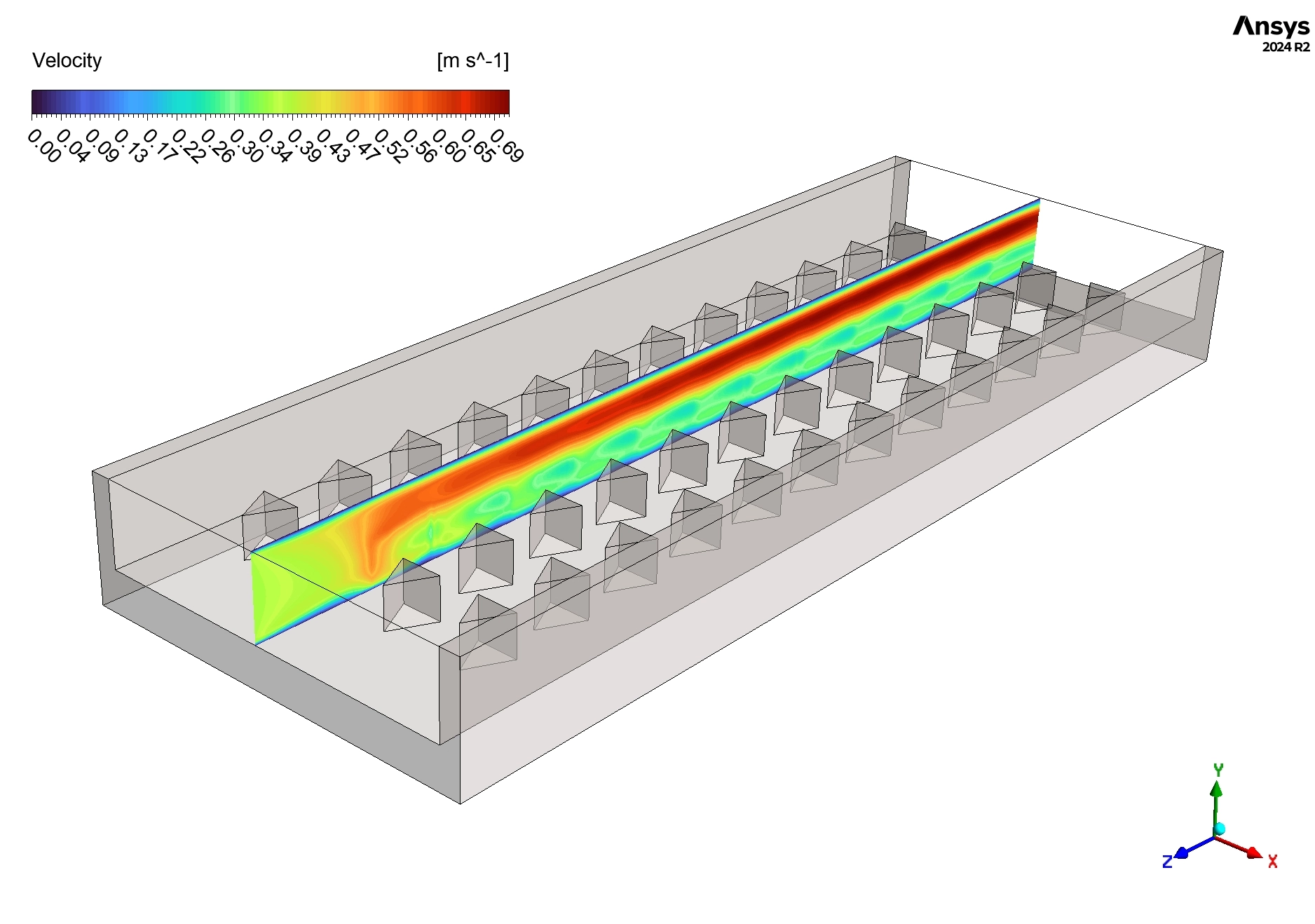
A real analysis of the simulation results, based on the provided contours and data, confirms that our Triangular Shaped Pin Fins ANSYS Fluent model is highly accurate. The primary goal of a validation study is to match the experiment. Looking at the table below, specifically at a Reynolds number (Re) of 400, the experimental Nusselt number was 33.92, and our simulation predicted 33.62. This results in an incredibly small error of only 0.90%. This proves the validity of our method. When we examine the physics in the contours, we can see why it works. The velocity contour shows the fluid accelerating to a maximum of 0.59 m/s between the fins. The sharp back edge of the triangular fins creates a “separation zone” or wake, where the velocity drops to 0-0.15 m/s. These wakes create mixing that disrupts the boundary layer, enhancing heat transfer.
| Reynolds Number (Re) | ANSYS Fluent CFD Nusselt Number (Nu sim) | Experimental Nusselt Number (Nu exp) | Error (%) |
| 200 | 24.31 | 23.39 | 3.92% |
| 400 | 33.62 | 33.92 | 0.90% |
| 600 | 39.85 | 42.53 | 6.30% |
| 800 | 44.96 | 49.56 | 9.28% |
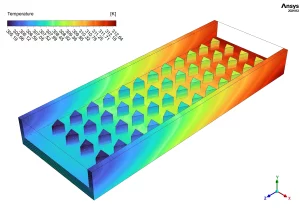
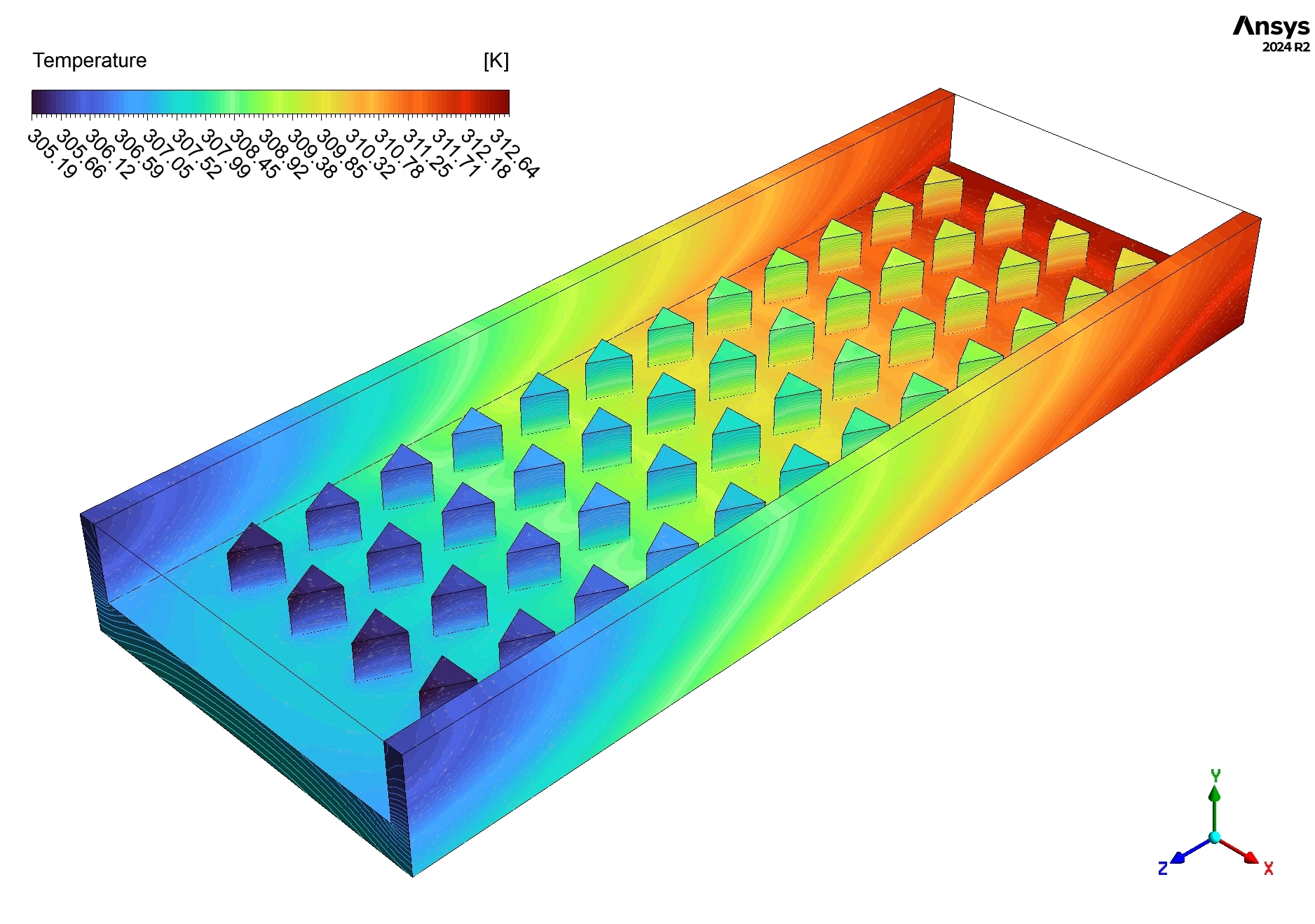
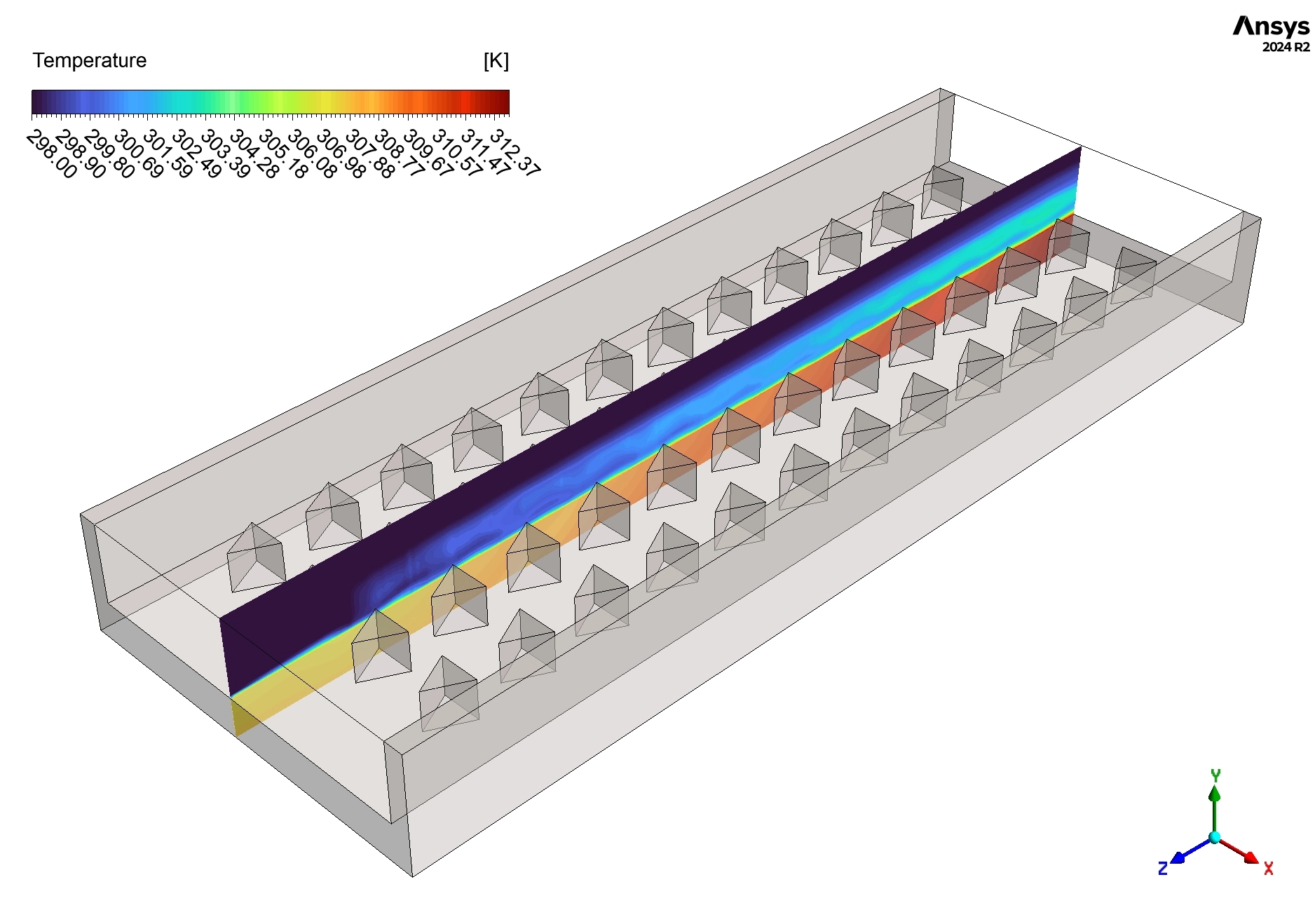
Figure 3: Temperature Contours (Top View) ranging from Blue (300 K) at the inlet to Red (313 K) at the outlet, visualizing the heat absorption along the channel length.
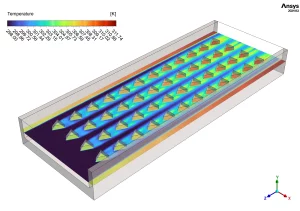
Figure 4: Temperature contours showing the gradient from the fin base to the tip.
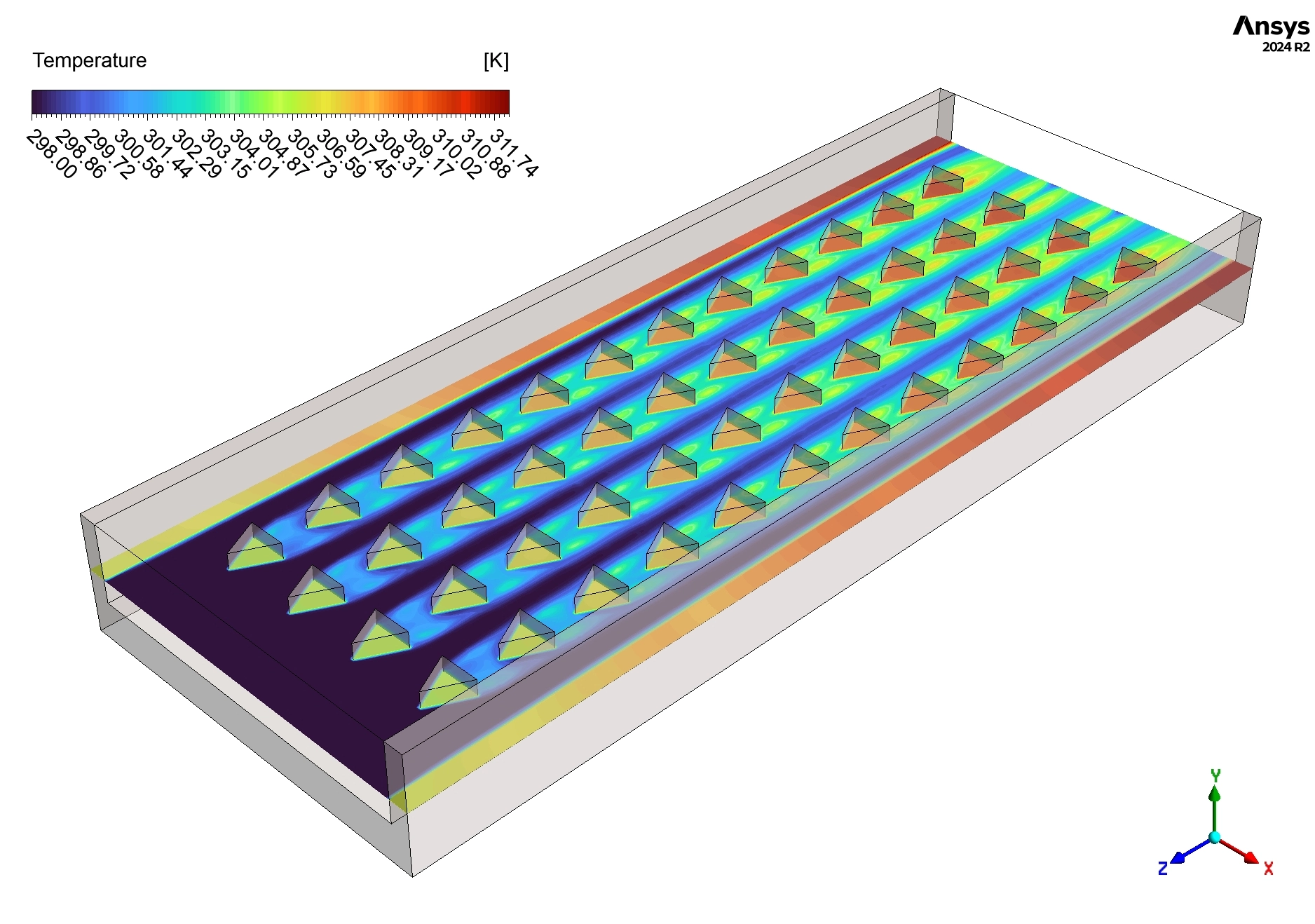
Thermally, the temperature contours confirm that the Conjugate Heat Transfer is functioning correctly. The fluid enters at a cool 300 K and heats up to 313 K at the outlet as it absorbs energy. More importantly, we can see a clear temperature gradient within the fins themselves: the base of the fin is hot at 312 K, while the tip is cooler at 305 K. This proves that heat is conducting up through the copper fin and then convecting into the nanofluid. The combination of the wake mixing and the effective conduction through the triangular geometry leads to a massive improvement in cooling, with the Heat Transfer Coefficient jumping from roughly 5700 to nearly 10716 W/m²K at higher speeds. This Triangular Shaped Pin Fins CFD analysis successfully validates that the simulation can replace expensive experiments for future designs.
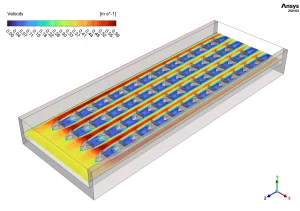
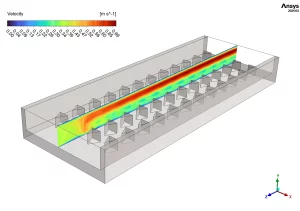
Figure 5: Velocity contours showing the separation zones behind the triangular fins.
Key Takeaways & FAQ
- Q: Why use Triangular Shaped Pin Fins instead of round ones?
- A: As shown in this Triangular Shaped Pin Fins CFD simulation, the sharp corners of the triangle create separation zones and wakes (blue areas in the velocity contour). This turbulence mixes the fluid better than smooth flow around a circle, which increases the heat transfer rate.
- Q: What is an Open Microchannel Heat Sink?
- A: Unlike closed channels, an Open Microchannel Heat Sink allows some fluid to flow over the top of the fins. This reduces the pressure drop, meaning the pump doesn’t have to work as hard, while still providing excellent cooling.
- Q: What does the validation error of 0.90% mean?
- A: An error of 0.90% is excellent. It means the ANSYS Fluent simulation results are almost identical to the physical experiment. This confirms that the Triangular Shaped Pin Fins Simulation is valid and trustworthy.









Reviews
There are no reviews yet.