
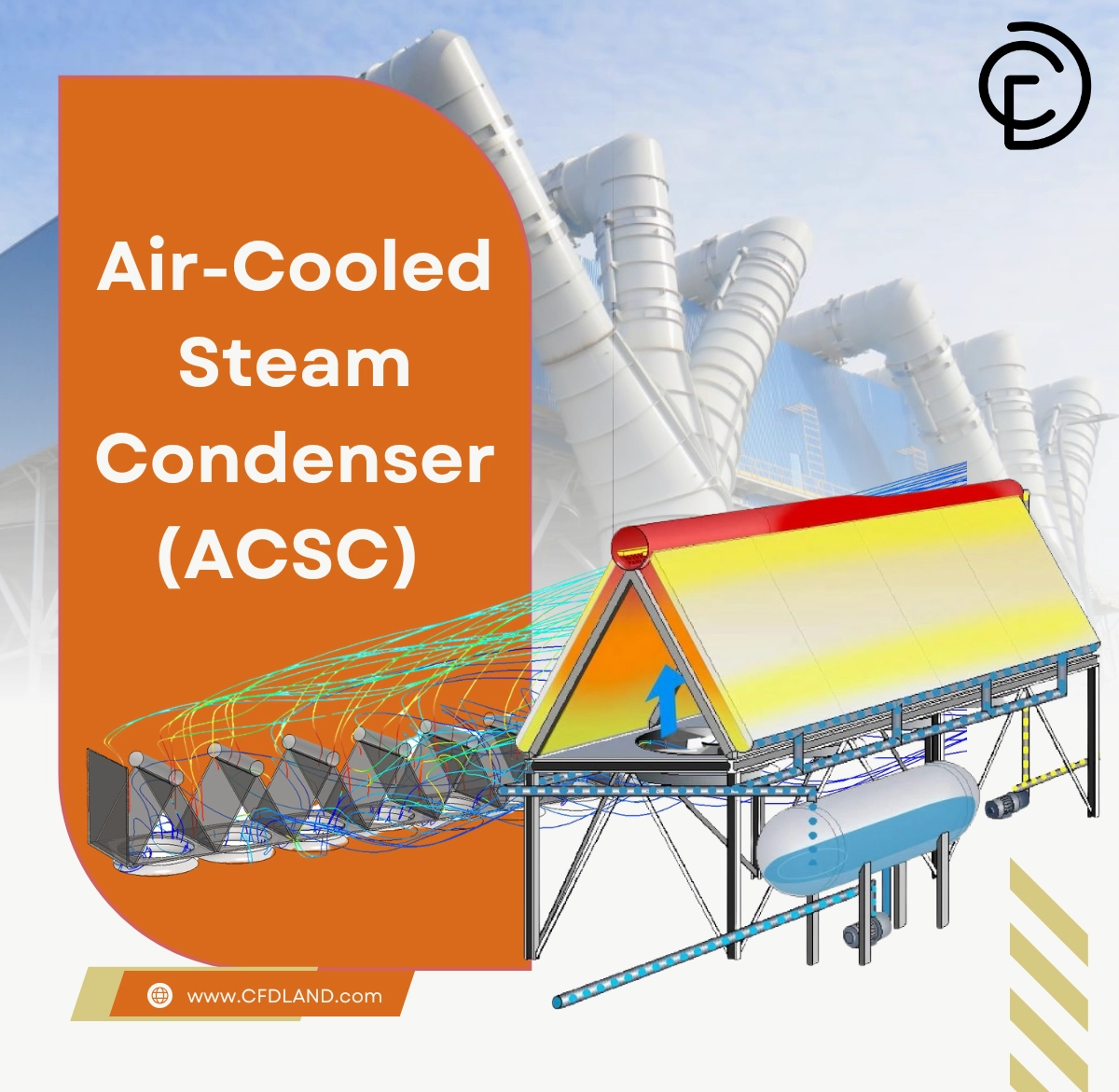
Power plants boil water to make steam, and this extremely high-pressure steam turns giant turbines to generate electricity. After the steam passes through the turbine, it must be cooled down and turned back into liquid water to be reused. In dry regions where water is scarce, power plants cannot use cooling towers. Instead, they build an Air-Cooled Steam Condenser (ACSC). This is a massive machine that uses giant fans to pull cold outside air over hot, steam-filled pipes to cool them down. However, strong winds and extremely hot summer weather can stop these giant fans from working correctly. Because building and testing real-world power plants costs millions of dollars, engineers use an Air-Cooled Steam Condenser CFD simulation to test the system on a computer first.
This report is a complete Air-Cooled Steam Condenser fluent simulation educational tutorial. We use ANSYS Fluent to visualize the invisible wind and track the heat transfer. A detailed CFD Analysis of Air-Cooled Steam Condenser helps designers spot major airflow problems before they build the real plant. For more foundational lessons on simulating industrial cooling systems, please explore our Heat Transfer tutorials.
- Reference [1]: Zhang, Xuelei, and Tingting Wu. “Effects of diffuser orifice plate on the performance of air-cooled steam condenser.” Applied Thermal Engineering98 (2016): 179-188.
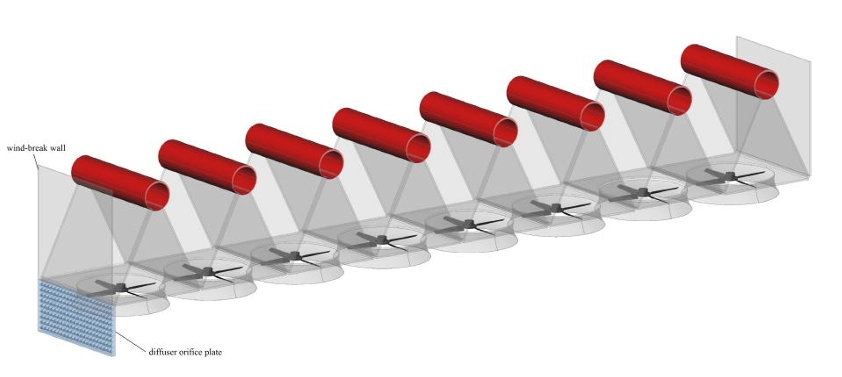
Figure 1: Diffuser Orifice Plate Location, showing the structural setup of the condenser based on the reference paper geometry [1].
Simulation Process: Porous Zone and Fan Cell Zone Fluent Setup
For this Air-Cooled Steam Condenser ANSYS Fluent project, we built a large 3D virtual model of eight A-frame condenser cells. To make sure the computer calculates the air friction perfectly, we created a very fine, high-quality mesh consisting of exactly 19,505,605 tetrahedral cells with boundary layers.
We set up the physics to perfectly mimic a real-world power plant. First, we set the cold outside air entering the system from the bottom at a temperature of 287.15 K (about 14°C). The hot steam pipes are too complex to draw individually, so we modeled them as a “Porous Zone” with a fixed, glowing hot wall temperature of 319.75 K.
The most important step in an ACSC simulation is the fan. Instead of drawing complex spinning blades, we used the Fan Cell zone Fluent condition. We gave the software a “polynomial pressure jump” equation. This mathematical trick tells the computer exactly how hard the fan is pulling the air upward, saving massive amounts of calculation time.
Post-processing: Thermal Efficiency and Hot Air Recirculation Analysis
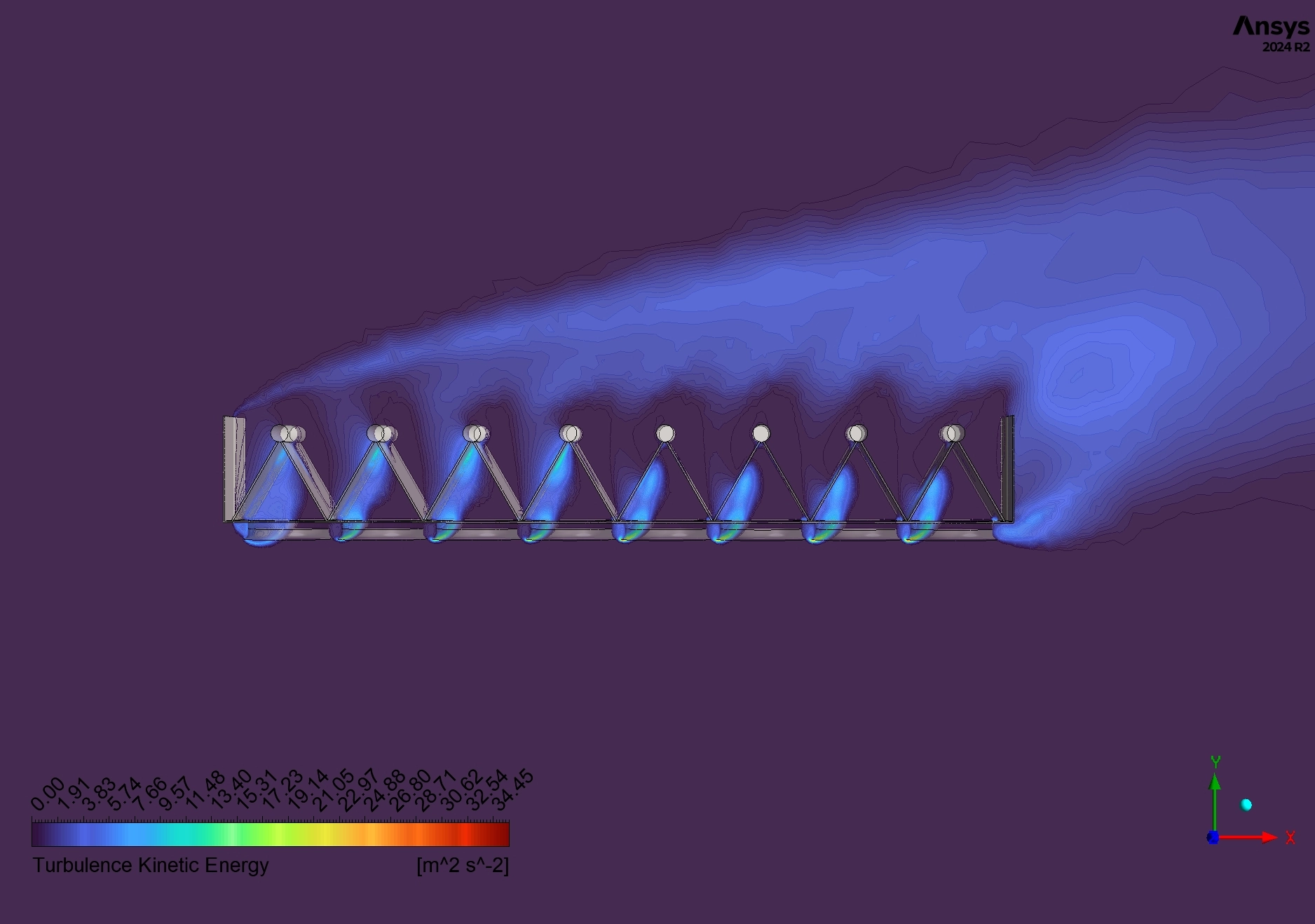
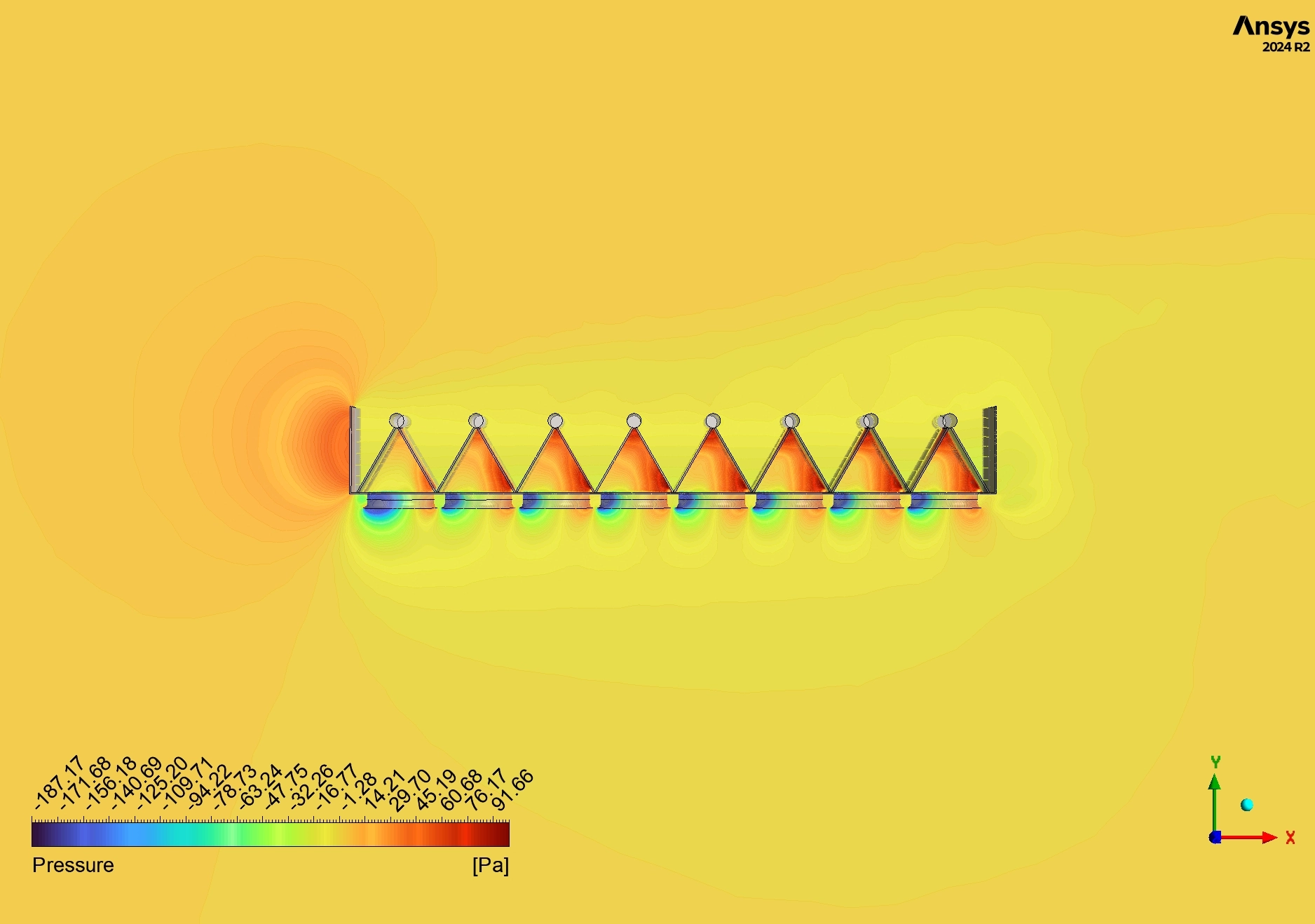
To truly master this Air-Cooled Steam Condenser fluent study, we must strictly analyze the Cause and Effect shown in the visual contours. We will look at how the fan pulls the air, how the heat is transferred, and the critical design flaw discovered at the edges.
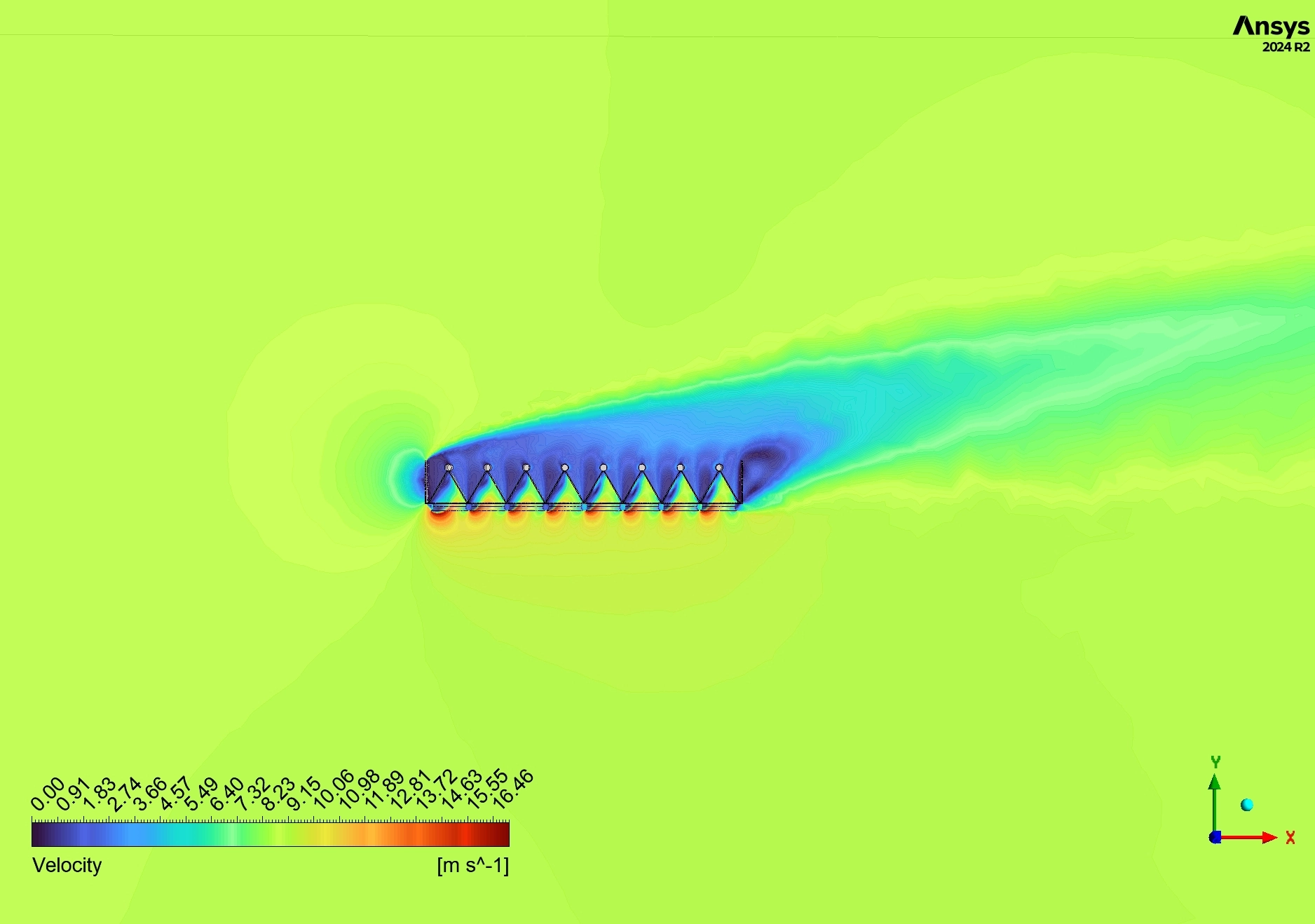
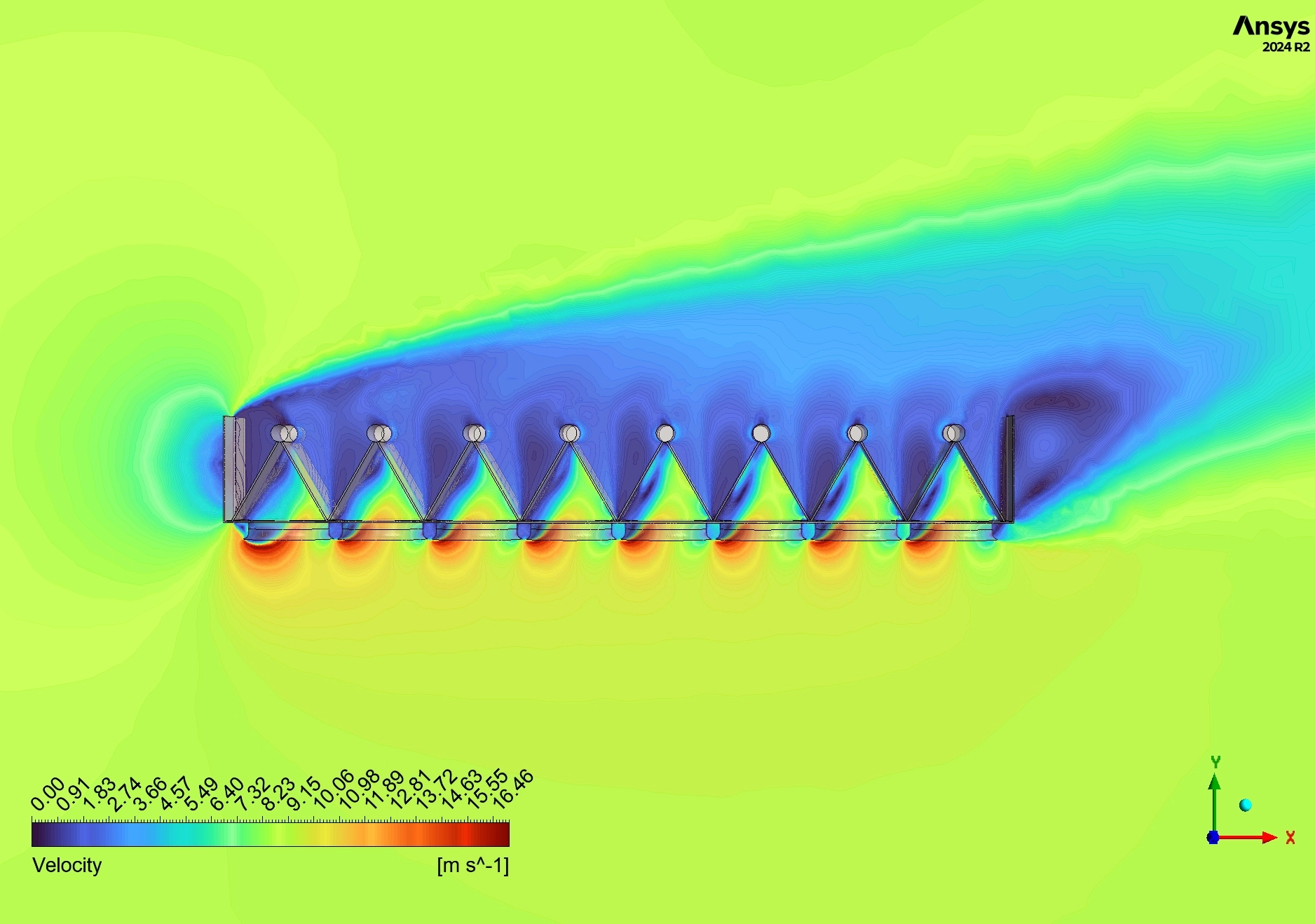
Look at the Velocity Contours (Figures 2 & 3). The fan acts like a giant vacuum cleaner. The cold air enters slowly from the bottom of the structure at speeds of 0 to 4 m/s . As the fan pulls the air up into the narrow throat, the speed suddenly shoots up to a massive 16.46 m/s (colored Red/Orange). However, after the fan, the air crashes into the tight, metal fins of the hot steam pipes (the porous zone). These tight pipes act like a physical filter, creating heavy resistance. Because of this resistance, the air slows back down to 4 to 8 m/s. This pressure drop is the exact physical barrier the fans must fight against to keep the air moving.
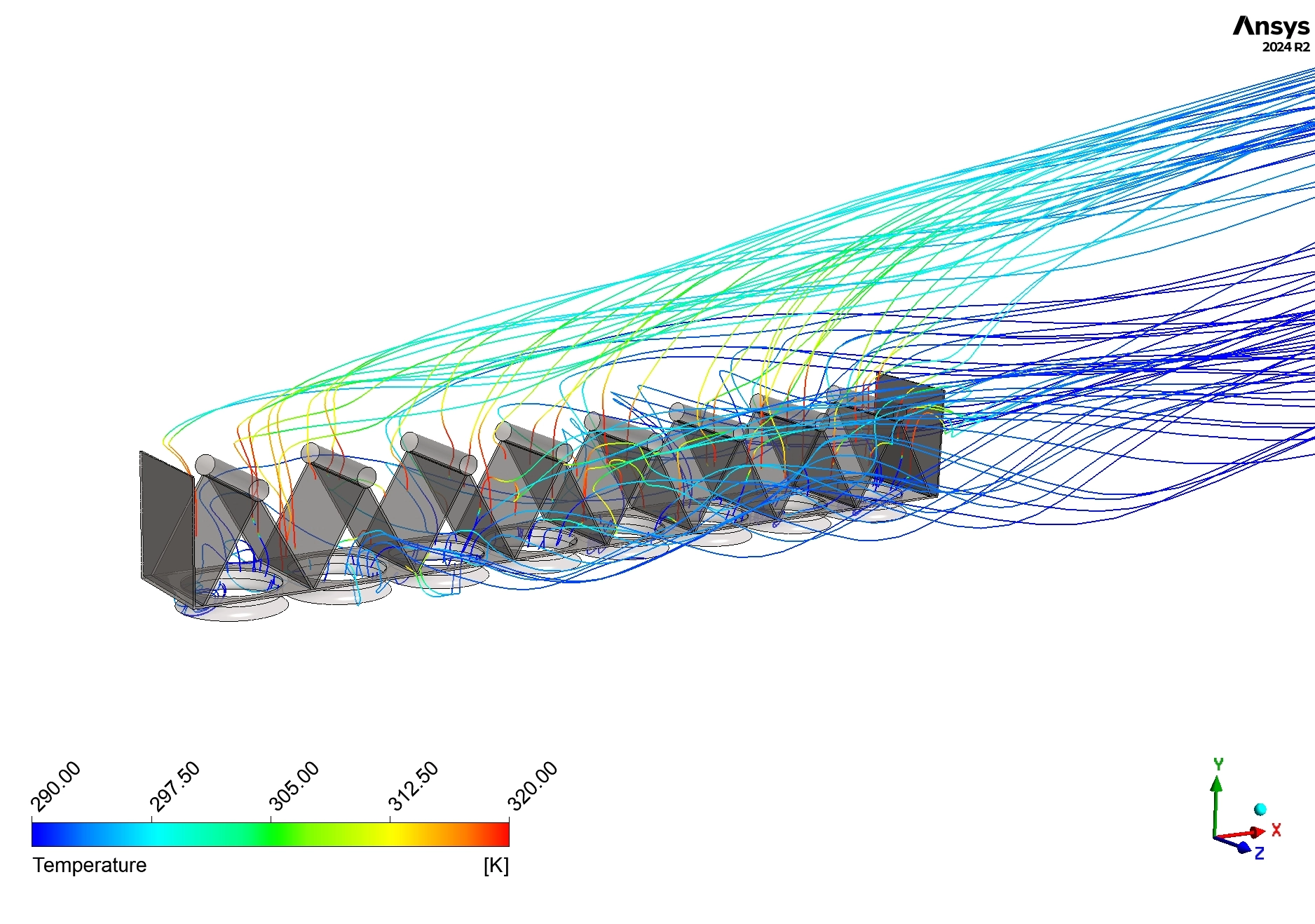
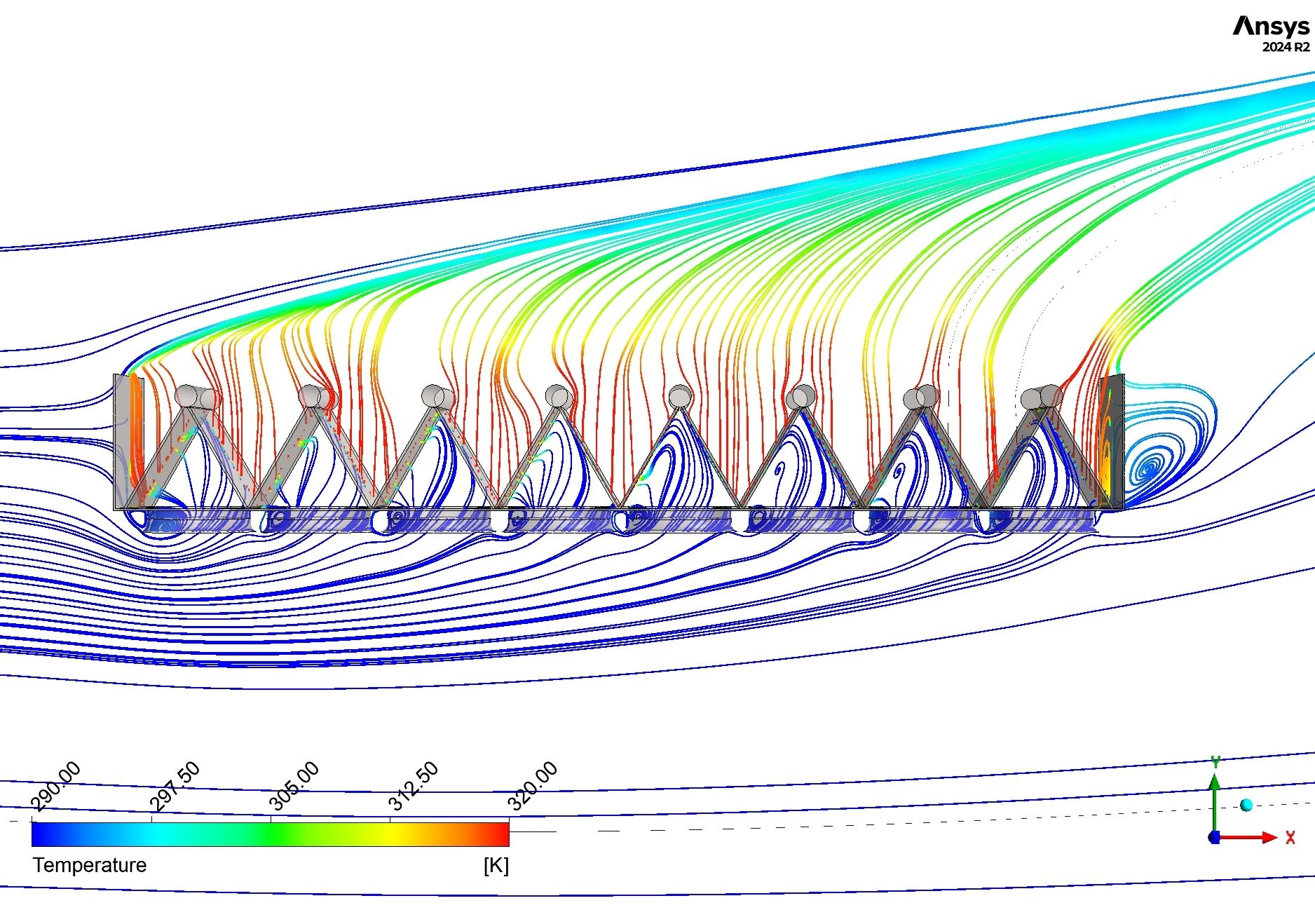
Next, we look at the heat transfer in the Temperature Streamlines (Figure 4). The cold air starts at the bottom at 287.15 K (Blue). As this air pushes through the porous zone, it touches the 319.75 K hot metal walls. Because the air is colder than the metal, it rapidly absorbs the heat. When the air exits the top of the machine, it has turned Yellow and Red, reaching temperatures between 305 K and 321.69 K. This massive temperature rise of 18 K to 33 K proves that the machine is working. The cold air successfully “stole” the latent heat out of the steam.
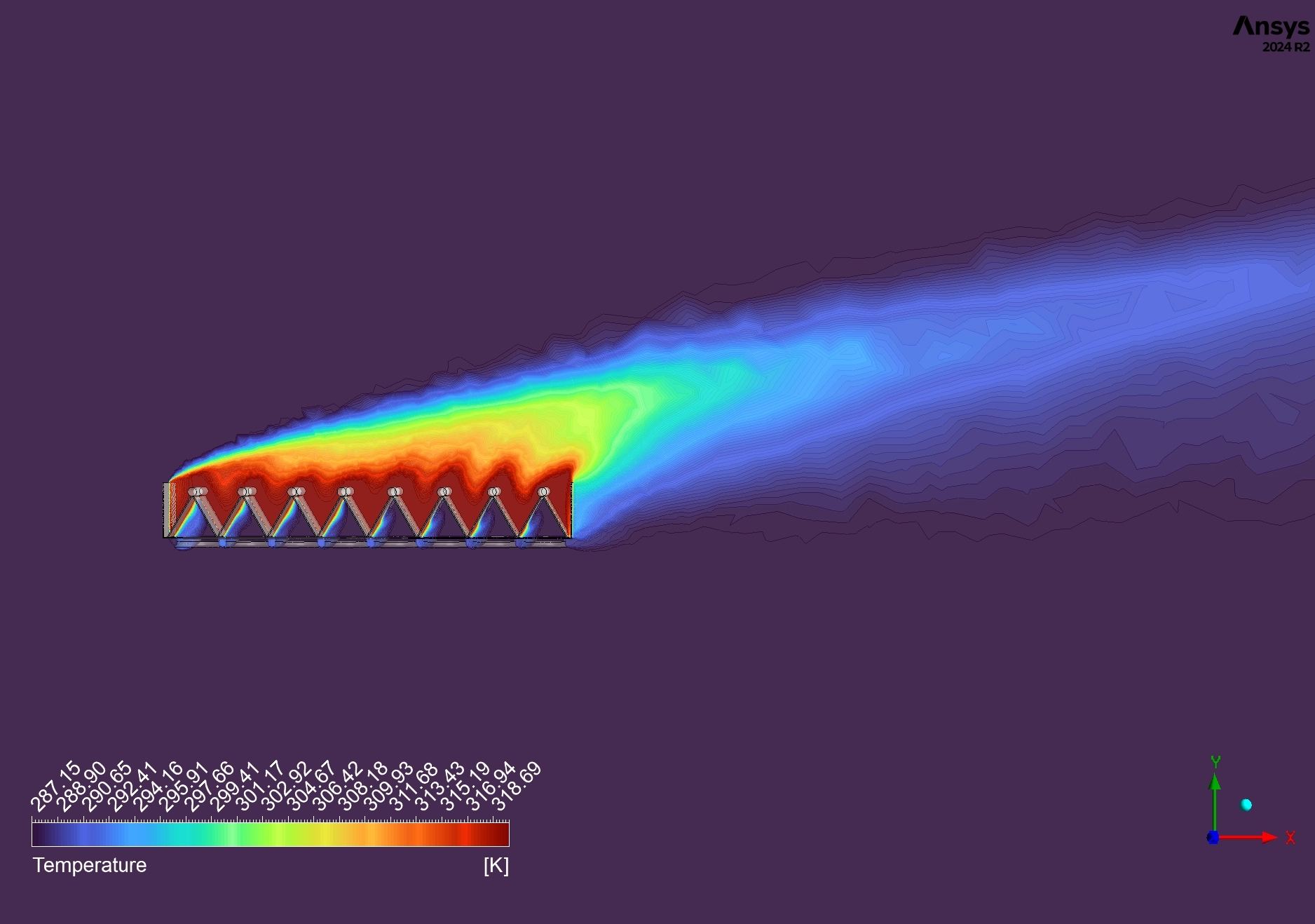
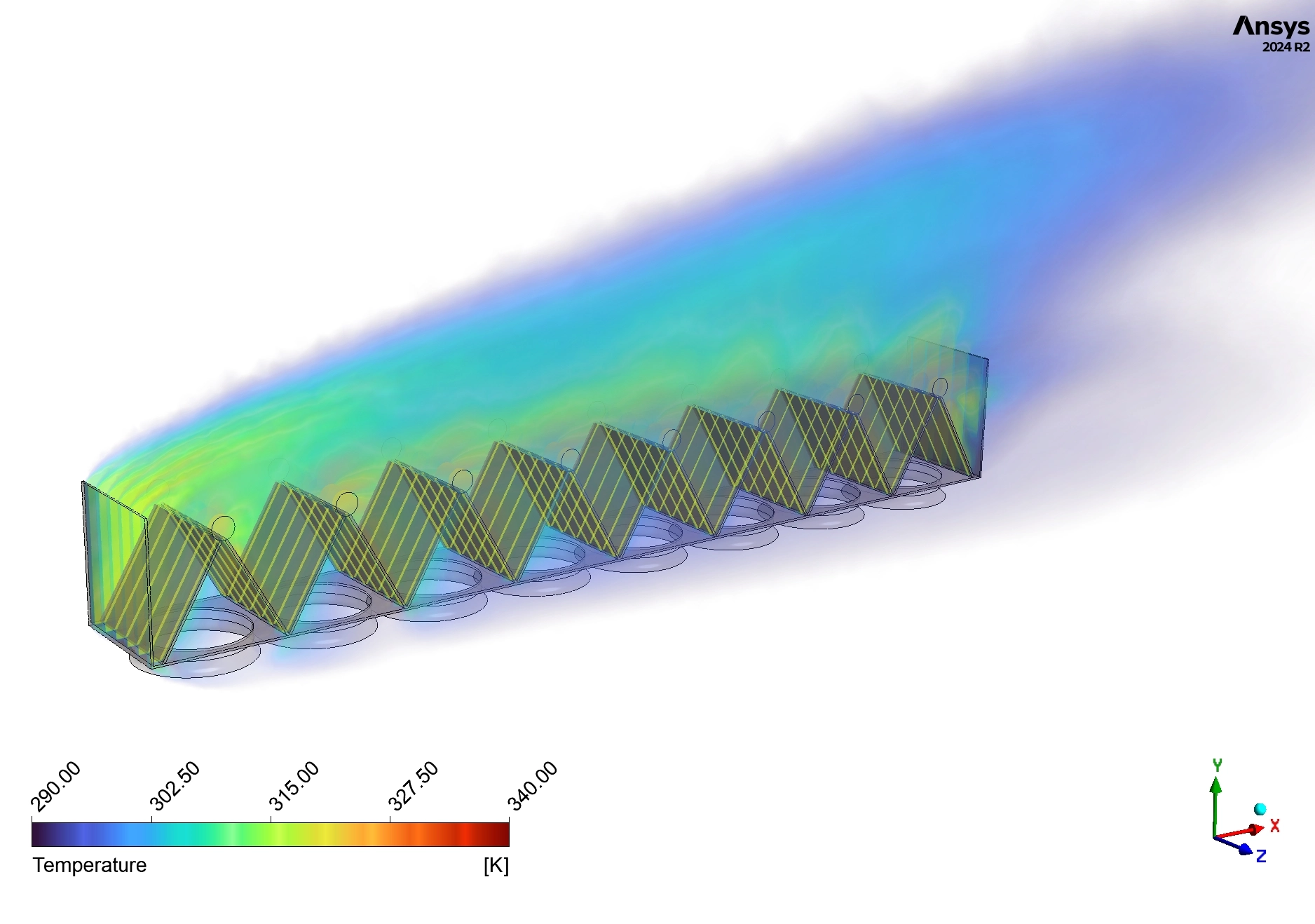
Finally, we must look at the overall system in the Temperature Contour (Figure 5). The six fans in the center are working perfectly. But look closely at the edges of the platform. The streamlines show a massive problem called Hot Air Recirculation (HAR). Instead of blowing straight up into the sky, the hot exhaust air (measuring 318 K to 322 K) curves backward and gets sucked right back down into the outer edge fans. This is a terrible failure. Because the edge fans are swallowing hot air instead of cold air, their cooling power drops by 5% to 15%.
Figure 2: Velocity Contours through the ACSC, displaying the air speed jumping from the slow inlet (0.00 m/s, Blue) to the high-speed fan throat (16.46 m/s, Red).
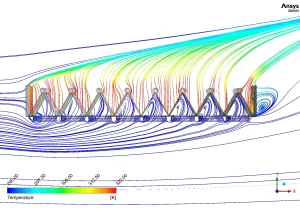
Figure 4: Temperature-Colored Streamlines, proving the thermal lift. Cold air enters at 287.15 K (Blue) and heats up to 321.69 K (Red) as it absorbs heat from the steam tubes.
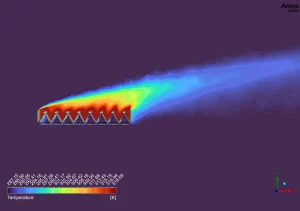
Figure 5: Temperature Contour on Horizontal Plane, illustrating the severe “Hot Air Recirculation” where 322 K exhaust air is sucked back down into the edge fans.
This highly accurate CFD analysis shows engineers exactly what to fix. Because we proved this hot recirculation exists, the manufacturer knows they must build physical “Windbreak Walls” or “Diffuser Plates” at the outer edges of the machine. These walls will physically block the hot air from curling backward, saving the power plant from losing electricity.
Key Takeaways & FAQ
- Q: What is the Fan Cell zone Fluent condition?
- A: It is a math tool in ANSYS Fluent that uses a pressure jump equation to simulate the exact pulling power of a giant fan, without needing to calculate the complex physical spinning of the blades.
- Q: Why does the air speed drop after the fan?
- A: The air is forced through the steam heat exchangers (modeled as a Porous Zone). The tightly packed metal pipes create heavy physical resistance, slowing the air from 16.46 m/s down to 4-8 m/s.
- Q: What is Hot Air Recirculation (HAR)?
- A: It is a severe flaw shown in our ACSC simulation where hot exhaust air (322 K) curves backward and is sucked back into the fans. This ruins the cooling efficiency and forces engineers to build protective Windbreak Walls.





Reviews
There are no reviews yet.