



Centrifugal pumps push massive amounts of water through industrial pipelines. Inside the heavy metal casing, a spinning steel wheel called an impeller does all the hard work. As the blades spin fast, they create intense water pressure to move the fluid forward. This heavy fluid force pushes back against the metal blades. Over time, this constant pushing makes the solid steel bend and twist. Engineers must understand this invisible stress to prevent the machine from breaking down. If you need to know more about fundamentals of centrifugal pumps, you are highly recommended to read our blog first.
Guided by the foundational research of Babayigit et al. (2015) regarding multistage pump performance, we can explore these internal forces virtually.The objective of this project is to use ANSYS Fluent & Mechanical to predict the internal water pressure and calculate the resulting structural bending of the solid steel impeller. By mapping these physical loads, designers can build stronger, more reliable pumps that last longer in the field.
- Reference [1]: Babayigit, Osman, et al. “Numerical identification of blade exit angle effect on the performance for a multistage centrifugal pump impeller.” EPJ Web of Conferences. Vol. 92. EDP Sciences, 2015.
Figure 1: The geometric model of the steel centrifugal pump impeller and the central drive shaft.
Simulation Process: One-Way FSI and MRF Setup
We place the steel impeller inside its spiral fluid casing. To simulate real operation, we must make the fluid spin. We apply the Multiple Reference Frame (MRF) method to the computational zone. This mathematical tool forces the fluid domain to rotate at 1000 rpm, simulating the true physical motion of the motor.
As the virtual water spins, it generates heavy forces. We capture this using a one-way Fluid-Structure Interaction (FSI) model. The fluid solver calculates the heavy water pressure pushing against the blades. It transfers this pressure load directly to the mechanical solver. Using the programmed Young’s modulus and Poisson’s ratio for solid steel, the mechanical solver bends the impeller. Because the metal bending is very small, it does not significantly alter the primary water flow. Therefore, a one-way data transfer is highly efficient and perfectly reliable for this specific turbomachinery CFD simulation.
Post-processing: Pressure Gradients and Impeller Structural Bending
The internal physics of a spinning pump reveals a chaotic and powerful environment. The steel impeller spins rapidly at 1000 rpm inside the spiral pump casing. This rotation grabs the incoming water from the center and throws it violently outward. We observe this physical action clearly mapped on the pressure contour. The fluid creates a strong suction zone near the central inlet, dropping to a severe low pressure of -15,923.375 Pa. As the water travels outward along the metal blades, it gains massive momentum. The spiral casing squeezes this fast-moving fluid, building up a heavy pushing force that reaches a maximum of 50,506.078 Pa near the outer discharge area.
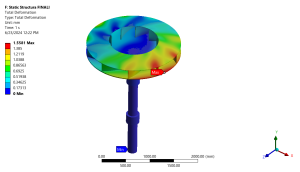
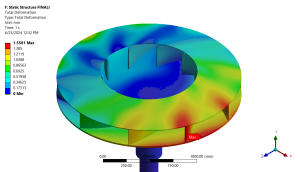
Figure 2: The structural deformation map revealing uneven bending along the unsupported outer rim of the impeller disc.
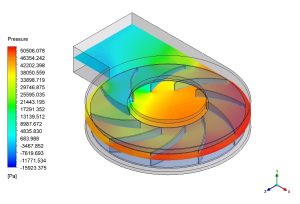
Figure 3: The pressure distribution within the spiral casing highlighting extreme fluid load variations pushing against the blades.
This huge difference between the central suction and the outer high-pressure discharge creates a severely unbalanced load on the metal. The water literally pulls on the center while pushing hard against the outer edges. The structural solver captures how the solid steel reacts to this uneven fluid force. The central shaft remains firmly locked in place by the motor bearings. The deep blue zones on the shaft show absolutely no movement, resting safely at 0 mm. However, the flat outer disc is free to flex under the heavy water load. The extreme fluid pressure pushes against the outer rim, forcing the steel to bend upward like the tip of a diving board. The bright red warning zones on the deformation map show a peak structural bending of 1.5581 mm. While this physical shift seems tiny to the naked eye, this continuous, uneven flexing during high-speed operation creates intense metal fatigue that will eventually destroy the pump.
FAQ About Centrifugal Pump Simulation and Impeller CFD
- Why does the pump impeller bend unevenly?
- The spiral design of the pump creates different pressure zones. Strong suction pulls at the center, while heavy discharge pressure pushes the outer edges. This uneven fluid load forces one side of the metal disc to bend more than the rest.
- Why use a one-way FSI model for this turbomachinery project?
- The maximum physical bending of the steel is only 1.5581 mm. Because this metal movement is so tiny, it does not change the overall path of the spinning water. Sending data only one way from the fluid to the solid provides a highly accurate result while saving computing time.







Reviews
There are no reviews yet.