
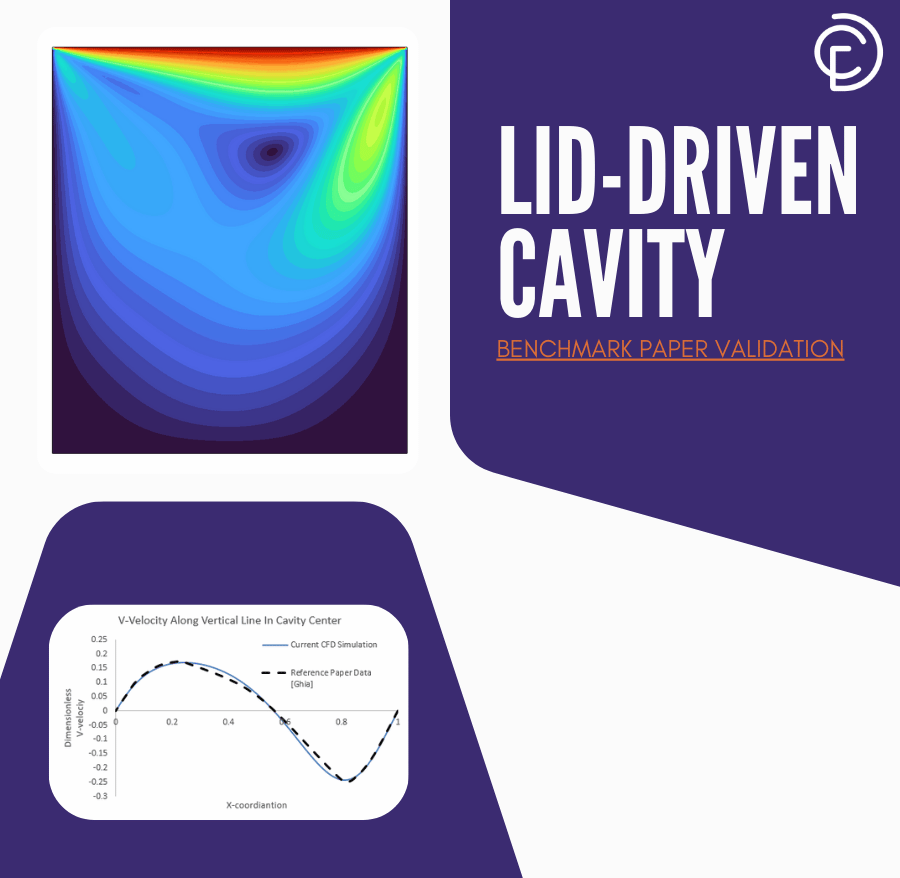
The Lid-Driven Cavity CFD simulation is one of the most important and widely used tests for any fluid dynamics solver. It’s a simple-looking problem: a square box filled with fluid where the top wall (the “lid”) moves at a constant speed, dragging the fluid inside. This simplicity is what makes it a perfect benchmark case. Its results are well-documented, especially in the famous paper by Ghia et al. [1], allowing engineers to check if their CFD software is producing accurate results. This report details a Cavity Validation CFD analysis where we replicate this classic experiment in ANSYS Fluent.
This fundamental validation exercise is a key part of our comprehensive ANSYS Fluent course for beginners, a Course that teaches you the essential skills to perform reliable and accurate simulations.
- Reference [1]: Ghia, U. K. N. G., Kirti N. Ghia, and C. T. Shin. “High-Re solutions for incompressible flow using the Navier-Stokes equations and a multigrid method.” Journal of computational physics3 (1982): 387-411.
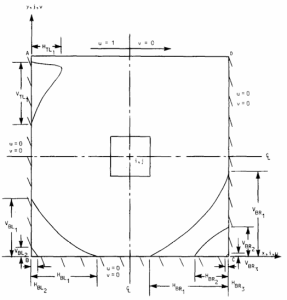
Figure 1: Cavity flow configuration and boundary conditions
Modeling the Lid-Driven Cavity Fluent Simulation
The simulation was performed using a 2D model of a square cavity. The setup is straightforward but requires precision:
- Boundary Conditions: The top wall has a constant velocity, while the other three walls are stationary (no-slip condition).* Flow Regime: The flow is defined as laminar and incompressible, which is appropriate for the target Reynolds numbers in this benchmark.
- Mesh: A high-quality, structured mesh is used, with cells clustered near the walls where velocity changes rapidly. This is critical for an accurate Cavity CFD analysis.
Results & CFD Analysis: How Lid Motion Creates a Vortex and Proves Accuracy
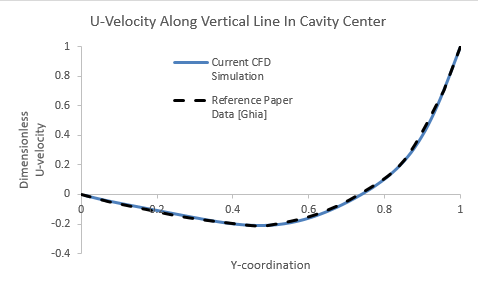
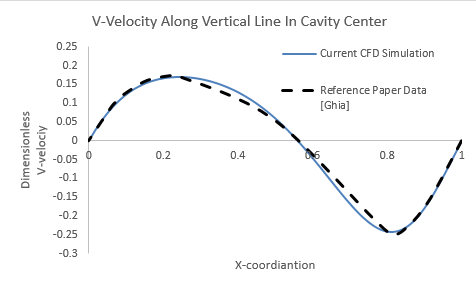
The formation of this vortex is the “effect” that we must validate to prove our model’s accuracy. This is not just a qualitative check; it is a quantitative CFD Validation. We do this by comparing specific velocity measurements from our simulation against the trusted results from Ghia et al. [1]. The graphs in Figure 2 show the velocity profiles along the vertical and horizontal centerlines of the cavity. The solid lines represent our Lid-Driven Cavity Fluent simulation results, while the circles represent the benchmark data from Ghia. The lines pass directly through the circles, demonstrating a near-perfect match. This excellent agreement is the definitive proof that our simulation is correctly capturing the complex physics of this shear-driven flow. **The most significant achievement of this analysis is the clear, quantitative validation of the CFD model. By showing that the momentum transfer from the moving lid (the cause) produces a primary vortex with velocity profiles that precisely match the established benchmark data (the effect), we have rigorously confirmed the accuracy and reliability of the ANSYS Fluent solver for viscous, incompressible flow problems, establishing a foundation of trust for more complex simulations.
The graphs contrasting the resulting velocity profiles with the reference data provide a strong agreement, so validating the precision of the present CFD simulation. The strong correlation between the simulated findings and the benchmark data for both U and V velocity components verifies that the simulation accurately represents the flow dynamics within the cavity at Re=100. This agreement indicates that the selected numerical methods and mesh resolution are sufficient for accurately capturing the flow characteristics at this Reynolds number.
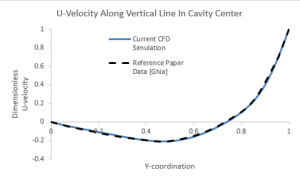
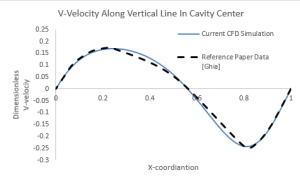
Figure 2: Validation graphs comparing the velocity profiles from the present study (solid lines) against the benchmark data from Ghia et al. (circles). The excellent agreement confirms the simulation’s accuracy.
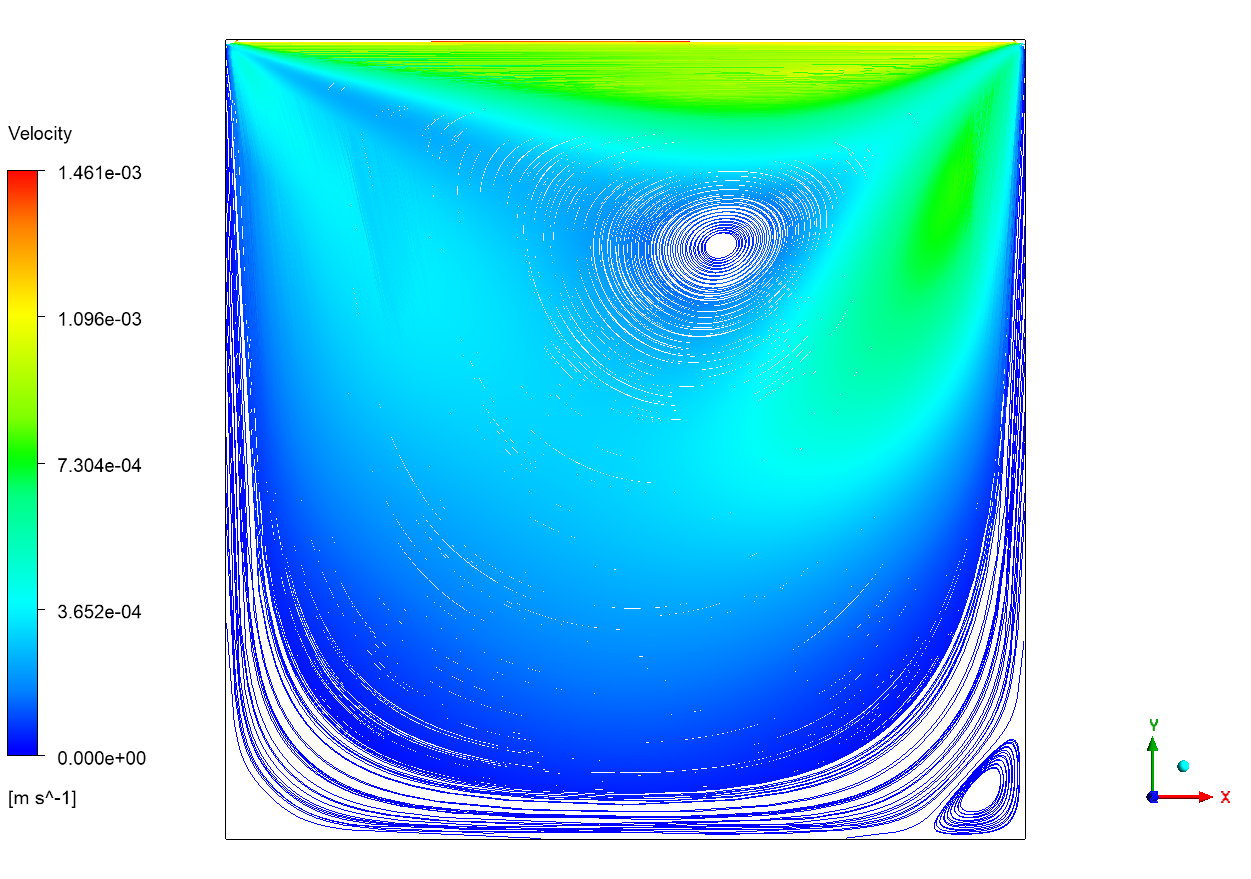
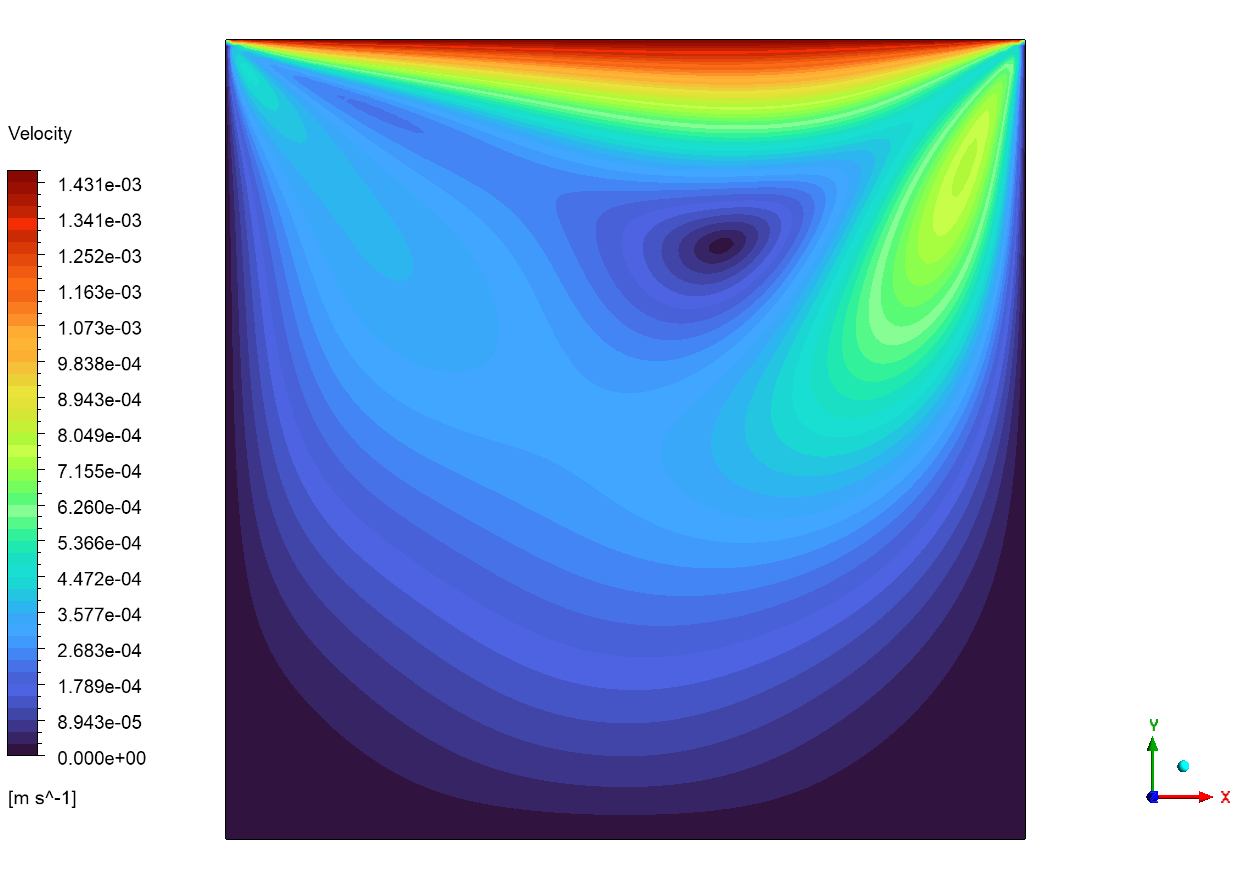
The simulation results provide a clear and fully substantiated story that begins with the moving lid, which is the sole “cause” of all fluid motion. Due to the fluid’s viscosity (its “stickiness”), the lid drags the layer of fluid directly touching it at the same speed. This moving layer then drags the layer below it, which in turn drags the next, and so on. This transfer of momentum from the top down is the engine that drives the flow. The immediate “effect” of this is the creation of a large, primary vortex that fills the cavity. The fluid is dragged across the top, is forced down by the right wall, travels back across the bottom, and rises up the left wall to complete the cycle. The velocity streamlines in Figure 3 provide a perfect, clear visualization of this main recirculation zone.
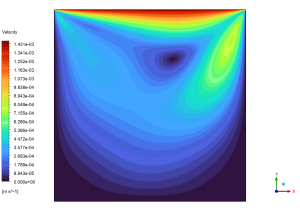
Figure 3: Velocity streamlines from the Lid-Driven Cavity CFD simulation, clearly visualizing the large primary vortex and smaller secondary vortices in the corners.
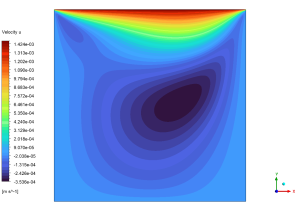
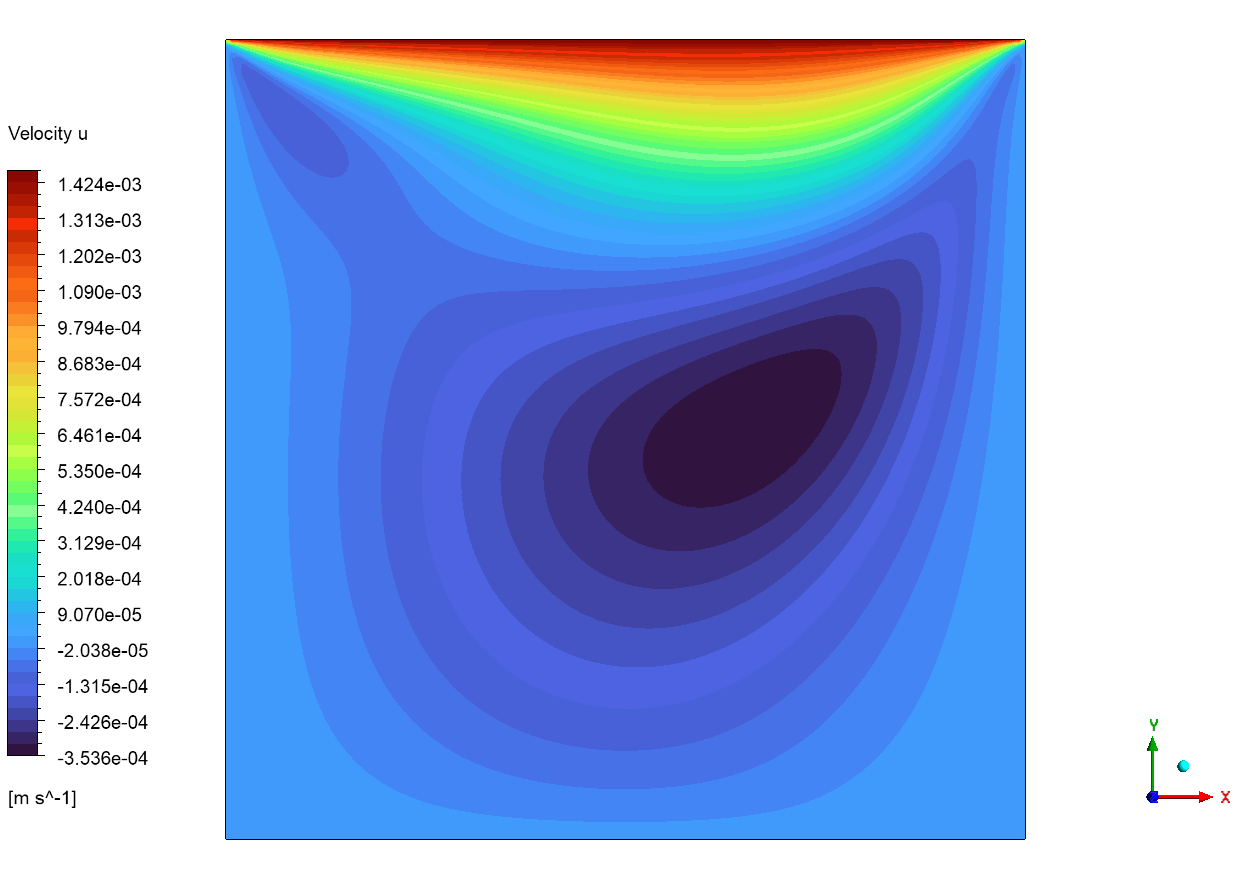
Figure 4: U-velocity in Lid-driven cavity CFD simulation
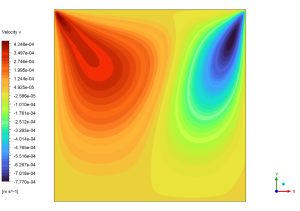
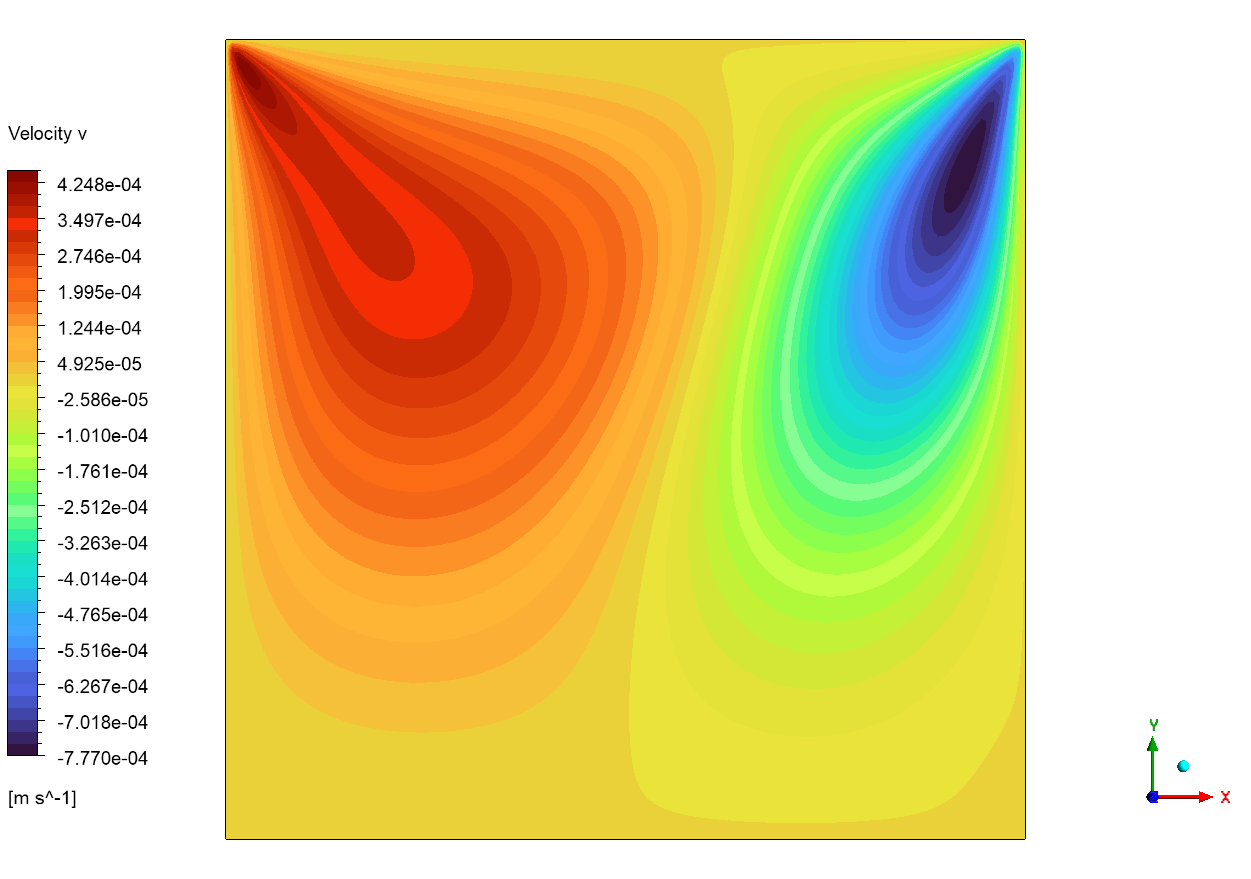
Figure 5: V-velocity in Lid-driven cavity CFD simulation






Reviews
There are no reviews yet.