


In many electronic devices, cooling fans are not an option due to noise or space limits. Instead, engineers rely on Heat sink natural convection. This is a form of passive cooling where no external power is used to move the air. The process works on a simple principle: the heat sink fins get hot, which warms the surrounding air. As the air gets hotter, it becomes lighter (less dense) and rises. This movement creates a continuous flow of cool air replacing the hot air, keeping the electronics safe.
Designing these systems requires precise Heat sink thermal analysis. A poorly designed heat sink can lead to overheating and component failure. To prevent this, we use CFD simulation to predict performance before manufacturing. This project performs a detailed Heat Sink Fins CFD validation study. We simulate the airflow and heat transfer to check our accuracy against the experimental work of Liou et al. [1]. For more guides on thermal management, please visit our Heat Transfer tutorials.
- Reference [1]: Liou, Hung-Jyun, Shwin-Chung Wong, and Yi-Cheng Lin. “Revisit on the natural convection from horizontal multi-channel rectangular-fin heat sinks.” International Journal of Thermal Sciences171 (2022): 107232.
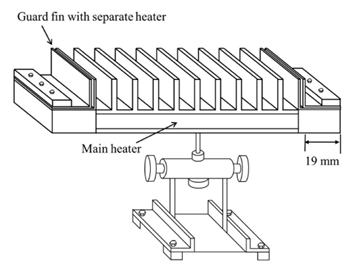
Figure 1: The experimental setup of the heat sink used in the validation paper [1].
Simulation Process: Modeling Buoyancy in ANSYS Fluent
The simulation process began with creating a 3D model of the rectangular-fin heat sink using ANSYS Design Modeler. To simulate the open environment, a large air domain was drawn around the solid part. We then used ICEM to generate a high-quality structured mesh. The mesh contains 2,217,120 cells. A fine mesh is absolutely essential for Natural Convection CFD because the air movement is very slow and sensitive to small changes.
The physics setup in ANSYS Fluent focused on capturing the buoyancy-driven flow. We activated the Boussinesq model for density. This model tells the solver how the air density changes as the temperature rises. Without this, the software would not know that hot air should rise. We set the flow to Laminar, which is typical for natural convection where air speeds are low. This setup allows us to perform a rigorous Heat sink thermal analysis, calculating exactly how much heat the fins can dissipate.
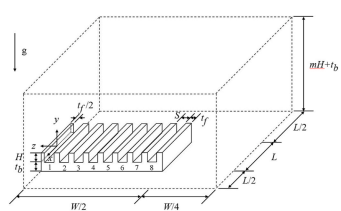
Figure 2: The computational domain showing the heat sink placed within the larger air volume for the CFD simulation. [1].
Post-Processing: Thermal Analysis and Validation
The most critical step in this tutorial is the validation. We compared our Heat sink fins simulation results with the reference data. The table below shows the heat transfer coefficient (h) for two different channels on the heat sink. For Channel 1, our CFD simulation predicted a value of 3.07 W/m²K, compared to the paper’s 3.11 W/m²K. This is an error of only 1.3%. For Channel 2, the error is even lower at 1.1%. This proves that our Heat sink natural convection model is highly accurate.
| h (paper) | h (CFD Simulation) | Error | |
| Channel 1 | 3.11 | 3.07 | 1.3% |
| Channel 2 | 3.49 | 3.45 | 1.1% |
To understand the physics, we analyze the contours in Figure 3. The temperature contour shows the fins reaching a peak temperature of 358K(about 85°C). This heat is the “engine” of the flow. The velocity contour reveals the result: a plume of warm air rising directly above the heat sink. The maximum velocity reaches 0.51 m/s. This speed is generated entirely by the temperature difference. The hot fins decrease the air density, causing it to float upward against gravity. This visual confirmation of the thermal plume demonstrates that the fins are effectively transferring heat into the air, validating the thermal performance of the design.
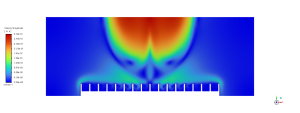
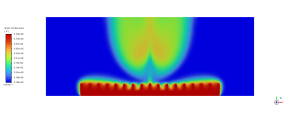
Figure 3: Velocity field (top) and temperature distribution (bottom) showing the rising thermal plume.
Key Takeaways & FAQ
- Q: What drives the airflow in natural convection?
- A: The airflow is driven by buoyancy. As the heat sink fins warm the air, the air expands and becomes less dense. Gravity pulls the cooler, heavier air down, which pushes the hot, lighter air up. This creates a continuous cycle of airflow without any fans.
- Q: Why is the Boussinesq model used in Fluent?
- A: The Boussinesq model is a simplified way to calculate density changes based on temperature. It is very efficient and accurate for natural convection CFD problems where temperature differences are small to moderate. It links the temperature field directly to the momentum equation (gravity force).
- Q: What is the heat transfer coefficient (h)?
- A: It is a measure of how well heat flows from a solid surface (the fin) to a fluid (the air). In our validation, values like 3.07 W/m²K indicate the efficiency of the heat transfer. A higher “h” means better cooling performance.









Reviews
There are no reviews yet.