


A Particle deposition in microchannel with Slip walls CFD simulation is a computer model that studies how tiny particles stick to the walls inside very small channels. This is a critical process in devices like microchips and medical labs-on-a-chip. This Microfluidics CFD Simulation helps engineers understand and prevent channel blocking, or fouling. When channels are this small, the air flow behaves differently; it can slide along the wall instead of stopping completely. This is called a slip wall. A Particle deposition in microchannel Fluent analysis uses the Discrete Phase Model (DPM) to track individual particles. It includes special forces like Saffman lift and Brownian motion, which control how these tiny particles move. This type of Slip walls CFD study is essential for designing reliable micro-devices.
- Reference [1]: Hosseini, Seyed Mohammad Javad, Ataallah Soltani Goharrizi, and Bahador Abolpour. “Numerical study of aerosol particle deposition in simple and converging–diverging micro-channels with a slip boundary condition at the wall.” Particuology13 (2014): 100-105.

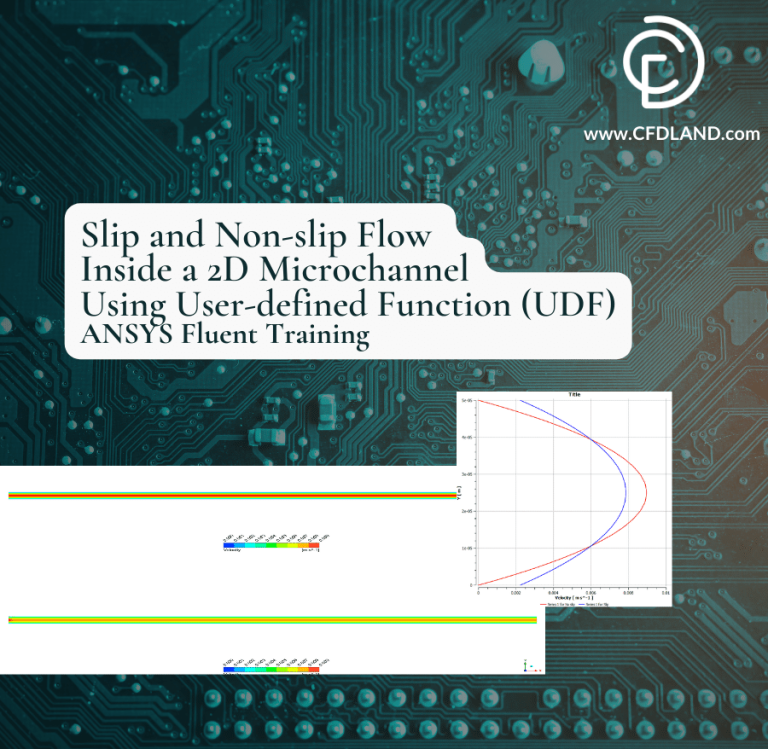
Figure 1: A comparison of gas velocity contours, showing the difference between a standard no-slip condition and the Slip walls Fluent model in a microchannel [1].
Simulation Process: Fluent DPM Setup, Modeling Slip Flow and Particle Forces in a Microchannel
To perform this Particle deposition in microchannel Fluent study, we created a 2D model of the microchannel. This approach is efficient and accurate because the channel is much longer than it is tall, so the most important physics happen in two dimensions. We then built a high-quality structured mesh with organized, square-like cells. In ANSYS Fluent, a special User Defined Function (UDF) was used to create the slip wall condition. This UDF applies the Maxwell slip velocity model, which correctly simulates how gas flows in micro-channels where the flow can slide along the surface. The most important part of the setup was the Two-Way Discrete Phase Model (2-Way DPM). This model was used to introduce and track tiny inert particles with a diameter of 1e-6 m. To make the particle tracking realistic, we included several key forces. The Stokes-Cunningham drag law was used to calculate the drag on the particles. We also activated the Saffman lift force, which pushes particles away from the wall in fast-moving flow, and the Brownian force, which models the random zig-zag motion of small particles as they are hit by air molecules.
Post-processing: CFD Analysis, Correlating Slip Velocity with Particle Transport and Deposition
The simulation results provide a complete understanding of how slip walls affect particle deposition. From an engineering viewpoint, the key is to see how the special wall condition changes the particle behavior. The particle velocity contours in Figure 2 show that particles are moving at speeds up to 0.02 m/s in the center of the channel. Crucially, unlike a normal pipe flow, the velocity near the walls is not zero. This non-zero wall velocity is direct proof that our UDF for the slip condition is working correctly. This slip effect allows particles near the wall to keep moving, which changes how they deposit. The velocity vectors in Figure 3 confirm the flow is smooth and laminar, but they also show particles moving across the main flow direction near the walls. This cross-stream movement is caused by the combination of the Saffman lift force and the random Brownian motion, which are the main reasons particles either move toward the wall to deposit or are pushed away from it.

Figure 2: Particle velocity magnitude contours from the Particle deposition in microchannel CFD simulation, showing particle transport patterns with slip walls.

Figure 3: Velocity vectors displaying the laminar flow field and particle motion, highlighting the effect of the UDF for slip walls.
The DPM volume fraction contours in Figure 4 show where the particles are concentrated. The highest concentration (up to 1.42e-15) is in the center of the channel, where the particles are carried along by the main flow. The concentration is lower near the walls, which is the zone where particles are being removed from the flow by deposition. Finally, the particle residence time in Figure 5 links everything together. It shows that particles can stay in the channel for up to 1.39 seconds. The particles near the bottom wall (red regions) have the longest residence time. This is the most important finding for predicting fouling. A longer residence time means the particle has more opportunity to be captured by the wall due to random Brownian motion. This confirms that particles that slow down near the slip walls are the most likely to deposit.
The most important achievement of this simulation is its successful use of a UDF-driven slip model combined with a detailed DPM analysis to prove that particles near the walls have longer residence times. This directly correlates to a higher probability of deposition, providing a clear physical reason for microchannel fouling and offering a validated tool to design more resistant surfaces.

Figure 4: DPM volume fraction contours from the Discrete Phase Model (DPM) Fluent analysis, revealing the distribution of particle concentration.

Figure 5: Particle residence time distribution, showing how long particles stay in the microchannel, which is a key factor in deposition.








Reviews
There are no reviews yet.