


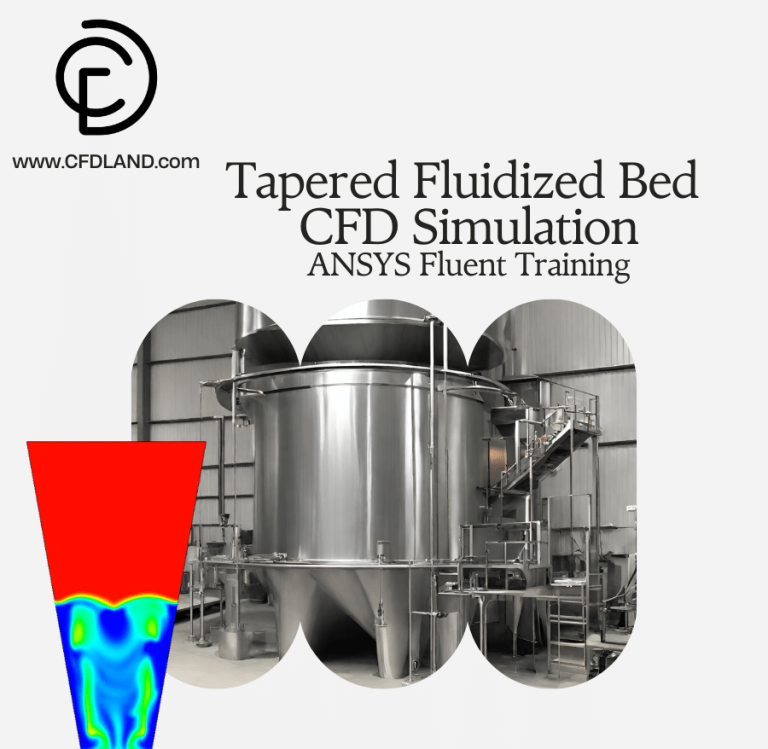
A Conical Fluidized Bed reactor is a very advanced tool used in many industries, such as chemical processing and environmental cleanup. Unlike a standard cylinder pipe, this reactor is shaped like a cone. This shape gives it a big advantage. It helps particles mix better and move more smoothly. Because the shape changes, the heat and chemical substances spread out evenly across the whole bed. This leads to faster and better reactions.
In this Conical Fluidized Bed CFD simulation, we perform a CFD simulation study. We recreate the experiment described in the research paper by Cooper and Coronella (2005). We simulate the mixing of two different materials: Coke and Titanium Dioxide (TiO2). We use ANSYS Fluent to model how these particles interact. This ANSYS Fluent multiphase tutorial helps you understand the Eulerian-Eulerian approach for granular flows. For more multiphase projects, please visit our Multiphase CFD tutorials.
- Reference [1]: Cooper, Scott, and Charles J. Coronella. “CFD simulations of particle mixing in a binary fluidized bed.” Powder Technology 151.1-3 (2005): 27-36.

Figure 1: Schematic diagram of the conical fluidized bed geometry. [1]
Simulation Process: Geometry, Mesh, and Eulerian Multiphase Setup
For this Conical Fluidized Bed CFD analysis, we started by designing the geometry using ANSYS Design Modeler. The shape is conical, which means it gets wider at the top. We had to be very careful with the blocking strategy to create a high-quality mesh. We generated a structured grid using quadrilateral elements in ANSYS Meshing. A structured grid is essential for multiphase flows because it helps the solver calculate the particle movement accurately without errors.
Next, we set up the physics in the ANSYS Fluent solver. Simulating granular flow is complex because we have two different solid materials mixed with gas. Therefore, we selected the Eulerian Multiphase Model. This model treats the gas, the Coke particles, and the TiO2 particles as separate “phases” that interact with each other. We had to define specific properties for the granular materials. Coke particles are much larger than TiO2 particles. Because of this size difference, the “phase pairs” setting is very important. It tells the software how the big particles collide with the small particles. We also set the drag laws to calculate how the gas pushes these solids upwards.
.
Post-processing: Conical Fluidized Bed CFD Particle Mixing Analysis
In this section, we analyze the results of the Conical Fluidized Bed simulation. We focus on the mixing quality and the flow patterns of the different particles. First, we analyze the Flow and Velocity Patterns. The conical shape creates a unique flow behavior. As the gas moves up, the cross-section of the cone gets bigger. This causes the gas velocity to decrease. This natural velocity gradient is great for mixing. It prevents the particles from just shooting out the top. The animation shows that the flow is very dynamic. We see a “circulation pattern” where particles move up in the center and fall down near the walls. This circulation is crucial for avoiding “dead zones” where no reaction happens.


Figure 2: Coke & Gas volume fraction contour of Particle Mixing in a Conical Fluidized Bed CFD Simulation

Figure 3: TiO2 volume fraction contour showing segregation patterns.
Second, we examine the Particle Mixing and Segregation. The contours clearly show the interaction between the Coke and TiO2. The smaller TiO2 particles have a lower Stokes number, which means they follow the gas flow easily and disperse widely. The larger Coke particles are heavier and tend to stay lower or move towards the walls. However, the simulation shows that they eventually mix well. In the center of the bed (the core zone), the interaction is strongest. The mass fraction contours show that the concentration of both phases settles between 0.3 and 0.7. This indicates a high quality of mixing. The simulation successfully captures the transition from initial separation to a well-mixed state, validating the effectiveness of the Eulerian model for this type of reactor.
Key Takeaways & FAQ
- Q: What is a Fluidized Bed?
- A: It is a vessel containing solid particles. When a gas is pumped from the bottom at high speed, the particles float and behave like a fluid. This provides excellent contact between the gas and the solids.
- Q: Why use a Conical Fluidized Bed instead of a cylindrical one?
- A: In a cylinder, the gas speed is constant. In a cone, the speed drops as the area gets wider. This change in speed creates better circulation and mixing, and it prevents particles from being blown out of the reactor.
- Q: What is the Eulerian Multiphase Model?
- A: It is a CFD method where both the fluid (gas) and the solids (particles) are treated as continuous phases that penetrate each other. It is the best model for dense flows with many particles.
- Q: What causes particle segregation?
- A: Segregation happens when particles of different sizes or densities separate. Heavier particles sink, and lighter particles float. A good reactor design, like the conical bed, fights this segregation to ensure good mixing.




Reviews
There are no reviews yet.