


Structures submerged in moving fluids face constant physical threats. Think of a tall metal pillar standing in a fast river. The water pushes hard against the solid surface. If the material is flexible, it bends backward. But as it bends, it acts like a loaded spring and snaps back. This creates a continuous, chaotic sway. If this vibration grows too wild, the metal snaps. Engineers must predict these dangerous physical loops before building real structures.
The objective of this project is to use ANSYS Fluent to analyze the internal fluid pressure and calculate the resulting physical sway of a flexible vertical plate. By mapping these continuous forces, designers can prevent sudden structural failures in real-world marine and industrial environments.
Simulation Process: Two-Way FSI Modeling Setup
We place a vertical plate inside a fluid testing channel. The bottom base of the plate is firmly locked to the floor, while the top stands free in the fluid. To capture the true physical sway, we rely on a two-way FSI modeling approach.
Standard one-way models only send data in a single direction. That is not enough here. We establish a continuous Fluent-structural coupling loop. The fluid solver maps the water pressure pushing against the obstacle. It fires this data to the mechanical solver. The mechanical solver bends the solid plate based on the pressure load. Because the plate bends significantly, it physically changes the shape of the fluid channel. The structural solver sends these new geometric coordinates straight back to Fluent. The fluid mesh updates, and the cycle repeats. For these cases, continuous data loop is a core focus of our fluid-structure interaction tutorials.
Post-processing: Fluid Suction, Material Stress, and Dynamic Sway
The physics of an oscillating plate shows a destructive cycle of energy. The story begins with the moving fluid. As the plate swings through the channel, it pushes the fluid away on one side and leaves an empty void on the other. We observe this massive imbalance clearly on the pressure contour. The fluid pushes hard against the leading face, generating a positive pressure of 0.134 Pa. Meanwhile, the trailing face creates a deep vacuum, dropping to a severe suction zone of -4.341 Pa.
This heavy pressure gap pulls and pushes the solid material violently. The structural body must absorb this load. The Von-Mises stress contour reveals exactly where the material suffers the most damage. The top of the plate is free to move, so it safely avoids heavy strain, dropping to a minimum stress of 2.5985e-6 MPa. However, the bottom base cannot move. All the bending force travels straight down to this locked root. This creates a highly concentrated, dangerous stress hotspot peaking at 0.020873 MPa.
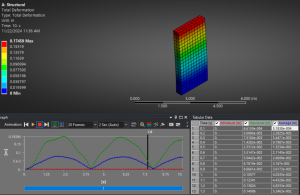
Figure 1: The dynamic displacement history and contour capturing the continuous, rhythmic sway over a 10-second period.

Figure 2: The structural stress map showing the dangerous load concentration resting entirely at the locked root.
Because the fluid forces never stop pushing, the strained metal cannot stay still. We evaluate the total deformation contour and data graph to capture the final physical sway. The locked bottom root stays perfectly safe at 0 m. The free tip absorbs the energy and whips violently through the fluid. The structural solver records a maximum physical bend of 0.17459 m at the very top edge. We track this aggressive motion over a continuous 10. s testing window. The transient displacement graph plots a beautiful, repeating wave. The tip swings forward, stops, and whips backward over and over again. This rhythmic chart proves the Fluent-structural coupling perfectly captures the true chaotic nature of a vibrating plate

Figure 3: The fluid pressure distribution highlighting the massive physical force driving the plate motion.
FAQ About Plate FSI Modeling and Oscillation
- Why does the vertical plate bend back and forth continuously?
- The severe fluid pressure difference pushes the plate forward. As it bends, the solid material’s natural stiffness acts like a spring, pulling it back. This fight between fluid pushing and structural pulling creates continuous oscillation.
- Where is the highest stress located on the vibrating plate?
- The maximum internal stress hits 0.020873 MPa right at the fixed bottom base. The top is free to move, but the locked bottom must absorb all the bending leverage.
- Why is two-way FSI modeling required for this CFD project?
- The free tip of the plate moves a massive 0.17459 m. This large physical movement drastically changes the path of the surrounding fluid. The fluid and solid solvers must talk back and forth continuously to capture the true changing environment.








Reviews
There are no reviews yet.