
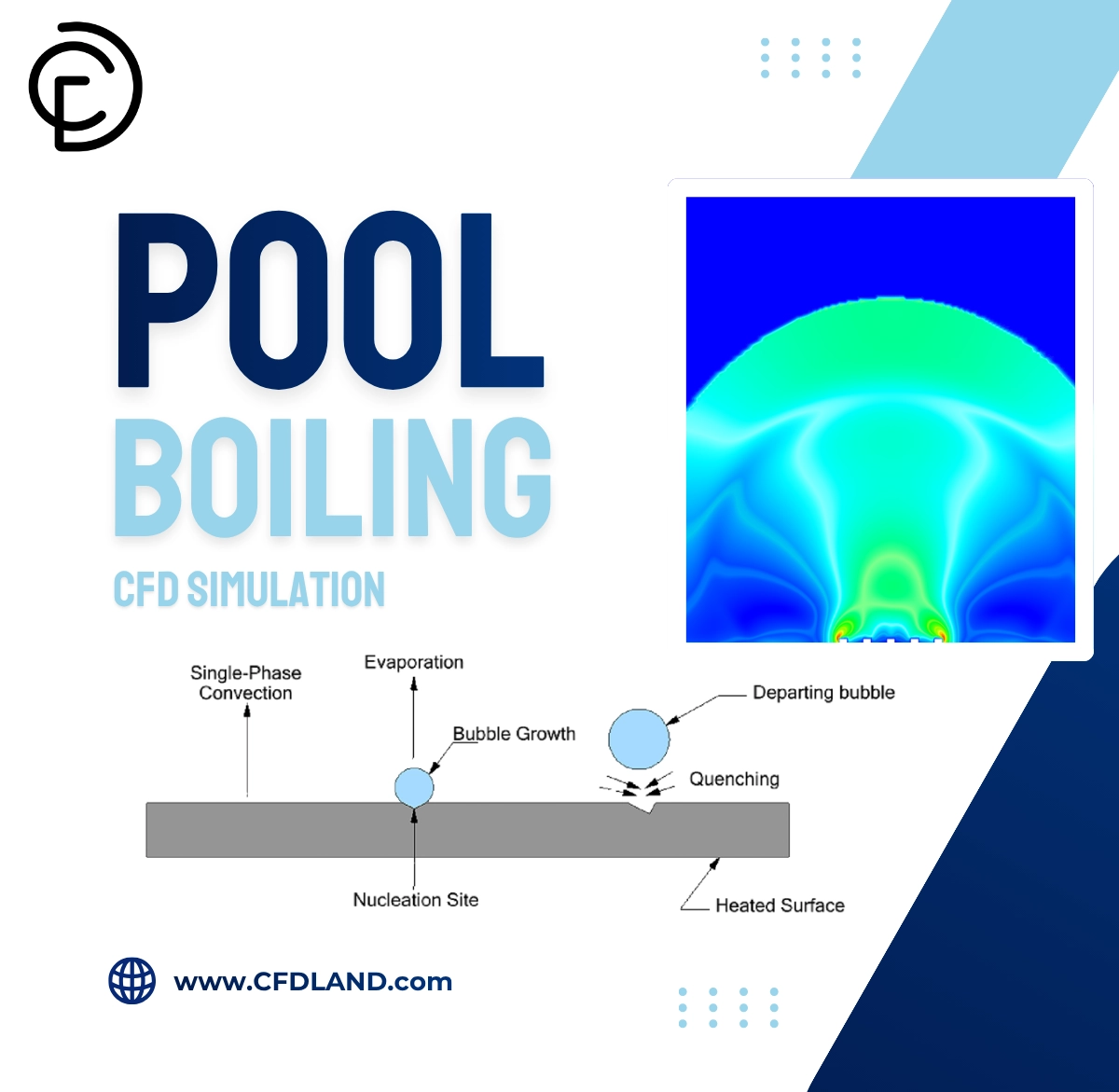
Heating a liquid until it turns into vapor is a vital industrial cooling process. Boiling happens when a hot solid surface sits inside a stationary pool of liquid. Designers often add small fins to this hot surface. Fins increase the contact area and speed up the thermal cooling. Building physical test models for this is very expensive. Instead, We use a detailed pool boiling CFD simulation to understand how the bubbles form, grow, and detach safely.
We base our computational model on the academic paper by Jaswal et al. By recreating their finned surface experiment, this ANSYS tutorial teaches you how to calculate phase changes and thermal forces. You can find more advanced phase-change tutorials in our Mass Transfer CFD simulation training section.
- Reference: Jaswal, Rajan, et al. “Experimental and numerical investigation of pool boiling heat transfer from finned surfaces.” Applied Thermal Engineering233 (2023): 121167.
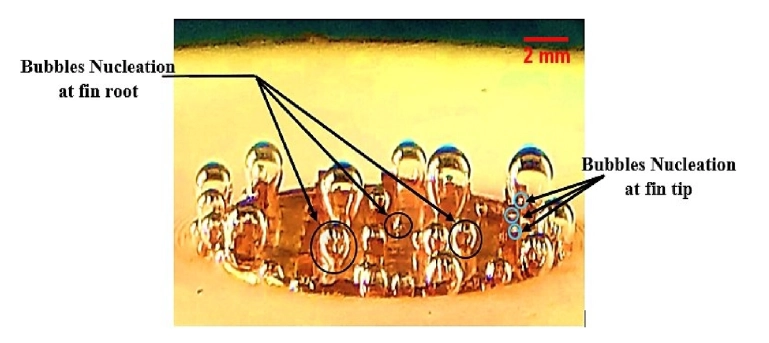
Figure 1: The physical nucleation of bubbles forming at the roots and tips of the solid fins. [1]
Simulation Process: Eulerian Setup in Pool Boiling Numerical Study
To recreate the physical boiling process, we build a 2D computational domain containing the rectangular fins. We divide this fluid space using a dense grid of 464,503 quad elements. We use the Eulerian multiphase model combined with the RPI wall boiling model. This specific setup calculates the physical interaction between the heavy liquid water and the light water vapor.
We must calculate the physical forces acting on the bubbles. The drag model calculates the fluid resistance pushing against the rising bubbles. The wall lubrication force physically pushes the vapor away from the solid fin walls. The Lopez de Bertodano turbulent dispersion force spreads the bubbles out. Finally, the Cole correlation finds the bubble departure frequency. These dynamic forces define the true physics of a pool boiling Fluent simulation. We apply these standard mathematical formulas to calculate the multiphase forces:
F_{k, LW} = C_{WL}\rho_l \alpha_g |v_l - v_g|^2 n_w
C_{WL} = \max\left(0, \frac{C_{W1}}{d_{bubble}} + \frac{C_{W2}}{y_w}\right)
F_{l, dispersion} = -F_{g, dispersion} = C_{TD}\rho_l K_l \nabla \alpha_g
C_D = \min(C_D^{vis}, C_D^{dis})
f = \frac{\sqrt{4g(\rho_l - \rho_g)}}{3\rho_l d_{bubble}}
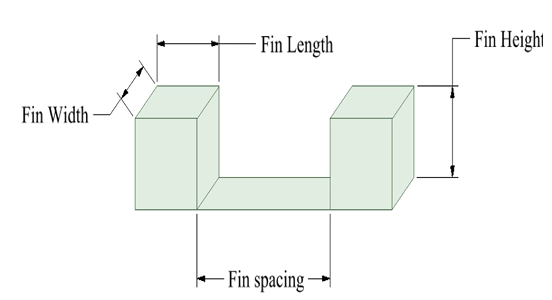
Figure 2: The geometric parameters of the rectangular fins used to build the computational domain.
Post-processing: Heat Flux Outputs in Pool Boiling Simulation
To check our setup, we calculate the surface heat transfer rates. The RPI model splits the total energy into three distinct parts: convective, quenching, and evaporative heat flux.
q_{total} = q_{conv} + q_{quen} + q_{evap}
q_{quen} = C_W \sqrt{\frac{2k_l}{\pi \alpha_l t_w}}(T_s - T_l)A_{bubble}
We run the test with a saturation temperature of 373.15 K and a wall superheat of 22 K. The table below shows our final thermal achievements. The quenching heat flux hits 106,330.68 W/m². This is slightly higher than the evaporation heat flux of 95,328.43 W/m². This physical balance proves that cold liquid rewetting is the main cooling driver. The total surface heat flux reaches a very high output of 202,561.76 W/m².
| Parameter | Value | Unit |
| Vapor Volume Fraction | 0.0105 | – |
| Saturation Temperature | 373.15 | K |
| Evaporation Heat Flux | 95,328.43 | W/m² |
| Quenching Heat Flux | 106,330.68 | W/m² |
| Total Surface Heat Flux | 202,561.76 | W/m² |
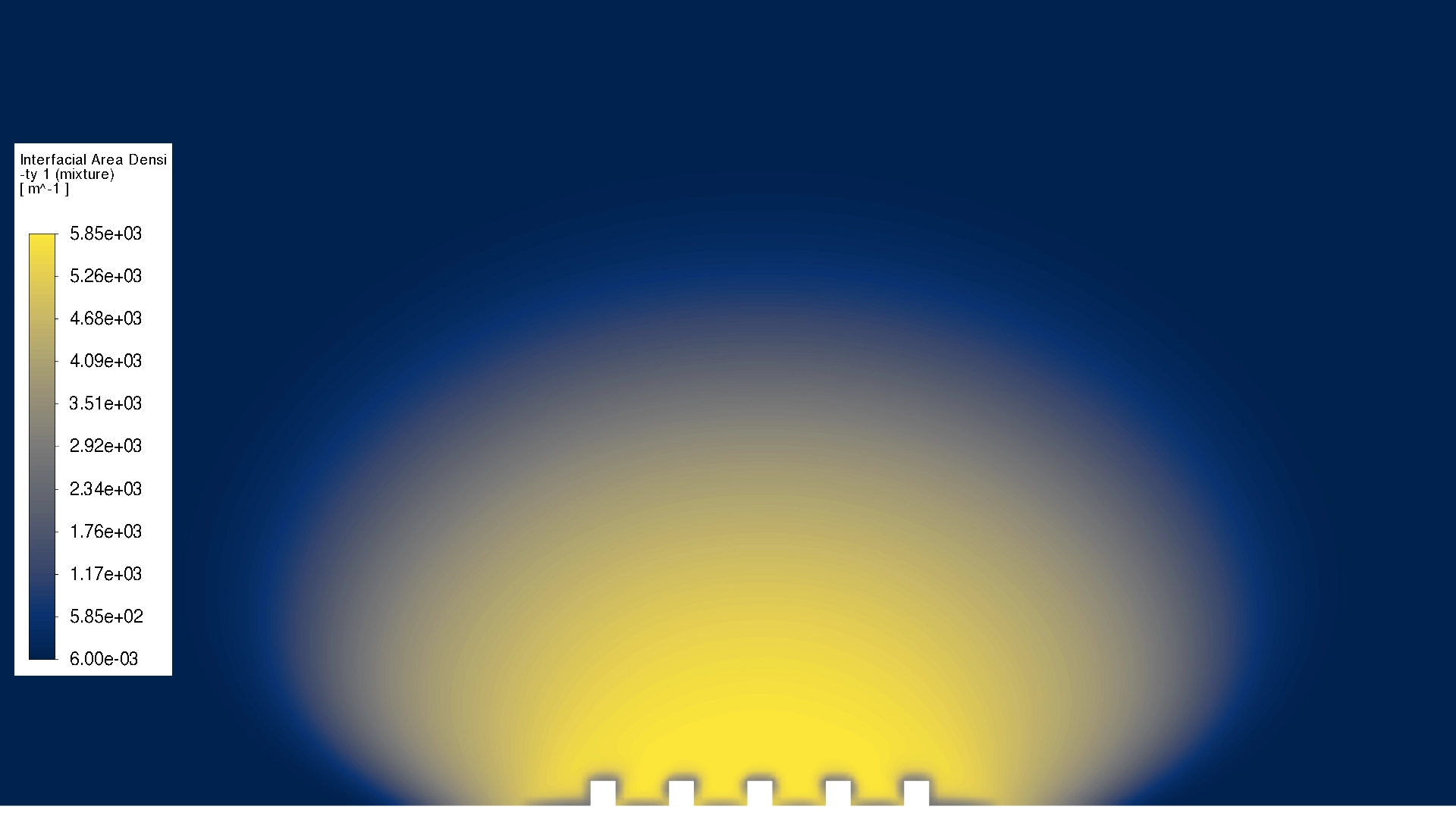
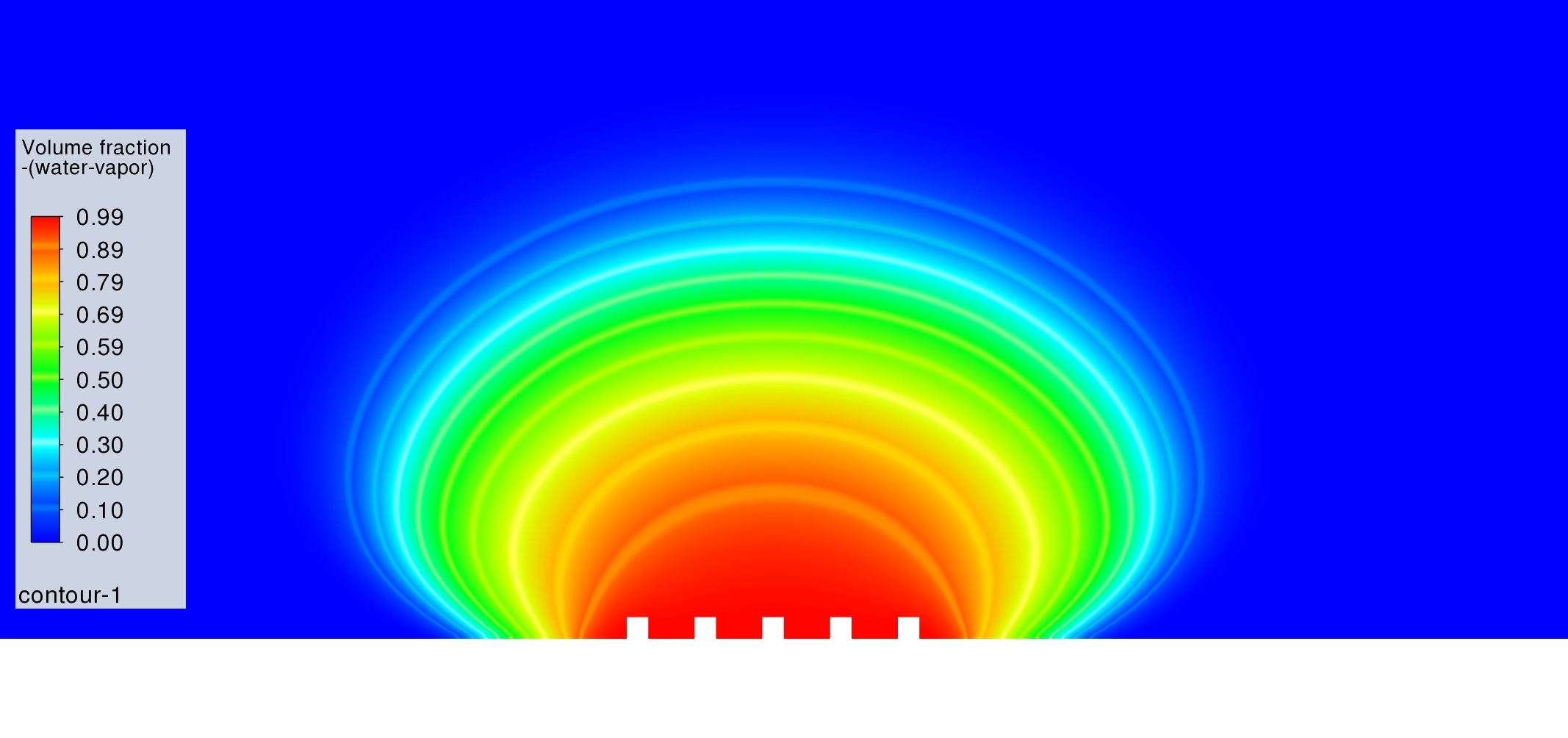
We analyze the contours to understand the phase change physics. The vapor volume fraction contour shows a large vapor dome sitting directly above the fins. The red center reaches a pure vapor value of 0.99. The color fades to a blue liquid value of 0 far from the heater. This proves that individual bubbles successfully merge into a large vapor mass right after leaving the solid finned surface.
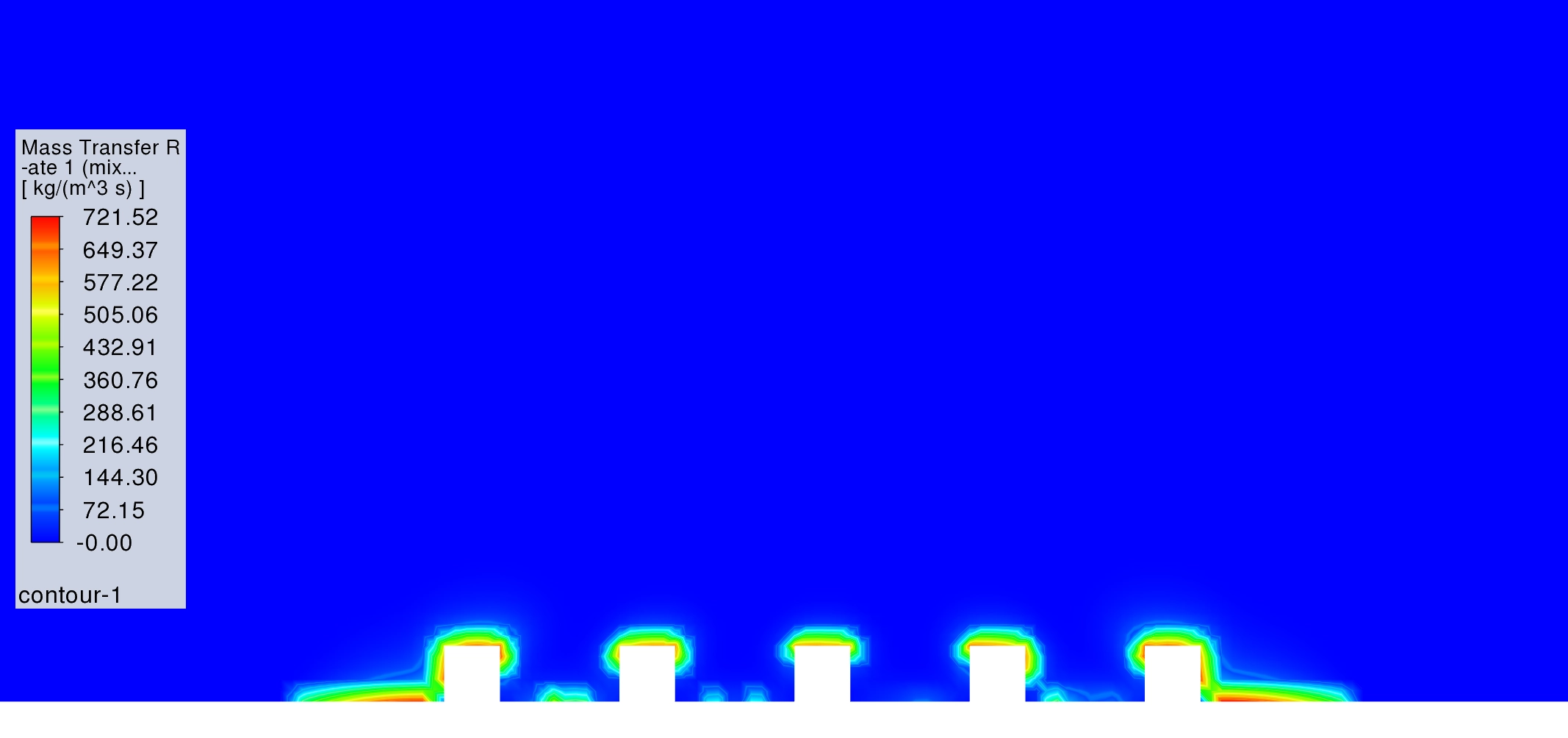
The mass transfer rate contour explains where the boiling physically happens. The phase change is strongest exactly at the fin edges and gaps. We see a high red value of 721 kg/m³·s tightly wrapping the fin tips. This confirms that adding physical fins drastically increases the active evaporation area.
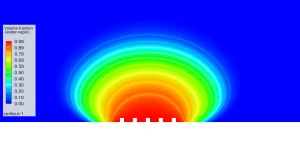
Figure 3: The vapor dome proving that small bubbles merge into a larger mass after departure.
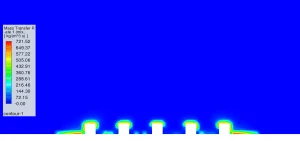
Figure 4: The mass transfer field confirming that boiling phase change is strongest at the fin edges.
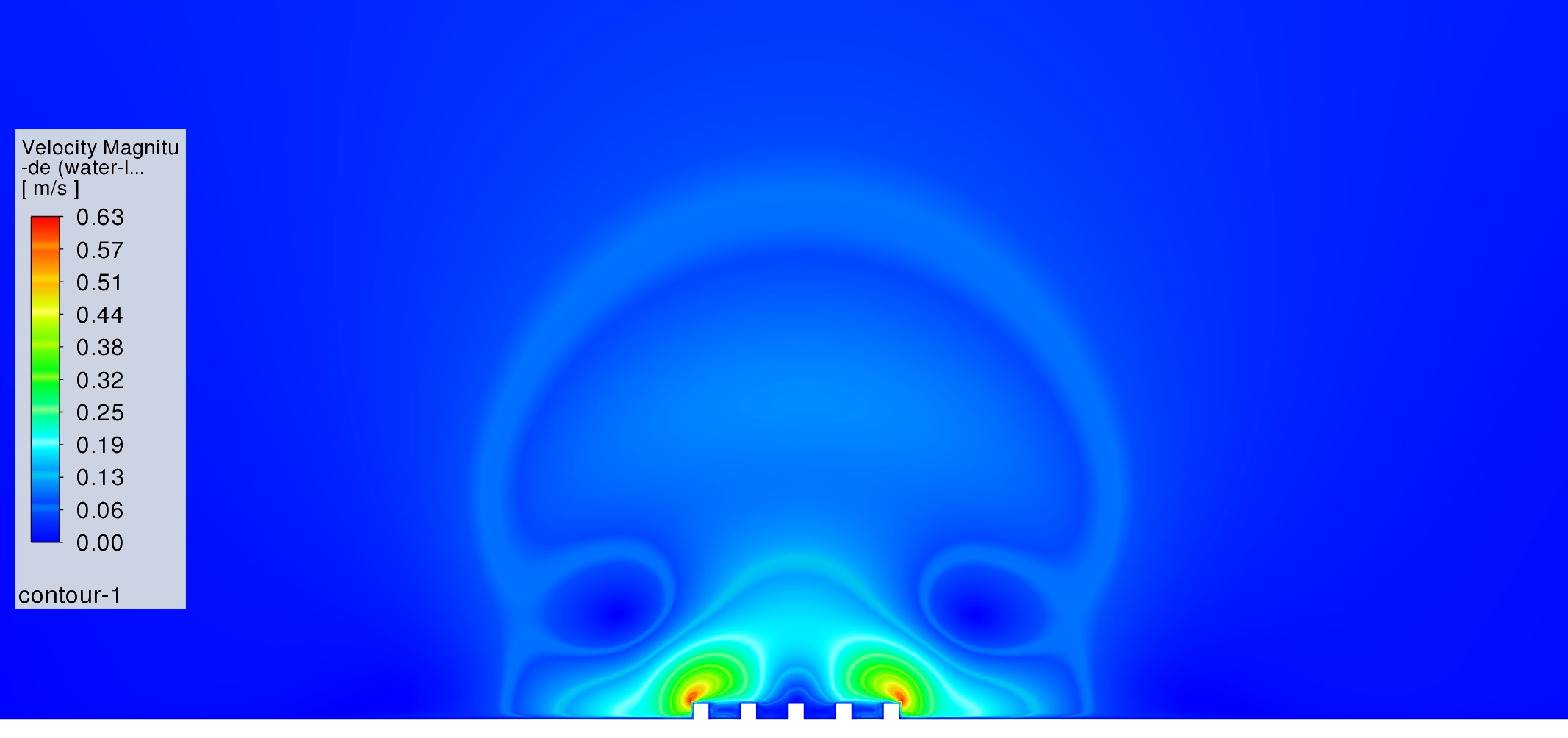
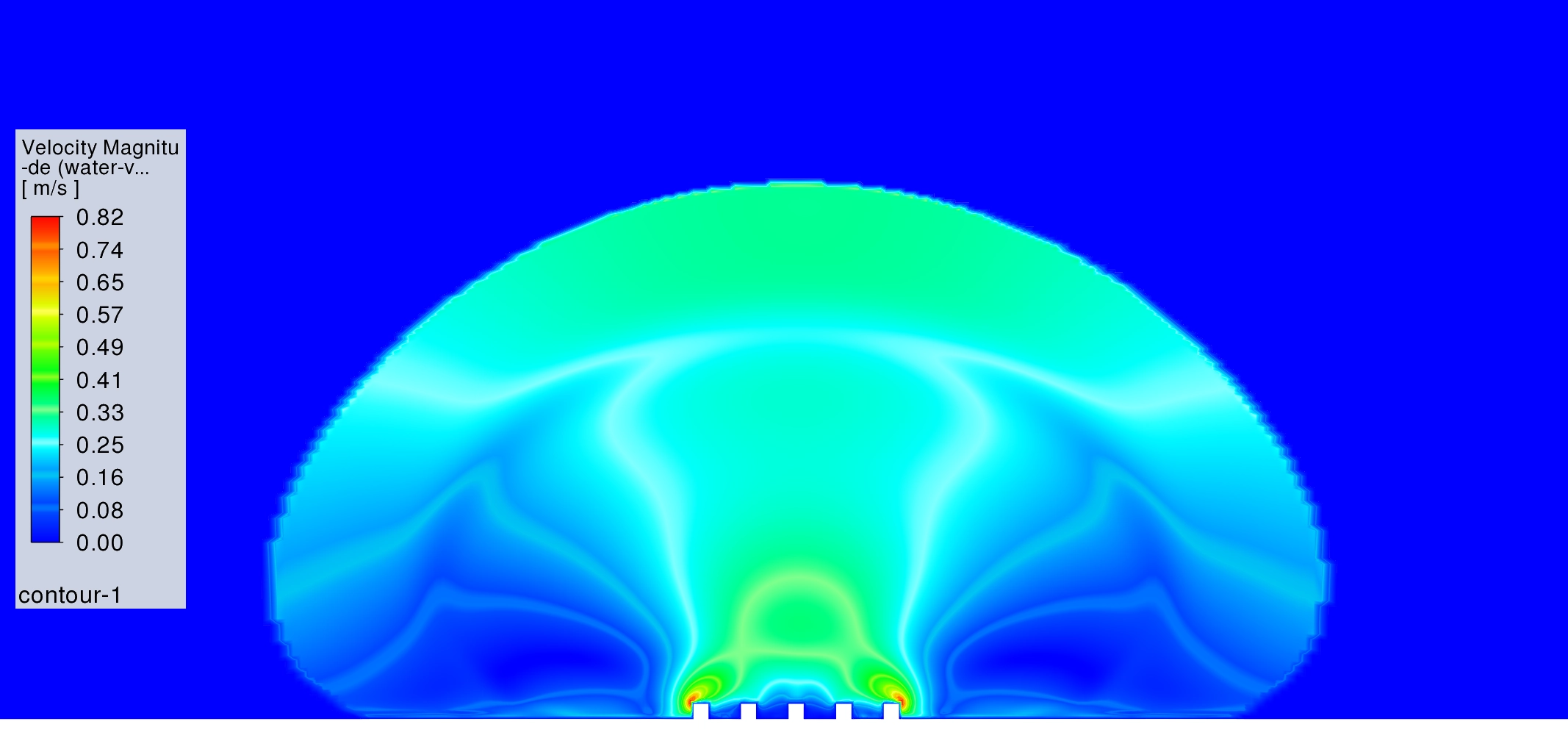
Finally, the velocity magnitude contour tracks the fluid motion. As the large vapor bubbles depart, they push the heavy water sideways. This physical pushing creates two fast symmetric jets near the outer fins, reaching a top speed of 0.82 m/s. In the central zone, the merged vapor plume rises slowly. This speed difference confirms proper bubble-induced liquid circulation inside the domain.
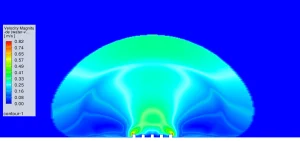
Figure 5: The fluid velocity tracking the physical liquid circulation driven by the rising bubbles
FAQ About Pool Boiling Physics and Multiphase Forces
- What does the quenching heat flux represent in this pool boiling numerical study? When a vapor bubble detaches and floats away, it leaves an empty dry spot on the hot wall. Fresh cold liquid immediately rushes in to fill this gap. The quenching heat flux measures the thermal energy absorbed by this new cold liquid.
- Why is the mass transfer rate so high specifically at the fin tips? The sharp edges of the fins are fully exposed to the surrounding liquid. This physical geometry creates intense local heating, causing the liquid touching the edges to evaporate and form bubbles very rapidly.
- Why do we see fast fluid jets of 0.82 m/s on the outer edges? As the large vapor mass grows and rises from the center fins, it physically displaces the heavy water above it. This pushing action forces the surrounding liquid to accelerate outward and downward, creating fast jets on the sides.





Reviews
There are no reviews yet.