




Refrigeration systems in cars and air conditioners rely on a special fluid called R134a. This fluid is amazing because it absorbs heat and changes from a liquid to a gas. This process is called Flow Boiling or evaporation. Understanding R134a Evaporation in Tube CFD simulation is critical for making efficient coolers. When the liquid R134a enters a hot tube, it boils and turns into vapor. This changes the density and speed of the fluid dramatically.
However, seeing inside a copper tube is impossible without expensive cameras. Therefore, engineers use ANSYS Fluent to simulate this complex physics. This R134a Evaporation in Tube fluent tutorial helps us see the bubbles forming and the temperature changing. We use R134a Evaporation in Tube fluent simulation to predict exactly when the liquid turns to mist. For more lessons on phase change physics, please explore our Mass Transfer tutorials. The geometry is based on general principles found in research like Kumar and Nagraj [1].
- Reference [1]: Kumar, Pramod, and M. R. Nagraj. “CFD Analysis of Fluid Flow and Heat Transfer in Two-Phase Flow Microchannels.” J. Eng. Res. Technol2.8 (2013): 2132-2143.

Figure 1: R134a Coolant
Simulation process: Mixture Multiphase and Lee Model Setup
To start this R134a Evaporation in Tube ANSYS fluent analysis, we modeled a single 3D cylindrical tube. The mesh (grid) is the most important part for accuracy. We generated a very high-quality Structured Hexahedral Mesh using ANSYS ICEM CFD. The grid contains exactly 405,595 cells. We organized the cells carefully to align with the pipe direction. This is necessary to see the very thin layers near the wall where the heat moves from the copper to the liquid R134a.
We set up the physics using the Mixture Multiphase Model in ANSYS Fluent. This model treats the liquid and vapor as fluids that move together but have different densities. To make the boiling happen, we activated the Lee Evaporation-Condensation Model. This model tells the software to turn liquid into vapor when the temperature goes above the saturation point. We set the operating pressure to 770 kPa, which corresponds to a saturation temperature of 30°C (303.15 K) for R134a. We defined the inlet as pure Liquid R134a and applied a Constant Heat Flux to the wall. This heat energy forces the Evaporation in fluent process to start as the fluid flows down the tube.

Figure 2: Structured Grid Generation, displaying the high-quality hexahedral mesh with 405,000 cells.
Post-processing: Analysis of Nucleate Boiling
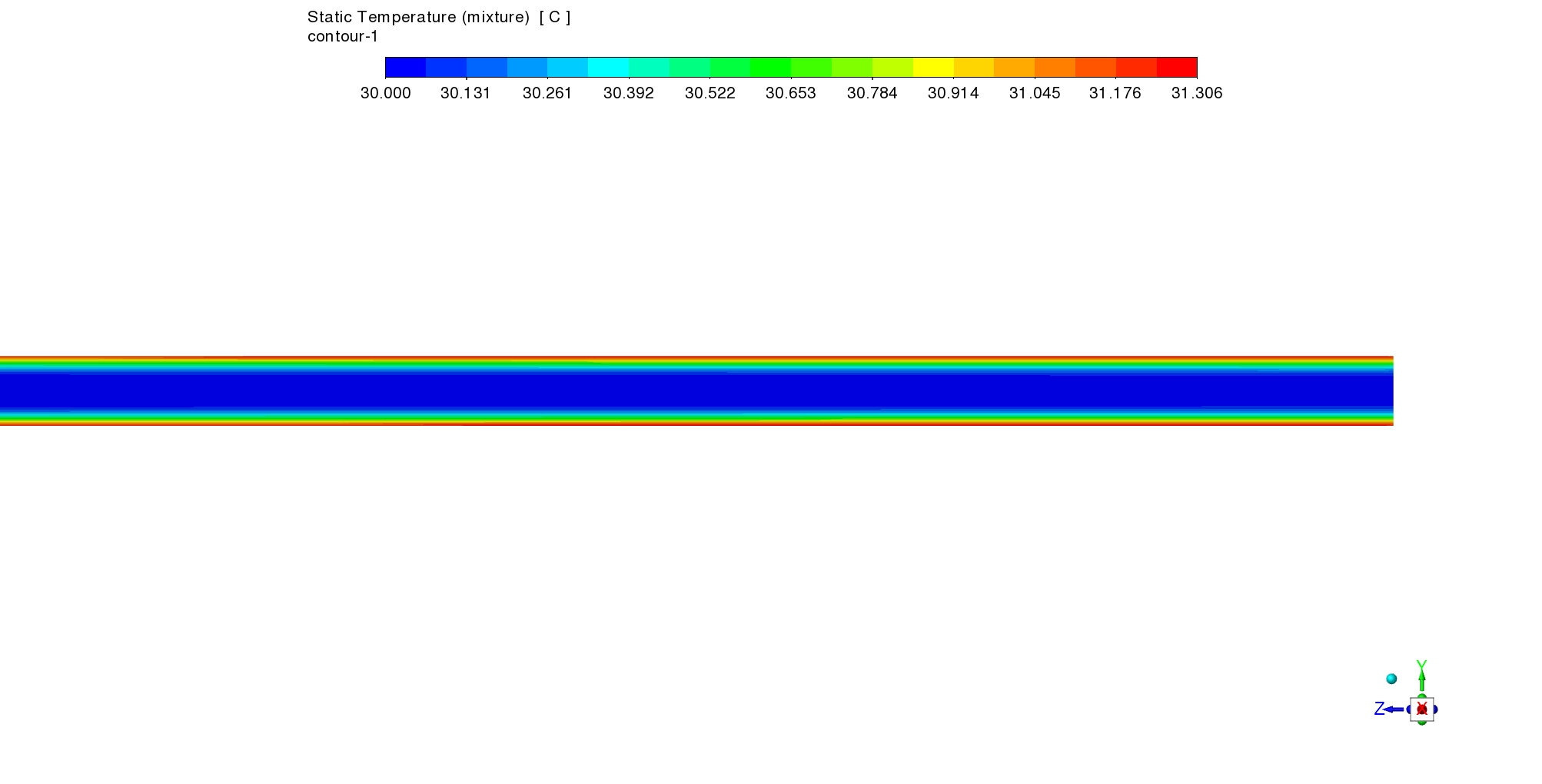
To truly understand the physics of this R134a Evaporation in Tube CFD simulation, we must tell the story of the fluid as it travels from the inlet to the outlet. The story begins at the inlet, where the R134a is a subcooled liquid. The walls are hot, but the fluid takes time to warm up. Looking at the Vapor Volume Fraction data (Figure 3 and 4), we see that for the first 80% of the pipe, nothing happens visually. The fraction is 0. The fluid is simply absorbing heat, getting ready to boil.
The “Action” happens in the last 20% of the tube. The temperature of the liquid near the wall finally exceeds 30°C (303.15 K). This triggers the Mass Transfer simulation. The Lee Model starts converting liquid mass into vapor mass. The graph shows an Exponential Growth Curve starting at position -0.02 m. This is the Onset of Nucleate Boiling. Tiny bubbles begin to form. The Mass Transfer Rate jumps from zero to a peak of at the very end of the pipe. This number represents the speed of evaporation.
However, the total amount of vapor is still very small. The simulation results show a maximum Vapor Volume Fraction of 0.003 (or 0.3%). This means the flow is not yet a mist; it is still mostly liquid with just a few bubbles. This is a critical finding for a designer. It proves that under these specific conditions (Pressure 770 kPa and the applied Heat Flux), the tube is either too short or the heat is too low to cause “Bulk Boiling.” We are currently in the “Subcooled Boiling Region.” To get more vapor, the manufacturer would need to increase the length of the evaporator tube.

Figure 3: Vapor Volume Fraction Contours at Exit, visualizing the onset of phase change (Max 0.003).

Figure 4: Volume Fraction Profile on Centerline, showing the exponential growth of vapor content.

Figure 5: Wall Temperature Distribution required to activate the evaporation mechanism.
Key Takeaways & FAQ
- Q: Why is the vapor fraction so low (0.3%)?
- A: The fluid is in the “Subcooled Boiling” phase. The liquid has just reached the saturation temperature of 30°C near the outlet in this R134a Evaporation in Tube CFD simulation.
- Q: What is the Lee Model?
- A: It is the standard Mass transfer simulation model in ANSYS Fluent used to calculate how fast liquid turns into gas based on temperature difference.
- Q: Why use a Structured Mesh?
- A: With 405,595 hexahedral cells, we can accurately capture the thin thermal boundary layer where the bubbles first appear.




Reviews
There are no reviews yet.