


A Water Entry of Dimpled Sphere CFD simulation is a computer model of an object with a surface like a golf ball dropping into water. This type of analysis is a complex Fluid-Structure Interaction (FSI) CFD problem. It helps engineers understand how an object’s surface can reduce drag. Using a Water Entry of Dimpled Sphere Dynamic Mesh in Fluent, we can see the exact moment the sphere hits the water and how the splash and an air cavity form behind it. This transient CFD simulation uses the Volume of Fluid (VOF) model to see the clear line between air and water. Our study is validated against the important experimental work in the reference paper, “Experimental investigation of water entry of dimpled spheres” [1], to ensure our results are accurate.
- Reference [1]: Shokri, Hossein, and Pooria Akbarzadeh. “Experimental investigation of water entry of dimpled spheres.” Ocean Engineering 250 (2022): 110992.
![: T he role of dimples on the air cavity formation [1]](https://cfdland.com/wp-content/uploads/2024/08/Picture4.jpg)
Figure 1: T he role of dimples on the air cavity formation [1]
Simulation Process: Fluent Setup, Overset Mesh and Six-DOF for FSI Analysis
For this Water Entry of Dimpled Sphere CFD study, we designed a column-shaped fluid domain in Design Modeler. A special meshing strategy called Overset Mesh was used in ANSYS Meshing. This means we created a high-quality background mesh for the water and air, and a separate, very fine mesh around the dimpled sphere. This allows the sphere to move freely through the fluid without distorting the mesh. The final mesh contained 1,050,000 structured elements. In ANSYS Fluent, we used the transient solver because the event happens over time. We activated the Multiphase VOF model to track the free surface between water and air. Most importantly, we used the Dynamic Mesh model with the Six-DOF (Six Degrees of Freedom) solver, which allows the simulation to calculate the forces from the fluid and use them to move the sphere realistically.
Post-processing: CFD Analysis, Cavity Dynamics and Hydrodynamic Drag Reduction
The VOF contour provides a professional visual that acts as a diagnostic map of the impact event. From an engineering standpoint, this visual confirms a key finding from the reference paper [1]: the dimples fundamentally change the physics of the water entry. As the sphere enters the water, it creates an air cavity behind it. The dimples on the sphere’s surface help to stabilize this cavity, keeping it attached to the sphere for a longer time compared to a smooth sphere. This is not just a visual effect; it is a sign of a significant change in the fluid dynamics. The splash pattern also appears less aggressive, which suggests that the impact energy is being managed differently by the dimpled surface.
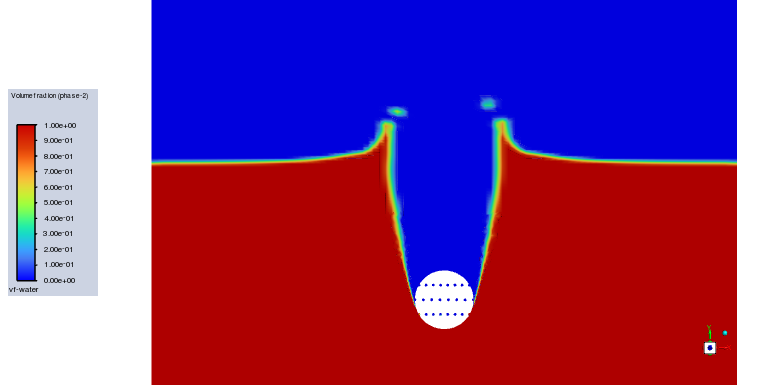
Figure 2: A professional visual of the volume fraction from the Free Surface Flow CFD simulation, showing the splash and cavity formation as the dimpled sphere enters the water.
The pressure contour explains the engineering “why” behind this behavior. The dimples work by creating a turbulent boundary layer. In simple terms, they cause tiny disruptions in the thin layer of water flowing over the sphere’s surface. This turbulence helps the flow “stick” to the sphere longer, delaying the point where the flow separates from the back of the sphere. This delayed separation is what stabilizes the air cavity and, most importantly, leads to a significant drag reduction. The simulation captures the pressure fields that are the direct cause of these forces. The most important achievement of this simulation is its ability to model how the micro-geometry of the dimples leads to a macro-scale change in flow behavior, successfully linking the surface texture to delayed flow separation, a stable cavity, and a lower overall drag force—providing a validated tool for designing more efficient objects for water entry.
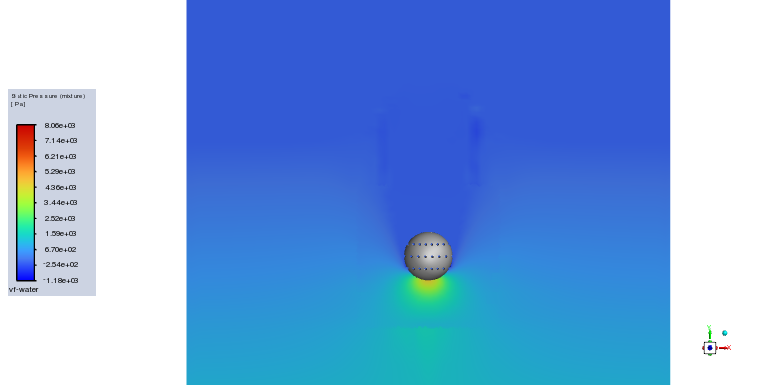
Figure 3: A pressure contour from the FSI CFD analysis, highlighting the pressure distribution and impact forces on the dimpled sphere.





Reviews
There are no reviews yet.