
Whenever doors open in large shopping malls or a commercial Refrigerated room, a massive amount of climate-controlled air escapes. This wastes incredible amounts of heating or cooling energy. To solve this, engineers install an “air curtain” above the door. This machine blows a high-speed jet of air straight down to the floor, creating an invisible wind wall that blocks the outside weather. A properly designed air curtain can save up to 80% of the energy normally lost through an open doorway. However, finding the perfect wind speed and blowing angle is very difficult. Instead of building expensive physical test rooms, engineers use an Air Curtain Performance CFD simulation. It is extremely important to state clearly that this is an educational CFD analysis and visualization tutorial, not a validation study. We use the ANSYS Fluent software to visualize the invisible air mixing and temperature changes over time. By running a complete CFD Analysis of Air Curtain Performance, HVAC designers can perfectly adjust their nozzles to stop outside air from leaking in. For more easy lessons on how to simulate indoor airflow, heating, and cooling, please explore our HVAC tutorials.
- Reference [1]: Gonçalves, J. C., J. J. Costa, and A. M. G. Lopes. “Parametric study on the performance of an air curtain based on CFD simulations-New proposal for automatic operation.” Journal of Wind Engineering and Industrial Aerodynamics193 (2019): 103951.
- Reference [2]: Gonçalves, J. C., et al. “Study of the aerodynamic sealing of a cold store–Experimental and numerical approaches.” Energy and Buildings55 (2012): 779-789.
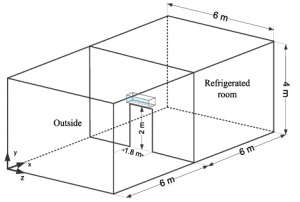
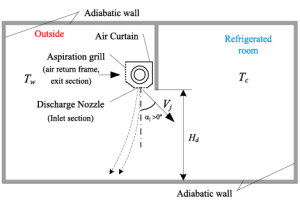
Figure 1: 3D Geometry and 2D Sketch, showing the calculation domain with dimensions for the connected indoor and outdoor spaces.
Simulation Process: Transient Flow and Tetrahedral Meshing
For this Air Curtain Performance ANSYS Fluent project, we built a complete 3D computer model of two rooms (indoor and outdoor) connected by an open doorway. To make sure the computer calculates the invisible wind barrier accurately, we divided the empty space into a very fine, high-quality grid containing exactly 1,432,118 tetrahedral cells. We packed the smallest cells directly under the air curtain slot where the air speed is the highest.
To create an accurate Air Curtain Performance fluent simulation, we must solve for time and temperature:
- Transient Solver: We set the software to calculate the changing physics over 300 seconds (5 minutes of real time) to see how the barrier holds up.
- Thermal Buoyancy: We programmed the air curtain to blow a warm jet at exactly 30°C (303 K). The outdoor zone was set to a cooler 22°C (295 K). We activated gravity in the software so it could calculate thermal buoyancy (the natural physics where hot air floats up and cold heavy air sinks down).
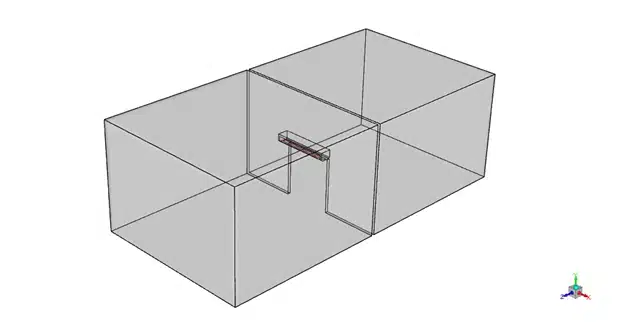
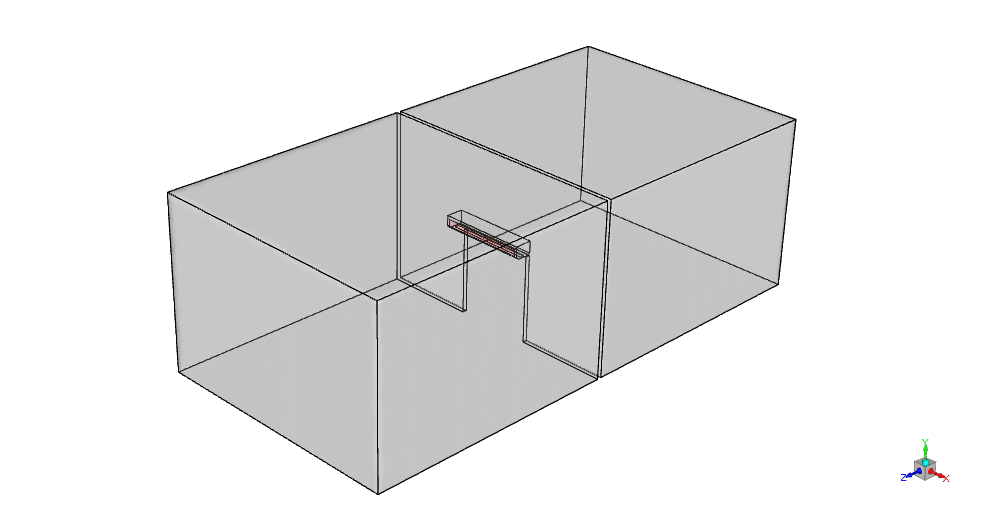
Figure 2: Designed Geometry, displaying the 3D model of the doorway and the overhead air curtain device.
Post-processing: The Analytical Physics of Thermal Barriers
To truly master this Air Curtain Performance fluent study, we must strictly analyze the Cause and Effect shown in the contours. We will look at how the temperatures fight over 300 seconds, how well the room is sealed, and why the current jet design is flawed.
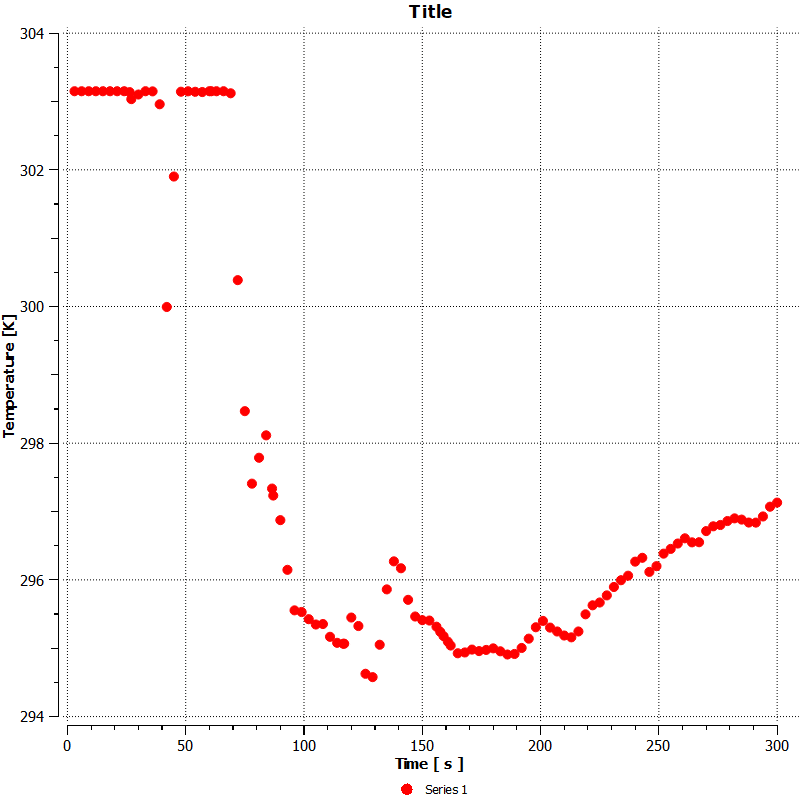
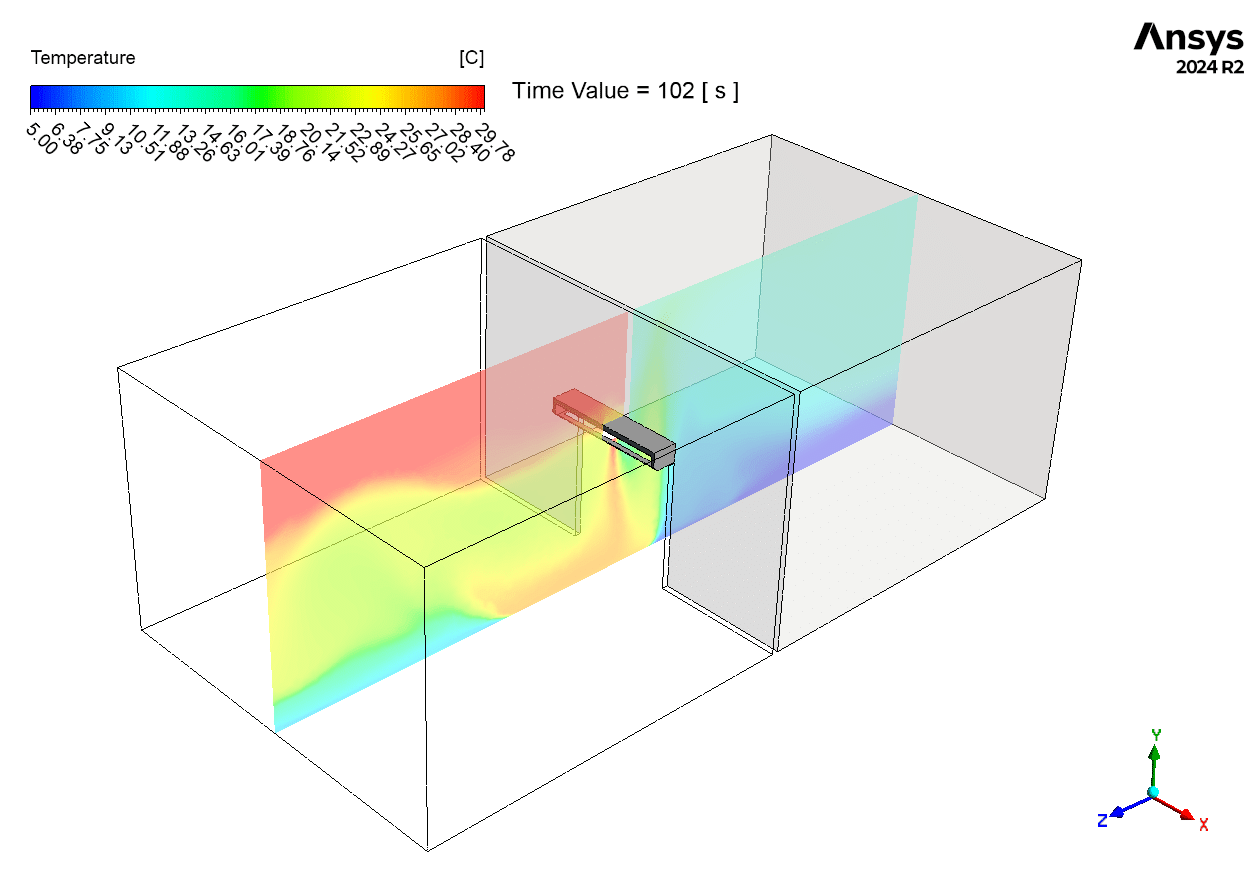
Look at the Temperature Monitoring Plot (Figure 3), which tracks the middle height of the doorway. When the machine first turns on, the warm jet pushes straight to the floor, making the ground very warm at 303 K (30°C). However, between 100 and 200 seconds, the heavy, cold outdoor air pushes back against the jet. The temperature sharply drops to between 294.5 K and 296 K (21.5°C to 23°C). The crucial engineering finding: After 200 seconds, the temperature stops dropping. It stabilizes in a “quasi-steady state” between 296 K and 297 K. This proves that the air curtain successfully survives the initial push of the cold air and creates a permanent, stable thermal wall.
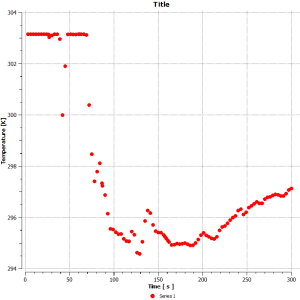
Figure 3: Temperature Monitoring Plot, showing the temperature dropping between 100-200s before stabilizing at a quasi-steady 296-297 K.
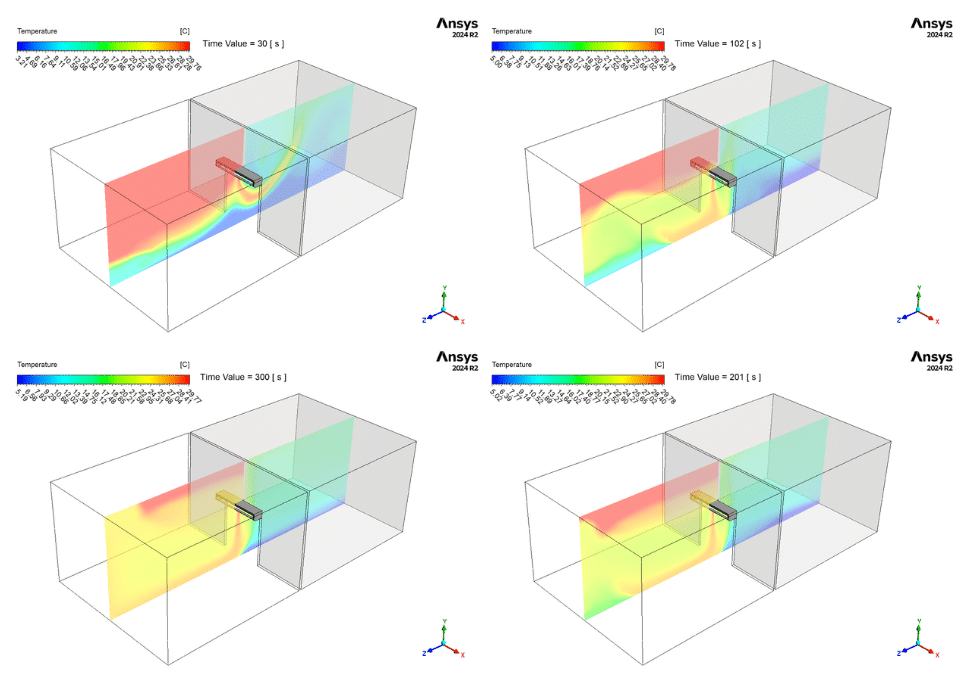
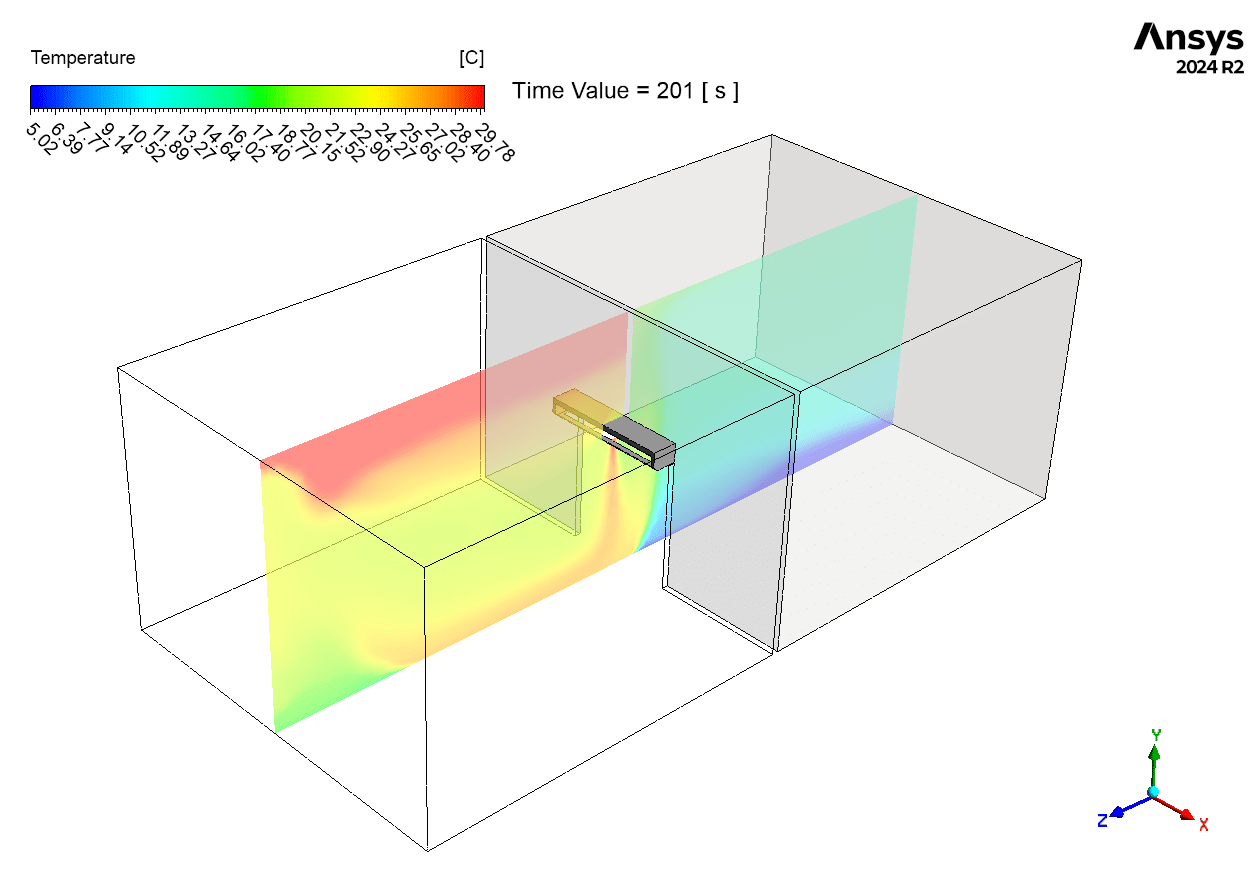
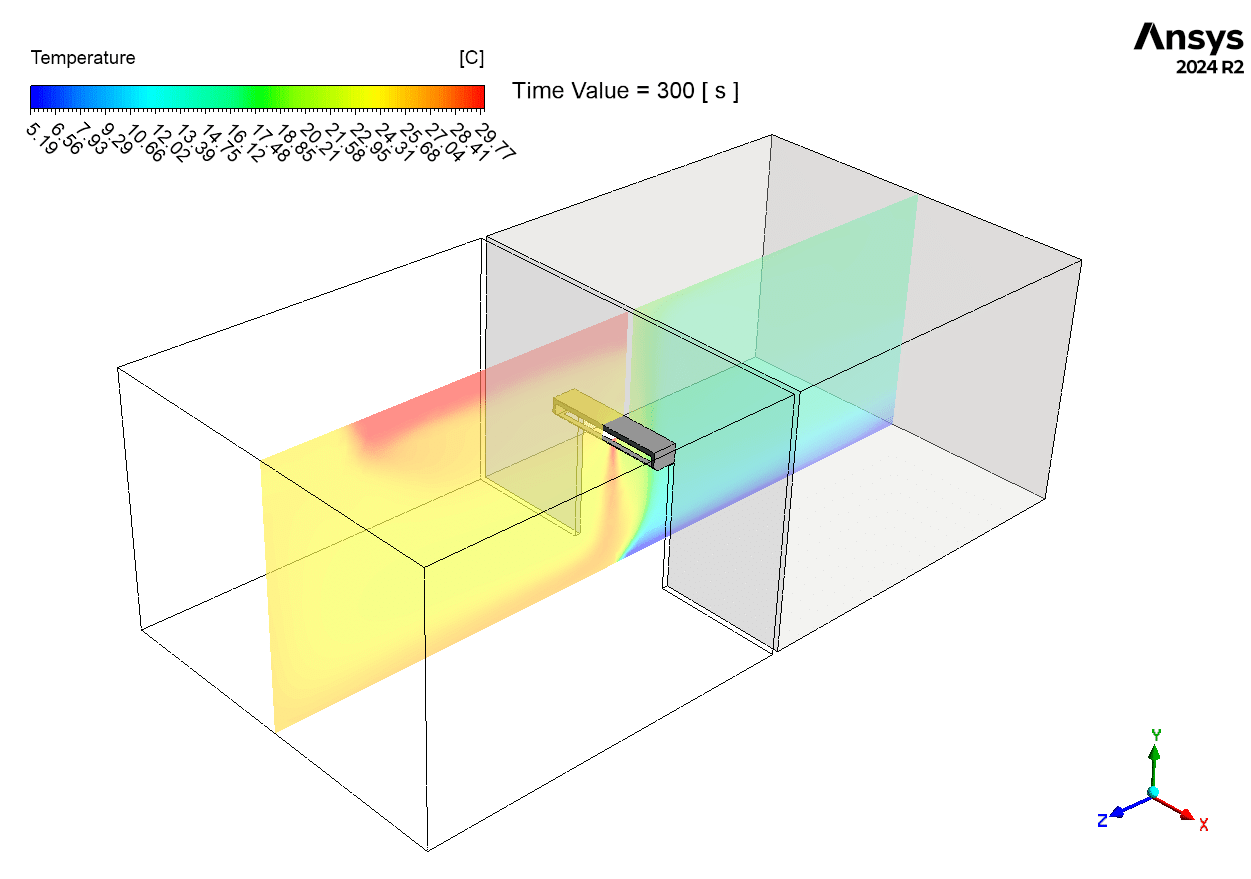
Next, look at the Transient Temperature Contours (Figure 4) to see how much heat is saved.
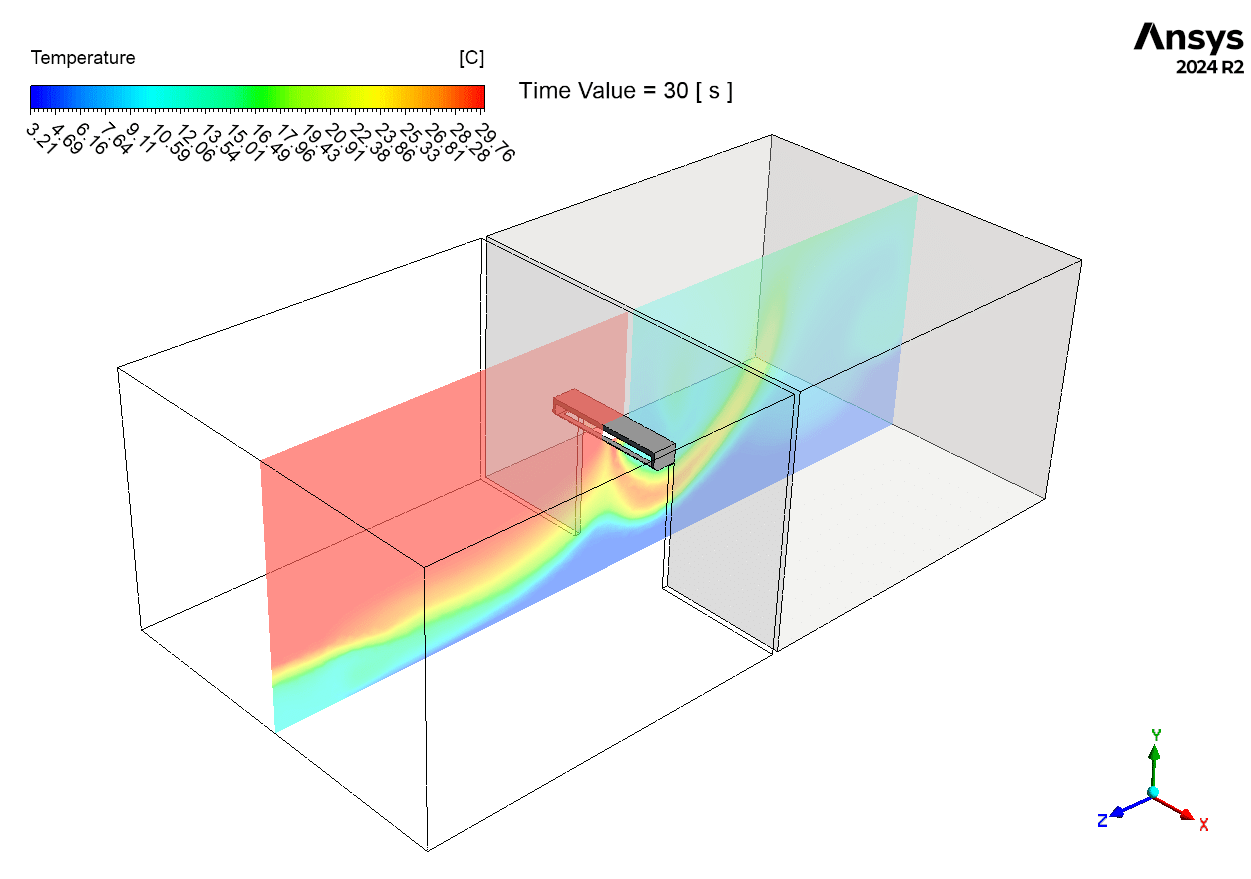
- At t=30 seconds, the barrier is fresh and strong. The indoor room is perfectly protected, glowing Red/Orange at 27°C to 30°C, while the outside is Blue/Cyan at 22°C to 24°C.
- At t=300 seconds, the simulation shows the final reality. Some cold air has successfully leaked inside. The indoor room has cooled down slightly, turning Yellow at 26°C to 28°C. If the air curtain was turned off, the room would plummet to 22°C. Because the room only dropped 2 to 4 degrees after 5 minutes, this highly accurate CFD analysis proves the machine has a sealing efficiency of 60% to 70%.
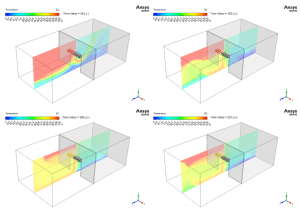
Figure 4: Transient Temperature Contours (t=30s to 300s). The indoor room starts at 30°C (Red) and slowly cools to 26-28°C (Yellow), proving a 60-70% sealing efficiency.
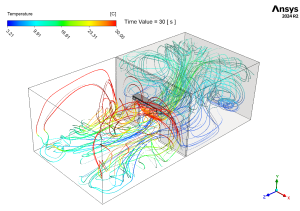
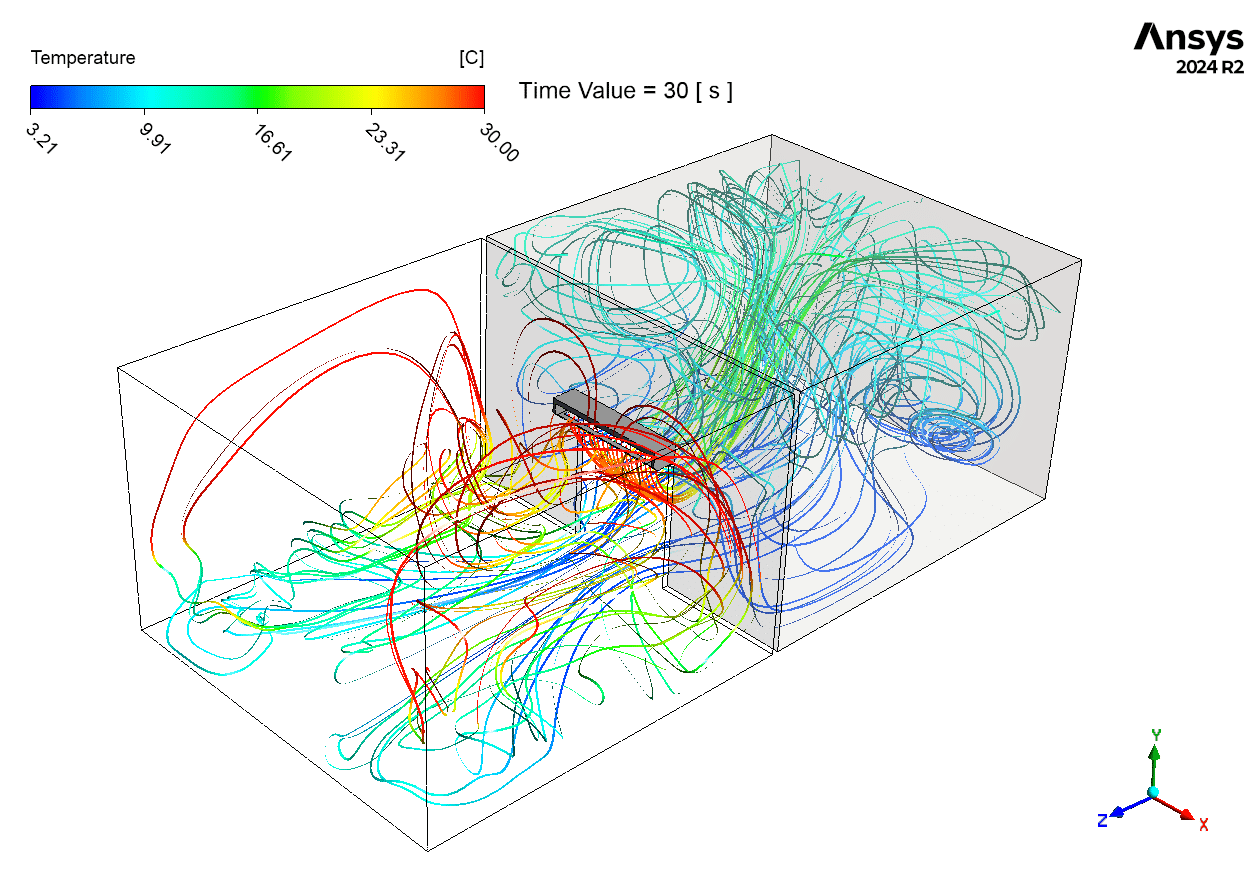
Figure 5: Airflow Streamlines at t=30s. The vertical 30°C jet hits the floor and splits. The inward-curving split drags cold outdoor air inside, identifying a critical design flaw.
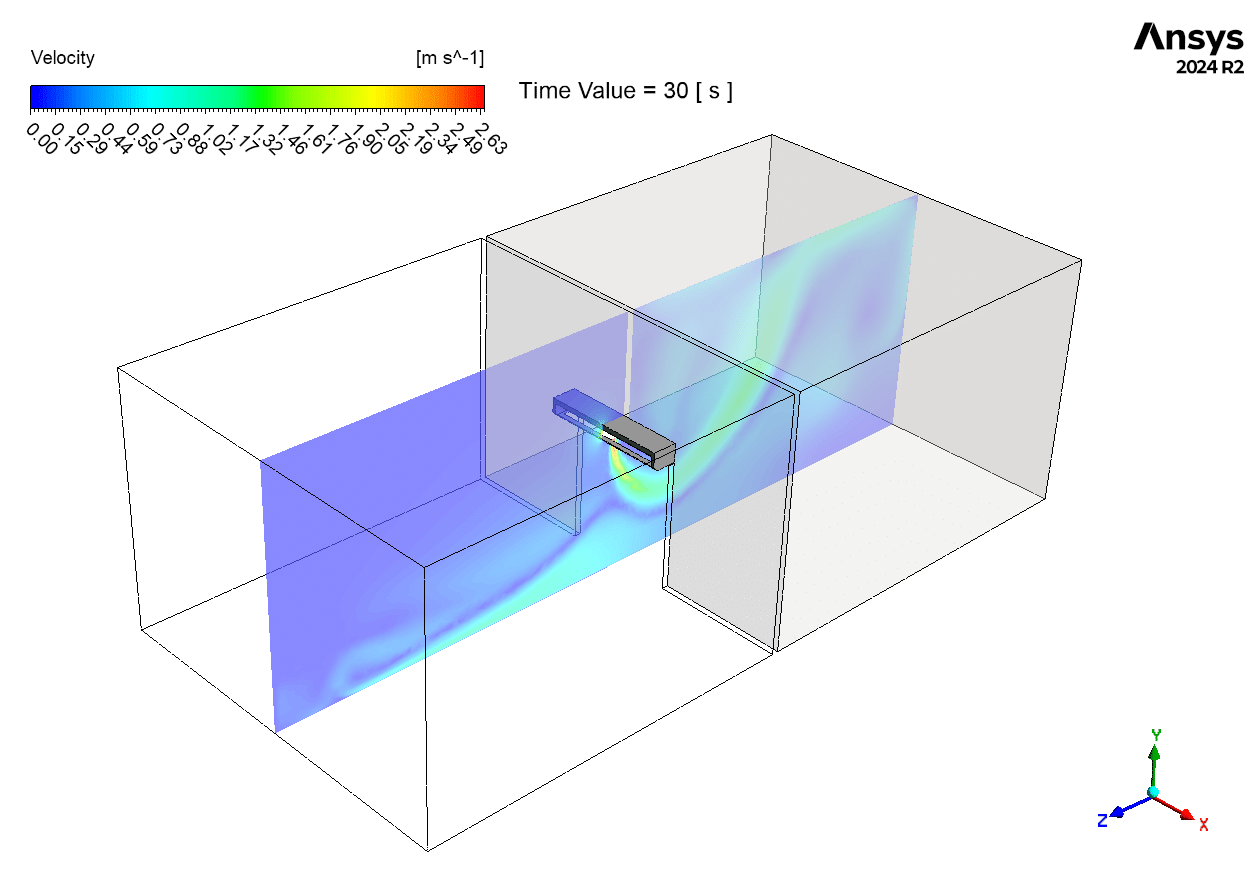
Why is the efficiency only 70% and not 100%? Look at the Airflow Streamlines (Figure 5). The 30°C jet (Red lines) shoots straight down to the floor. When it hits the hard floor, physics forces the air to split in two directions (bifurcation). One half curves outward, successfully pushing the cold air away. However, the other half curves inward into the warm room. As this jet curves inward, it acts like a vacuum. It drags the cold 22°C outdoor air (Blue lines) inside with it, creating large, swirling turbulent vortices. This mixed air spreads through the room, creating a 3°C to 5°C thermal gradient (warm red air at the ceiling, cooler green/yellow air at the floor).
This CFD analysis visually proves exactly what engineers must fix. Because the vertical jet splits inward and drags cold air inside, designers must tilt the air curtain nozzle outward by 10 to 15 degrees. This simple change will force all the turbulent vortices to stay outside, maximizing the performance for any heated space or Refrigerated room.
Key Takeaways & FAQ
- Q: What does a transient solver do in ANSYS Fluent?
- A: A transient solver calculates how physics change over time. In this study, we watched the hot and cold air fight each other continuously for 300 seconds to see if the thermal wall would hold.
- Q: What is thermal buoyancy?
- A: It is the natural physical law where hot air is light and floats upward, while cold air is heavy and sinks. Our simulation includes gravity to calculate how the cold 22°C air tries to slide under the warm 30°C indoor air.
- Q: Why does the air curtain jet drag cold air inside?
- A: Because the jet shoots perfectly straight down. When it hits the floor, half of the wind splashes inward, creating a vacuum that drags cold outdoor air inside. Tilting the nozzle outward fixes this.




Reviews
There are no reviews yet.