

In modern engineering, efficiently removing heat is a major challenge. Standard fluids like water often have limited thermal conductivity, which restricts their cooling power. To solve this, engineers utilize Nanofluids. A nanofluid is an advanced coolant created by suspending nanometer-sized particles (such as Copper Oxide, CuO) in a base fluid. The primary purpose of these particles is to enhance the fluid’s thermal properties.
The most critical metric for evaluating these systems is Nanofluid Thermal Resistance. Thermal resistance measures how much a material or fluid resists the flow of heat. In cooling applications, we want this value to be as low as possible. A lower Thermal Resistance means the system can dissipate heat more effectively, keeping components cooler. This project details a Nanofluid Thermal Resistance CFD study aimed at validating numerical models against experimental data. We focus on a 0.5% volume fraction of CuO nanoparticles to demonstrate how they improve heat transfer compared to pure water. For more resources on advanced cooling simulations, please explore our Microfluid and Nanofluid tutorials. The simulation reproduces the results from the reference paper by Arani et al. [1].
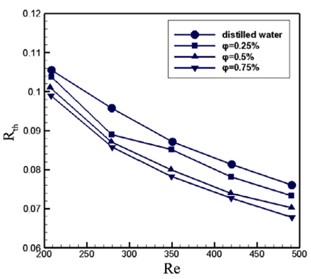
Figure 1: Graph comparing Thermal Resistance vs. Reynolds number, showing how nanofluids perform better than base fluids. [1]
Simulation Process: Modeling Nanofluid Properties in Fluent
The simulation process began with creating the geometry of a rectangular microchannel using ANSYS Design Modeler. A high-quality structured mesh was generated in ANSYS Meshing. This grid, containing 112,800 cells, was designed with fine distinct layers near the walls. This refinement is crucial for capturing the thermal boundary layer, which directly influences the calculation of Nanofluid Thermal Resistance.
The physics setup in ANSYS Fluent used a Single-Phase Model. In this approach, we assume the nanoparticles and the water are perfectly mixed and move at the same velocity. Instead of tracking individual particles, we modify the physical properties of the fluid mixture. We calculated the effective density, viscosity, specific heat, and thermal conductivity for the 0.5% CuO-water mixture using theoretical correlations. These new properties were defined as a custom material in Fluent. The flow was set to Laminar with a Reynolds number of 350. To monitor the performance, a custom report definition was created to calculate the Thermal Resistance in real-time during the Nanofluid cooling simulation.

Figure 2: High-quality structured mesh used to resolve thermal gradients in the Nanofluid CFD simulation.
Post-processing: Validation and Thermal Analysis
The most important part of this tutorial is validating the accuracy of our Nanofluid Thermal Resistance prediction. The table below compares our CFD simulation results with the experimental data from the reference paper. Our simulation predicted a Thermal Resistance of 0.081. The reference paper reported a value of 0.082. This results in an incredibly small error of only 1.2%. This close agreement proves that the Single-Phase model in ANSYS Fluent is highly accurate for this type of Nanofluid simulation. It confirms that adding 0.5% CuO successfully reduces the resistance to heat flow.
| Reference Paper | Present CFD Simulation | Error | |
| Thermal Resistance | 0.082 | 0.081 | 1.2% |
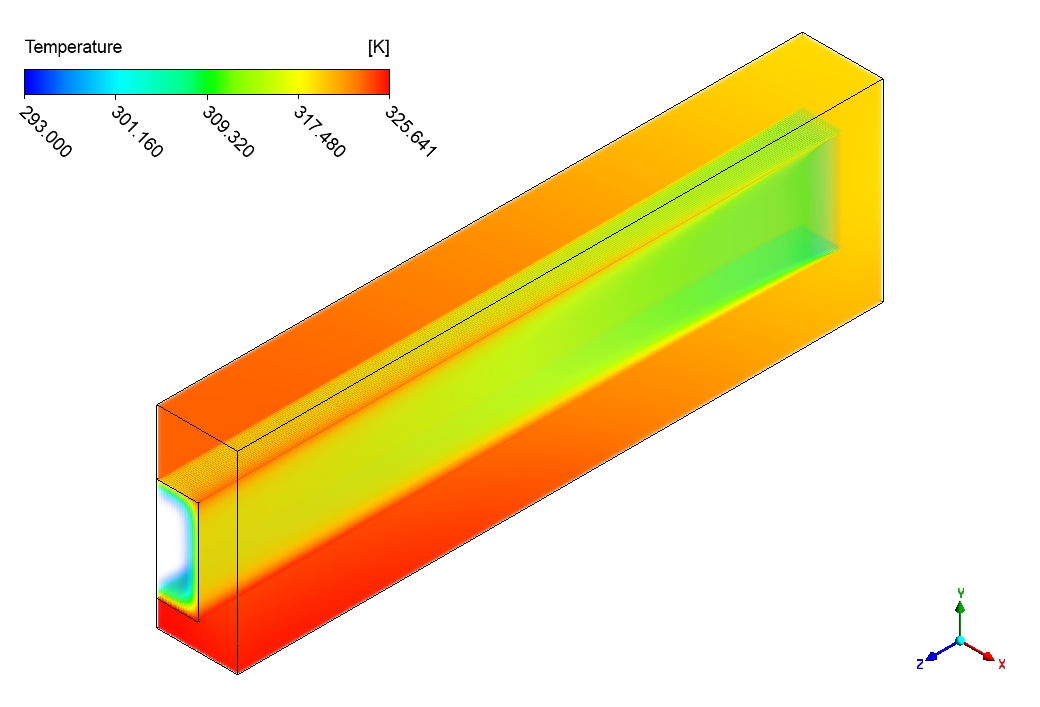
To understand the physics behind this result, we analyze the Temperature Contour in Figure 3. The contour shows the temperature distribution inside the channel. The values range from a cool inlet temperature of 293 K to a maximum wall temperature of 325.641 K. The red regions at the walls indicate where the heat is entering. The gradient (change in color) from the wall to the center shows how the heat is penetrating the fluid. The CuO nanoparticles enhance the fluid’s thermal conductivity. This allows the fluid to absorb heat from the hot walls more quickly than pure water could. By conducting heat faster into the bulk of the fluid, the temperature difference between the wall and the fluid decreases, which directly corresponds to a reduction in Thermal Resistance. This efficient heat removal is why nanofluids are the future of high-performance cooling.

Figure 3: Temperature contour showing the thermal gradient and effective heat removal by the CuO nanofluid.
Key Takeaways & FAQ
- Q: What is Nanofluid Thermal Resistance?
- A: It is a measure of how difficult it is for heat to pass from a hot surface into the nanofluid. Mathematically, it is the temperature difference divided by the heat flux. A lower thermal resistance means the nanofluid is better at cooling.
- Q: How do nanoparticles reduce Thermal Resistance?
- A: Nanoparticles (like CuO or Al2O3) have much higher thermal conductivity than base fluids (like water). Suspending them in the fluid increases the mixture’s overall ability to conduct heat. They also increase energy exchange through Brownian motion and micro-convection, further lowering the resistance.
- Q: Why use a Single-Phase model for Nanofluid CFD?
- A: For low concentrations of nanoparticles (like 0.5%) where the particles are very small and well-dispersed, the mixture behaves like a continuous fluid. The Single-Phase model is computationally faster and, as shown by the 1.2% error in this validation, very accurate for predicting Nanofluid Thermal Resistance.






Reviews
There are no reviews yet.