


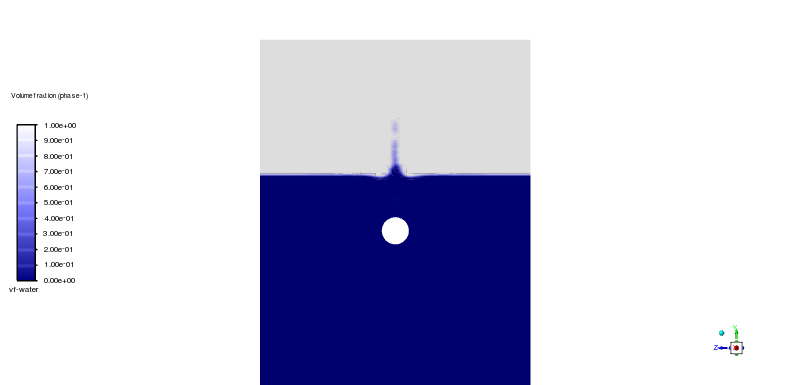
A Falling Ball Into Water CFD simulation is a computer model that shows what happens when an object drops into water. This type of transient CFD simulation is very useful. It helps engineers design better ships and offshore platforms by studying how they interact with waves. Using a Dynamic Mesh in Fluent, we can see the exact moment a solid object hits a fluid. This creates a splash and waves. This is a classic Fluid-Structure Interaction (FSI) CFD problem. We use the Volume of Fluid (VOF) model to see the clear line between air and water. Our study is based on the methods from the key research paper, “Experimental investigation of water entry of dimpled spheres” [1], to make sure our results are accurate.
- Reference [1]: Shokri, Hossein, and Pooria Akbarzadeh. “Experimental investigation of water entry of dimpled spheres.” Ocean Engineering250 (2022): 110992.
![Experimental setup of falling smooth sphere into water [1]](https://cfdland.com/wp-content/uploads/2024/08/Experimental-setup-of-falling-smooth-sphere-into-water-1.png)
Figure 1: The experimental setup used for validating the Water Entry CFD simulation [1].
Simulation Process: Fluent Setup, VOF and Overset Mesh for Transient FSI
To perform this Dynamic Mesh CFD study, we chose the settings in ANSYS Fluent very carefully.
- Geometry and Mesh: The 3D model of the ball and the fluid domain was created in ANSYS Design Modeler. We used the Overset Mesh technique. This means we created two separate, high-quality meshes: one for the fluid and one for the area around the ball. The main fluid domain has a structured mesh of 1,050,000 hexagonal cells, with more cells packed near the water’s surface where the impact happens.
- Physics and Models:
- Multiphase Model: We activated the Volume of Fluid (VOF) model to accurately track the free surface, which is the boundary between the air and water.
- Dynamic Mesh: We turned on the Dynamic Mesh model and chose the Overset option. This lets the ball’s mesh move freely over the background fluid mesh.
- Motion Solver: We used the Six-DOF (Six Degrees of Freedom) solver. This is the most important part, as it calculates the forces from the water and uses them to move the ball realistically.

Figure 2: A professional visual of the structured Overset mesh used for the Dynamic Mesh CFD analysis.
Post-processing: CFD Analysis, Splash Dynamics and Impact Forces
The VOF contour provides a professional visual that acts as a diagnostic map of the impact event. From an engineering standpoint, it shows the transfer of momentum from the solid ball to the fluid. As the ball enters the water, it pushes the fluid up and out, creating the classic crown-shaped splash. This isn’t just a random shape; its height and angle are direct results of the ball’s speed and weight. The simulation also captures the formation of an air cavity behind the ball. This occurs because the ball is moving downward faster than the water can flow in to fill the space, which is a key physical event in water entry problems. The outward-spreading waves show how the initial impact energy is dissipated across the water’s surface.
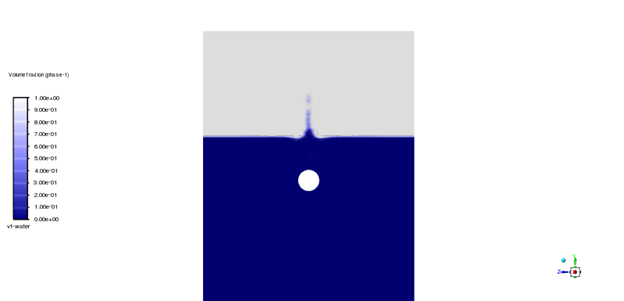
Figure 3: A professional visual from the Falling Ball Into Water CFD simulation, showing the moment of splash formation.
The pressure contour tells the other half of the engineering story. This professional visual shows a zone of high pressure on the bottom surface of the ball at the moment of impact. This high pressure is the force of the water resisting the ball’s motion. The Six-DOF solver uses this exact pressure data to calculate the forces and slow the ball down. At the same time, we can see low-pressure regions on the top sides of the ball, which contribute to the complex forces that could cause tumbling. The most important achievement of this simulation is its ability to fully couple the motion of a solid object with the free-surface flow of a fluid, using the calculated fluid forces to drive the object’s movement and predict the resulting splash and cavity in a way that matches real-world experiments.
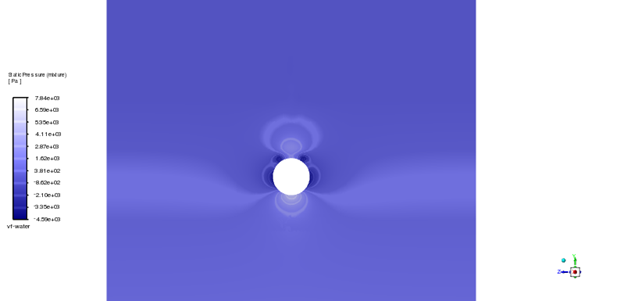
Figure 4: A pressure contour from the Fluid-Structure Interaction (FSI) CFD analysis, highlighting the impact forces on the sphere.





Reviews
There are no reviews yet.