

Industrial engineers use a helical heat exchanger to transfer thermal energy safely inside tight physical spaces. This ANSYS Fluent CFD simulation tutorial explains the complex swirling fluid physics that prevent dirt buildup and massively boost cooling. By mastering this Helical Heat Exchanger CFD training, you will understand Dean vortices, and you can learn even more in our heat exchangers CFD simulation courses.
- Reference [1]: Abu-Hamdeh, Nidal H., et al. “A detailed hydrothermal investigation of a helical micro double-tube heat exchanger for a wide range of helix pitch length.” Case Studies in Thermal Engineering 28 (2021): 101413.
- Reference [2]: Kuvadiya, Manish N., et al. “Parametric analysis of tube in tube helical coil heat exchanger at constant wall temperature.” International Journal of Engineering Research & Technology 1.10 (2015): 279-285.
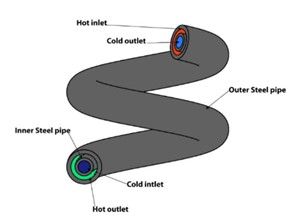
Figure 1: Schematic diagram of the double-tube Helical Heat Exchanger geometry.
Simulation Process: Structured Grid Physics
We must capture the exact fluid flow around the tight curves accurately. We use ANSYS Meshing to divide the complex geometry into precise blocks. This creates a highly accurate structured grid containing exactly 1302912 hexagonal cells. A structured grid calculates curved flow paths much better than a basic square mesh.
We push hot fluid into the inner steel pipe and cold fluid into the outer pipe. They flow in opposite directions to maximize the energy exchange. The ANSYS Fluent software calculates the changing speeds and temperatures continuously. This reveals exactly how the curved metal walls force the heavy water to spin and mix.
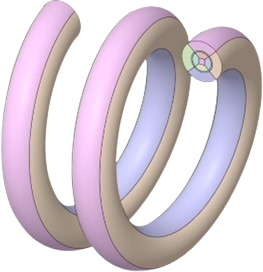
Figure 2: Helical heat exchanger geometry divided into blocks for structured grid generation.
Post-processing: Analysis of Swirling Thermal Physics
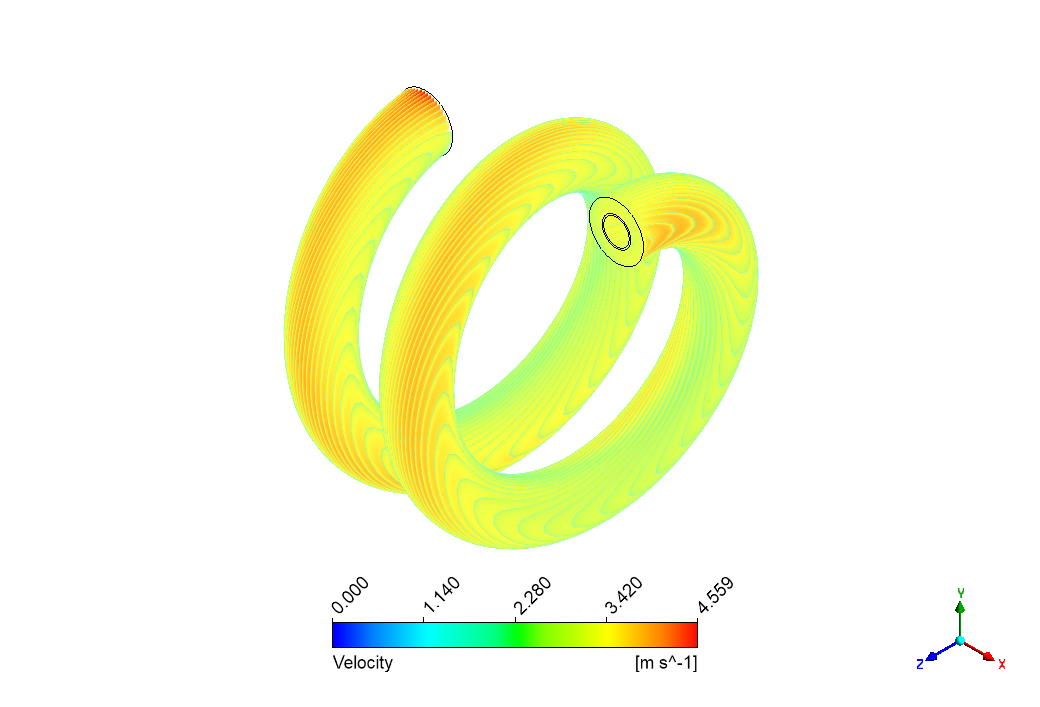
We must now evaluate the exact thermal performance of the double-tube design. We analyze the continuous energy transfer directly through the visual contours. The physical design forces the two fluids to travel in opposite directions. The schematic shows the hot fluid entering the top inner steel pipe while the cold fluid enters the bottom outer pipe. This opposite flow direction maintains a strong thermal driving force along the entire metal coil. As the fluids travel along the tight spiral path, the physical space restricts them. The cold water velocity actually increases from an initial speed of 3.19 to a final speed of exactly 3.25. This small acceleration represents the beginning of the powerful heat transfer engine.
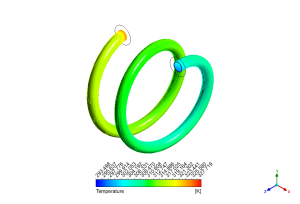
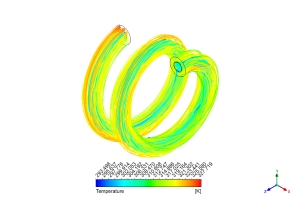
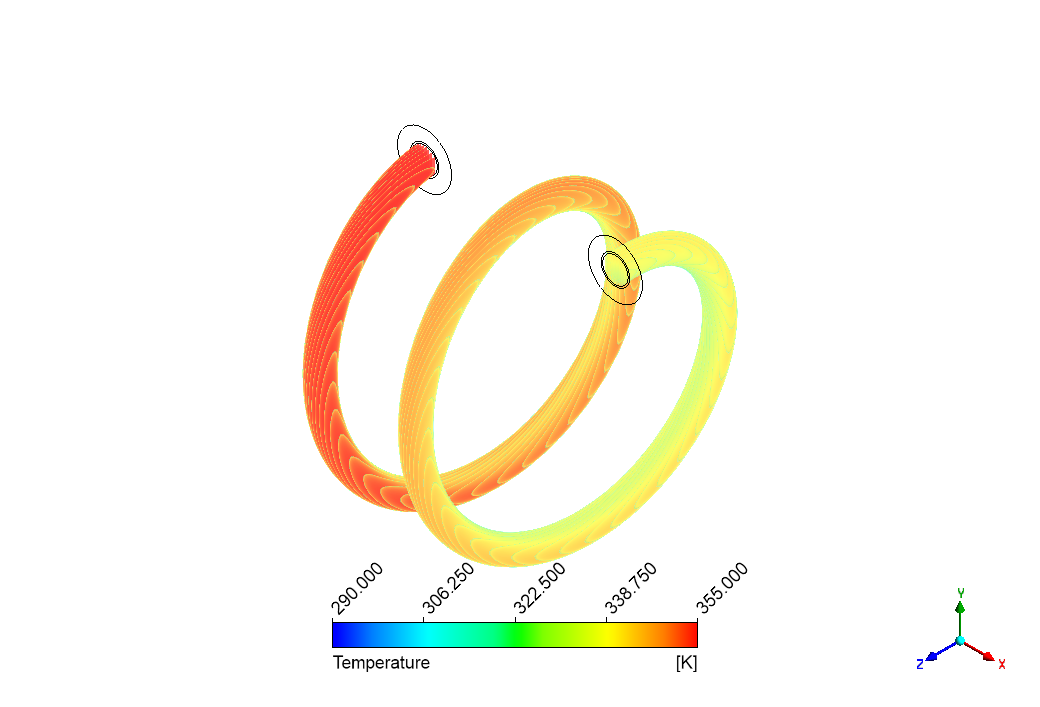
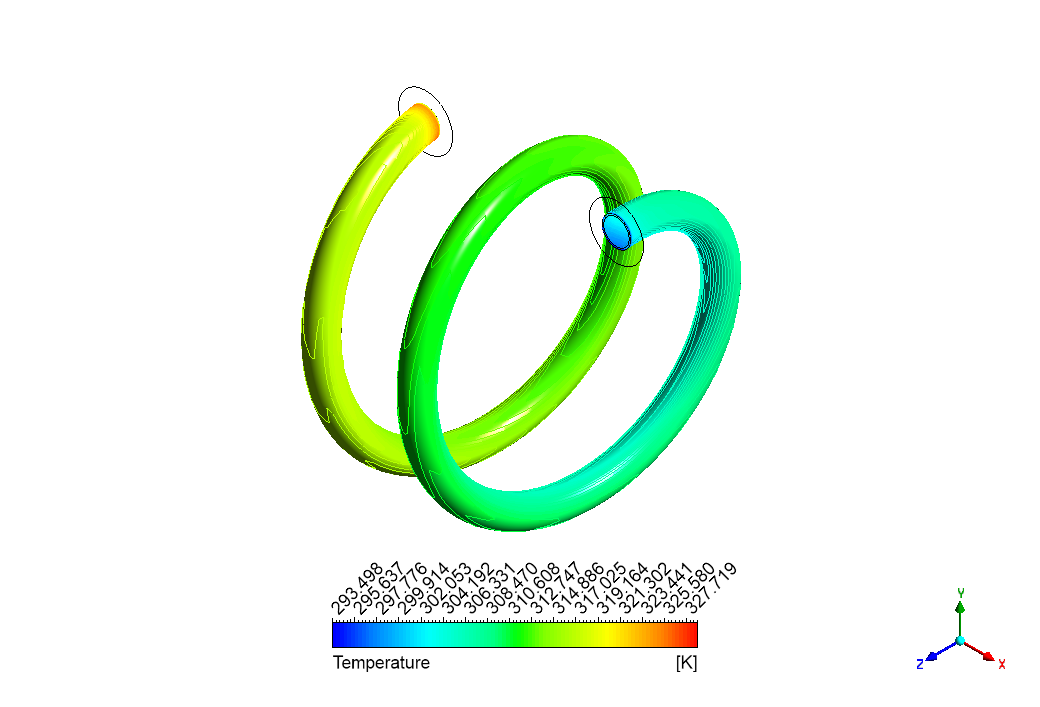
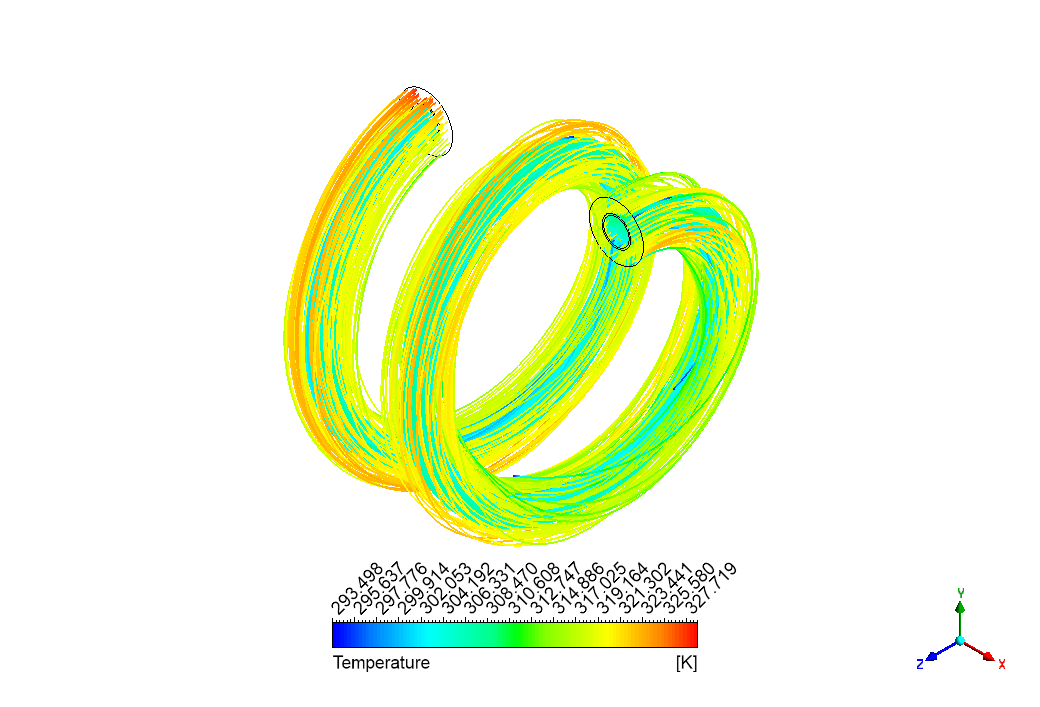
Figure 3: The visual streamlines proving the curved walls force the fluid to spin and violently mix the thermal energy and The spatial thermal map proving the hot fluid continuously loses its heat to the cold shell as it travels downward.
When water flows straight, it forms a lazy thermal blanket against the wall. A helical shape completely destroys this flat blanket. The tight curved path forces the fast water to push outward due to centrifugal force. This outward push creates a secondary swirling motion called Dean vortices. We can physically see this intense mixing by looking at the fluid streamlines. The colorful lines twist and wrap around each other violently inside the circular pipe. This constant churning action aggressively scrapes the hot fluid away from the center and smashes it directly against the cold metal wall. This violent physical mixing is the exact reason a spiral design transfers heat much faster than a standard straight pipe.
We evaluate the three-dimensional temperature contours to see the final cooling result. The color scale strictly ranges from exactly 293.498 at the coldest blue up to 327.719 at the hottest red. The solid metal wall acts as a perfect thermal bridge. Looking at the inner coil, the fluid starts bright red at the top inlet. As it spirals downward, the intense Dean vortices force the heat into the wall. The color shifts smoothly from red to yellow, then green, and finally blue at the bottom exit. At the same time, the cold outer fluid absorbs this exact energy, shifting from blue to green as it rises.
The numerical calculation proves this massive energy exchange is highly successful. The system achieves a large mean temperature difference of 49.63. This massive thermal drop is direct physical proof of the design efficiency. The secondary swirling flows generated by the helical geometry are not a minor background effect. They are the absolute primary physical mechanism that makes this compact heat exchanger function so effectively.
-
Frequently Asked Questions (FAQ)
- What are Dean vortices?
- When water flows around a tight curve, the heavy water pushes outward. This push causes the water to split and spin in circular tornados inside the pipe. These tornados are called Dean vortices, and they are excellent at mixing hot and cold fluid.
- Why use a helical tube instead of a straight tube?
- A straight tube lets water flow too smoothly, meaning the heat stays trapped in the middle. A helical tube forces the water to spin and crash into the walls. This crashing action pulls the heat out much faster, saving space.
- What is a structured grid in CFD?
- A structured grid uses perfect six-sided blocks instead of random triangles. It takes more time for an engineer to build, but it calculates swirling fluid physics with much higher mathematical accuracy.
- What are Dean vortices?






Reviews
There are no reviews yet.