

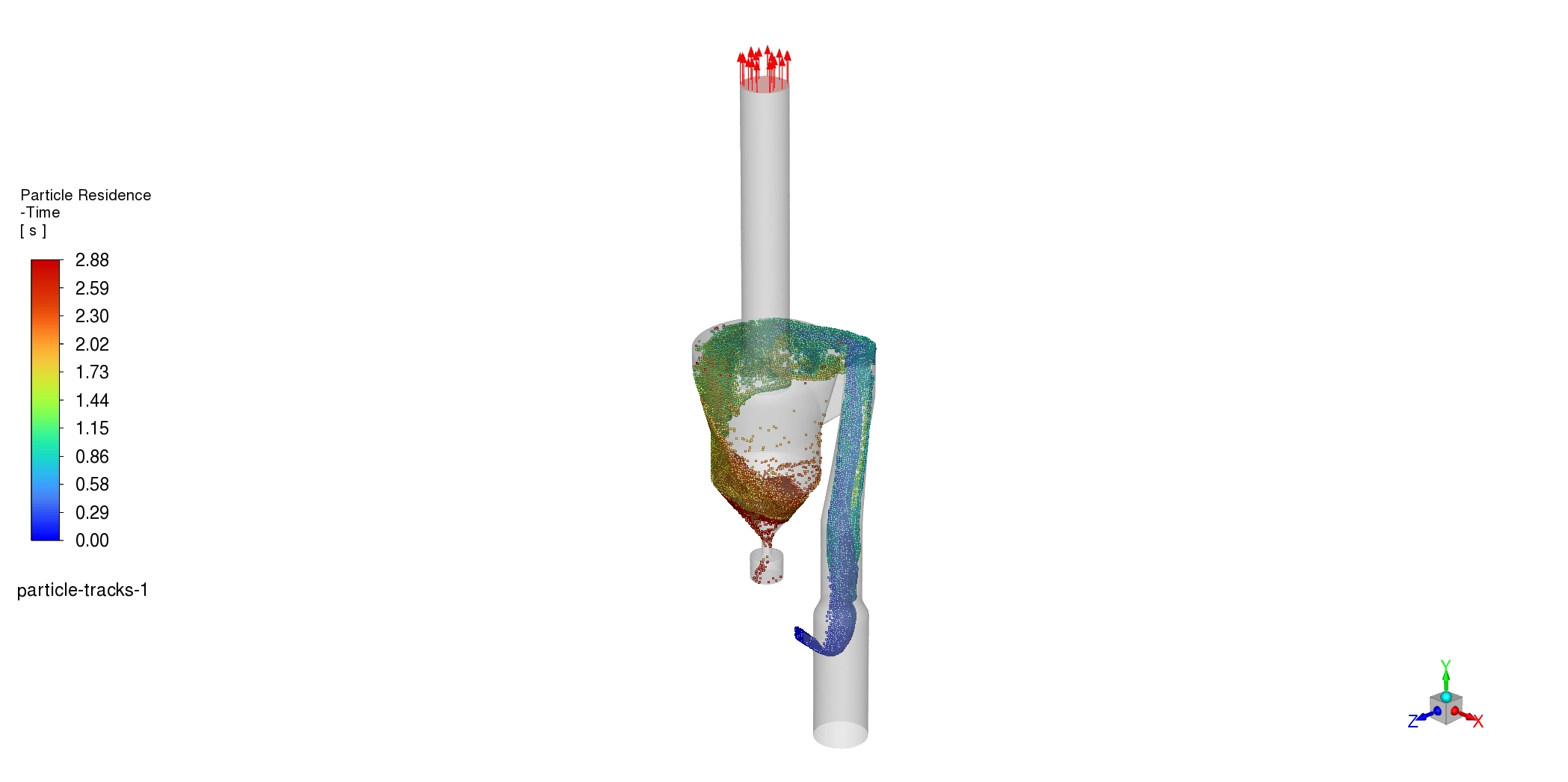

An industrial cyclone preheaters CFD simulation is one of the most important tools for making industries like cement production more energy-efficient. Cyclone preheaters are large towers that use hot exhaust gas from a kiln to heat up raw materials before they go into the kiln. This saves a huge amount of fuel. An industrial cyclone preheaters Fluent analysis lets engineers see the complex flow of hot gas and solid particles inside. The challenge is that these preheaters are filled with a very large number of particles, like a thick, dusty cloud. A normal simulation is not good enough for this.
This report shows a special cyclone preheaters CFD study that uses an advanced method called the Dense Discrete Phase Model (DDPM) in ANSYS Fluent. A standard simulation model can only track particles that are far apart. The DDPM Fluent model is different; it is designed for situations where there are so many particles that they are constantly bumping into each other. This Dense Discrete Phase Model Simulation is the only way to accurately see how this thick cloud of particles moves, heats up, and separates inside the cyclone. This information is critical for designing better preheaters that use less energy and improve the quality of the final product.
- Reference [1]: Mirzaei, Mohamadali, et al. “CFD simulation and experimental validation of multiphase flow in industrial cyclone preheaters.” Chemical Engineering Journal465 (2023): 142757.
- Reference [2]: Investigation of erosion in an industrial cyclone preheater by CFD simulations
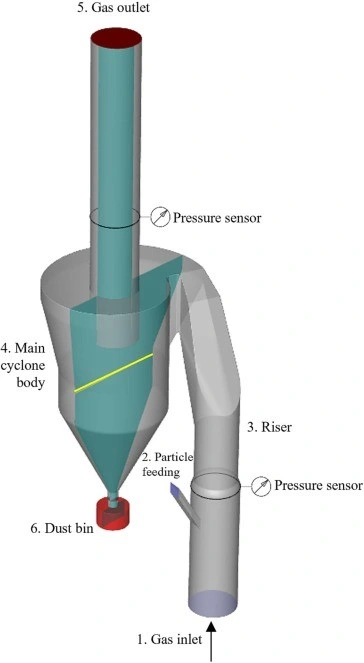
Figure 1: A simple diagram showing the parts of the industrial cyclone preheater used in this CFD simulation [1]
Simulation Process: Fluent Multiphase & DDPM Setup, Modeling the Dense Particle Flow
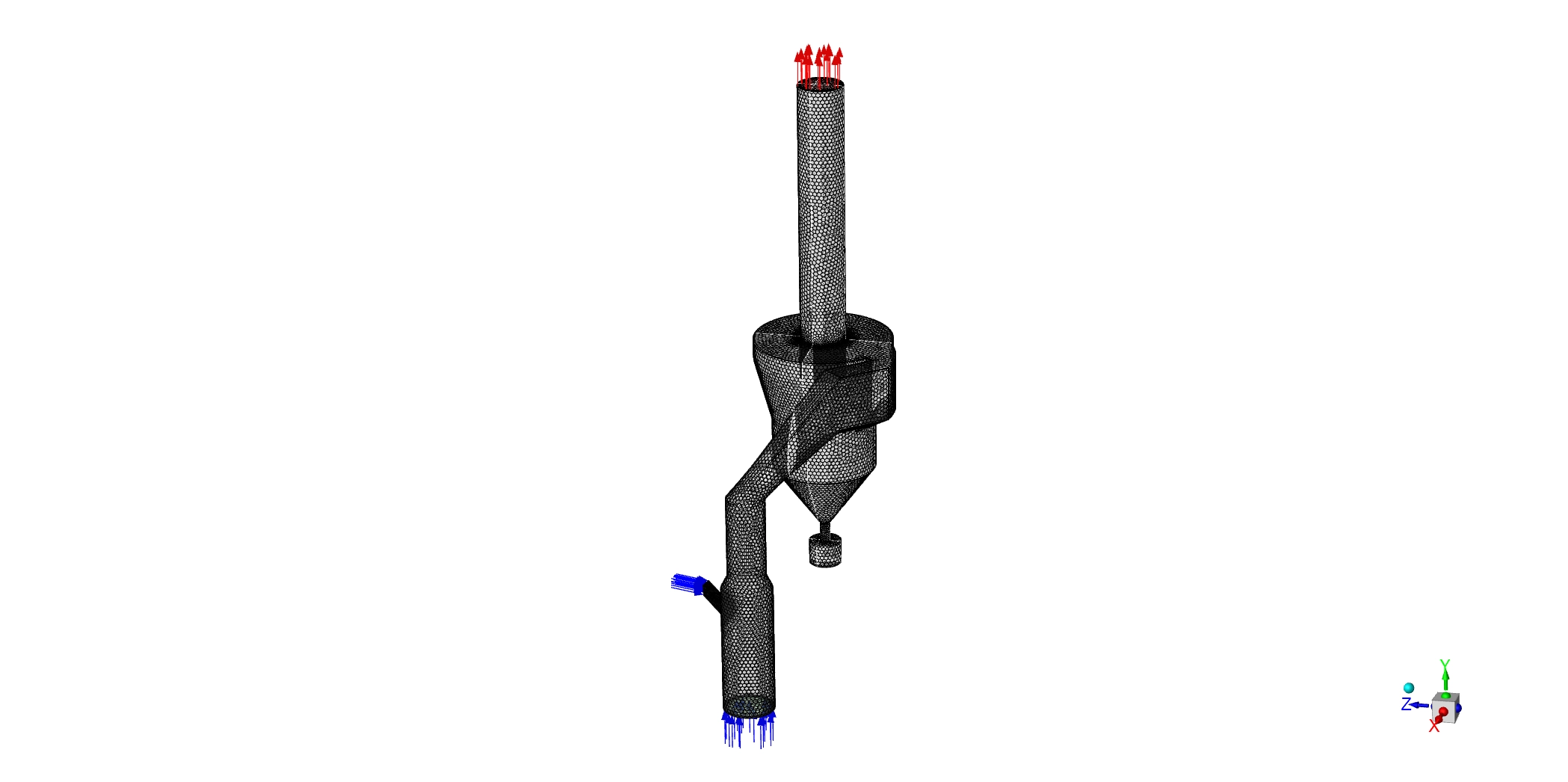
The industrial cyclone preheaters CFD Simulation Using DDPM begins with the creation of a precise three-dimensional preheater model in ANSYS Fluent. This geometric model is an exact digital replica of the industrial cyclone, including its complex features like the tangential inlet ducts, the main cyclone chambers, the lower particle collection zones, and the central gas outlet section (vortex finder). Following the geometry creation, the computational domain is discretized using Fluent meshing technology. A high-quality grid consisting of 308,312 polyhedral cells is generated. Polyhedral cells are specifically chosen for this industrial cyclone CFD simulation because they provide superior numerical accuracy for complex swirling flow calculations and particle tracking when compared to standard mesh types.
The core of the CFD simulation is the multiphase physics setup in ANSYS Fluent, which employs a sophisticated Eulerian multiphase model combined with the Dense Discrete Phase Model (DDPM). The Eulerian framework is used to solve the governing equations for the continuous gas phase, accurately predicting its flow patterns, turbulence, and pressure fields. The DDPM is then used to handle the dense flow of solid particles through a Lagrangian particle tracking approach. This DDPM Fluent implementation is critical because it accounts for particle-particle interactions and collisions, which are prevalent in industrial cyclone preheaters operating with high solid loadings. A two-way DPM model configuration is activated to ensure that the strong coupling between the gas and particle phases is captured; this means the particles affect the gas flow through momentum and energy exchange, and the gas flow, in turn, governs the particle trajectories and heat transfer. The simulation uses unsteady particle tracking to capture the time-dependent motion of particles and accurately calculate their residence time. The model incorporates a comprehensive set of forces acting on the particles, including drag forces (using a Filtered drag law to account for turbulence and clustering), lift forces in the swirling flow, and wall lubrication forces to model near-wall behavior. This detailed physics setup in this cyclone preheaters Fluent simulation ensures that the complex gas-solid interactions are modeled with high fidelity, leading to reliable predictions of separation efficiency and thermal performance.
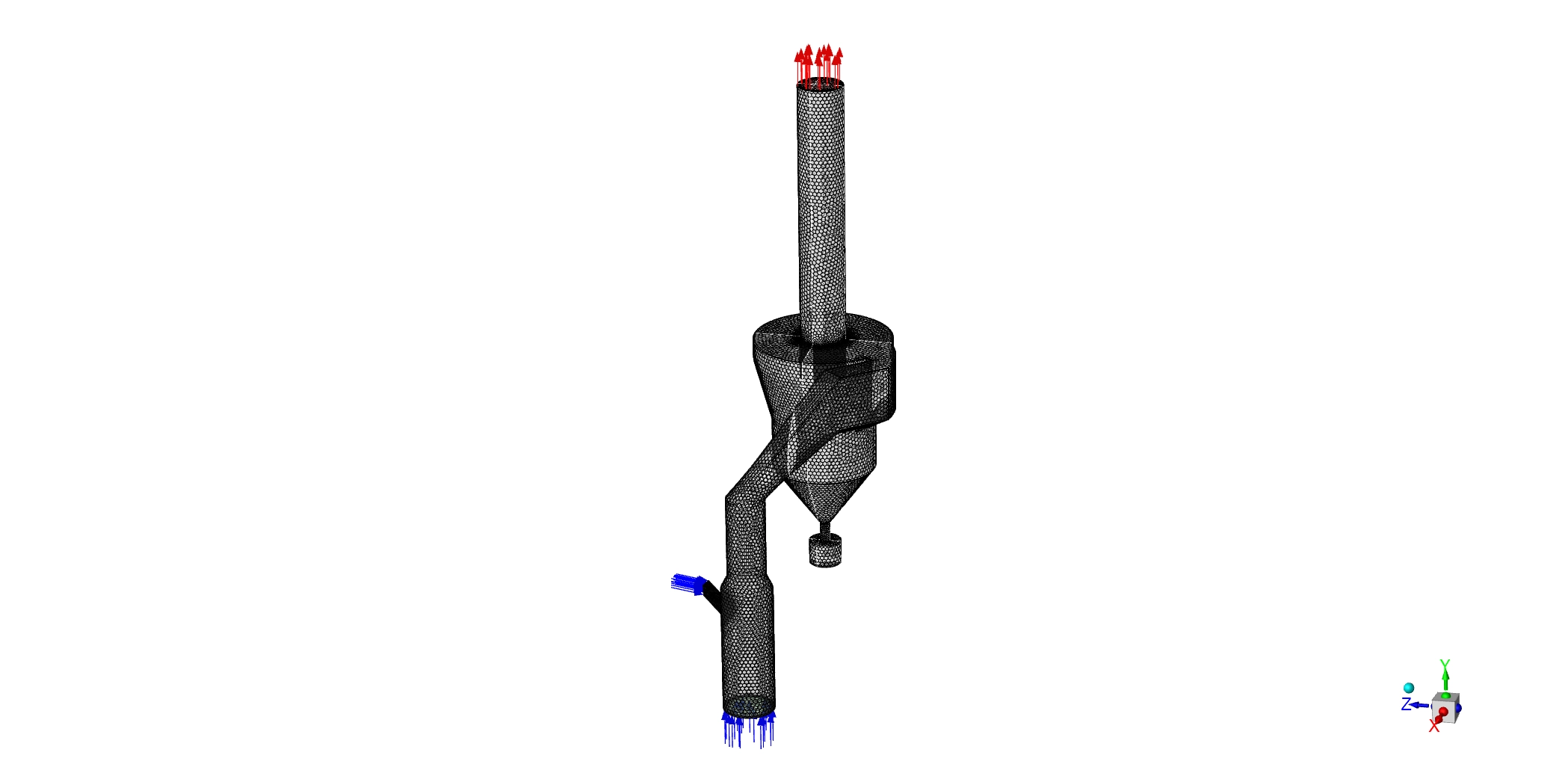
Figure 2: The high-quality polyhedral mesh with 308,312 cells used to fill the preheater’s geometry for the Fluent simulation
Post-processing: CFD Engineering Inspection of Preheater Performance
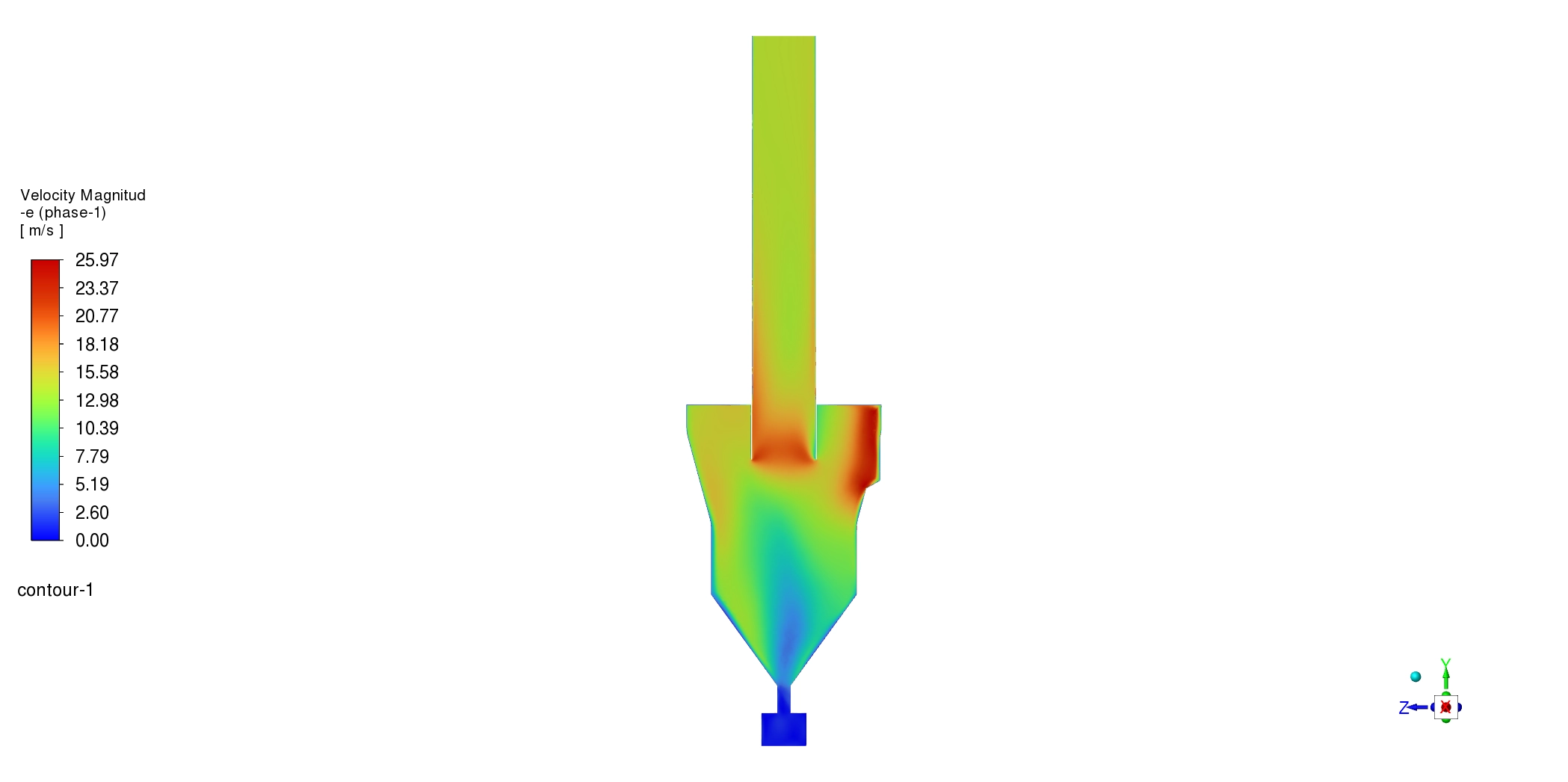
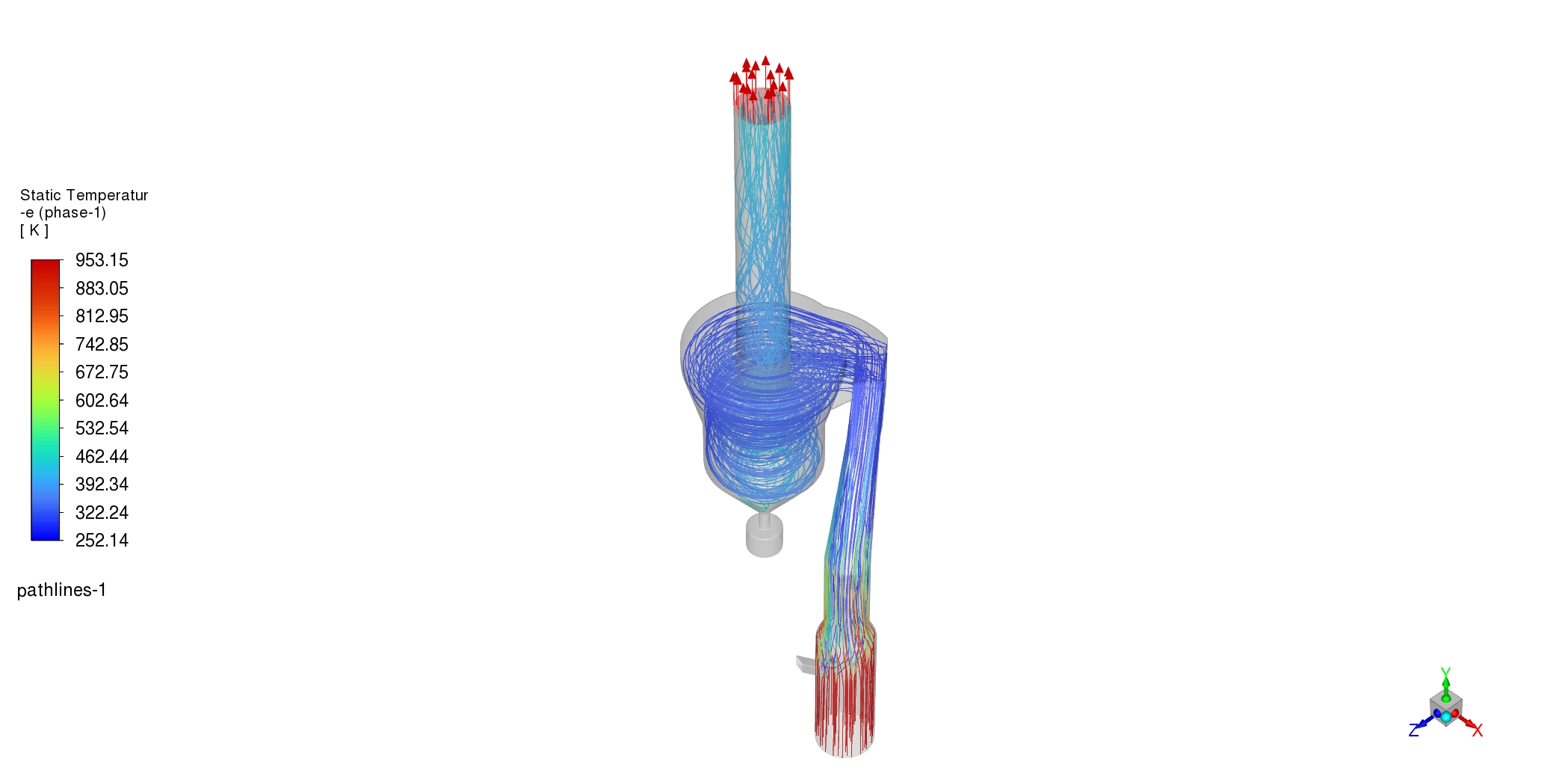
The simulation results give us a complete video of what happens inside the preheater. We will now inspect this video to see how well the hot gas engine works and to follow the journey of the particles. First, we need to inspect the engine that drives the entire process: the hot gas. The pathlines in Figure 3 show how this engine works. The hot gas enters the cyclone and is forced into a powerful, swirling motion, creating a classic cyclone vortex. This spinning motion is the secret to the cyclone’s success. The velocity contour in Figure 4 shows us how powerful this engine is. The gas reaches very high speeds (red and orange colors) as it spins, creating the strong force needed to separate the particles.
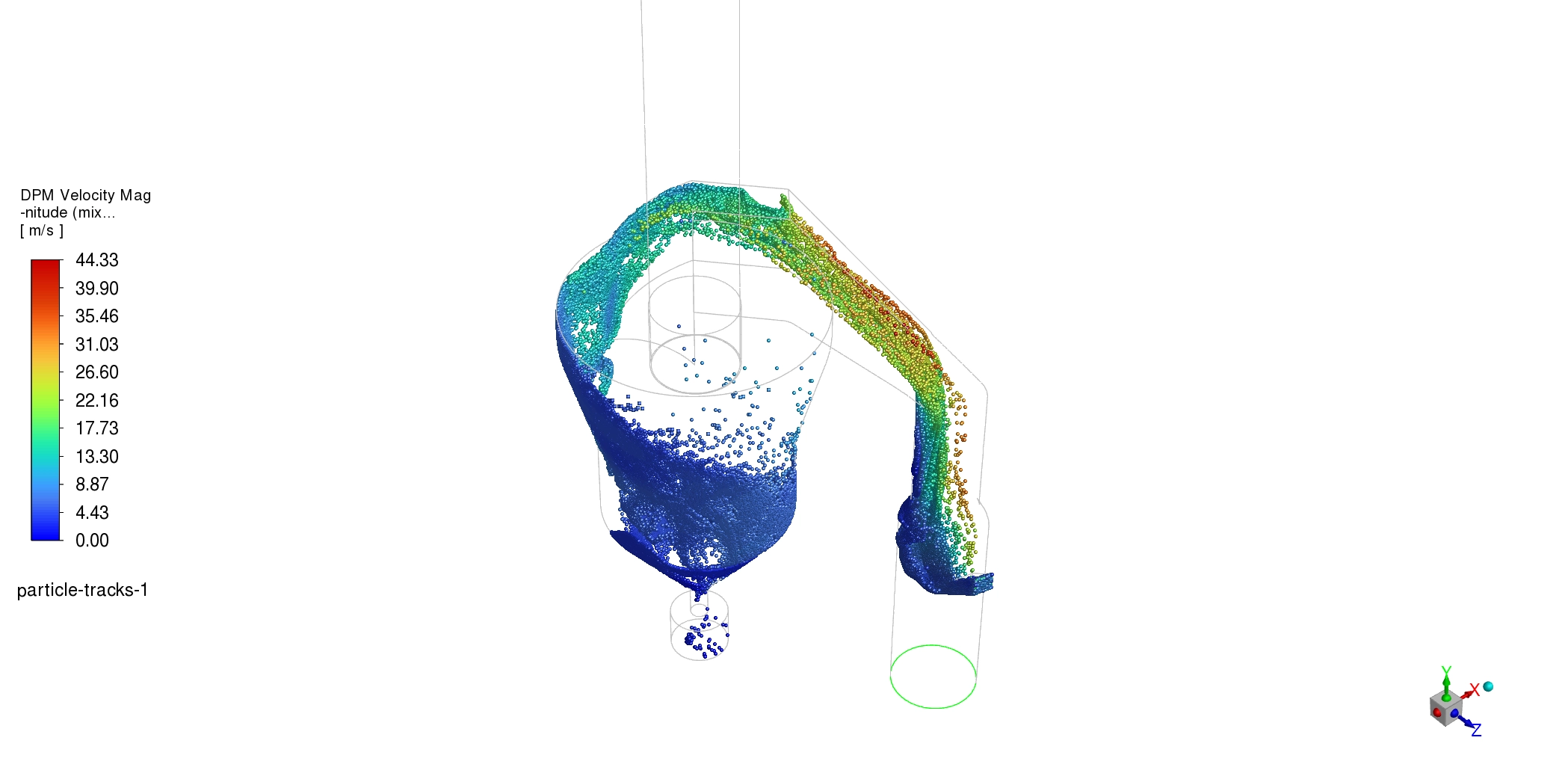
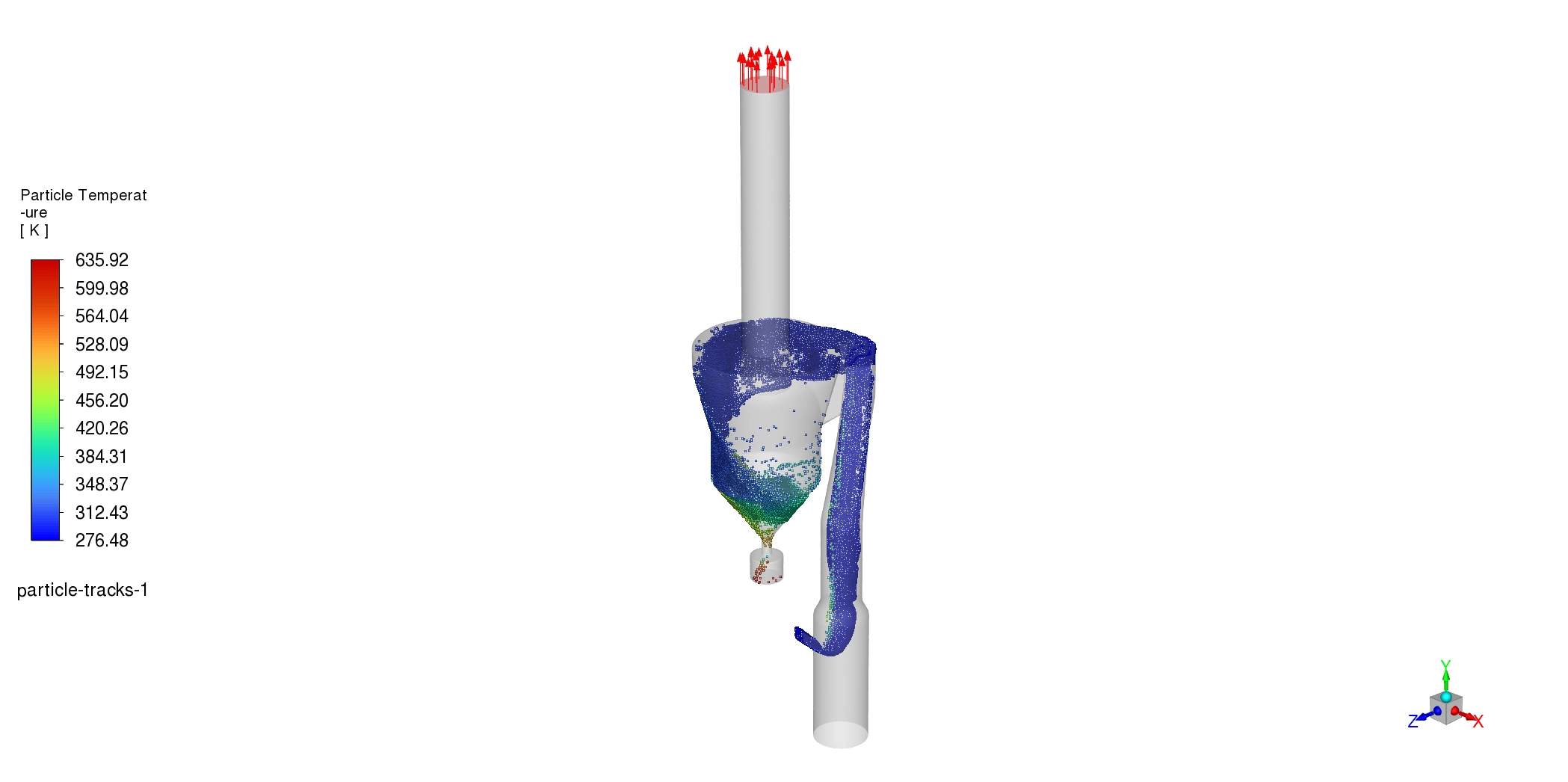
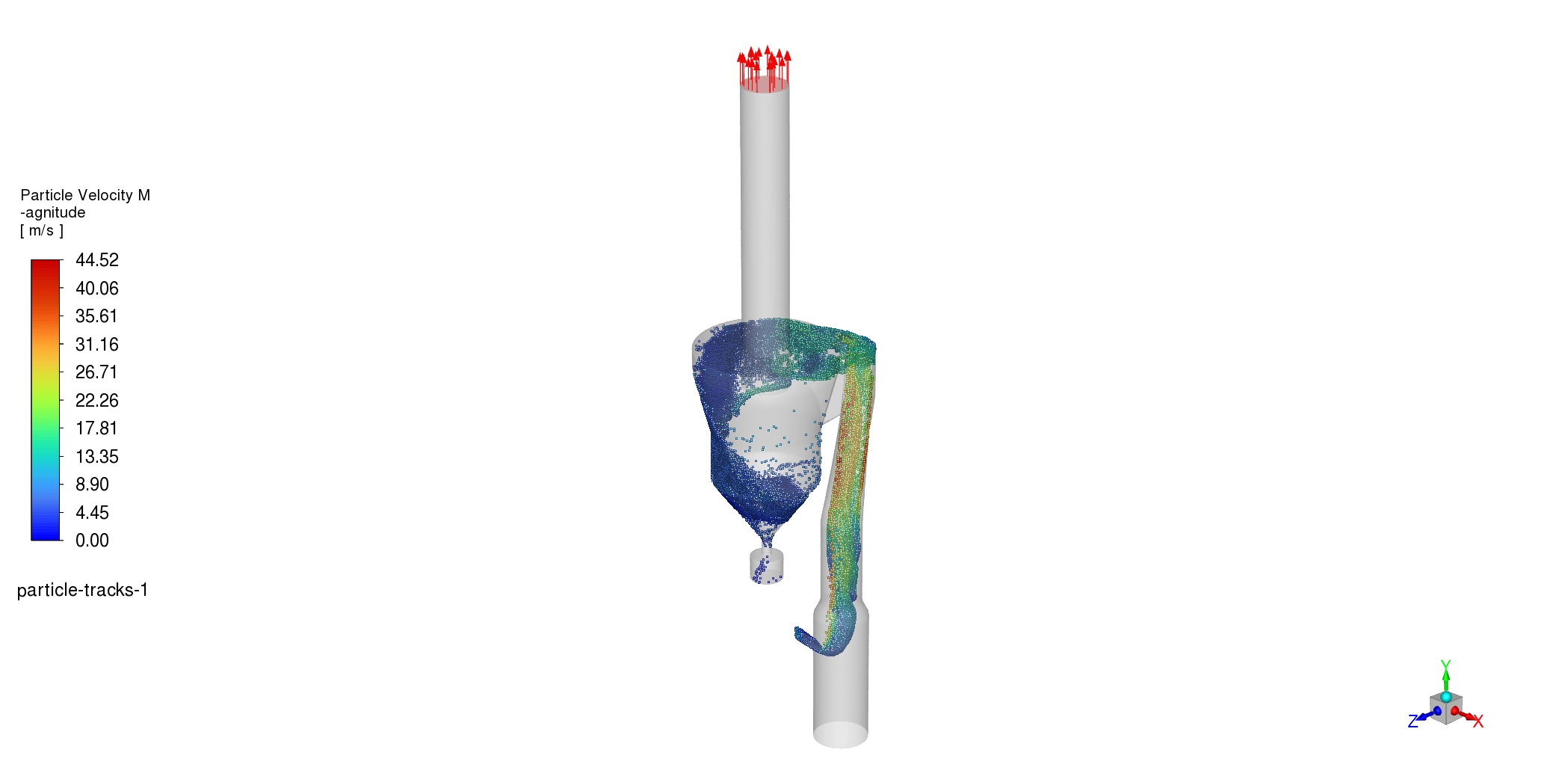
The temperature part of Figure 3 shows us if the engine is doing its main job: transferring heat. The gas enters very hot (up to 795 K) and leaves much cooler ( down to 288 K). This large drop in temperature is the most important achievement of the preheater’s design. It is direct proof that the heat energy is not being wasted. Instead, it is being successfully transferred from the gas to the raw material particles, which is the entire purpose of the machine. Now that we have inspected the engine, we can follow the journey of a single particle. The particle velocity contour in Figure 5 shows the first part of this journey. As soon as particles enter the cyclone, the powerful gas vortex grabs them and throws them against the wall. We can see them reaching very high speeds, up to 44.52 m/s. This centrifugal force is what separates the heavier raw material from the gas. The particles then spiral down the walls to be collected at the bottom.
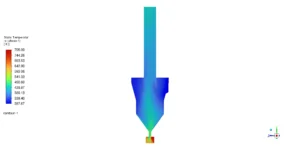
Figure 3: Static temperature distribution with pathlines in industrial cyclone preheater from CFD simulation using ANSYS Fluent – gas flow temperature ranges
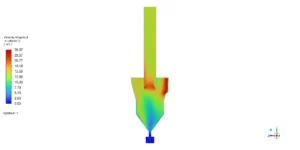
Figure 4: The gas velocity magnitude contour. This contour shows how fast the gas is moving, which is the force that drives the separation.
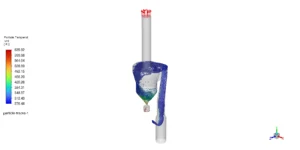
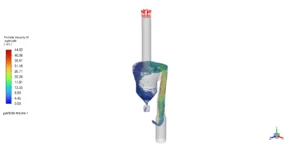
Figure 5: The particle velocity and temperature contours from the DDPM analysis. These contours show the speed and temperature of the particles on their journey through the preheater.
The particle temperature contour in Figure 5 shows the second, and most important, part of the journey. The particles enter cold (276.48 K). As they travel through the hot gas engine, they absorb heat. By the time they are ready to leave the cyclone, their temperature has increased dramatically (up to 635.92 K). This shows that the preheating process is working very effectively. The long, swirling path gives the particles enough time to absorb a large amount of heat from the gas. The simulation proves that the design successfully uses the vortex to do two jobs at once: it separates the particles and it heats them up.
This industrial cyclone preheaters CFD simulation is an extremely powerful tool for the engineers who design and operate these large industrial systems:
- It Provides a Clear Picture of Performance: For the first time, engineers can see exactly how the gas and the thick cloud of particles are behaving inside the cyclone. The DDPM model is the key to getting this clear picture.
- It Helps Find the Perfect Balance: The best cyclone design has a perfect balance. It needs a vortex that is strong enough to separate the particles well, but it also needs to give the particles enough time to get hot. This simulation allows designers to test small changes on the computer to find the optimal design that gives the best separation and the most heating for the lowest energy cost.
- It Reduces Fuel Costs: By using this simulation to make the preheating process even a few percent more efficient, a cement plant can save a very large amount of money on fuel costs every year. This makes the entire operation more profitable and better for the environment.


Reviews
There are no reviews yet.