
In the modern aviation industry, severe noise pollution is a major environmental problem. When standard airplane blades rotate, their sharp tips cut the air very violently. This fast movement creates a spinning tornado of air called a tip vortex. This vortex generates massive pressure waves that humans hear as extremely loud noise. To solve this problem, engineers invented the closed-loop ring blade. In this educational guide, we will explore the Toroidal Propeller Effect on Aeroacoustics CFD to mathematically understand how this new shape destroys noise. By following this step-by-step fluent simulation, engineering students can learn how to safely visualize invisible sound waves before manufacturing real metal parts. A complete CFD Analysis of Toroidal Propeller Effect on Aeroacoustics helps aircraft manufacturers locate exactly where the loudest noises are born. Inside the software, designers mount the Toroidal Propeller on fuselage and mathematically measure the exact decibel levels. Calculating these complex aerodynamic noises requires a very strong understanding of turbulent wakes and pressure fluctuations. To deeply learn how sound waves travel through moving fluids and air in a virtual geometry, please carefully explore our comprehensive Acoustics tutorials.
- Reference [1]: Vu, Xuan-duc, et al. “Numerical Aerodynamic and Aeroacoustic Analysis of Toroidal Propeller Designs.” International Journal of Aviation Science and Technology01 (2024): 20-33.
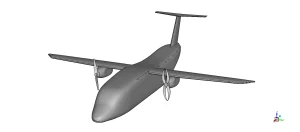
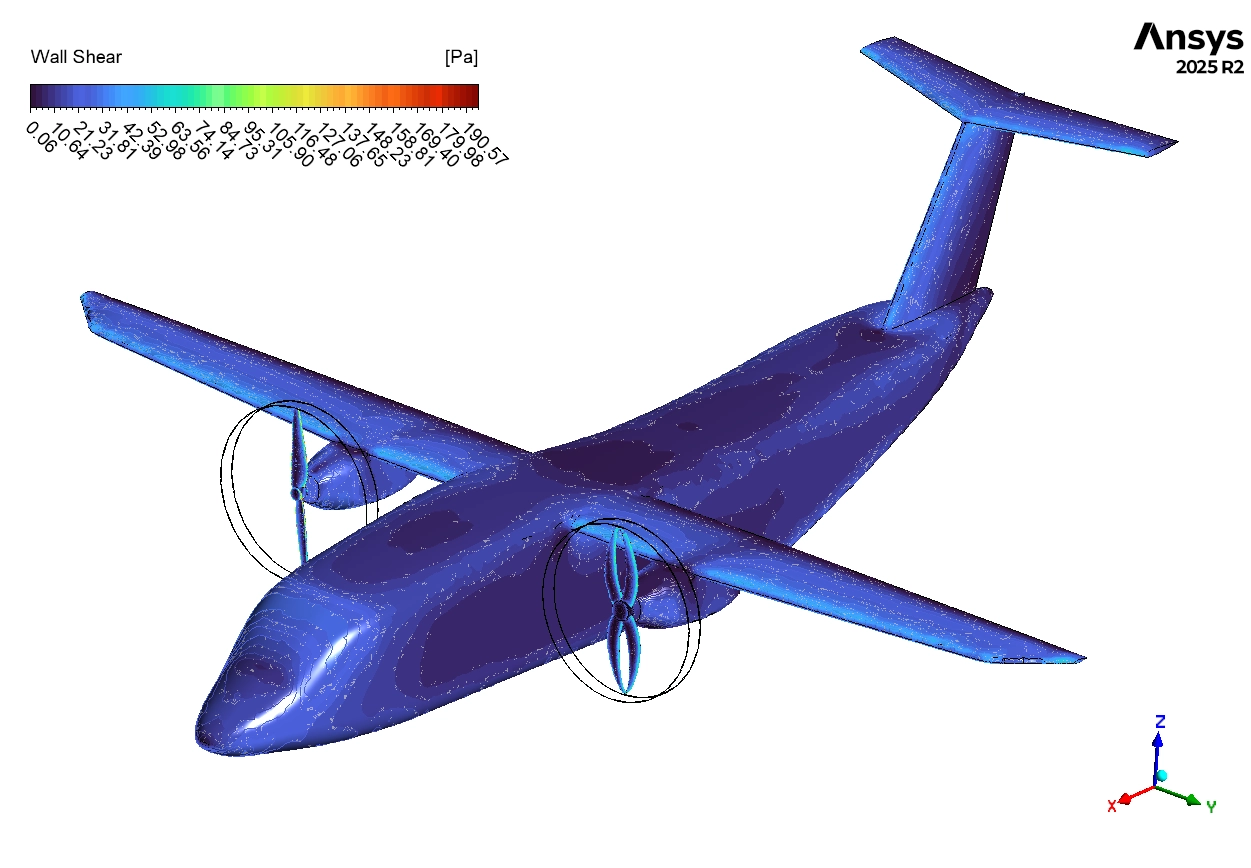
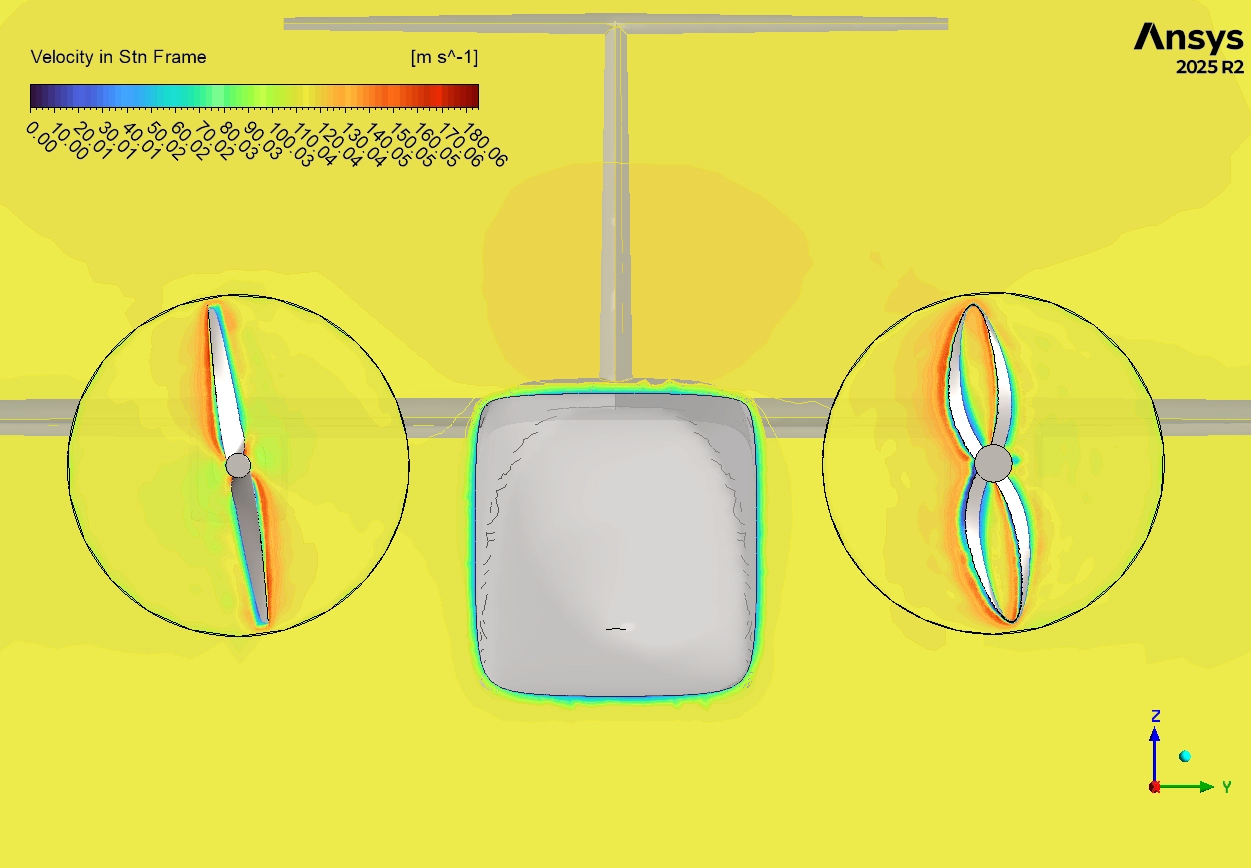
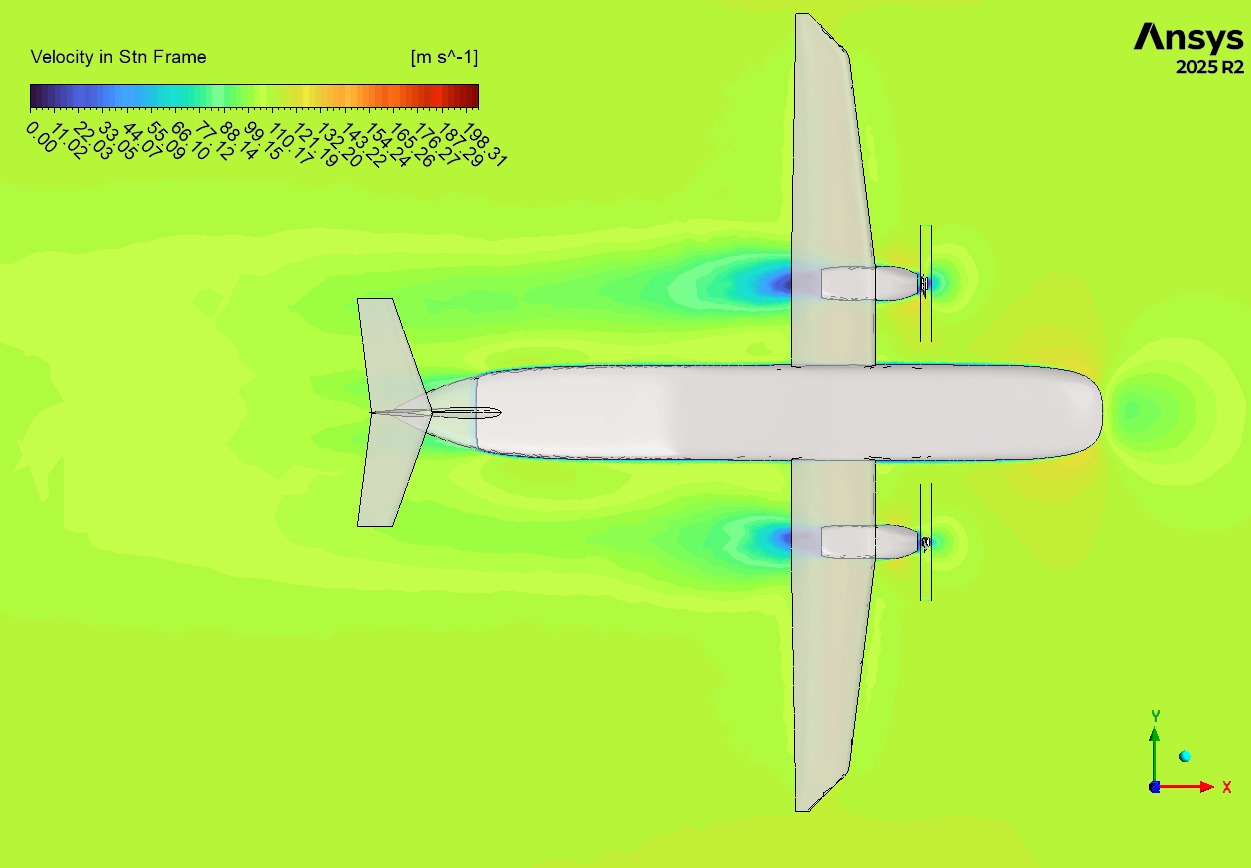
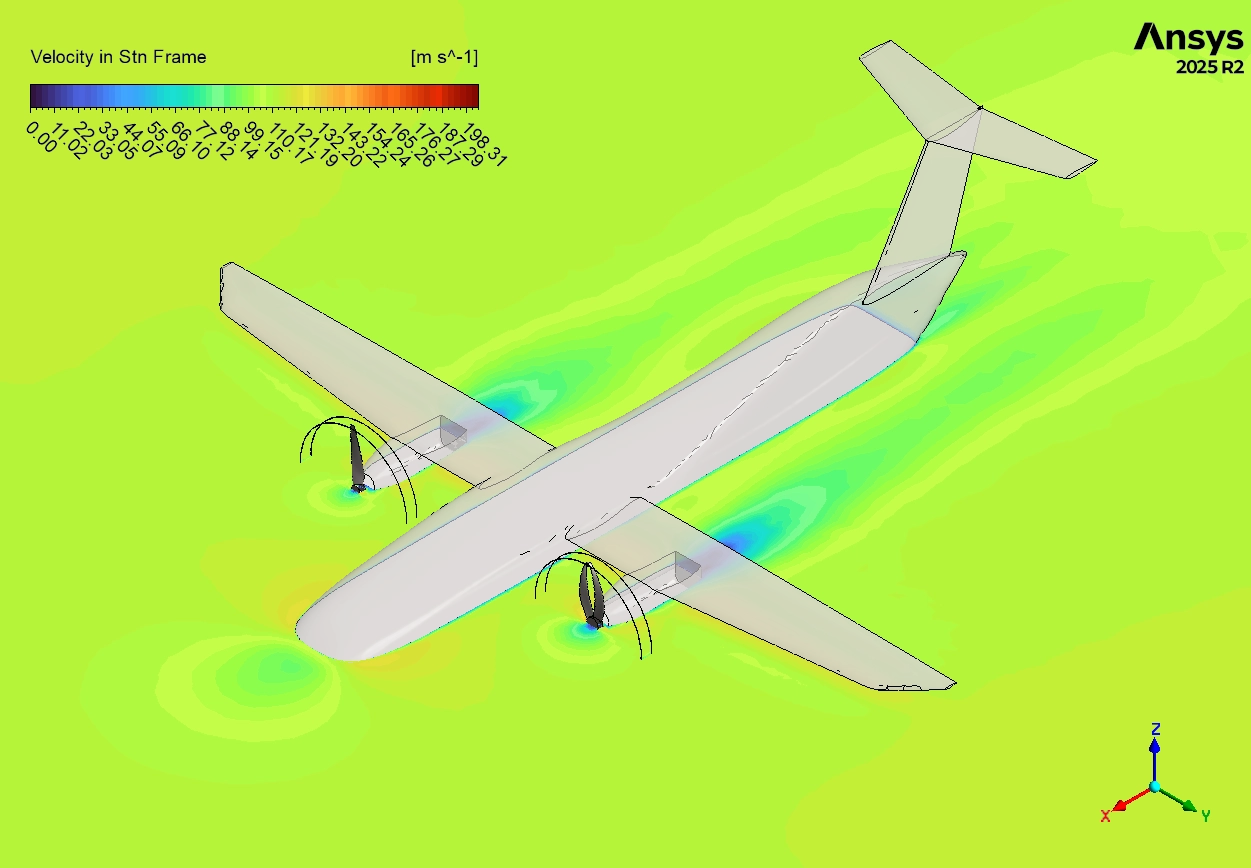
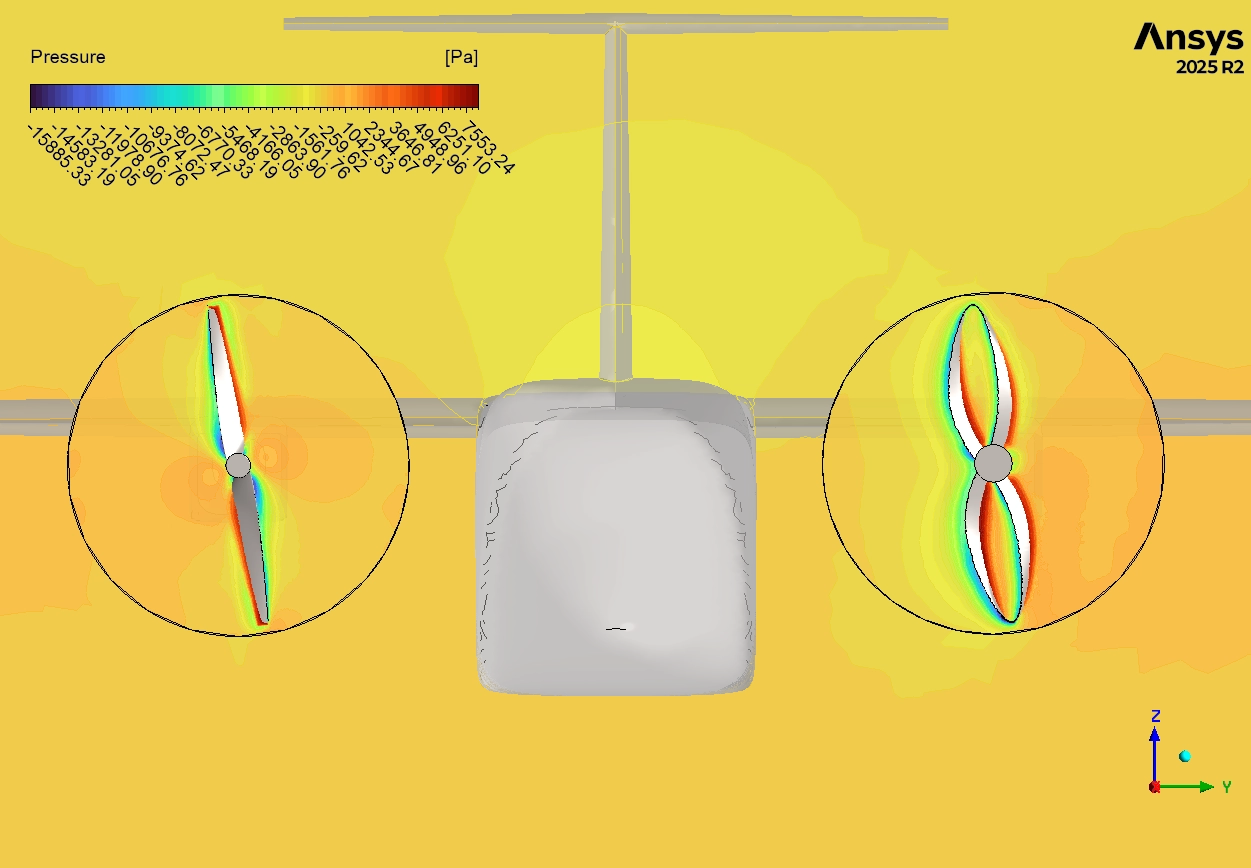
Figure 1: 3D geometry of fuseloge equipped with Toroidal and conventional Propellers
Simulation Process: Broadband Noise Model for Aeroacoustics analysis
To begin this Toroidal Propeller Effect on Aeroacoustics ANSYS Fluent project, we built a complete 3D computational representation of an aircraft. We installed a conventional straight propeller on the left side and a closed-loop ring propeller on the right side. This setup creates a perfect side-by-side learning comparison. Next, we used the ANSYS meshing tool to divide the empty air and the solid fuselage into exactly 10,453,827 tetrahedral cells. Tetrahedral cells are highly effective because they easily adapt to the complex, highly curved geometry of the continuous ring blade.
To simulate a real flight environment, we applied exact aerodynamic boundary conditions. We programmed the virtual aircraft to fly forward at Mach 0.325, which equals exactly 110.5 m/s. We then instructed the Moving Reference Frame (MRF) solver to rotate both propellers at exactly 300 RPM. Finally, we activated the Broadband Noise Sources mathematical model. This advanced acoustic model uses the calculated turbulence data to predict exactly how the spinning blades create loud, high-frequency sound waves.
Post-Processing: Analysis of Aeroacoustics and Fluid Physics
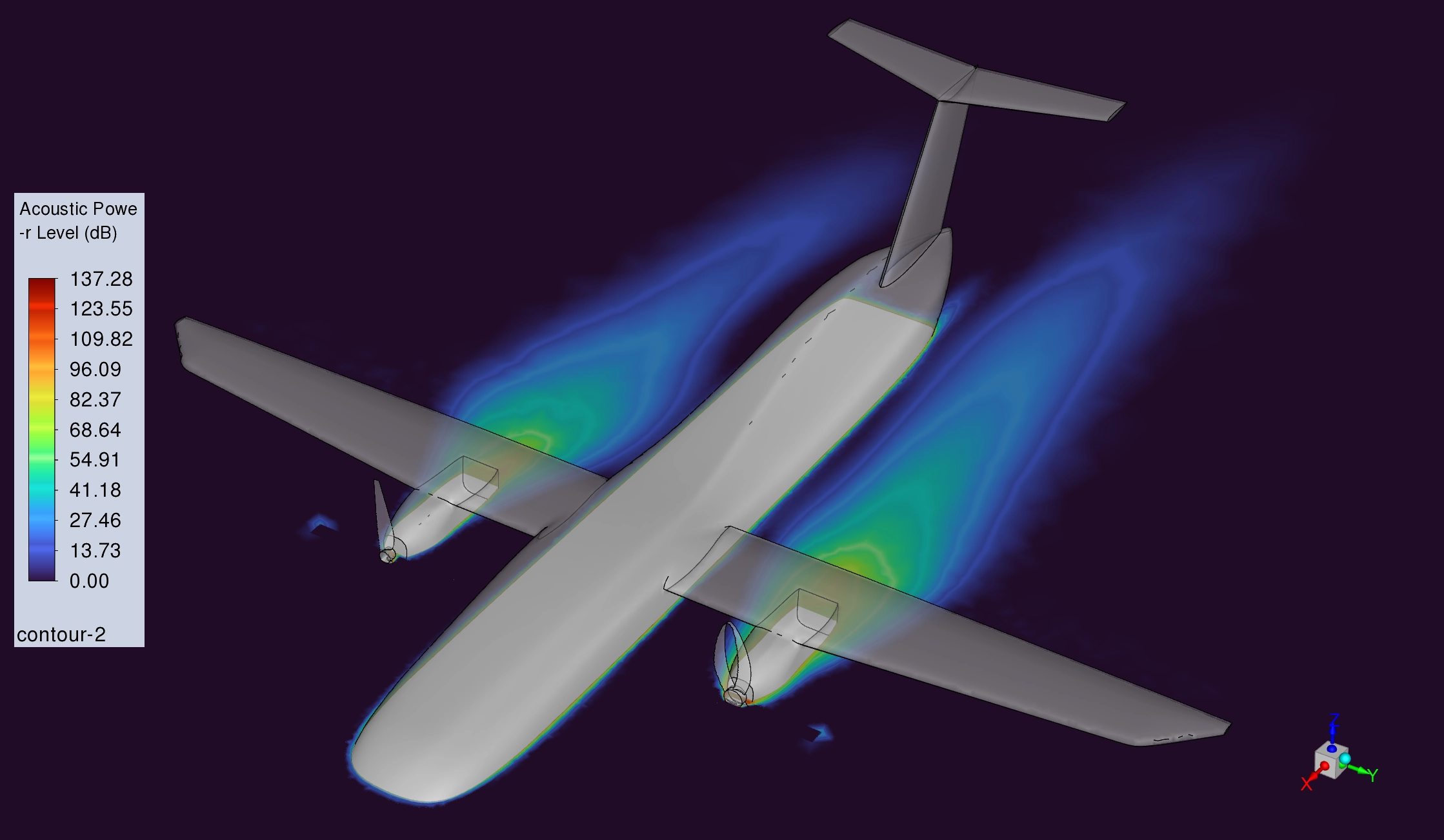
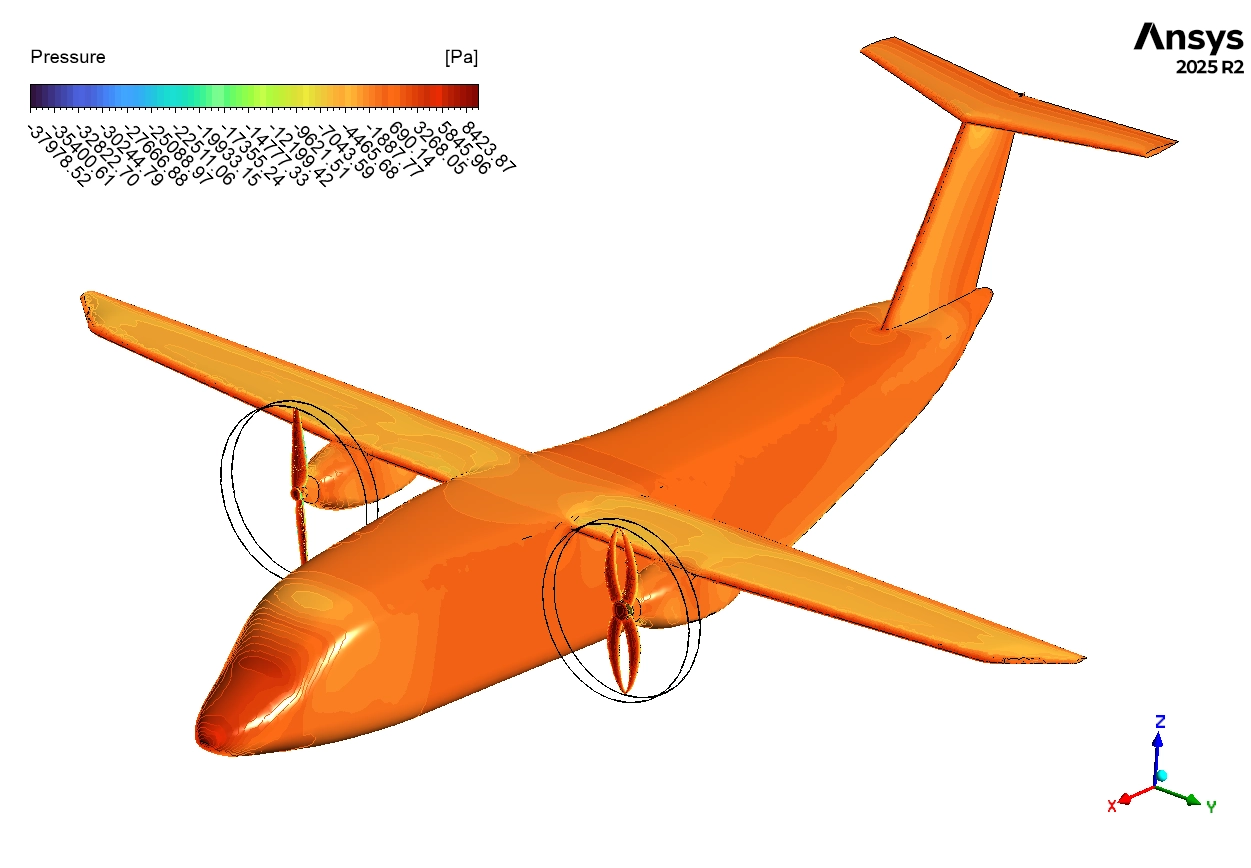
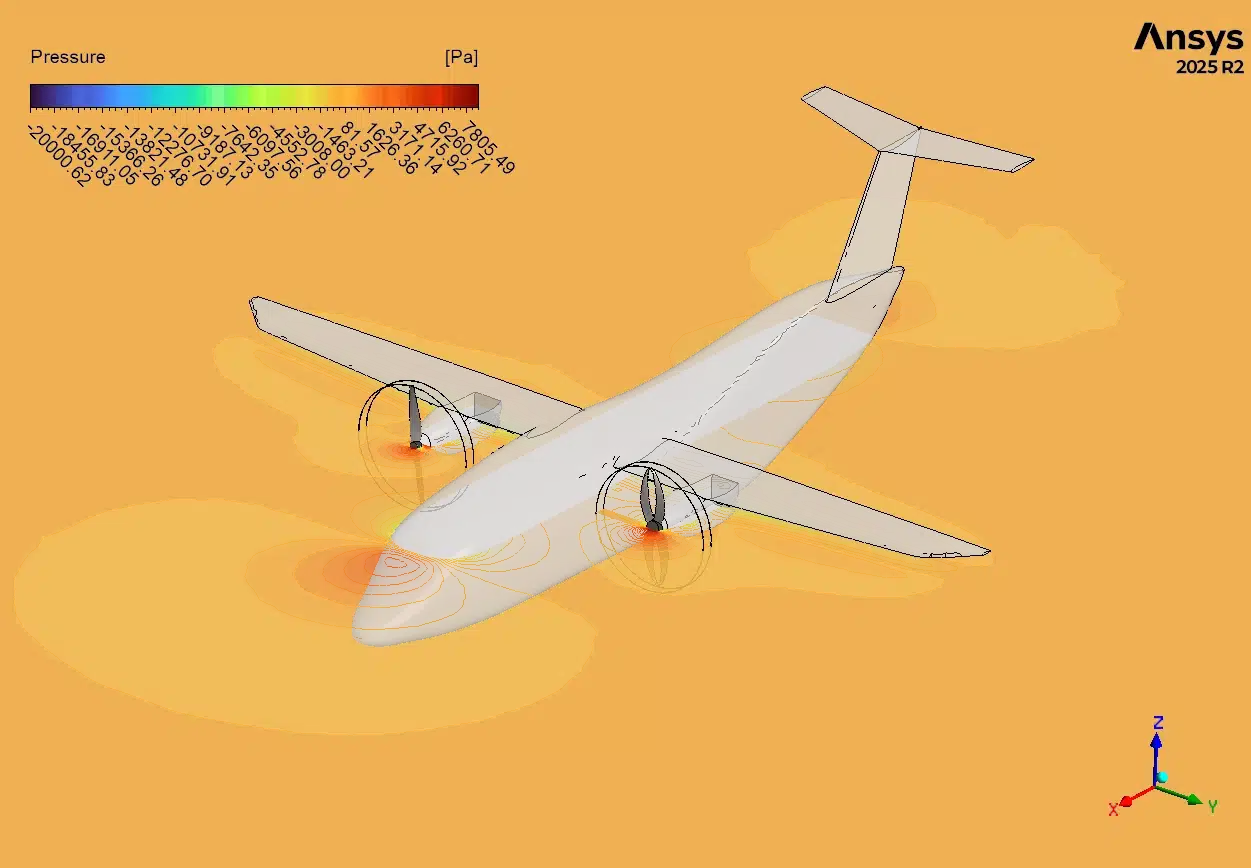
To truly understand the engineering success of this quiet blade design, we must coherently analyze the pressure contours and the acoustic polar plots together. This continuous scientific analysis explains exactly how the physical blade shape controls the air pressure and destroys the sound waves. We begin by examining the pressure contours on the blade surfaces. The software calculated a pressure scale ranging from an extreme low of -15,663 Pa to a high of +15,729 Pa. When we observe the conventional straight blade, we see severe pressure discontinuities. Dark red high-pressure spots appear exactly at the sharp blade tips. This sharp pressure drop forces the air to violently leak over the edge, creating the noisy tip vortex. However, the toroidal blade shows a perfectly smooth pressure distribution around the entire continuous ring. Because there is no sharp tip, the air cannot leak. This specific geometry completely prevents the noisy tip vortex from ever forming. By stopping the pressure leak, the noise is destroyed at its physical source. Next, we analyze the acoustic power contours to see how this smooth pressure affects the sound. The 3D volume acoustic field shows a maximum scale of 137.28 dB. Close to the conventional propeller, we see massive yellow hotspots reaching 82 to 110 dB, proving that the violently mixing tip wake generates huge amounts of broadband noise.
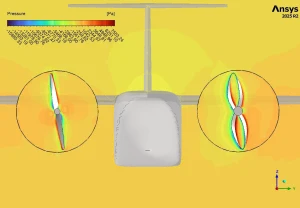
Figure 2: Aerodynamic pressure gradient contour comparing the conventional propeller and the toroidal propeller, highlighting the pressure distribution from -15,663 Pa to +15,729 Pa.
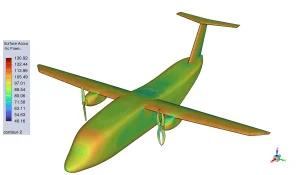
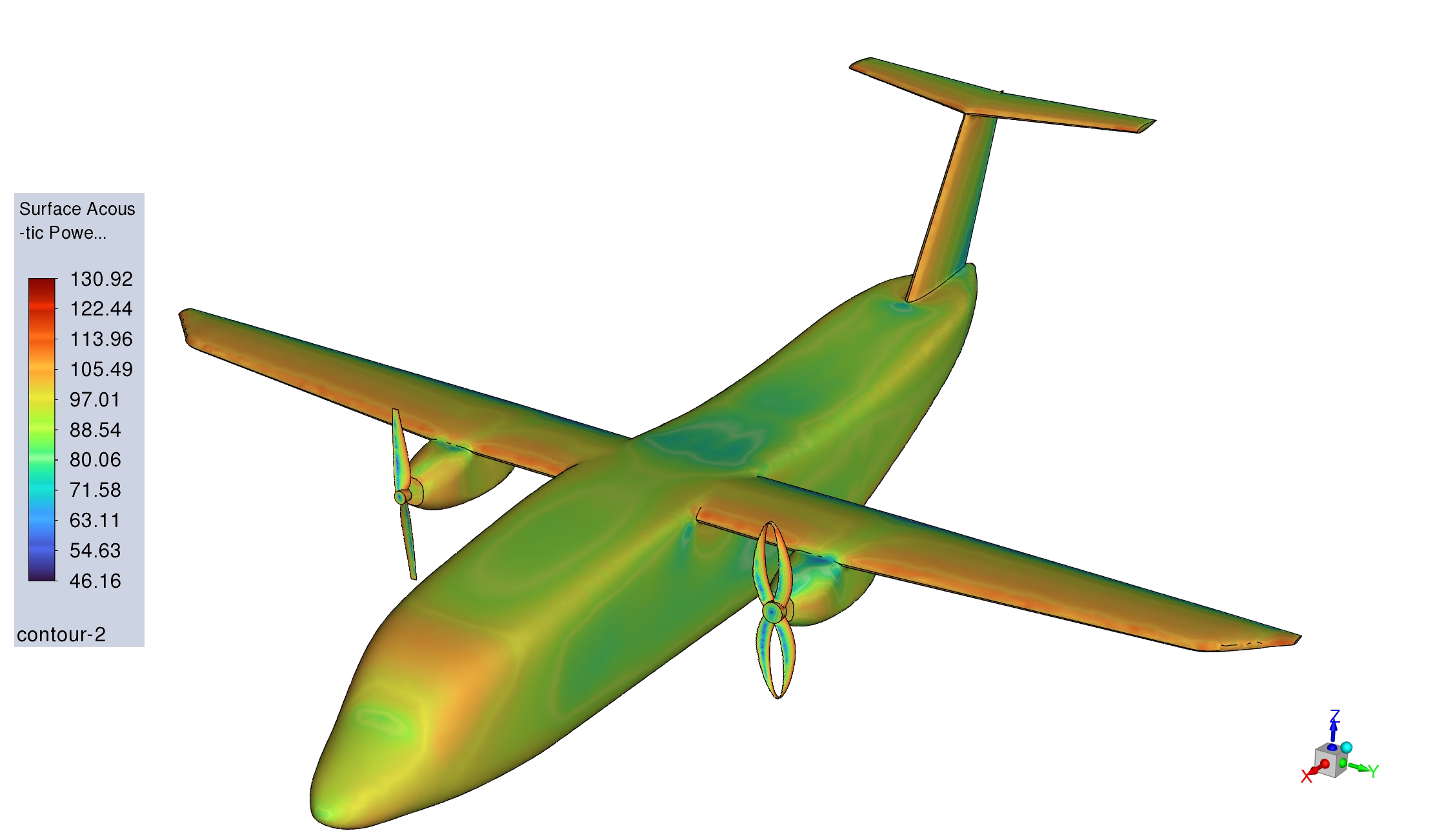
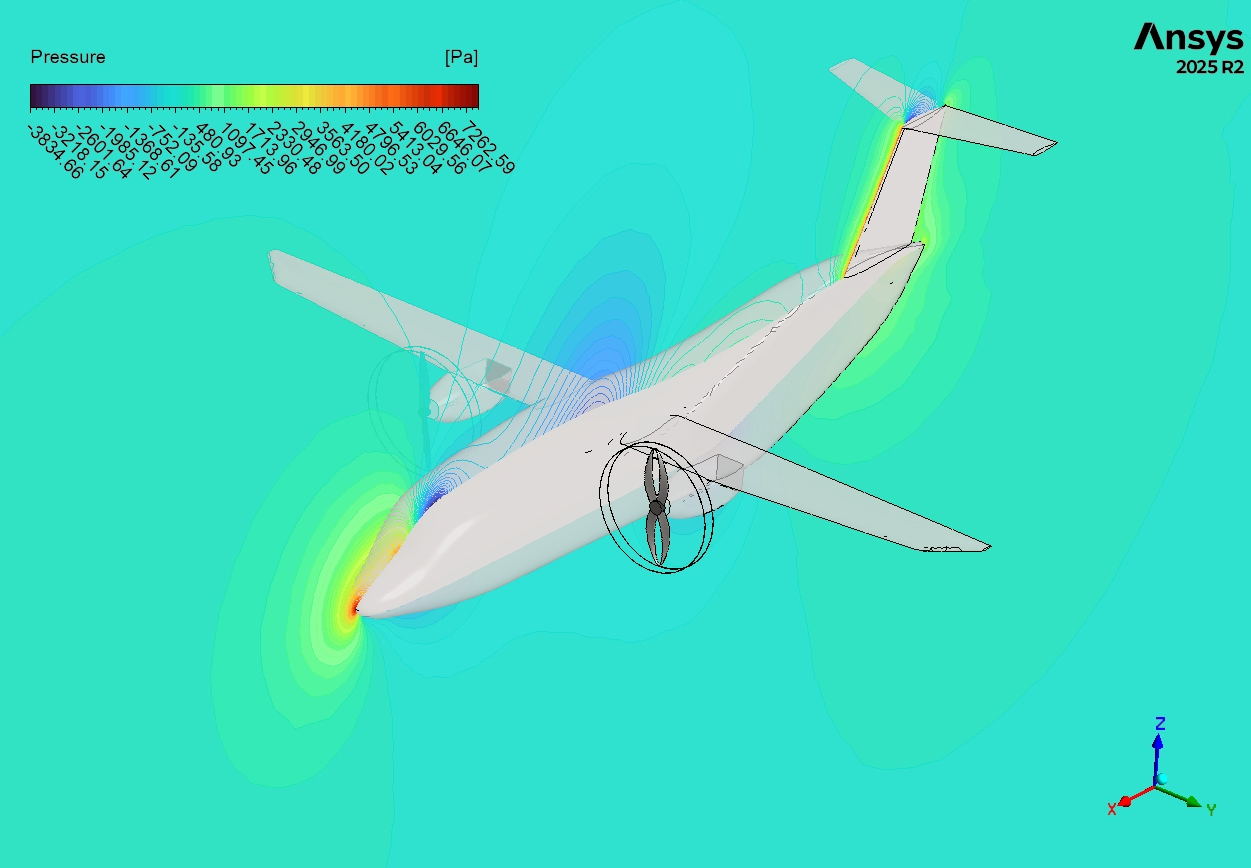
Figure 3: Surface acoustic sound level distribution around the fuselage and blades, analyzed using the Broadband Noise Source model in ANSYS Fluent.
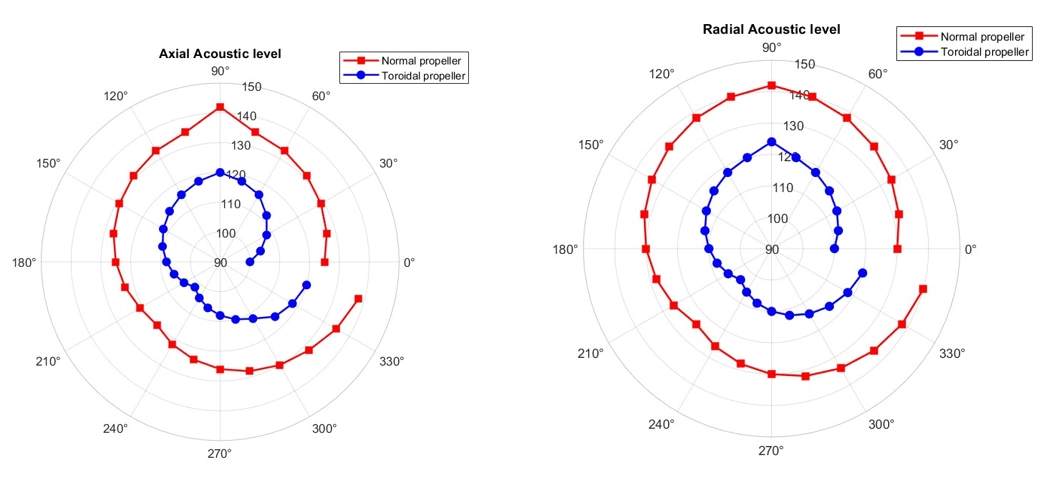
To find the exact origin of this sound, we connect these volume fields to the surface acoustic power contours. The overall surface scale ranges from 46.16 dB to 130.92 dB. When we look closely at the conventional straight blade, we see bright orange hotspots exactly at the tips, measuring 105 to 114 dB of acoustic power. In sharp contrast, the toroidal propeller nacelle shows only smooth green and yellow colors. The acoustic energy spreads evenly around the loop at a much lower 88 to 105 dB. By simply removing the blade tip, the peak surface noise generation drops significantly. Finally, to mathematically prove how this helps humans on the ground, we must read the exact acoustic directivity polar plots. The radial acoustic level graph measures the sound radiating outward into the sky. The conventional propeller reaches a painful, extremely loud peak of approximately 145 dB. The toroidal propeller stays consistently low, reaching only about 125 dB. This results in a massive, highly successful physical drop of exactly 20 dB. The axial acoustic level graph perfectly confirms this success. The normal blade hits 140 dB, while the ring blade drops heavily to 120 dB. In the science of aeroacoustics, every 10 dB reduction means the perceived loudness is cut in half. Achieving a 20 dB noise reduction means the toroidal design is incredibly quiet. This exact numerical data mathematically proves that eliminating blade tips perfectly suppresses vortex noise, making this design highly superior for future urban aircraft.
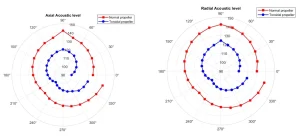
Figure 4: Polar directivity analysis showing the radial and axial acoustic power levels, demonstrating a 20 dB noise reduction for the toroidal propeller.
Table 1: Peak Aeroacoustic Noise Level Comparison
| Propeller Geometry Type | Peak Radial Acoustic Level | Peak Axial Acoustic Level | Unit |
| Conventional Straight Propeller | 145.0 | 140.0 | dB |
| Toroidal Ring Propeller | 125.0 | 120.0 | dB |
| Total Acoustic Noise Reduction | – 20.0 | – 20.0 | dB |
Frequently Asked Questions (FAQ)
- How much noise does the toroidal propeller reduce in this CFD simulation?
- A: According to the exact polar graphs calculated in ANSYS Fluent, the toroidal design drops the peak noise from 145 dB down to 125 dB. This massive 20 dB reduction makes the aircraft incredibly quiet and safe for urban flying.
- How does a toroidal propeller reduce aerodynamic noise?
- A: A toroidal propeller uses a continuous, closed loop instead of straight blades. By eliminating the sharp blade tips, it stops high-pressure air from leaking. This prevents loud, spinning tip vortices from forming, successfully lowering the noise by up to 20 decibels.
- What does the Broadband Noise Source model calculate?
- A: It is a specific mathematical equation used in fluid simulations. It calculates how turbulent air and rapid pressure changes generate physical sound waves, allowing engineers to measure the exact decibel levels around an aircraft.




Reviews
There are no reviews yet.