
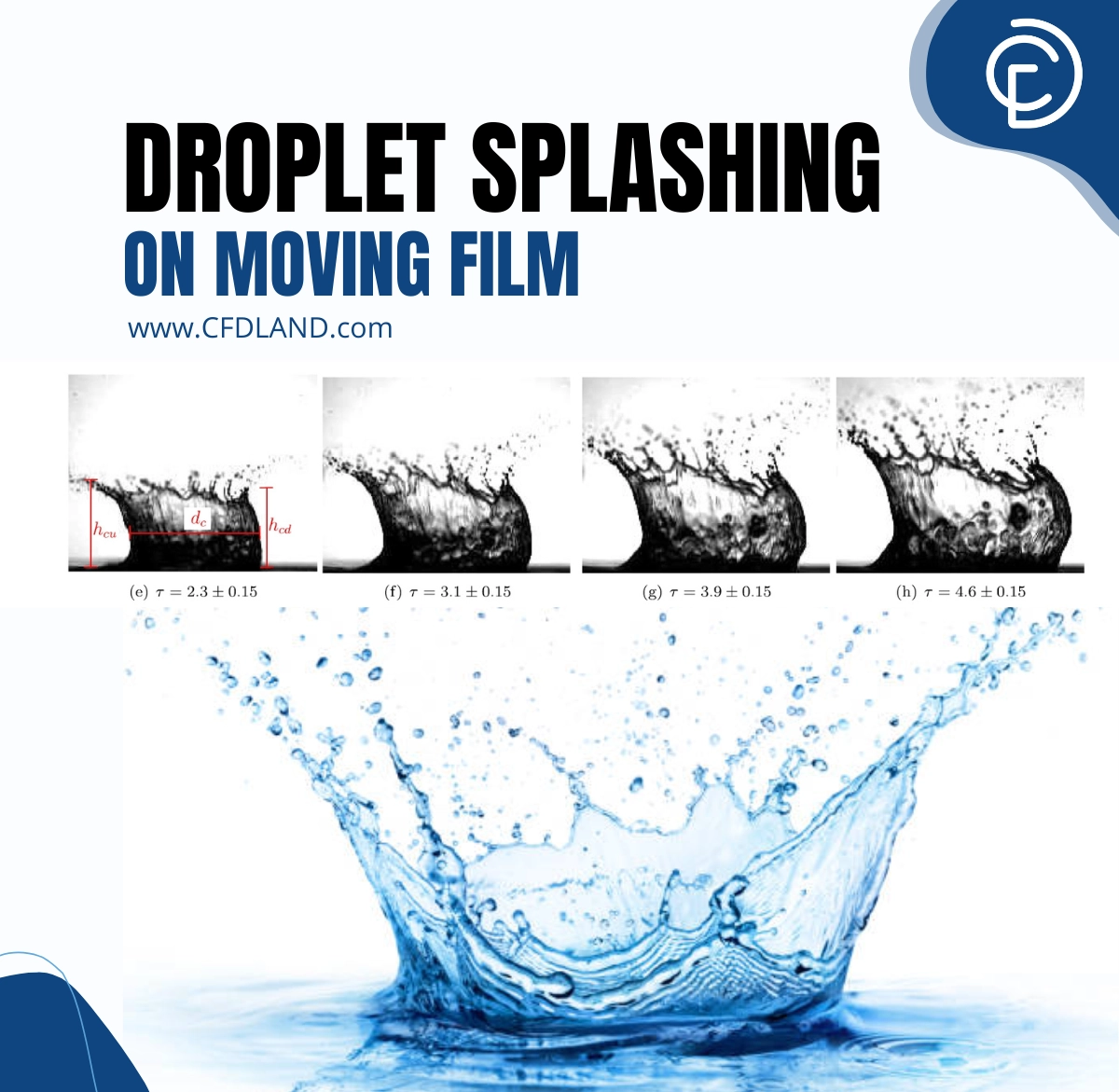
In this tutorial, we will learn exactly how to simulate a very complex multiphase flow problem: a fast liquid droplet violently crashing into a thin, moving layer of water. When a heavy raindrop hits the wet wing of a flying airplane, or when mud hits a moving car window, the water does not simply spread flat. Instead, it explodes upward into a beautiful, violent shape called a crown. This crown quickly breaks apart into many tiny secondary droplets flying in all directions. Understanding this exact splashing behavior is incredibly important for engineers. Because if too much water sticks to a freezing airplane wing, dangerous ice will build up. Therefore, designers must carefully predict exactly how much water splashes away versus how much stays on the metal surface to ensure safe flights and highly efficient engine fuel injection.
However, trying to physically record these tiny, fast water drops using high-speed cameras is extremely expensive and highly difficult. The entire crash happens in just a few milliseconds. To solve this problem easily and safely, we use a highly accurate droplet splashing CFD simulation. By using ANSYS Fluent, we can clearly watch the invisible boundary between the liquid water and the surrounding air. This computational representation allows engineers to perfectly calculate the water behavior without paying for expensive laboratory equipment. If you want to deeply master how to track heavy liquids hitting solid surfaces, please freely explore our professional Multiphase Tutorials. Let’s explore exactly how to set up this powerful simulation and carefully read the fascinating splashing results together.
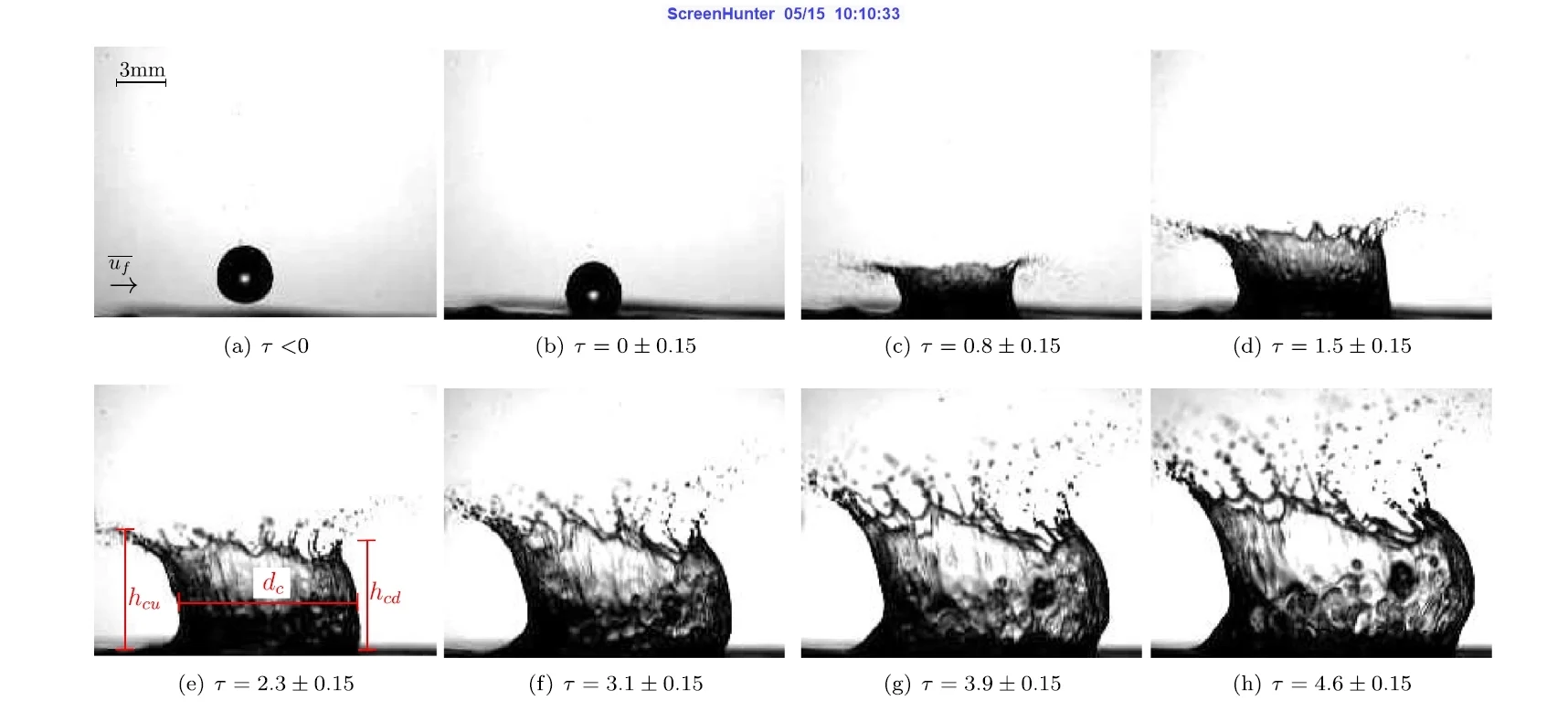
- Reference: Burzynski, David A., and Stephan E. Bansmer. “Droplet splashing on thin moving films at high Weber numbers.” International Journal of Multiphase Flow101 (2018): 202-211.
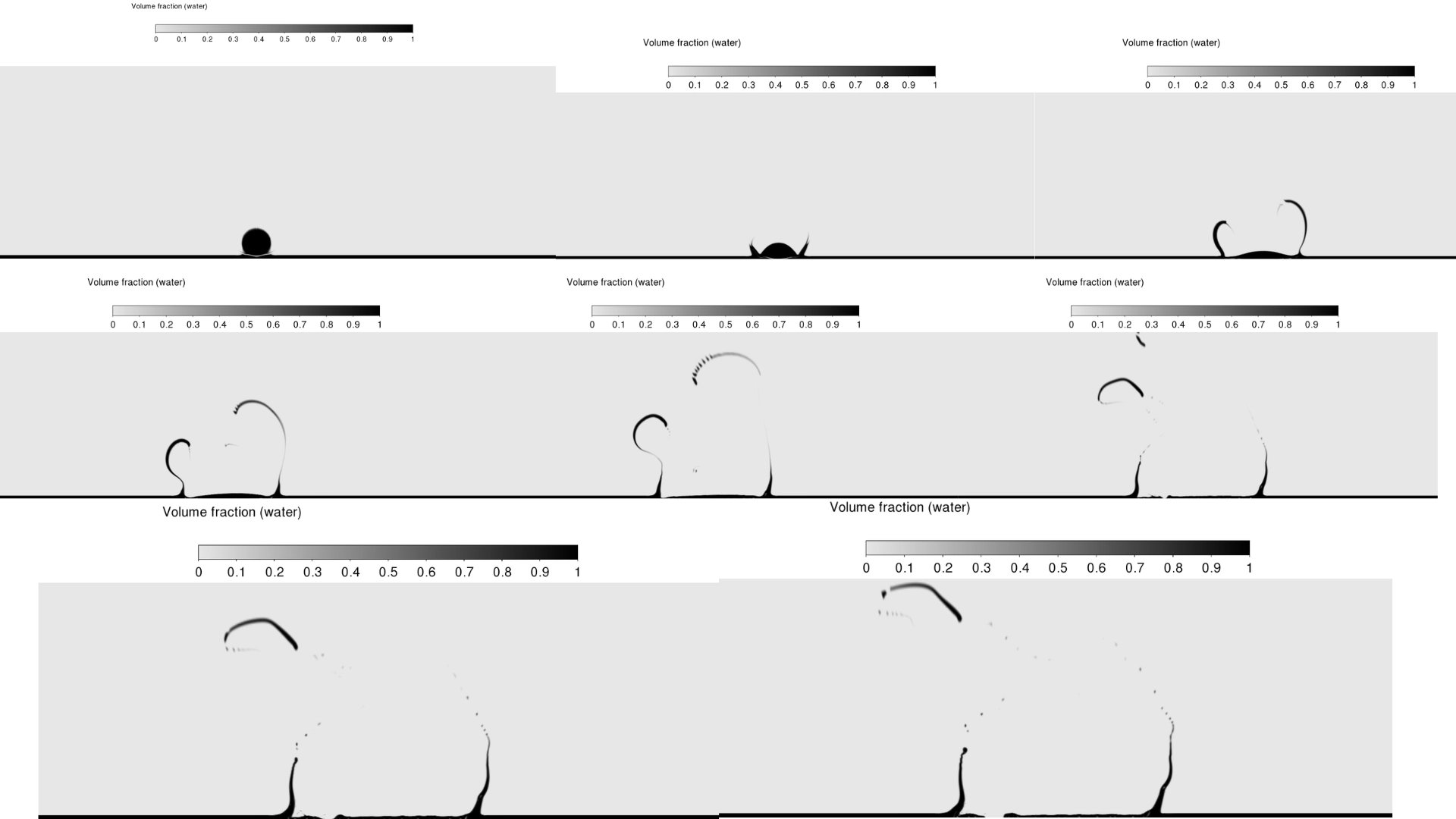
Figure 1: An 8-frame sequence of the Volume fraction (water) contour, perfectly visualizing the transition from a perfect spherical drop (solid black) into a violently expanding asymmetric crown.
Simulation Process: VOF Multiphase Mesh and Setup Guide
To correctly capture the physical crash of the water drop, we carefully built a 2D geometry in the software. We created a high-quality, fully structured grid using perfect quadrilateral shapes. This highly detailed fluid mesh contains exactly 620,000 cells. We specifically placed very tiny cells directly along the bottom surface to accurately catch the thin moving water film and the sharp boundary layer.
To track the exact boundary where the liquid water touches the air, we used the Volume of Fluid (VOF) method inside ANSYS Fluent. This powerful tool calculates a volume fraction for the water, meaning a value of 1 is pure water and 0 is pure air. Because the water drop falls with very high kinetic energy, we set the Weber number (We) to exactly 2281. Furthermore, to simulate the water hitting a moving object like an airplane wing, we applied a friction velocity (u*) of exactly 0.15 m/s to the bottom film, alongside a specific film thickness ratio (δ) of 0.13.
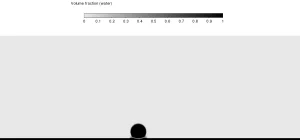
Figure 2: Detailed view of the initial splashing frames
Post-processing: Analysis of Crown Formation and Droplet Breakup
Let’s carefully analyze the exact physics shown in the provided 8-frame volume fraction image. This beautiful image sequence clearly tracks the entire 3.15 millisecond splashing event. In the first frame at the top left, the perfect spherical droplet is colored solid black, mathematically proving the water volume fraction is exactly 1. At this starting moment, it barely touches the bottom film. Moving to the second frame, the violent impact begins. The droplet heavily flattens, pushing the bottom film outward in all directions and creating a small crater depression on the surface.
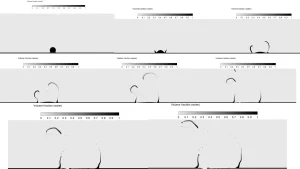
Figure 3: Final breakup stages in the volume fraction contour, capturing the exact moment the Rayleigh-Plateau instability causes the liquid ligaments to snap into tiny flying secondary droplets.
As we look at the third frame and move into the middle row, something highly fascinating happens. The squashed water violently shoots straight up into the air, creating a tall, thin wall of liquid known as a crown lamella. However, notice how this crown is not perfectly balanced. Because the bottom film is constantly moving horizontally at 0.15 m/s, the moving water pushes heavily against the splash. The software data exactly proves this moving film effect creates a highly asymmetric crown. The left side (upstream) of the crown is pushed down to a height of exactly 5 mm. Conversely, the right side (downstream) faces less resistance and grows much taller, reaching exactly 7.5 mm in height. The exact text data confirms this downstream wall is 50% taller than the upstream side. The total horizontal width of this expanding water crown reaches exactly 17 mm across.
Table 1: Droplet Splashing Dynamics Data
| Splashing Parameter | Measurement Location | Exact CFD Calculated Value |
| High-Inertia Impact Energy | Weber Number (We) | 2281 |
| Moving Film Speed | Friction Velocity (u)* | 0.15 m/s |
| Liquid Film Thickness | Ratio (δ) | 0.13 |
| Total Crown Width | Horizontal Splashing Distance | 17 mm |
| Upstream Crown Height | Left Side of Impact | 5 mm |
| Downstream Crown Height | Right Side of Impact | 7.5 mm (50% taller) |
| Total Splashing Time | Start to Ligament Breakup | 3.15 milliseconds |
Finally, let’s explore the bottom row of the image to understand the dangerous secondary splashing. As the thin black crown grows too tall, it becomes highly unstable. This is physically caused by the Rayleigh-Plateau instability. You can clearly see the smooth top edge of the crown beginning to tear apart into thin, wavy fingers called ligaments. Within milliseconds, these thin fingers violently snap. The final frames perfectly capture dozens of tiny, individual black circles flying completely free from the main water structure. These are the secondary droplets atomizing directly into the surrounding air. By carefully watching these exact spray patterns, aerospace and automotive engineers can successfully design highly advanced windshields and wings that naturally push heavy rain and dangerous ice away from the vehicle.
Frequently Asked Questions (FAQ)
- In this tutorial, why does the splashing crown look crooked?
- The crown is asymmetric because it crashes onto a moving liquid film. The moving film (traveling at 0.15 m/s) pushes against the left (upstream) side, keeping it shorter at 5 mm. The right (downstream) side faces less resistance and grows 50% taller, reaching 7.5 mm.
- How does the software track the water and the air?
- We use the Volume of Fluid (VOF) method. This mathematical tool calculates the exact volume fraction of the fluids. In the visual contours, pure water is colored black (a value of 1), and pure air is colored white/grey (a value of 0).
- What causes the water to break into tiny drops at the end?
- This is caused by a physical phenomenon called the Rayleigh-Plateau instability. As the liquid crown gets thinner and stretches upward, surface tension forces cause the rim to tear into small fingers, which then snap into free-flying secondary droplets.




Reviews
There are no reviews yet.