



Tall structures like buildings, bridges, and wind turbines must stand strong against the wind. An FSI Analysis On Vertical Beam CFD simulation helps engineers make sure these structures are safe. FSI stands for Fluid-Structure Interaction. It means we look at how fluids (like wind) push on solid things (like a beam), and at the same time, how the solid thing bends or moves, which then changes how the wind flows around it. It is a two-way street. In the real world, wind can cause buildings to shake or bend. This bending can then change how the wind hits the building, which can make it bend even more. This back-and-forth effect is very important to understand.
Old ways of designing only looked at the wind and the structure separately. But our 2-Way FSI CFD method is much better because it sees everything at once. We use ANSYS Fluent to calculate the exact wind forces. Then, we use ANSYS Structural to see how the beam bends because of these forces. This combined study helps us build safer, stronger structures that can handle strong winds without breaking or moving too much. This report shows how we use this powerful method to study a simple vertical beam. This study is based on a real engineering paper [1].
- Reference [1]: Bogaers, Alfred EJ, et al. “An evaluation of quasi-Newton methods for application to FSI problems involving free surface flow and solid body contact.” Computers & Structures173 (2016): 71-83.
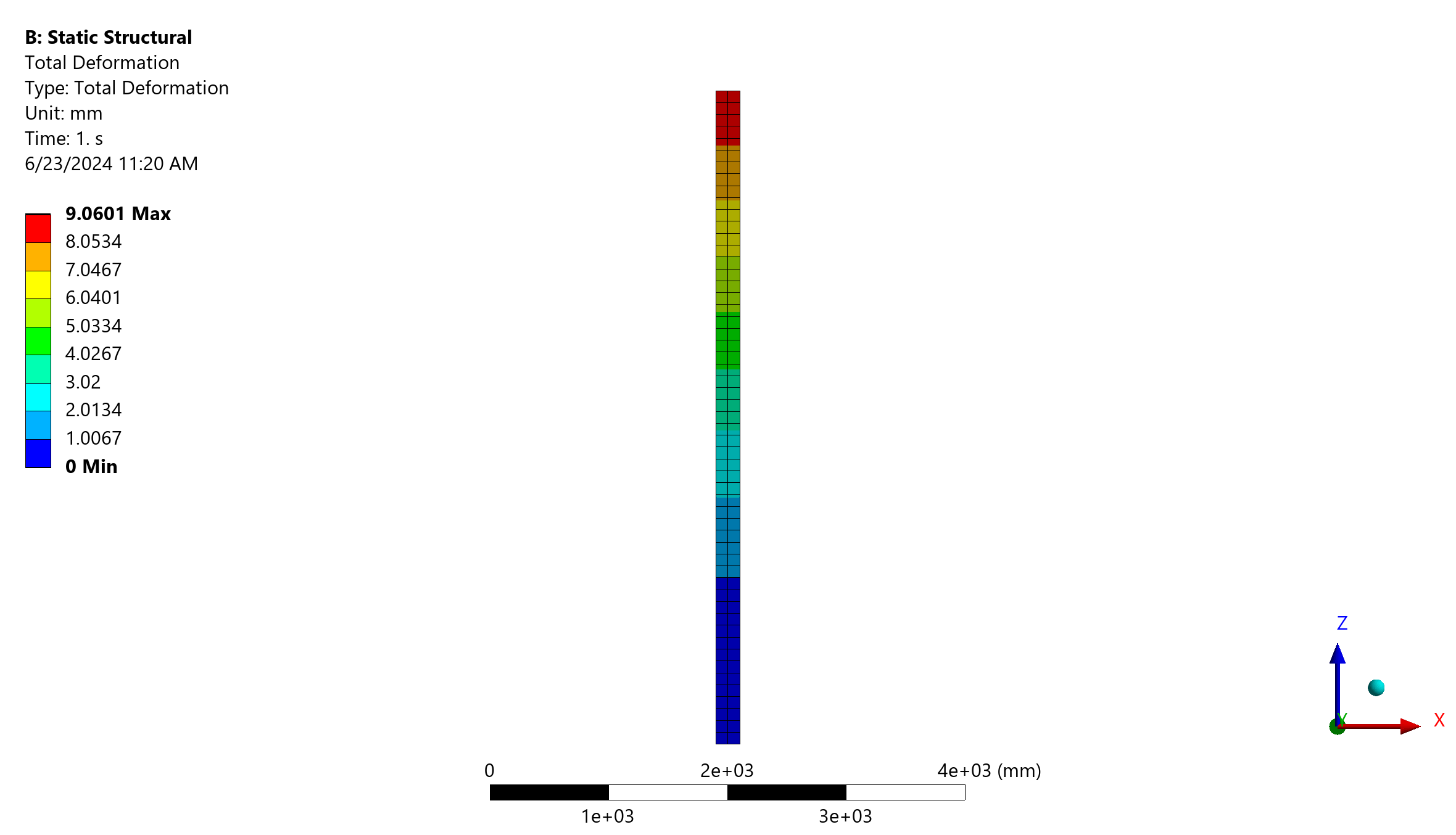
Figure 1- Schematic outline of the problem, showing the Vertical Beam FSI CFD setup [1]
Simulation Process: Setting Up the FSI Analysis in ANSYS
To perform the Vertical Beam FSI CFD simulation, we first created two main parts in the computer: the air around the beam (the fluid part) and the beam itself (the solid part). Figure 1 shows a simple picture of our setup. We used a special computer program called Design Modeler to draw these parts. Then, we divided both the air and the beam into many tiny boxes, like a puzzle. This is called creating a structured grid, and it helps the computer solve the problem accurately.
The vertical beam is made of steel. We told the computer how strong and stiff the steel is by giving it numbers like Young’s Modulus (2.7e+7 Pa) and Poisson’s Ratio (0.35). Then, we set up the wind. We made the wind blow at a steady speed of 0.1 meters per second (about 0.22 miles per hour) towards the beam. The most important part of this setup is the coupling between ANSYS Fluent (for the wind) and ANSYS Structural (for the beam). This coupling makes sure that the wind forces calculated by Fluent are sent to Structural, and then the beam’s bending from Structural is sent back to Fluent so the wind flow can adjust. This is what makes it a true 2-Way FSI CFD analysis.
Post-processing: Understanding Wind Force and Beam Bending
The simulation results tell a clear story of cause and effect, showing how the wind pushes the beam and how the beam responds. The main cause is the wind hitting the beam. The direct effect is that pressure builds up on the front side of the beam. The pressure contour in Figure 2 is the perfect proof. On the left side of the beam, where the wind hits first, we see high pressure (shown in red, around 16 kPa). This high pressure creates strong forces (shown in red, about 0.12-0.14 N) that push the beam back. But the wind also creates a pulling effect on the other side. On the right side of the beam, the pressure drops to negative values (shown in blue, about -4 kPa), which tries to pull the beam forward. This difference in pressure between the front and back of the beam is what creates the total pushing force of the wind. This FSI Analysis On Vertical Beam CFD simulation perfectly captures how the wind’s pressure distribution leads to direct forces on the beam, which is the essential first step in understanding its structural response. The even spread of pressure also confirms that our beam design handles the initial wind load well, without creating dangerous hot spots.
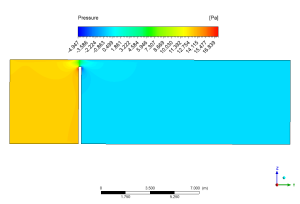
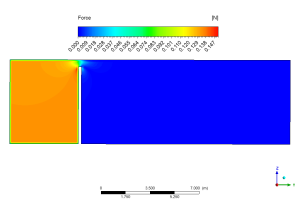
Figure 2: Pressure and force contours from the FSI Analysis On Vertical Beam CFD, showing how wind pushes and pulls on the beam.
The total deformation results in Figure 3 show exactly how the beam bends under these wind forces. It behaves like a classic “cantilever beam,” which means it is fixed at the bottom and free to bend at the top. The bottom of the beam (blue) barely moves because it is held firmly in place. But as we go up, the bending increases. The very top of the beam (red) bends the most, reaching a maximum of 9.06 mm. This bending is smooth from bottom to top, showing that the beam flexes naturally without any sudden weak points. For a beam that is about 2000 mm (2 meters) tall, a bend of 9.06 mm is very small – less than 0.5% of its height. The most important achievement of this FSI Fluent analysis is that it confirms the beam’s structural integrity. Even under the calculated wind forces, the maximum bending is well within safe limits, meaning the steel material is strong enough to absorb the wind’s energy and return to its original shape without permanent damage. This successful prediction of safe deformation is vital for designing reliable structures that can withstand real-world wind conditions.
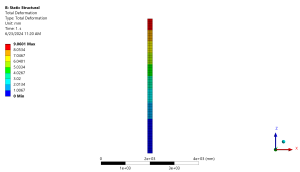
Figure 3: Total deformation results from the FSI Fluent analysis, showing the maximum bending (red) at the top of the beam.






Reviews
There are no reviews yet.