




Mixing gas into liquid is a critical job in chemical factories and water treatment plants. Traditionally, engineers used big tanks with spinning motors. However, these motors use a lot of electricity and can break. A smarter solution is the In-line Static Mixer. This is a pipe with stationary, twisted metal parts inside. It uses the energy of the flow itself to mix the fluids. To design these efficiently without building prototypes, we use In-line Static Mixer CFD simulation.
This project is a Gas-Liquid Mixing fluent tutorial. We will teach you how to simulate the interaction between air bubbles and water. We use ANSYS Fluent to visualize how the static blades force the fluids to combine. By performing this In-line Static Mixer for Gas-Liquid Mixing analysis, we can prove the efficiency of the design. For more lessons on complex flows, please visit our Multiphase tutorials.

Figure 1: Schematic showing the flow pattern changing as it passes through the mixer elements.
Simulation Process: Eulerian Multiphase Model and Mesh
To start this In-line Static Mixer ANSYS fluent analysis, we built a 3D pipe model containing “Helical” (twisted) mixing elements. We compared this to a standard empty pipe. The mesh (grid) is a Tetrahedron Mesh. We made the cells very small near the twisted blades because that is where the mixing happens.
In the ANSYS Fluent setup, we chose the Eulerian Multiphase Model. This is the best mathematical method for mixing two distinct fluids. We defined Water as the Primary Phase and Air as the Secondary Phase. The physics calculation solves how the drag forces pull the air bubbles along with the water. The twisted geometry forces the solver to calculate complex changes in direction, which is the key to Gas-Liquid Mixing.

Figure 2: 3D Geometry of the pipe equipped with helical mixing elements.
Post-processing: Analysis of Radial Mixing and Homogeneity
To truly understand the performance of this In-line Static Mixer CFD simulation, we must tell the story of the fluid’s journey. The story begins with the movement, shown in the Velocity Streamlines (Figure 5). In the empty pipe (left side), the water moves in straight, parallel lines. It creates a core where nothing mixes. However, in the In-line Static Mixer (right side), the twisted blades force the water to spin. The color scale shows the velocity reaching a maximum of 7.02 m/s (red). These red streamlines do not go straight; they follow a “Helical Pathway.” This spinning motion creates “Radial Mixing,” throwing the water from the center to the walls and back again.
This chaotic movement directly improves the Gas-Liquid Mixing. We can see this in the Volume Fraction Contours (Figure 6). The scale goes from 0 to 0.56. In the empty pipe, the red color stays stuck in the middle. The gas and liquid remain separate. But inside the mixer, the red color disappears and turns into a uniform green/light blue mix. This proves the In-line Static Mixer fluent simulation is working: the big gas bubbles are broken up and spread evenly through the water.
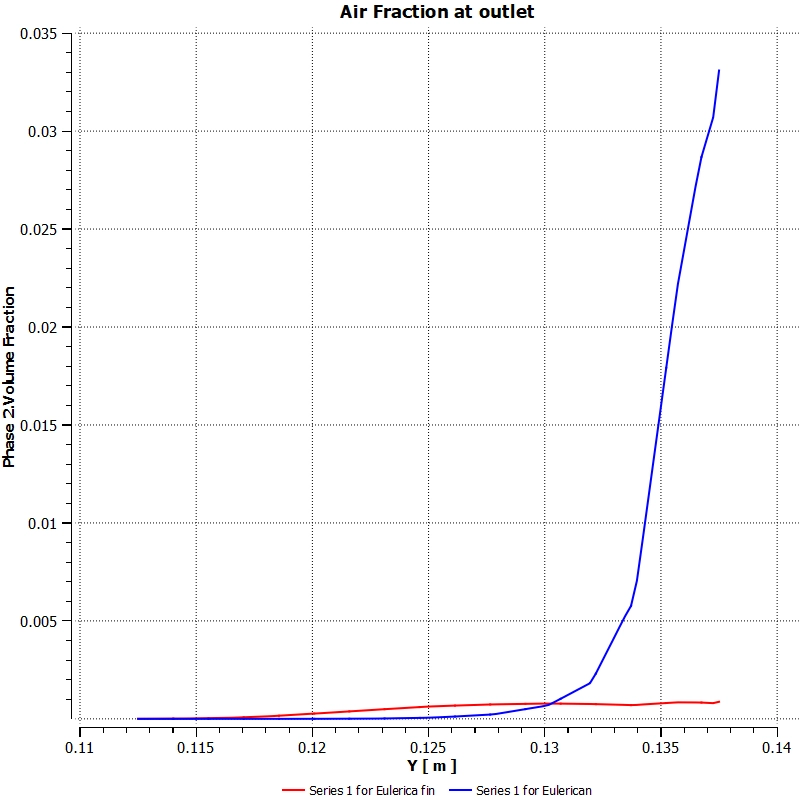
Figure 3: Graph showing a 30x increase in air concentration near the wall (0.033 vs 0.001).

Figure 4: Velocity contours showing the turbulent swirling motion.

Figure 5: Streamlines showing the helical pathways (up to 7.02 m/s) that drive the mixing process.

Figure 6: Volume fraction contours comparing the separated flow in an empty pipe vs. uniform mixing in the static mixer.
The final proof is in the numerical data graph (Figure 3). This graph measures the amount of air at the outlet, specifically near the wall (radial position 0.11-0.14 m). In the empty pipe (red line), the air fraction is almost zero, roughly 0.001. The air never reached the wall. In the Static Mixer (blue line), the air fraction jumps up to 0.033. This is a massive difference. By comparing 0.033 to 0.001, we calculate an approximate 30x improvement in gas dispersion. This data conclusively confirms that the helical blades successfully force the air to mix with the water across the entire width of the pipe.
Key Takeaways & FAQ
- Q: Why use the Eulerian Model?
- A: It accurately calculates the interaction between two continuous fluids (Air and Water) in this In-line Static Mixer CFD simulation.
- Q: How does the mixer work?
- A: The helical blades force the fluid to rotate. This “Radial Mixing” breaks bubbles and distributes them, as seen in the In-line Static Mixer fluent streamlines.
- Q: What is the improvement factor?
- A: The data shows a 30x increase in gas concentration near the pipe walls compared to an empty pipe.



Reviews
There are no reviews yet.