


A Missile Aerodynamics CFD simulation is a computer analysis that helps engineers understand how a missile flies through the air at very high speeds. The first and most important step in this process is often an Inviscid flow CFD Simulation. This type of analysis ignores the effects of air friction (viscosity) to focus on the biggest forces at supersonic speeds: shock waves. A Missile Fluent simulation is an essential tool for this job.
This report details an Inviscid flow fluent analysis of a missile using ANSYS Fluent. The goal is to capture the exact location and strength of the shock waves that form on the missile’s body. By using advanced techniques like adaptive meshing, this Missile CFD study provides a fast yet accurate picture of the pressure forces acting on the vehicle. This information is critical for designers to optimize the missile’s shape for better performance and stability. For more aerodynamics CFD simulation tutorials and advanced aerospace analysis, visit https://cfdland.com/product-category/engineering/aerodynamics-aerospace-cfd-simulation/.
- Reference [1]: Şumnu, Ahmet, and İbrahim Güzelbey. “The effects of different wing configurations on missile aerodynamics.” Journal of Thermal Engineering (2023): 1260-1271.

Figure 1: 3D schematic of designed missile
Simulation Process: Fluent-CFD Setup, Adaptive Meshing for an Inviscid Missile Simulation
The simulation process for this Missile Aerodynamics CFD study began with a 3D model based on a reference design [1]. The model was placed inside a large, conical-shaped fluid domain, which is ideal for high-speed external aerodynamics. Using ANSYS Meshing, an initial computational grid was created. A Body of Influence technique was used to make the mesh cells finer near the missile, ensuring the geometry was well-represented.
Inside ANSYS Fluent, the physics was configured for high-speed flight. The inviscid flow model was chosen because it is computationally efficient and very effective at capturing the strong shock waves that dominate supersonic aerodynamics. The most critical technique used was adaptive mesh refinement. This smart feature was programmed to monitor the simulation for large changes in air density (density gradients), which are a clear sign of a shock wave. When a shock wave was detected, Fluent automatically added more mesh cells in that exact location.


Figure 2: Detailed mesh showing refinement using the Body of Influence technique around the missile
Post-processing: CFD Analysis of Shock Waves and Aerodynamic Loading
The simulation results provide a complete engineering analysis, successfully capturing the entire complex system of shock waves and expansion fans that define the missile’s aerodynamic behavior at supersonic speed. From an engineering viewpoint, the analysis must focus on the shock waves, as they are the primary source of aerodynamic forces in this flight regime. The pressure gradient contour in Figure 3 acts like a map of these shocks. The intense white and red area at the very front is the bow shock, where the air is hit and compressed almost instantly. The simulation quantifies this intense compression with a maximum pressure gradient of 6.46e+05 Pa. Similar, less intense patterns are seen on the leading edges of the wings and tail fins, which are oblique shocks. These areas of extreme pressure gradient are the direct cause of wave drag, which is the main component of drag at supersonic speeds.
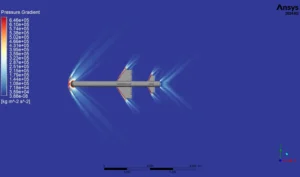
Figure 3: Pressure Gradient Contour
The Mach number contour in Figure 4 shows the consequences of these shocks on the airflow. The air, initially at a high Mach number, abruptly slows down as it passes through the bow shock. As it flows along the body, it accelerates again. The blue-green regions at the rear of the missile body and fins are expansion fans, where the pressure drops and the flow speeds up. The 3D contour provides a powerful visualization, showing that these shocks are not just lines but large, conical structures of high pressure that extend far from the missile.

Figure 4: Mach Number Contour

Figure 5: 3D Shock Wave Isosurface
The most important achievement of this simulation is the successful use of adaptive meshing to precisely capture these complex flow features. The contour in Figure 6 is the proof. It shows that the simulation was intelligent enough to automatically add more computational cells (the red areas) exactly where the pressure gradient and Mach number contours show the shocks are located. This gives an engineer high confidence that the shock location and strength are predicted accurately. For a missile designer or manufacturer, this inviscid flow CFD analysis is invaluable. It provides a fast and reliable first estimate of the pressure distribution, which determines the missile’s lift, drag, and stability.
 12
12
Figure 6: Cell Refine Level Contour






Reviews
There are no reviews yet.