
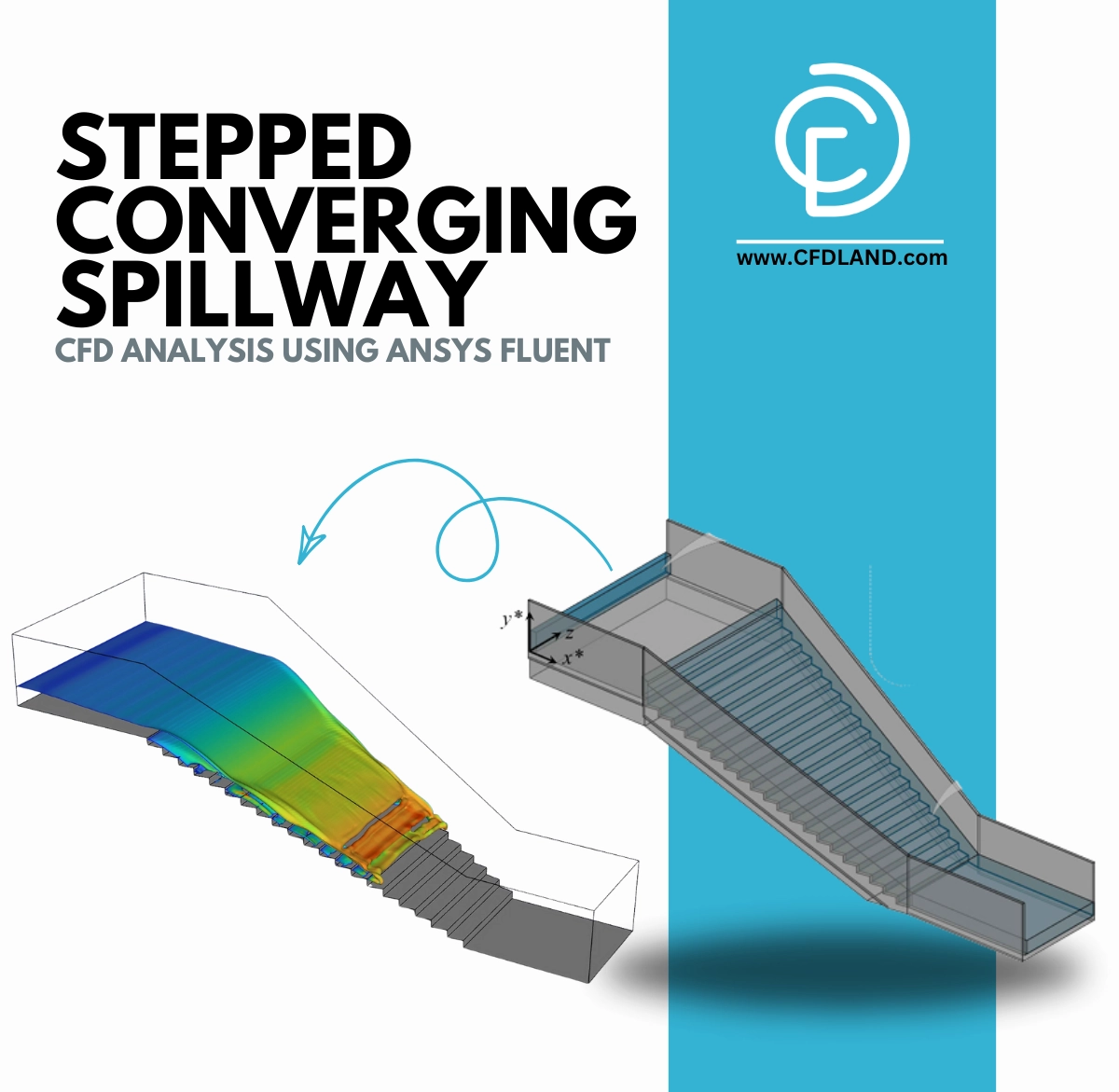
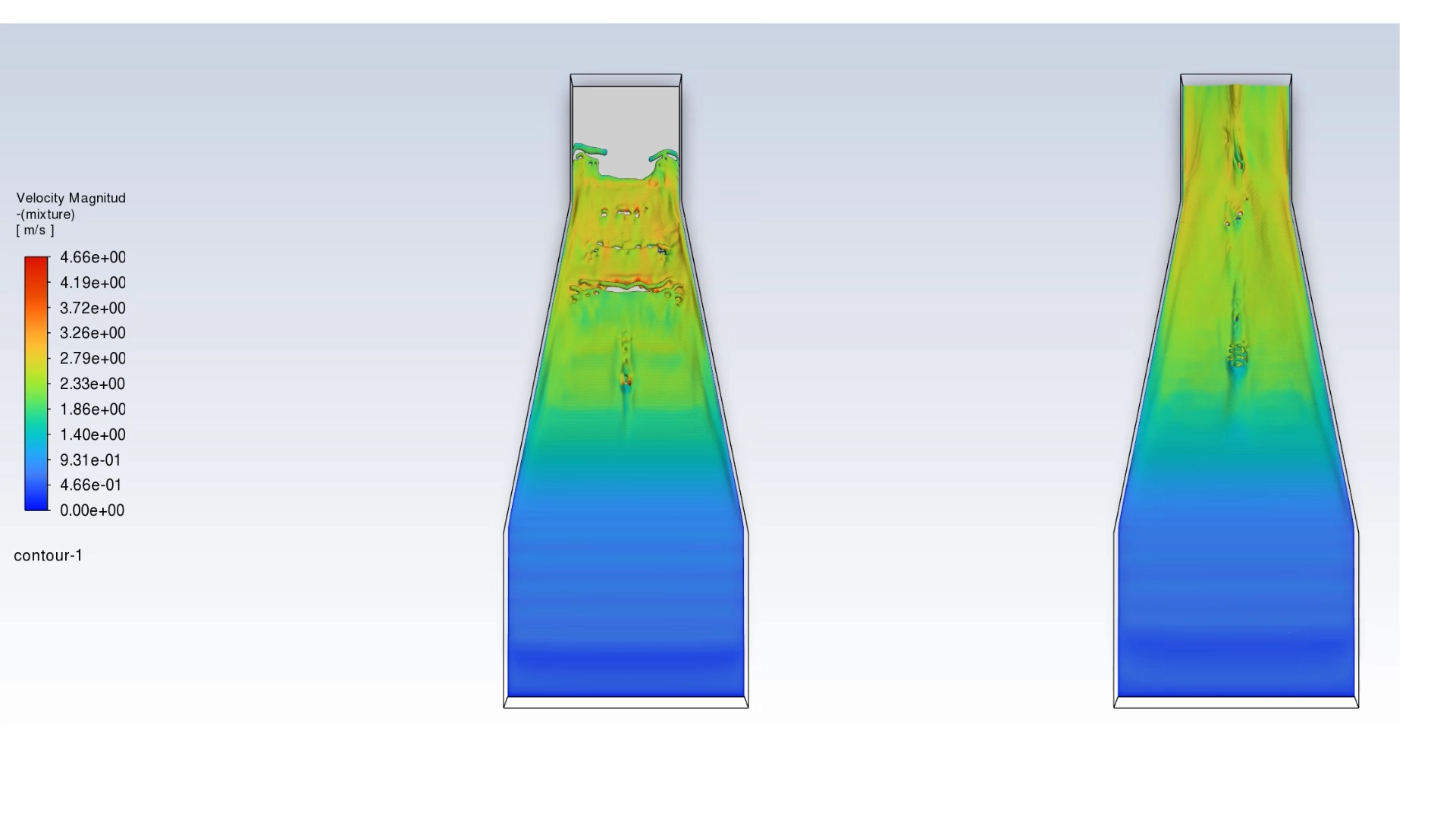
A Stepped Converging Spillway CFD analysis is a vital engineering tool used to design safe and effective dams. When a large amount of water must be released from a reservoir, a spillway guides it safely to the river below. A Stepped Spillway Fluent simulation helps engineers understand how the steps on the spillway can slow the water down and reduce its destructive energy. This report details a Spillway CFD simulation using ANSYS Fluent. The analysis uses the Volume of Fluid (VOF) multiphase model to accurately track the free surface of the water as it flows and mixes with air. This type of Open Channel Flow CFD is essential for predicting water velocities, flow patterns, and the efficiency of the spillway’s design, ensuring the dam structure is not damaged by high-energy water flow. For more open channel and multiphase simulations, visit: https://cfdland.com/product-category/module/multiphase-cfd-simulation/
- Reference [1]: Nóbrega, Juliana D., et al. “Smooth and stepped converging spillway modeling using the SPH method.” Water19 (2022): 3103.
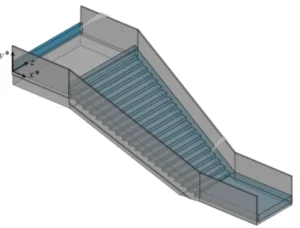
Figure 1: A schematic of the computational domain used for the Spillway CFD simulation, based on the reference paper [1].
Simulation Process: Fluent Setup, VOF Multiphase Configuration for Open Channel Flow
To ensure the simulation was accurate, the geometry of the stepped converging spillway was created based on the exact dimensions from a reference paper [1]. The model was then meshed using a high-quality hybrid grid, which primarily used hexagonal cells for the best accuracy in flow calculations. The mesh quality was excellent, with a minimum orthogonal quality of 0.867, which is a critical requirement for a reliable CFD analysis.
In ANSYS Fluent, the Volume of Fluid (VOF) multiphase model was activated. This is the correct model for free-surface flows like this because it can precisely track the interface between the water and the air. To make the simulation more realistic, the wall adhesion effect was also included. This small detail helps the model correctly simulate how water sticks to the spillway’s concrete surfaces. A transient (time-dependent) simulation was performed to watch how the flow develops over time, from the initial water release to a stable, continuous discharge down the spillway.
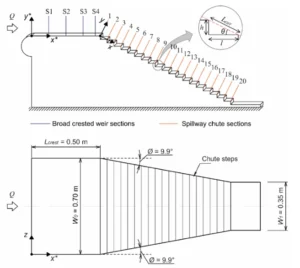
Figure 2: The physical geometry of the stepped converging spillway model, showing (a) the side view with steps and (b) the top view with converging walls [1].
Post-processing: CFD Analysis of Energy Dissipation and Flow Dynamics
The simulation results provide a clear and detailed engineering analysis of the spillway’s hydraulic performance, showing exactly how the design elements work together to control the water flow.
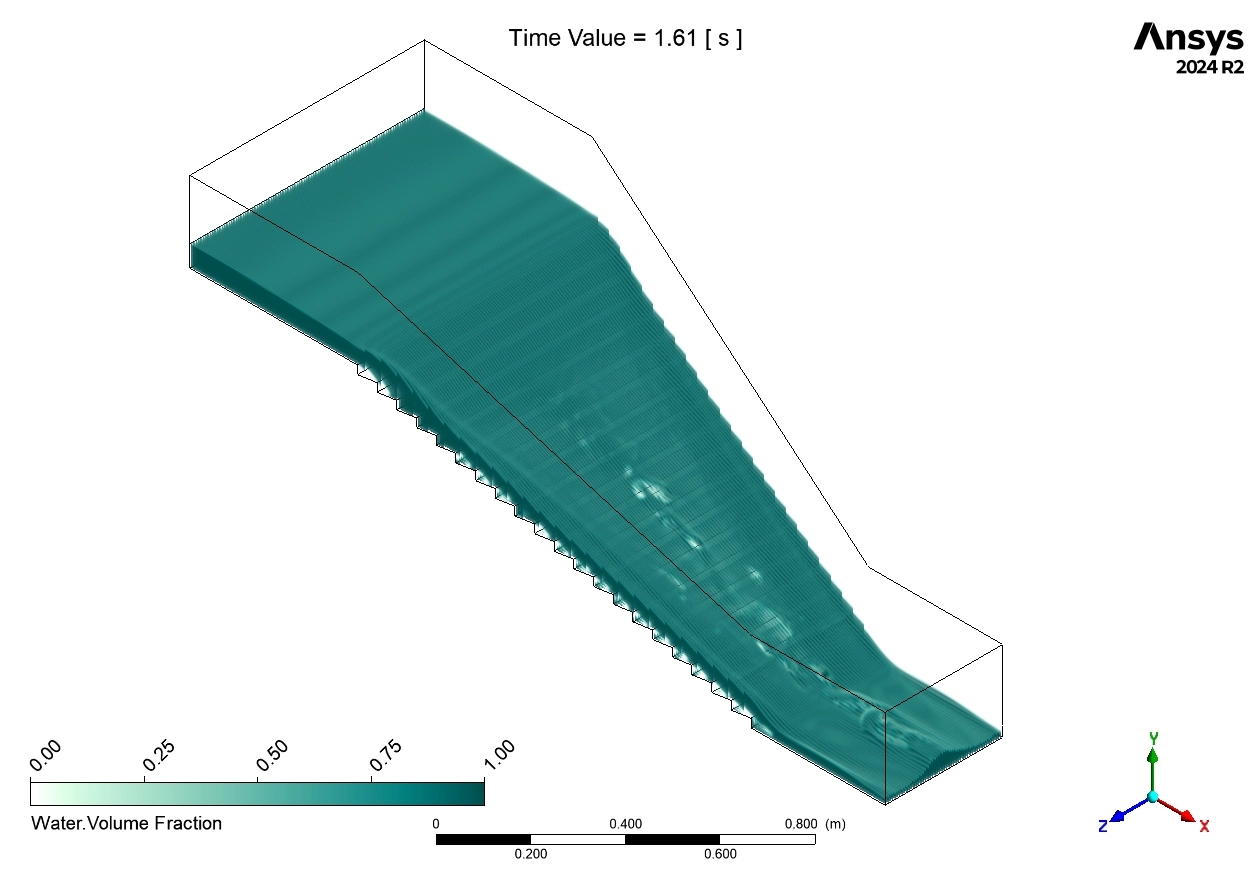
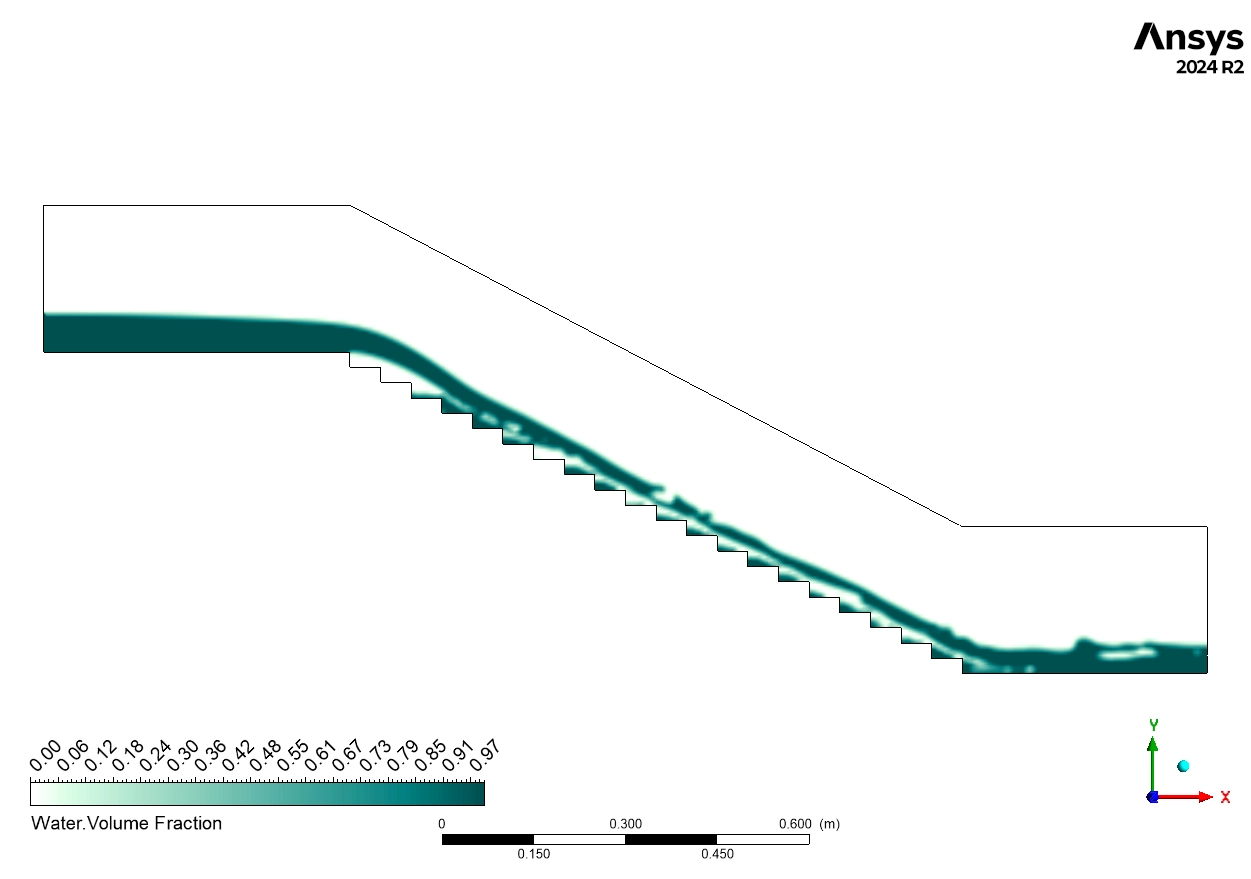
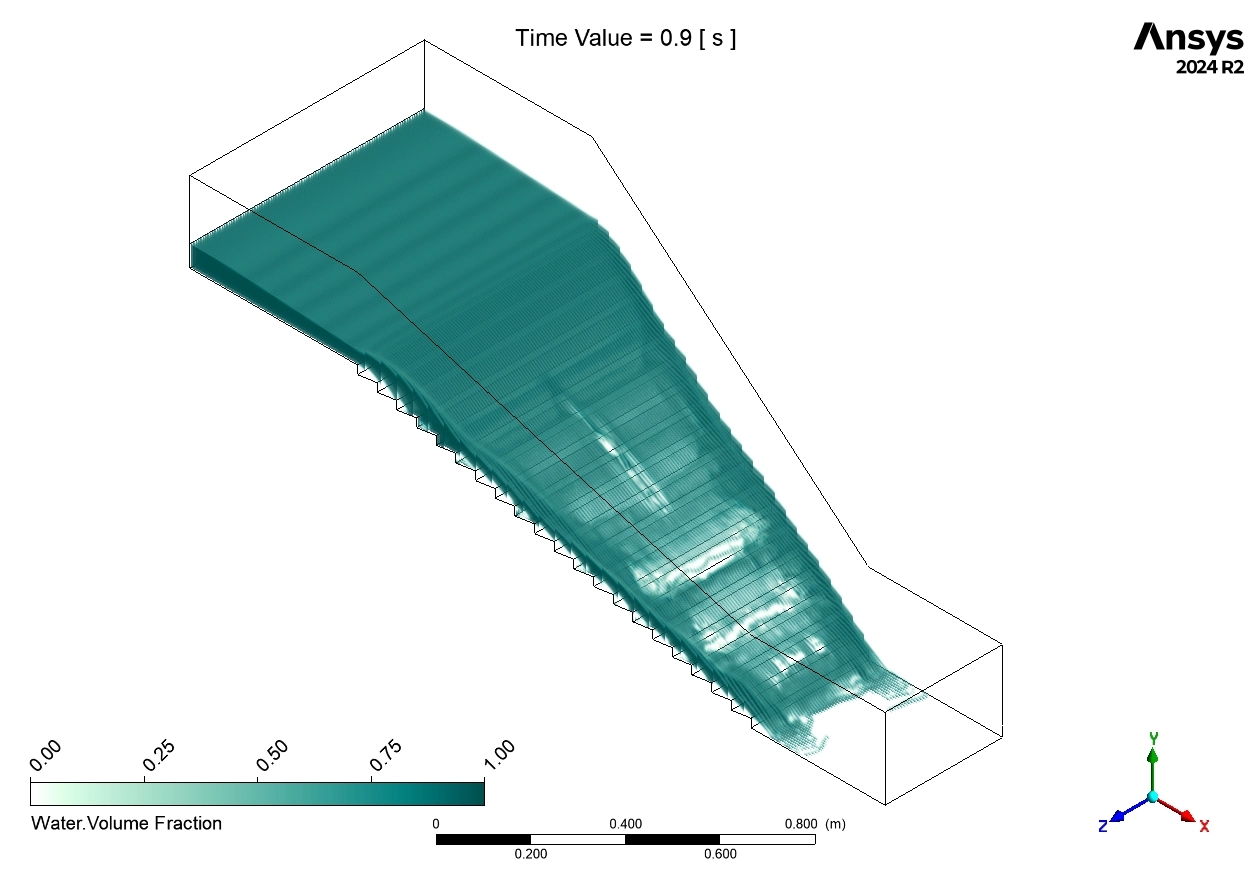
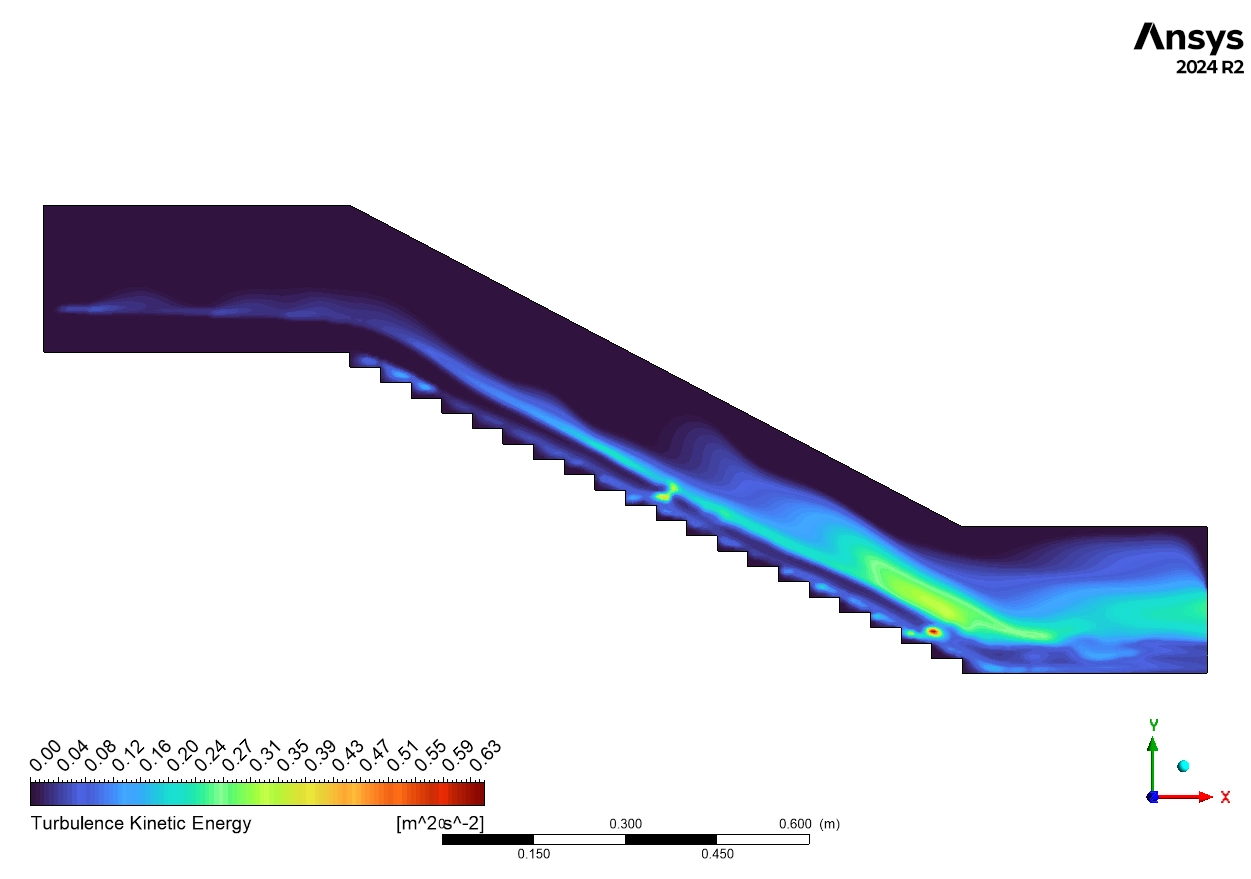
The water volume fraction contours in Figure 3 show the overall flow structure. The water travels down the spillway in what is known as a “skimming flow” regime. This means the main body of water flows over the tips of the steps. In the cavity between each step, a stable, re-circulating vortex of water is formed. These trapped vortices are not a problem; they are the primary mechanism for energy dissipation. The constant churning of these vortices acts like a brake, converting the water’s high kinetic energy into heat and turbulence, which is much less damaging to the structure. The model also shows how the water surface remains quite smooth, with very little air getting mixed in, indicating stable and non-chaotic flow.
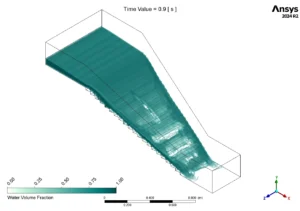
Figure 3: Contours of water volume fraction from the VOF Fluent model, illustrating the skimming flow regime and the formation of stable recirculation zones between the steps.
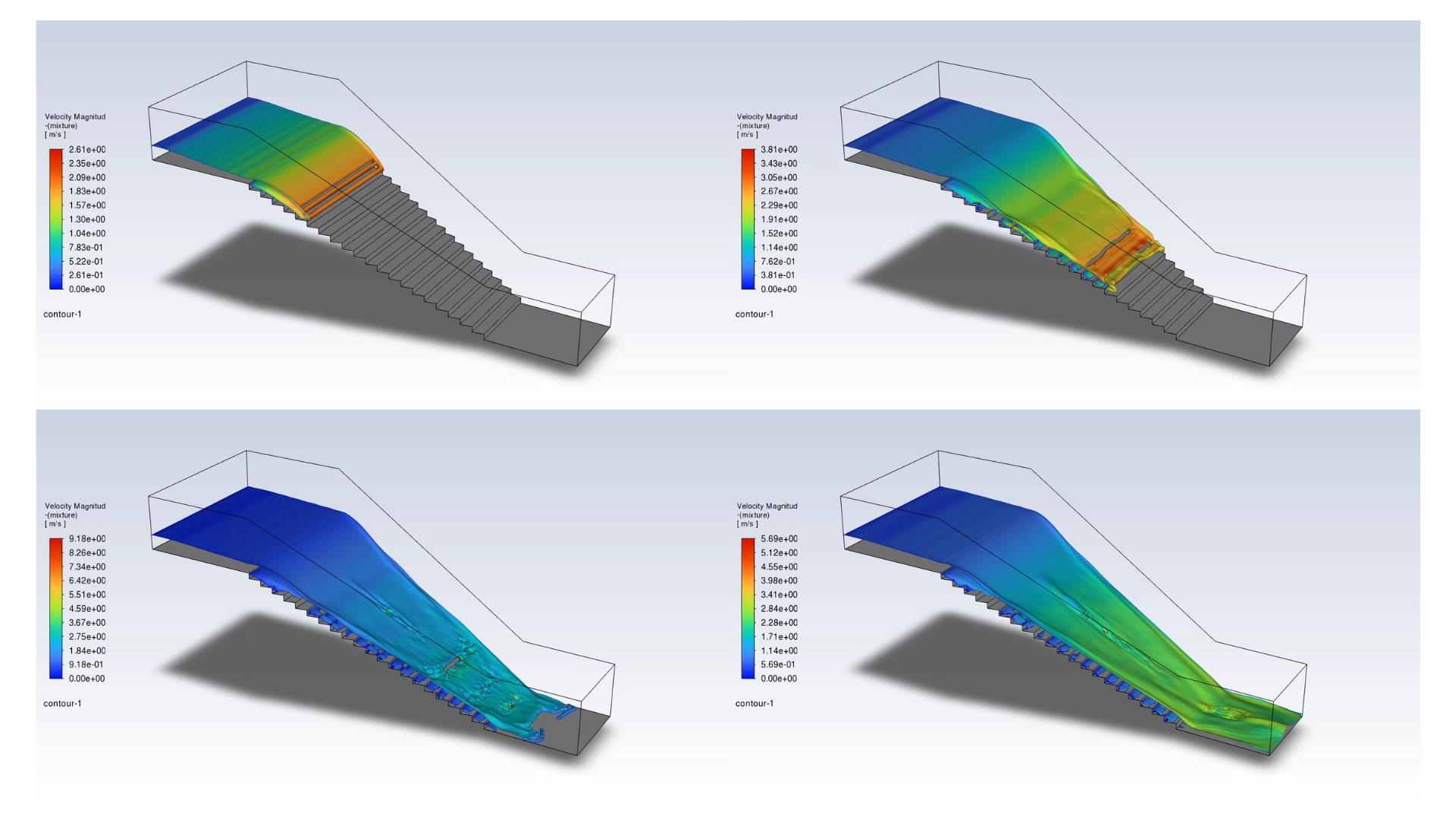
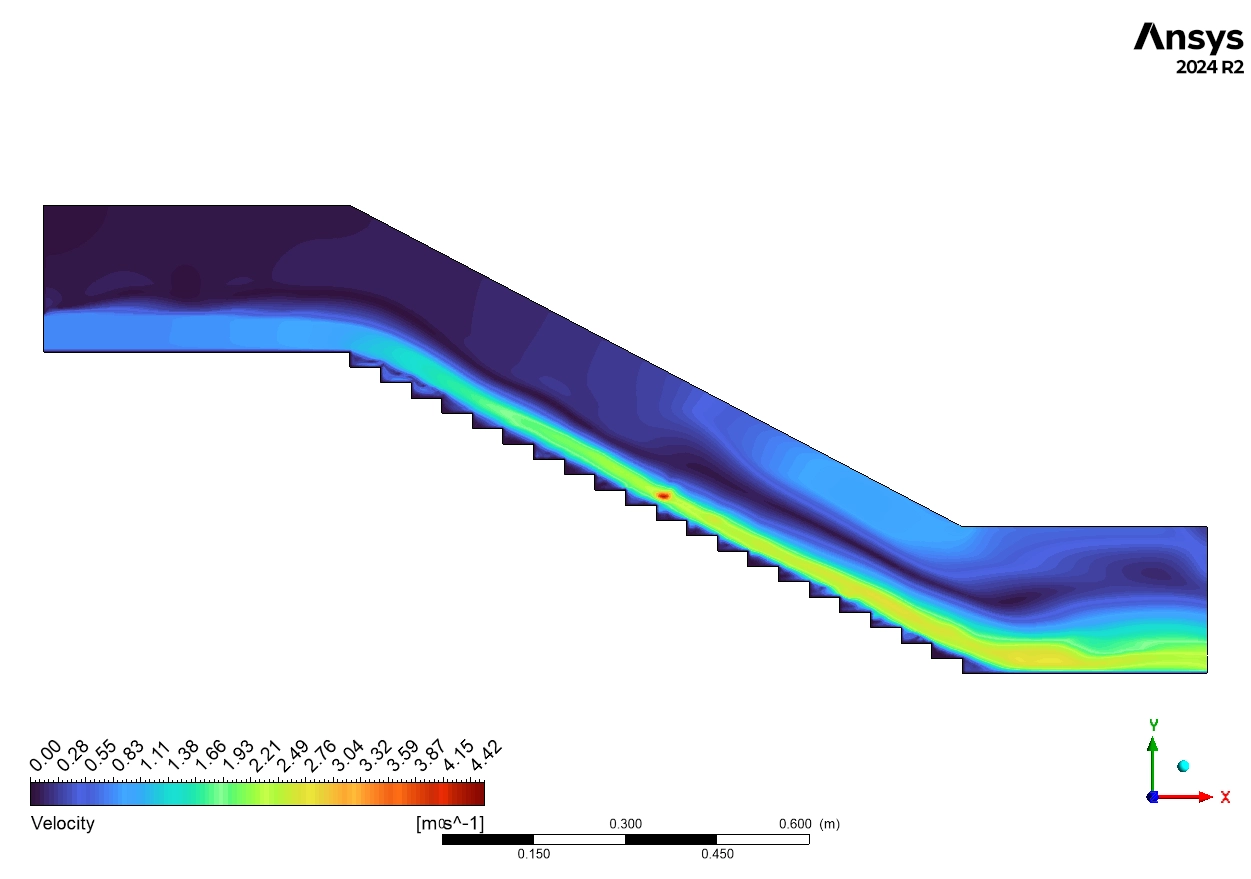
The velocity contours in Figure 4 provide the data to support these observations. The analysis shows that the water velocity gradually increases as it moves down the spillway, which is expected due to gravity. The converging walls of the spillway squeeze the flow, causing it to accelerate further towards the outlet, reaching a maximum velocity of approximately 5.69 m/s. This value is a critical engineering output. It tells designers the final speed of the water as it enters the downstream river channel, allowing them to design proper erosion protection. The velocity contours also clearly show the low-speed recirculation zones behind each step, confirming the energy dissipation mechanism seen in the volume fraction contours.
The most important achievement of this simulation is the successful quantification of the spillway’s energy dissipation performance. By accurately modeling the skimming flow and the stable vortices behind each step, the Stepped Spillway CFD model proves that the design effectively and safely reduces the water’s energy. The prediction of a controlled maximum exit velocity of 5.69 m/s validates that the spillway can handle the design flow rate without causing downstream erosion, ensuring the long-term safety of the entire dam structure.
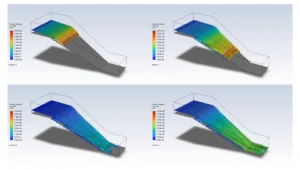
Figure 4: Velocity magnitude contours showing the gradual acceleration of water down the spillway and the peak velocity of 5.69 m/s in the narrow, converging outlet section.








1 review for Stepped Converging Spillway CFD Analysis using ANSYS Fluent
vorbelutr ioperbir –
Thank you for sharing with us, I think this website genuinely stands out.