
![The wall Static Pressure graph proving the bow shock impact creates a massive peak force near 450,000 [Pa].](https://cfdland.com/wp-content/uploads/2026/06/p2.webp "image of Supersonic Sphere Flow CFD Simulation: ANSYS Tutorial")
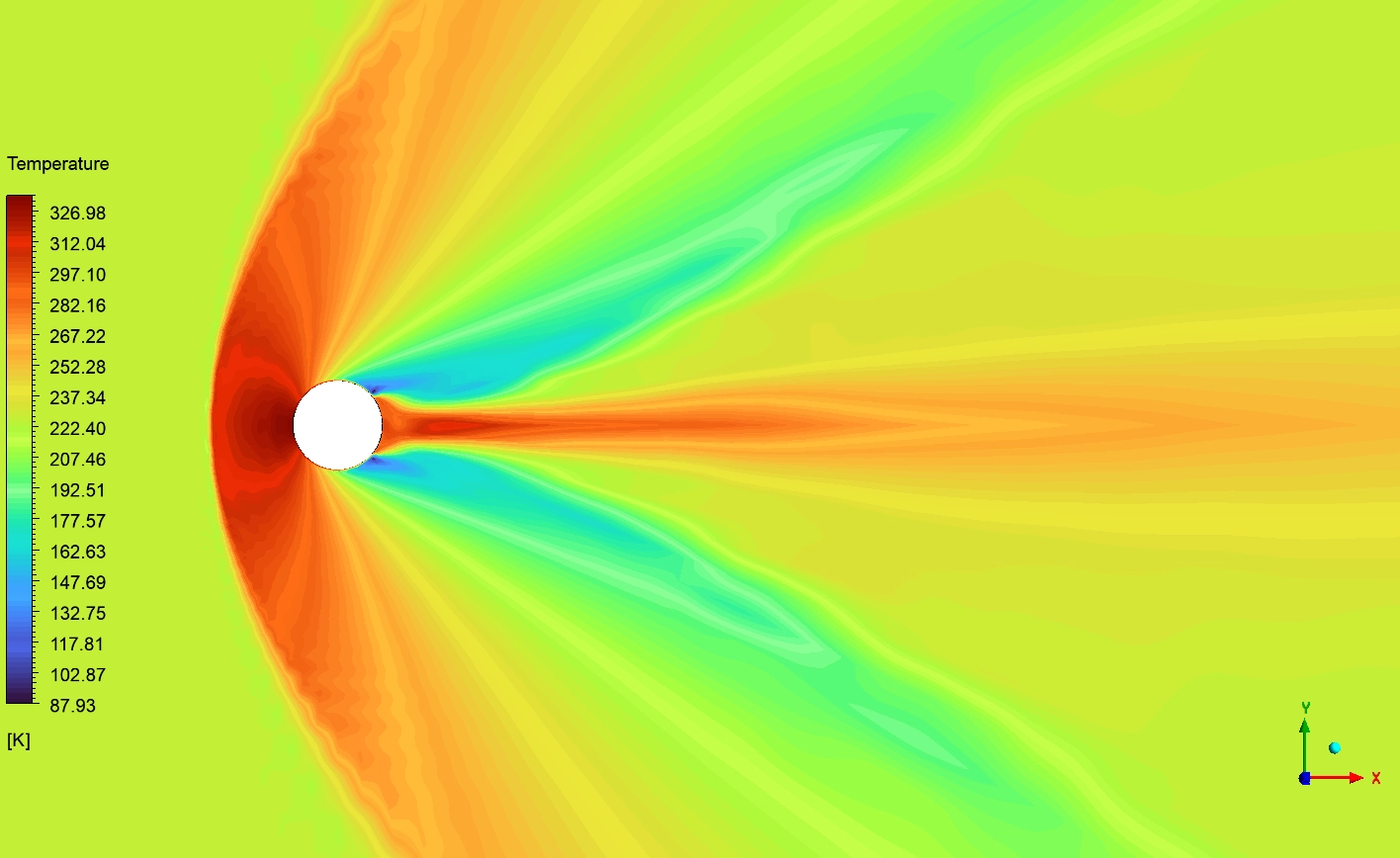
![The Velocity magnitude contour proving the upstream air decelerates from 682.57 [m s^-1] to exactly 0.00 [m s^-1].](https://cfdland.com/wp-content/uploads/2026/06/v-7.webp "image of Supersonic Sphere Flow CFD Simulation: ANSYS Tutorial")
![The Velocity magnitude contour proving the upstream air decelerates from 682.57 [m s^-1] to exactly 0.00 [m s^-1].](https://cfdland.com/wp-content/uploads/2026/06/v2-5.webp "image of Supersonic Sphere Flow CFD Simulation: ANSYS Tutorial")
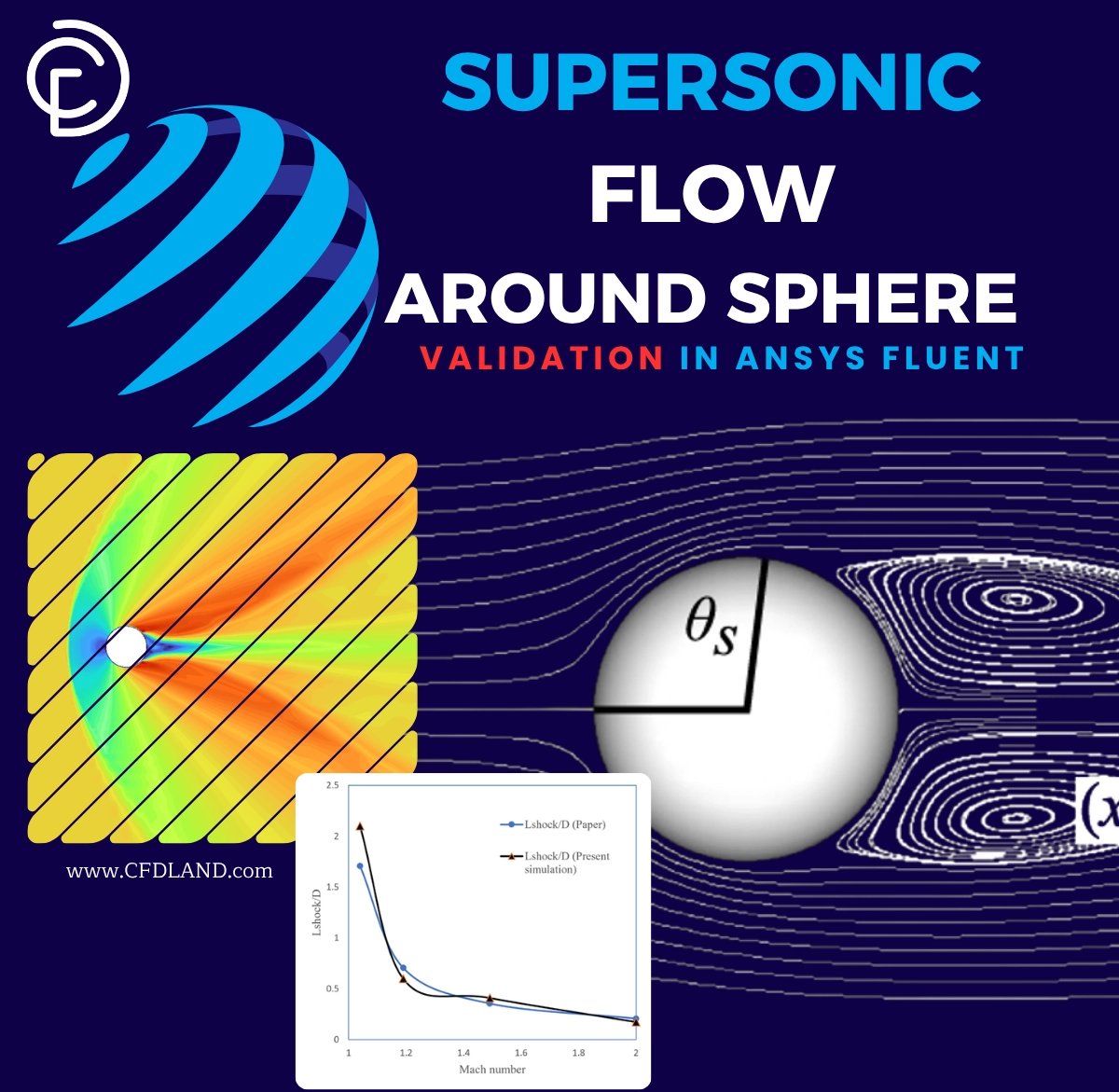
When an object flies faster than sound, it hits a solid wall of air. This violent collision creates a high-pressure wave known as a bow shock. If aerospace engineers calculate the distance of this shock incorrectly, extreme heat and drag will physically destroy the flying vehicle. This basic guide runs a supersonic flow around sphere CFD simulation to solve this critical aerodynamic problem.
The primary validation aim is to track the shock stand-off distance (Lshock/D ratio) and compare the solver output directly against published DNS reference data. We use the ANSYS Fluent density-based solver to capture this violent fluid behavior. For more high-speed aerodynamics training, studying our Fluid Mechanics CFD simulation category is your best next step. This computational study is based on the physical geometries and flow profiles from the following scientific research:
- Reference [1]: Nagata, T., et al. “Investigation on subsonic to supersonic flow around a sphere at low Reynolds number of between 50 and 300 by direct numerical simulation.” Physics of Fluids5 (2016).
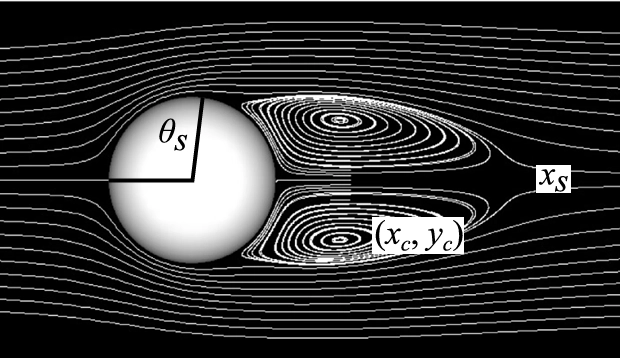
Figure 1: The physical geometry diagram defining the separation angle, separation length, and recirculation wake center. [1]
Simulation Process: Controlled Setup and Density-Based Solver
To capture the bow shock successfully, we require a highly controlled physical domain. We build a 2D space using a fully structured O-grid topology. This specific mesh aligns the calculation cells perfectly with the expected shock wave direction. This structure minimizes numerical diffusion errors during the simulation.
We configure the density-based solver in ANSYS Fluent to handle the severe density gradients. To thoroughly test the aerodynamics, we increase the freestream Mach number from a starting speed of 1.05 up to 2.0.
Figure 2: The structured O-grid topology created in ANSYS Meshing, featuring high cell density near the stagnation point.
Post-processing: Physics of Bow Shocks and Wake Separation
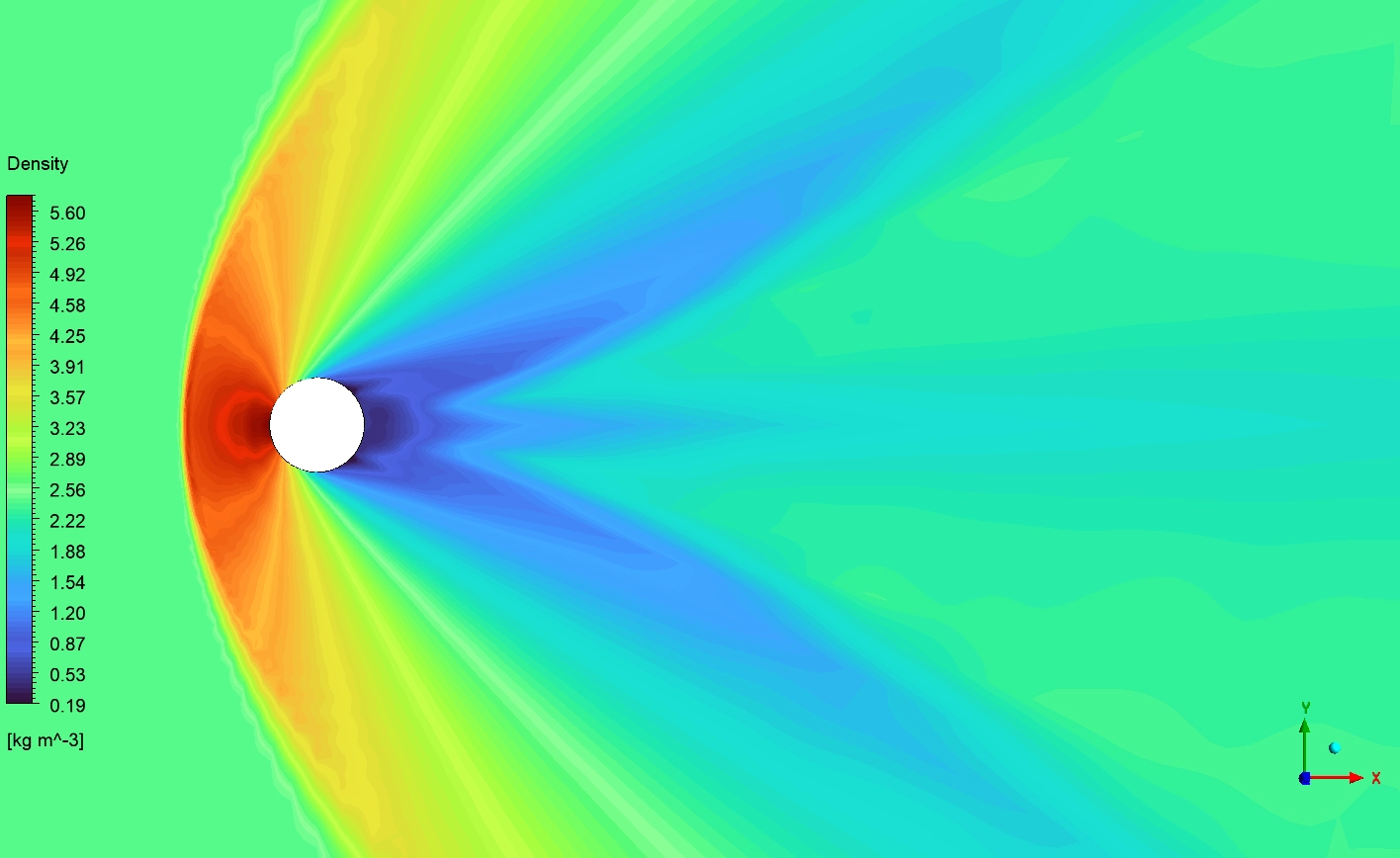
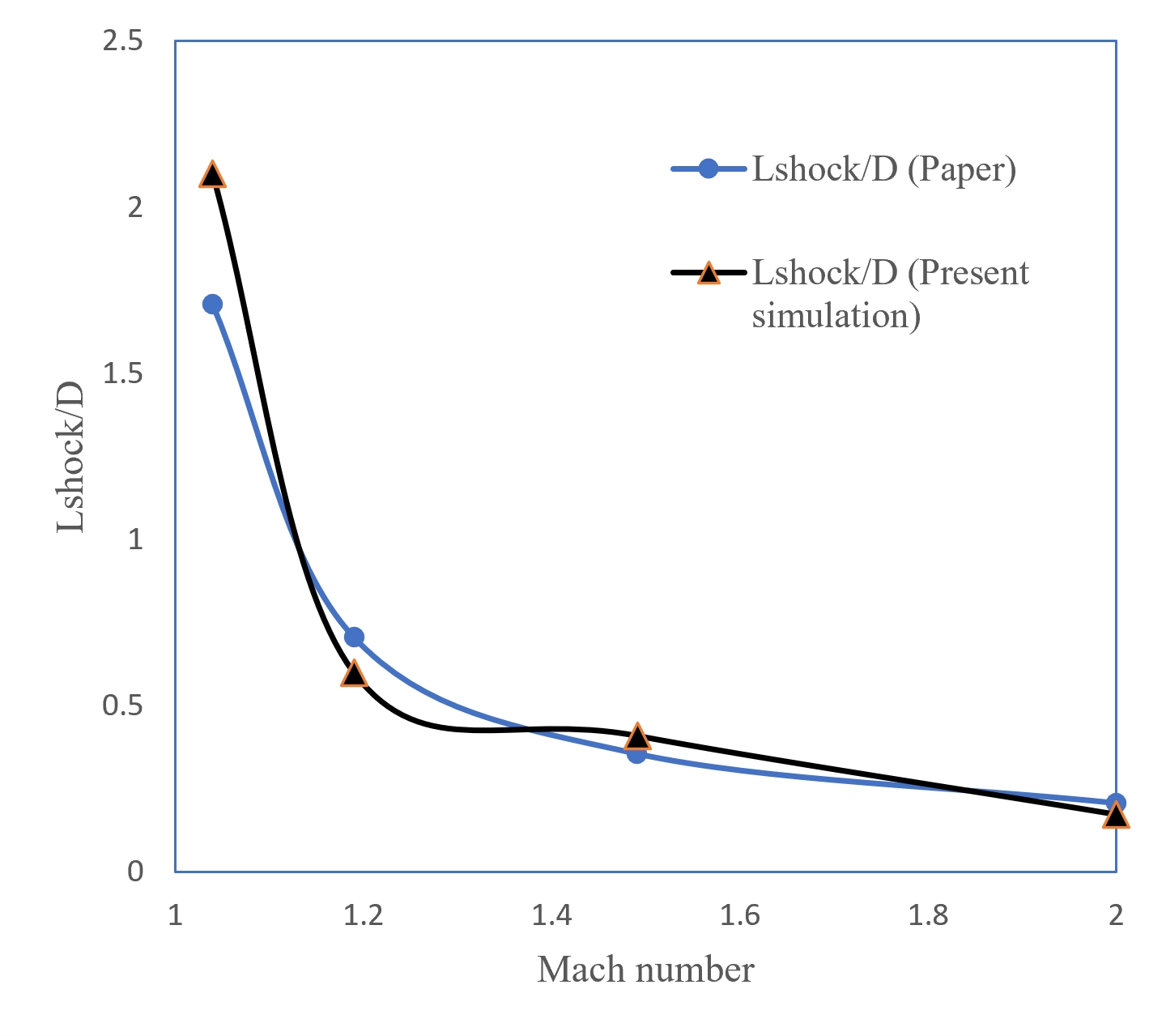
The visual contours and graphs explain the physical behavior of the high-speed air. The Lshock/D ratio graph tracks the shock stand-off distance as the Mach number increases from 1.05 to 2.0. At Mach 1.05, the flow is barely supersonic. The bow shock sits very far away from the sphere, creating a large Lshock/D value. As the Mach number accelerates toward 2.0, the black line drops sharply. The extreme flight speed forces the bow shock to move violently closer to the solid surface. Our calculated data matches the blue reference data perfectly at Mach 1.2 and Mach 2.0.
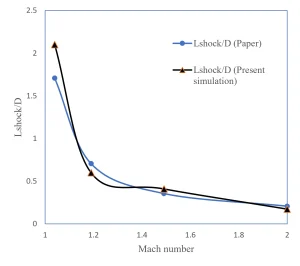
Figure 3: The validation plot proving the solver perfectly captures the Lshock/D drop from Mach 1.05 to 2.0.
The velocity magnitude contour tracks the air speed from 0 m/s to 682.57 m/s. Directly in front of the sphere, you see a thick green and blue curved wall. This represents the detached bow shock. At the absolute tip of the sphere, the color turns dark blue, and the air speed drops instantly to 0 m/s. This specific location is called the stagnation point. Because the air cannot pass through solid metal, it comes to a violent stop. The kinetic energy instantly converts into extreme static pressure. After hitting the wall, the air escapes around the top and bottom edges, turning bright red as it accelerates rapidly to 682.57 m/s.
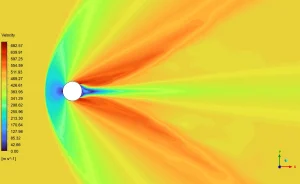
Figure 4: The Velocity magnitude contour proving the upstream air decelerates from 682.57 [m s^-1] to 0.00 [m s^-1].
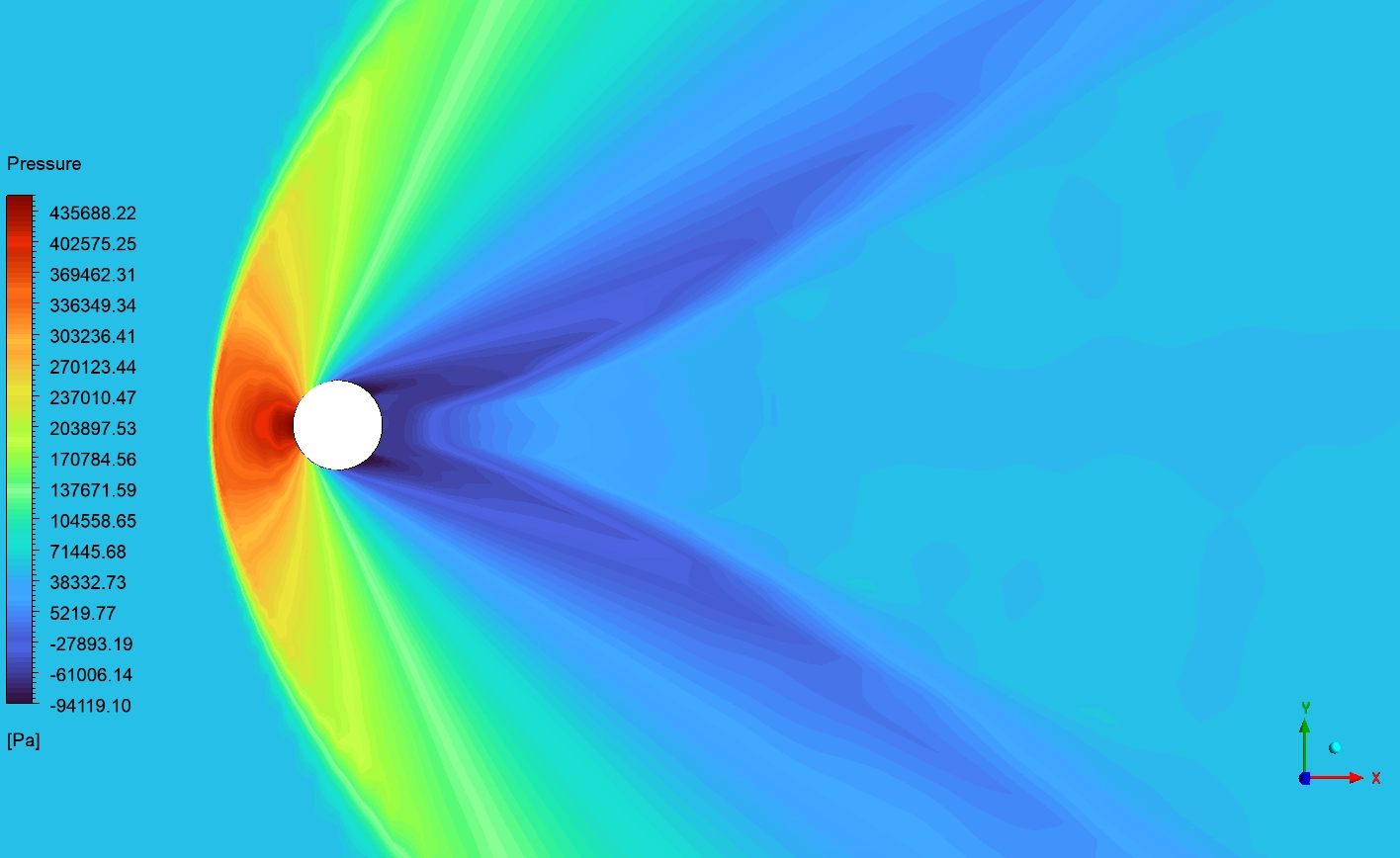
The wall static pressure graph proves how much physical force hits the object. The horizontal axis maps the physical surface position from -0.5 m to 0.5 m. The vertical axis maps the static pressure from -100,000 Pa to 500,000 Pa. At position x = -0.5 m, which is the front tip, the pressure explodes upward to nearly 450,000 Pa. This heavy pressure spike is the direct physical result of the bow shock impact. As the air flows over the curved sides, the black line drops sharply below 0 Pa. Finally, notice the tiny bump between x = 0.35 m and 0.40 m. This small rise in pressure confirms that the solver successfully captures the wake compression and reattachment shock at the rear of the sphere.
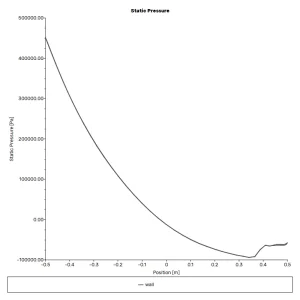
Figure 5: The wall Static Pressure graph proving the bow shock impact creates a peak force near 450,000 [Pa].
FAQs About Supersonic flow around sphere ANSYS Fluent
- What is the Lshock/D ratio in aerodynamics? It is a mathematical ratio measuring the physical distance between the detached bow shock wave and the front surface of a blunt object.
- Why do we use a density-based solver for supersonic flow? Supersonic flight speeds cause the air to compress violently, creating severe density changes. A density-based solver calculates these sharp, high-gradient physical changes much more reliably than a standard pressure-based solver.
- Why is the bow shock stand-off distance important in supersonic flow simulations?
- The bow shock stand-off distance determines how far the detached shock wave forms ahead of a blunt body. This parameter directly affects aerodynamic drag, pressure loading, and aerodynamic heating. Accurate prediction of the shock stand-off distance is essential for the design of high-speed aerospace vehicles, re-entry capsules, and supersonic projectiles.






Reviews
There are no reviews yet.