

Mixing heavy solid particles into a liquid fluid is a highly critical process in the chemical, pharmaceutical, and food industries. When a large rotating impeller spins inside a cylindrical vessel, it must push the water with enough energy to lift the heavy solid grains from the bottom floor. If the machine works correctly, it creates a perfect, uniform mixture. However, to build the best mixing machine without wasting money on broken physical prototypes, engineers perform a highly accurate Fluent-Rocky DEM Coupling for Mixing Tank simulation. This advanced method allows designers to see exactly how the twisting fluid pushes millions of individual solid particles in 3D space. It is very important to understand the difference between this advanced method and our previous Particle Mixing CFD: A DDPM Fluent Tutorial. In that previous project, we used only ANSYS Fluent and solved the mixing using a 3-phase Dense Discrete Phase Model (DDPM). The DDPM approach treats the solid particles mathematically like a continuous fluid. However, in this new project, we use a two-way software coupling. This means the Rocky DEM software explicitly tracks the real physical shape, size, and collision of every single solid grain. To learn more about tracking thousands of moving solid pieces inside liquids, please explore our comprehensive DEM simulations category. Practicing this tutorial project provides the perfect computational representation to find stagnant dead zones and fix bad impeller designs.
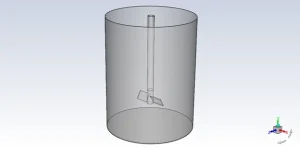
Figure 1: Geometry of the mixing tank and impeller, showing the 3D computational space of the cylindrical vessel and the rotating metal blades.
Simulation Process: Two-Way MRF Setup in ANSYS Fluent and Rocky
For this industrial particle mixing project, we built a complete 3D geometry of a cylindrical tank containing a rotating impeller. Inside the ANSYS Fluent software, we divided the liquid volume into exactly 230,801 polyhedral cells. We specifically used polyhedral cells because they provide much higher mathematical accuracy near the complex twisting blades. To make the fluid spin correctly, we activated the Mesh Motion method and set the impeller rotation speed to exactly 12 rad/s (114.6 RPM).
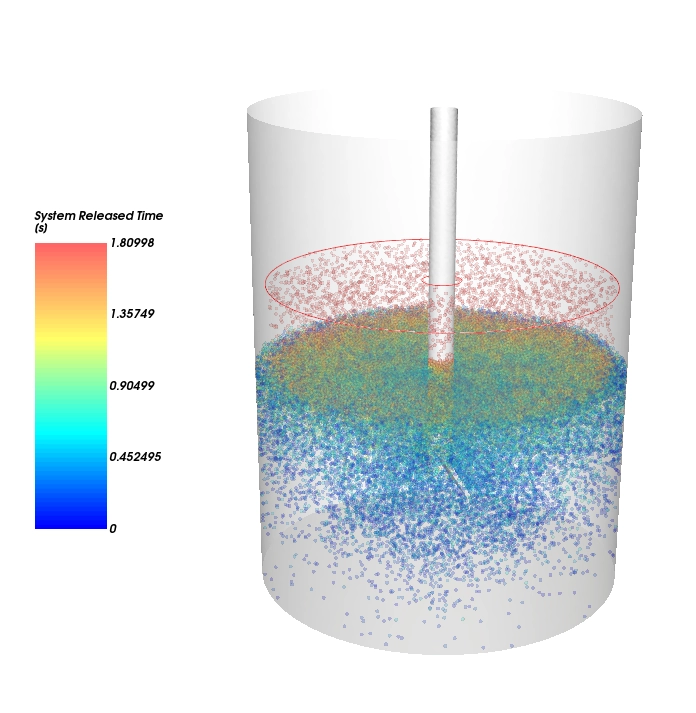
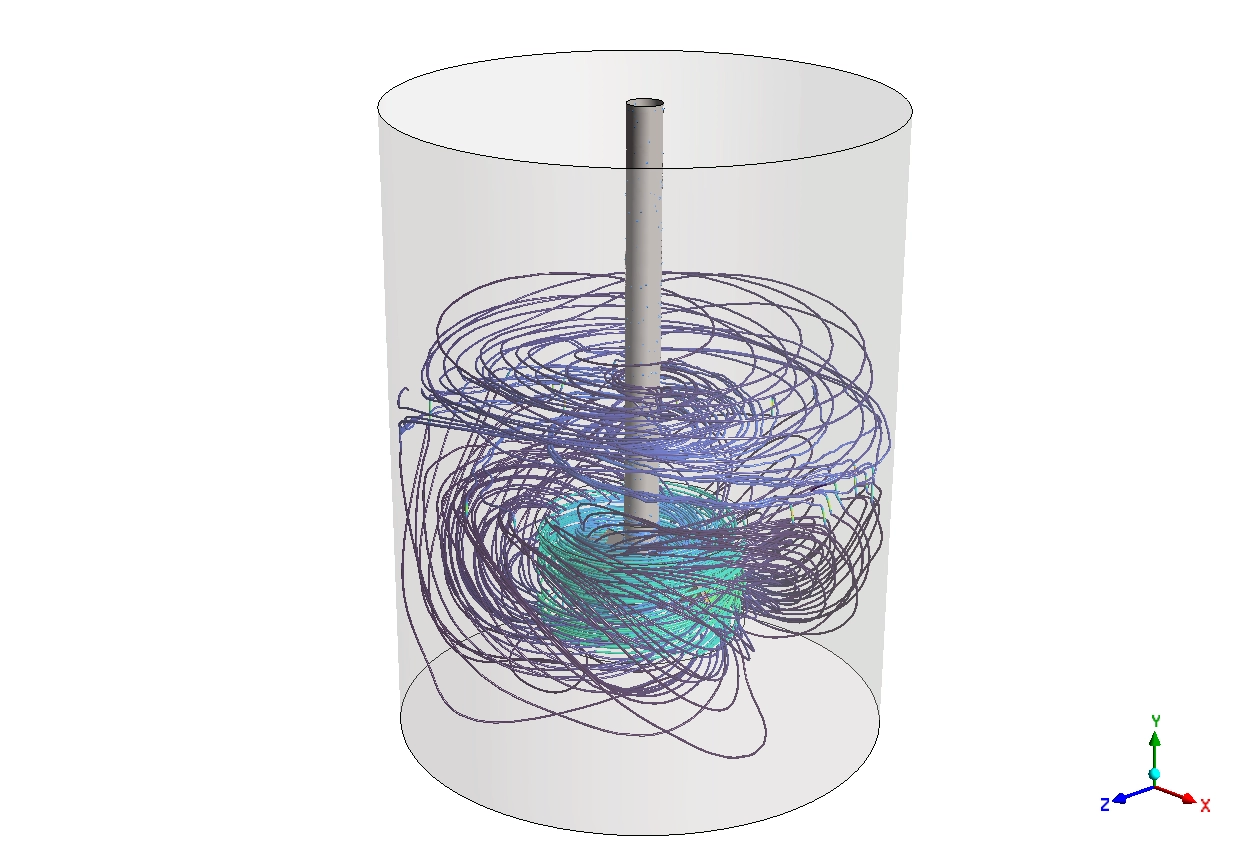
At the same time, we set up a powerful two-way Fluent-Rocky DEM Coupling. Inside the Rocky software, we injected thousands of solid particles from the top liquid surface. During the calculation, the fluid solver calculated the exact water velocity to push the particles, while the DEM solver measured exactly how the heavy solid grains displaced the water. Furthermore, we extract all tangential and normal forces based on valid references to perfectly calculate the physical interaction between the metal blades, the water, and the solid powders.
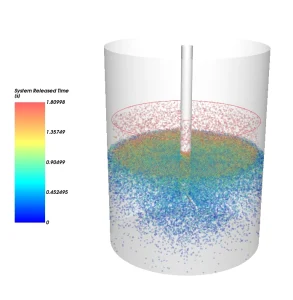
Figure 2: The process of releasing particles from a virtual surface above the water level for realistic initial condition
Post-processing: Analysis of Volume Fraction and Drag Forces
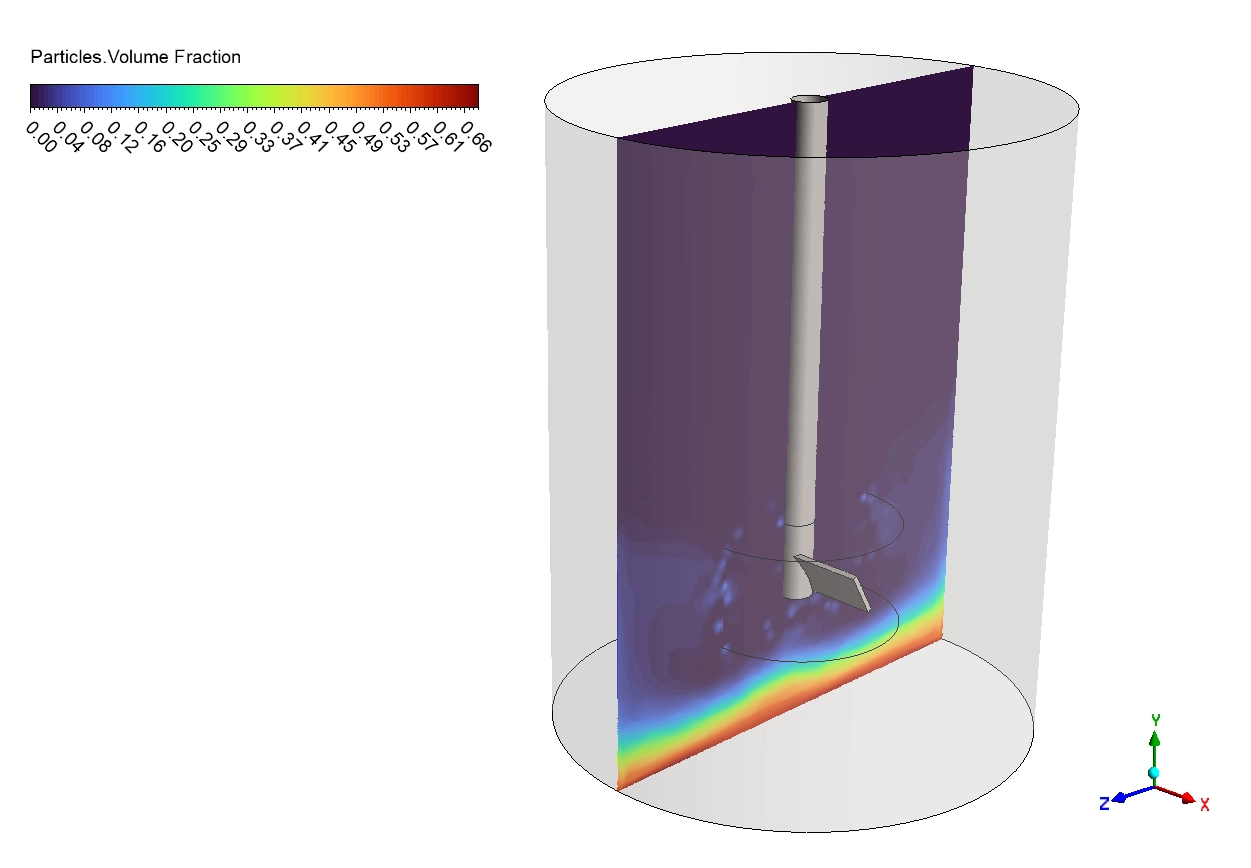
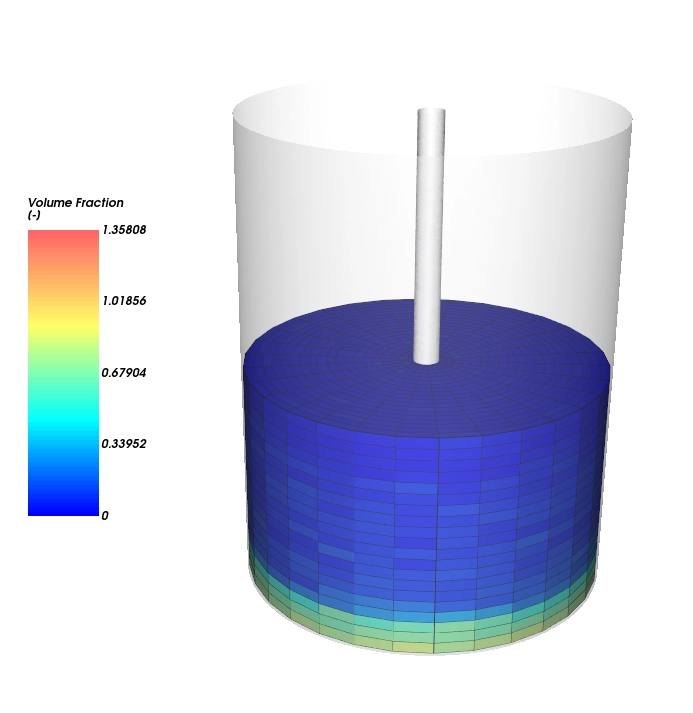
Let us carefully analyze the exact simulation contours to deeply understand the mixing performance. To see the true particle distribution better, we purposefully limited the maximum range of our color legends. First, we evaluate the Particles Volume Fraction contour. A perfect mixing tank should have the same color everywhere. However, the top of the tank shows a dark purple color, which represents a fraction of 0.00 to 0.04. This means the top area is almost completely empty water. Conversely, the bottom floor displays a bright rainbow gradient with a dense solid fraction reaching the limited red maximum of 0.66. This proves the mixing process is currently failing because the particles are simply sinking and packing together. This strongly confirms that the current motor speed of 12 rad/s is much too slow to lift the heavy grains.
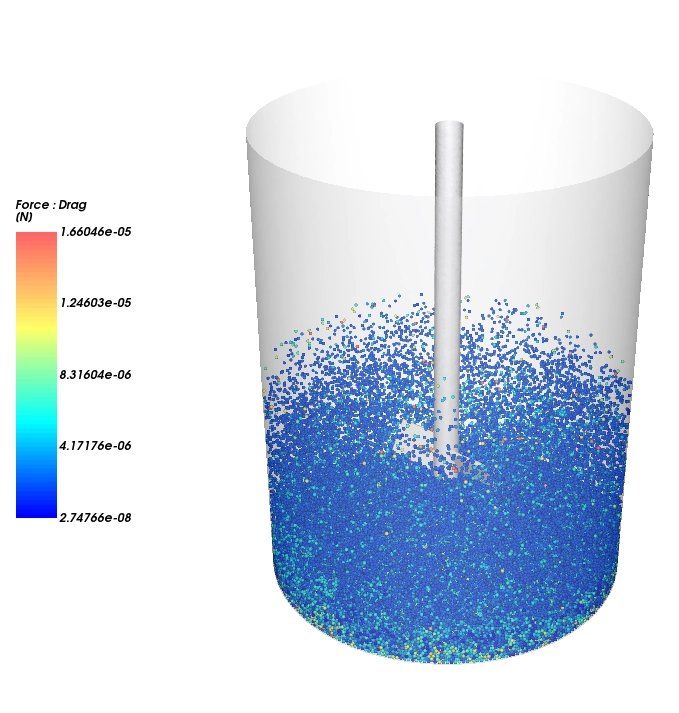
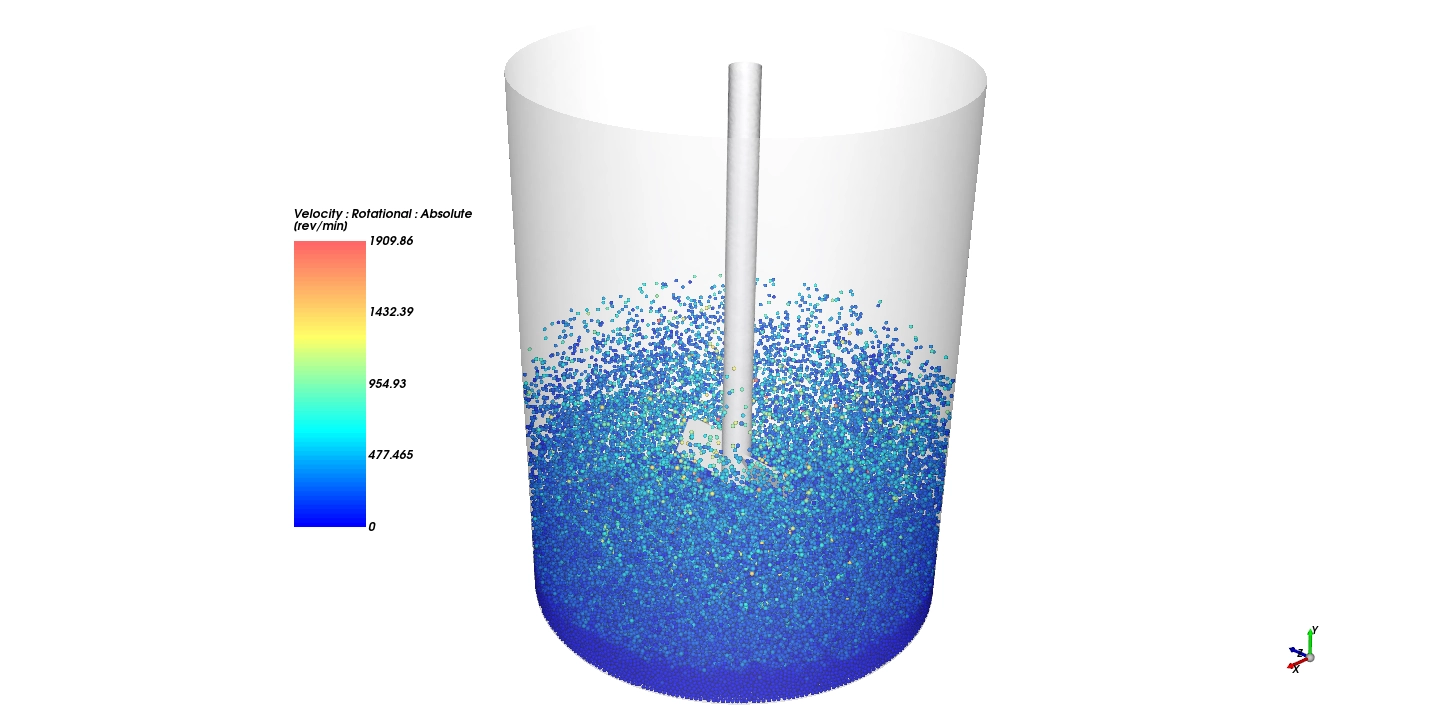
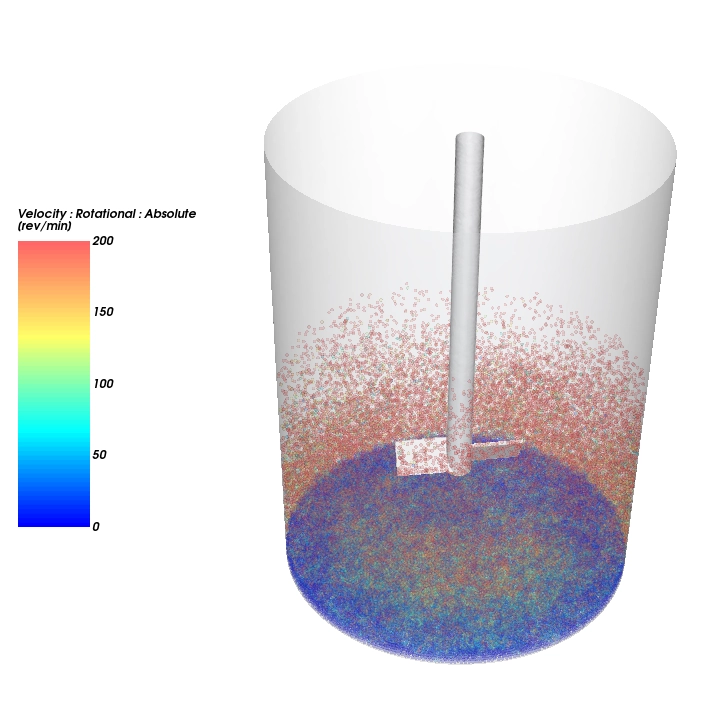
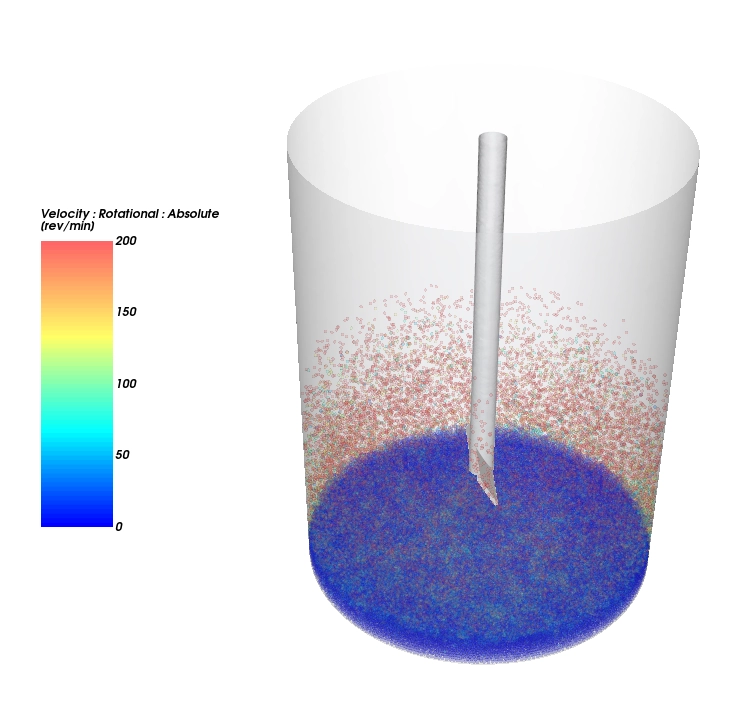
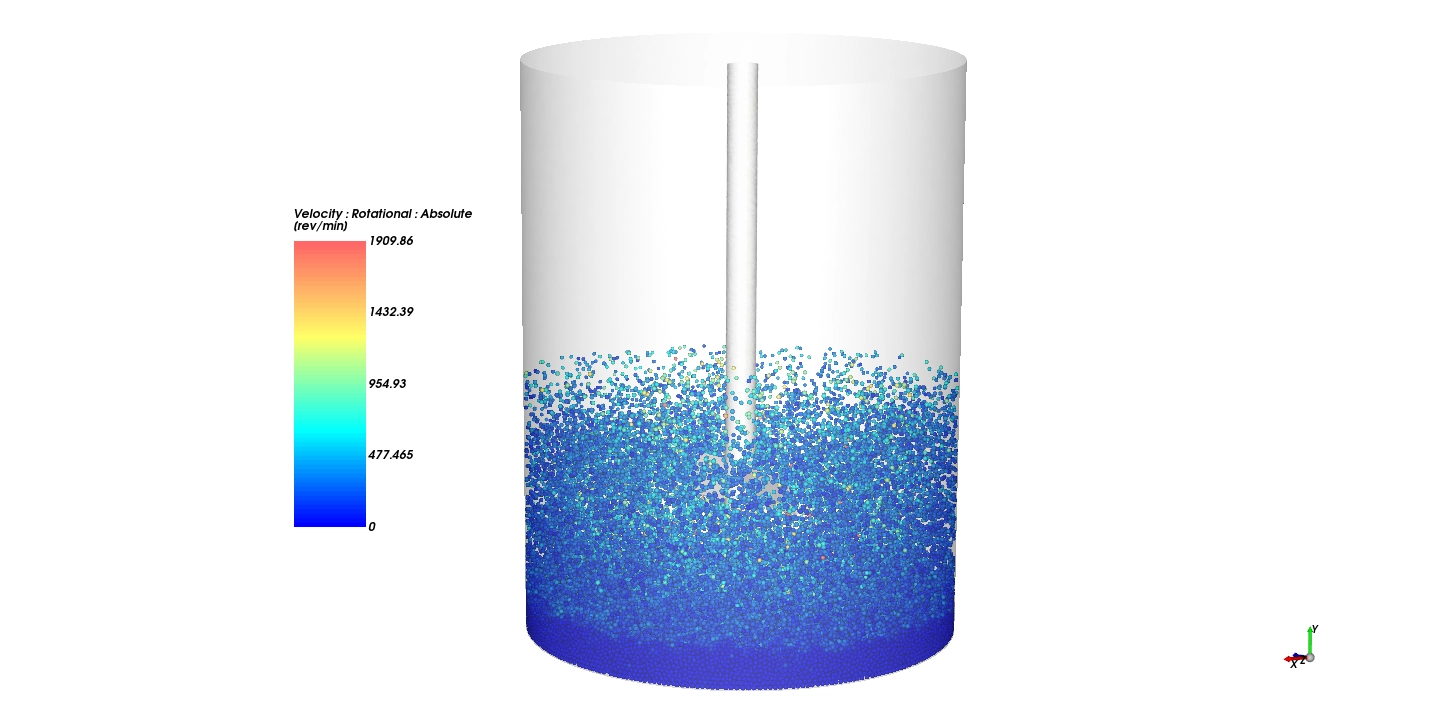
Next, we study the exact Force Drag acting on the particles to explain why they do not lift. We limited the drag legend to a maximum of 1.66e-05 N to highlight the differences. The deep blue particles sitting at the very bottom experience an extremely weak drag force of roughly 2.74e-08 N. This weak force happens because the densely packed grains block the water flow, creating a dangerous stagnant dead zone. The floating particles near the impeller feel a stronger pushing drag reaching the red maximum of 1.66e-05 N. While this middle force helps balance their heavy weight, it is still not enough energy to carry them to the top surface. Additionally, the Velocity Rotational Absolute contour shows that the heavy particles at the bottom barely move, remaining in the blue zone of 0 to 477 rev/min. Only the few particles directly struck by the twisting metal blades reach the extreme red maximum speed of 1909.86 rev/min.
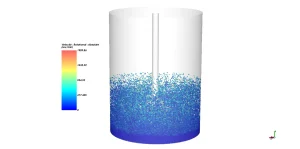
Figure 3: Velocity Rotational Absolute contour, visualizing how the spinning fluid throws the solid particles outward and upward inside the tank.
Figure 4: Force Drag contour (2.75e-08 to 2.66e-05 N), illustrating the exact pushing forces from the fluid acting on individual particles at the tank floor.
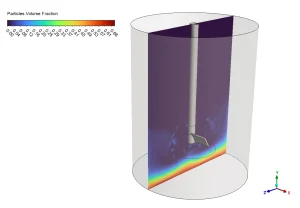
Figure 5: Particles Volume Fraction contour from Fluent CFD (0 to 0.98), showing the dense packed bed of particles at the bottom and the almost empty purple fluid at the top.
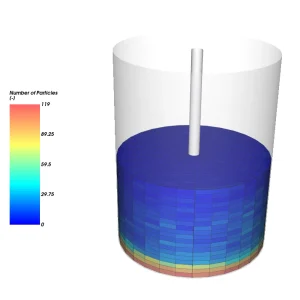
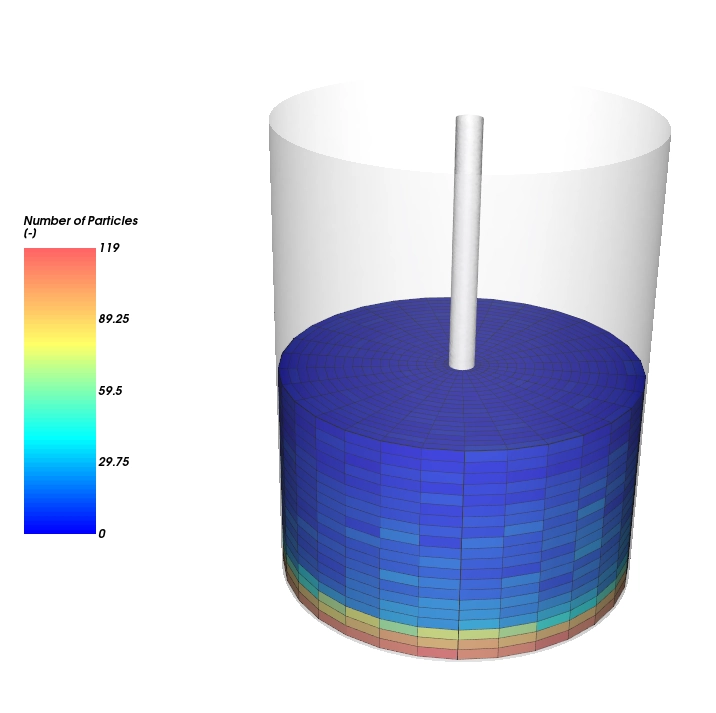
Figure 6: Number of Particles per cell from Rocky DEM (0 to 119), quantifying the exact grain count in different regions to mathematically check the vertical mixing quality.
Finally, we analyze the Number of Particles per cell to mathematically measure the vertical uniformity. The 3D grid data reveals a terrible concentration difference. The dark blue cells at the top of the tank contain exactly 0 particles. As we look lower, the colors change to cyan and yellow, until reaching the heavy red cells at the floor which contain exactly 119 particles. By seeing this massive 0 to 119 difference in the exact CFD simulation, factory designers know they must drastically increase the motor speed to successfully lift all the particles.
Frequently Asked Questions (FAQ)
- What is the difference between DDPM and two-way Fluent-Rocky DEM Coupling?
- In the DDPM approach, ANSYS Fluent treats the massive number of particles like a continuous fluid using statistical math. However, the Fluent-Rocky DEM Coupling explicitly calculates the real physical shape, mass, and direct collision of every single solid particle, which gives much higher accuracy for heavy granular flows.
- Why do the particles pack together at the bottom of the tank?
- The simulation proves that the impeller rotation speed (12 rad/s) is too slow. The twisting water does not create enough drag force to overcome the heavy weight of the solid grains. Therefore, the particles sink and create a stagnant dead zone.
- Why did engineers limit the legend ranges in the post-processing images?
- If the legend range is too wide, most of the tank will look like one single solid color. By strictly limiting the maximum number on the legend, engineers can clearly see the hidden distribution patterns and perfectly identify where the particles are starting to group together.







Reviews
There are no reviews yet.